Author: Tom Lopez

  • A. H. Marshall

    A. H. Marshall

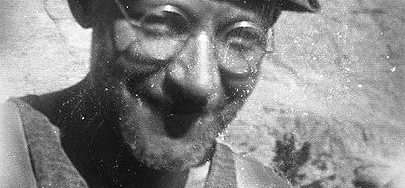
    A. H. Marshall was the first person to visit the high points of the 48 contiguous states, accomplishing the task between 1919 and 1936. He also was the first climber to focus on the Seven Devils Mountains. His efforts in the Seven Devils are covered on Page 18 of the book.

    I recently discovered a page on the Highpointers Club website which has links to Marshall’s fascinating journals. Use the following link to visit that page.

    Highpointers Club A.H. Marshall page.

  • 1948 Idaho Statesman Article: Here’s a Club for You to Join But It’s A Rough Organization

    1948 Idaho Statesman Article: Here’s a Club for You to Join But It’s A Rough Organization

    [Editor’s Note: This September 13, 1948 article was referenced on Page 18 of the book in the Mountaineering History Section. The name “Thatuna Hills” appears in the article. This name, which was not adopted by later map makers, refers to a western extension of the Bitterroot Mountains that now is considered the Northern Clearwater Mountains.]

    THE LION OF IDAHO, Mt. Borah, highest mountain in the state, is a favorite of Gem state mountain climbers. Rising 12,655 feet, the granite crag is often cloud-draped. Mt. Borah is part of the Pahsimeroi Mountains, and is in Custer county in the Lemhi National Forest. The photograph was taken from the Statesman’s airplane, Early Bird Number Four. Inset left shows pole at summit of Borah on Aug. 18 with three-inch layer of rime deposited by cool moisture-bearing wind. Temperature in mid summer rises but little above freezing. Right inset: looking down the other side of Mt. Borah discloses a desolate, rugged, rocky and lifeless mass of granite. Dotted arrow shows route used by several groups of mountain climbers in reaching the summit of Idaho’s highest peak.
    THE LION OF IDAHO, Mount Borah (the highest mountain in the state), is a favorite of Gem state mountain climbers. Rising 12,655 feet, the granite crag is often cloud-draped. Mount Borah is part of the Pahsimeroi Mountains and is in Custer County in the Lemhi National Forest. The photograph was taken from the Statesman’s airplane, Early Bird Number Four. Inset left shows a pole on the summit of Borah on August 18th with a 3-inch layer of rime deposited by cool, moisture-bearing wind. The temperature in mid-Summer rises but little above freezing. Right inset: looking down the other side of Mount Borah discloses a desolate, rugged, rocky and lifeless mass of granite. The dotted arrow shows the route used by several groups of mountain climbers in reaching the summit of Idaho’s highest peak.

    By Jack Anderson 

    Wanna join a club? There’s an exclusive organization which will almost guarantee less than 100 members by 1960. All you have to do to join is climb to the top of a little heap of granite in the middle of Idaho’s rugged area and sign the register atop Castle Peak. There won’t be many names, probably less than 10, on the register. Why climb a mountain? This question is asked to only a handful of Idaho residents, who each Summer go stomping up and down rocky peaks in the Gem state, much to the bewilderment of the majority of inhabitants.

    As an old saw goes, “You don’t have to be crazy, but . . .” Mountain climbers can probably advance a multitude of reasons for their breath-taking hobby. Adventure, danger, artistic ideals, exercise, attainment of skill–all could be bona fide reasons for notching one’s way up and down steep rocky hills. In no state of the union does such a minority group have as vast a field to pursue their reckless hobby. Idaho from the play slopes of its Panhandle to the craggy juts of the Southeast is a series of mountain ranges interspersed with valleys and streams. 

    In the north, the Cabinet Mountains form a purple backdrop for play and fishing on mountain lakes. The Coeur d’Alenes, the Beaverhead Mountains and the Bitterroot Mountains form the eastern boundaries. The Bear River Range, the Blackfoot Range, the Little Lost River Range, the Pahsimeroi Mountains, the Salmon River Range, the Seven Devils, the Thatuna Hills and the Sawtooths round out the mountain fastness.

    The Sawtooths are known as the “American Alps” and aside from evoking “oohs” and “ahs” from tourists, provide the mountain climber with considerable territory. Many of the Sawtooths have never seen the shoe of man atop their snow-locked peaks. In the heart of the Sawtooths, the country is upended. From the summit of Mount Hyndman, a portion of weird country known as the “Devil’s Bedstead” may be seen. Jagged quartz obelisks, jumbled, crumbled, interlaced, present a foreboding warning to travelers. It looks as if Nature took the remnants of orderly creation and threw them in a heap. 

    Who climbs mountains? Many perhaps seriously believe that only escapees from mental institutions would consider climbing to the top of a granite spire and then turning right around and inching back to terra firma level.

    Strangely enough, almost anyone can do it and all occupations have contributed to the ranks of intrepid mountain conquerors in Idaho. A well-known priest has climbed some of Idaho’s roughest pinnacles and several bold damsels have journeyed up lesser peaks.

    Mountaineering, as seen in the movies, consists of dangling out over space, supported by a thin strand of nylon, vainly swiping at a nearby rock with a pick axe. Actually, much fine climbing can be done with little more than a pair of tennis shoes, stout wind, and a determination to get to the top. 

    The lion of Idaho, Mount Borah (12,688 feet up to the topmost point), is a stern-looking, starkly impressive crag of grey granite. It rises in insular majesty from the sage-dotted plains of the Little Lost River Valley. Yet it can be climbed in a day with no more equipment than good tennis shoes, warm clothes and a camera for proof. The azure-scraping rocky peak is often cloud-draped and subject to squallish Summer storms and lashing lightning. On a clear day, Borah is a full day’s work but climbable.

    In the early days, Mount Hyndman (near Hailey) was considered by settlers to be the highest hill in the state. Recent topographical measurements give Borah the edge by about 150 feet. Hyndman is another boot hill or even a tennis shoe Teton for the average man. However, it is a rough 10-mile walk from car to summit, and vice versa, so most leisurely hill toppers take it as an overnighter. Boulder Mountain, Silver Peak, and Mount McCaleb are all climbs for the amateur with no fancy equipment.

    Farther into the canyons (where somber shadows live) rise mountains which have given some of the yodeling Swiss a few bad moments, and caused many to go home empty-sighted of mountain-top views. The Finger of Fate, a needle-like point of non-imposing  altitude, baffled a Boston, Massachusetts mountain climbing couple for an entire Summer. They finally gave up and went home to write a book about Idaho mountains. Many of the Alp-type mountains (termed “horn” mountains) have  precipitous sides which can be traversed only by “graveling.” Using ropes, spiked shoes and pitons is required on many Idaho mountains.   

    What’s up there? At the top pf some mountains will be found a pole and a stout iron box. Inside the water-proof container will be a register which the successful sign for posterity and relate the travails of their upward journey. An occasional hawk screams at the violation of his solitude. Trees show the battle with the elements and often have the bark shorn off the windward side from the battering of hailstones and buffeting gales. Lightning scars, snow slides and other examples of nature’s violence in the eons of chipping down the mountains are to be seen.  

    Caution is the watchword in mountain climbing and the violator seldom gets another chance. An experienced woman climber fell from the cliff-edge of Mount Leatherman nearly 1,000 feet to her death and several other lives have been lost. Although there is no official Idaho mountain climbing club, a group of Oregon mountaineers have formed the Mazamas Club and make mass jaunts up northwest peaks, placing the register boxes for one of the most exclusive clubs in the world.

  • Robert Fulton

    Robert Fulton

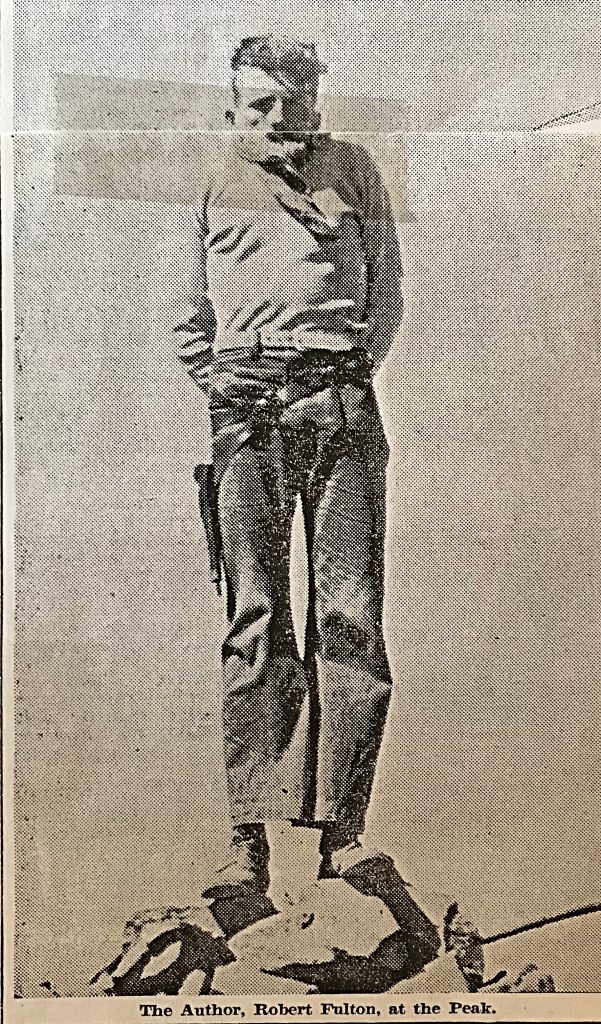
    Robert Fulton was an active Idaho climber in the 1930s. Robert was was fascinated with Mount Borah and wrote several articles chronicling the peak’s early climbing history. His 1935 article in the Idaho Statesman covering his second ascent of the peak (discussed on Page 17 of the book) is set out below.

    A TRIP TO THE TOP OF IDAHO

    By Robert Fulton

    The opening paragraph of a recent biography of a great man or our day states: “During every session of Congress since 1907, a certain magnificent and mysterious man has dominated the Senate chamber even as a certain high, rugged mountain dominates the jagged skyline back home in Idaho.”

    The man referred to, of course, is Senator Borah, and the high mountain mentioned is Borah Peak. Today there are being organized “Borah for President” clubs. To complete the author’s metaphor of the first paragraph, I want to tell you of another club: The “Borah Mountain” Club. The membership fee includes $2 or $3 worth of good shoe leather and a generous helping of ambition and energy. This writer claims right of “potential candidate for president” of the Club by virtue of having twice paid the fees mentioned.  

    In August 1930, Mr. Ray Odle (then of Fort Collins, Colorado) and I deposited the first register in the rock cairn at the summit of Borah Peak. Before 1930, even before recognized as Idaho’s highest, several men had ascended the mountain. Among these are Clyde Jenkins of Twin Falls, Idaho; Norman Wilson from some place in Califonia; and Will Bascom, well-known taxidermist from Mackay, Idaho.

    Twenty Climb Peak  

    Since we established the register in 1930, 20 individuals have accepted the rocky challenge of Borah Peak and have conquered her. During the Summer of 1934, a new government register was placed under the cairn. This was done by the United States Geological Survey group. This last Summer I was working on the German H. Ranch a few miles from Borah Peak. Three of us from the German H. (David Fulton, Fred Strasser of Texas and I) and Francis Smith, representing the Al West Ranch at Dickey, decided to climb the mountain. We selected Sunday, August 25th as the  day for the trial. 

    After an early breakfast at the ranch, we drove to the foothills in an auto. We arrived at timberline soon after 10 o’clock. We found quantities of scattered dead wood just above the timber and, as the Wind was blowing up the mountainside, we decided to build a small signal fire for those at the ranch to see. We rested for several minutes until the fire died before renewing the battle. A few hundred feet above timberline, we reached the top of a long horseshoe-shaped ridge, inclining ever upward and eventually leading to the summit.
    Those who have viewed the western face of Borah peak will probably remember this ridge as one of the distinguishing features of  the mountain. Many will remember this, as the state highway between Mackay and Challis presents many interesting and inspiring views of this side. This ridge starts far below timberline (heading south) and, after ascending a thousand feet or more above timber, it doubles completely back to the north forming the South Slope of the peak. Within this horseshoe curve is a mighty mountain canyon varying in depth from hundreds of feet on the West Rim to more than 2,000 feet on the east or mountain side of the ridge. This ridge presents a less precipitous trail to follow than if one endeavored to climb directly up the mountain from the North Slope.

    We arrived at the top of the ridge rather abruptly and, just as abruptly, the entire bulk of Borah Peak was thrown into bold relief against the morning sky. However, it still seemed far above.  

    From the top of the ridge, the climbing is often more difficult. There are frequent, almost perpendicular, cliffs to overcome. It is necessary to climb with hands as well as with feet. For this reason, the prospective climber should wear leather gloves.

    See Mountain Sheep 

    Far down the ridge to the right of us, we saw white dots. Mountain sheep? I aimed a revolver high over them and fired. They moved. Convinced that here was real wild game, we planned to get close enough for a shot at them with a camera. We proceeded quietly and soon, when going over the top of a small ridge, we saw (close-up) several head of the same creatures. No, not mountain sheep, just domestic sheep. We figured that they must be lost members of some band and decided to take them home with us on the return.  

    After more weary minutes that stretched into an hour and then another half, we had rounded the bend of our horseshoe ridge and there opened up (to the right of us) another valley. It was higher, narrower and more mountainous than the one we had left early in the morning. It was dotted here and there with small glacial lakes and high spots of snow. It was the Little Lost River Valley. It is to the east of Borah Peak.  

    1000 Feet to Go

    We had reached the base of the peak itself with only a thousand feet or so of climbing left. Far below us nestled close against the overhanging cliffs was an emerald lake and straight above us towered the elusive summit. We reached the top four hours and 20 minutes after leaving the car. Francis and David were ahead of Fred and me. Fred and I had stopped once too often to rest than had the other two.

    It was with a feeling of relief that we saw them contentedly sunning on the windless side of the peak. We joined them in a moment and sprawled immediately to rest. Fred saw a rather large bulky package in David’s hand. “What’s in it?” he asked.   “My lunch” said David.  “No, I carried yours and mine.”  Fred assured him, showing both lunches. Francis glanced at the package and burst into laughter.  

    Lunch in the Skies  

    We all questioned him but he could not talk. Instead he tore a hole in the package exhibiting a shirt, a pair of gloves and a pair of socks which he had bought the to the top, not aware of what it contained. We ate lunch on top–2 sandwiches each. As we finished the last crumbs, I believe we must all have been thinking the same thing: “Just wait till supper.” 

    We read through both registers. The following people have stood on top of Idaho since August 31, 1930: 

    Roy J. Davis, Pocatello, Idaho. This presents rather an interesting coincidence. I met Davis back in April 1931, at a YMCA gathering at Gooding College. Doctor Davis accompanied the U. of I. southern branch delegation and he was my room guest during that time. Finding his name on top of Borah Peak was the first I had seen it since 1931. R.C. Thoma, C. J. Henecheid, C. V. Hockaday (all of Rupert) were registered, Miriam E. Underhill and Robert M. Underhill of Boston,  Massachusetts.

    These latter two gentlemen (sic) are famous mountain climbers and they hold the time record for climbing Borah Peak in four hours under adverse conditions. The following men were members of the U. S. Geological Survey party who were engaged in mapping the Borah quadrangle in the Summer of 1934: Lester C. Walker, Twin Falls; Spotty Bruce, Challis; Lyman Marden, Boise; Lee Morrisson, Sacramento; Fred Hayford, Boise; William Eskeldson, Boise; James Wilson, no address given; E. J. Hughes, Portland; and A. H. Marshall, Vancouver, Washington.

    “A Stiff Workout”  

    I talked with these men after they had descended the mountain. They have been to the top of many high mountains in the western states, including our once “highest” Hyndman Peak. They stated that Borah offers a stiffer workout than does the average mountain. Ray Odle (Fort Collins, Colorado) had previously been to the summit of the famous Long’s Peak of his home state. His reaction was that for primitive mountain  grandeur, Borah peak outclasses the scenic Colorado attraction. 

    Two members at least of our party can boast second-best time by having reached the summit in 4 hours and 20 minutes. They are Francis Smith of Darlington and David Fulton of Eden. Fred Strasser of El Paso, Texas and I brought up the rear guard some 15 minutes later. This completes the Borah Mountain Club’s roll call.  

    Standing on top or the rock cairn, Fred waved his arm over the vast expanse of mountains and valleys and said, “It’s all mine.” We beat him out of most of it, however, before night. It is difficult to say exactly how far one can see from the top. There are two fairly distinct ranges of mountains running north and south far to the east. The second range is the Continental Divide, which marks the boundary of Montana. To the south, the big Blackfoot Butte and the Albion Mountains can easily be distinguished. To the north and west, the Salmon River Mountains and the Sawtooth peaks of Stanley Basin are scattered far below. The scenic grandeur stretching out in every direction cannot be described. It can only be witnessed.  

    Sheep Left Behind  

    We left the top after an hour and a half. On the way down, Francis Smith asked us what we intended to do about our sheep. We were all rather tired and did not feel spry enough to chase these woolies down the mountainside, but Fred was the first one to think of a credible way to back out. He stated that he had about decided to leave his until next year when there would be twice as many. This suggestion seemed very reasonable and we all subscribed to it.

    We reached the car eight hours and five minutes after leaving and, with razor-sharp appetites, we returned to the ranches. The next day I asked Fred what he thought of Borah Peak. In his easy Texas droll he responded, “Sometime I may even ‘discuss’ climbing it again.” The satisfaction it gives one to conquer this huge pile of granite is worth many times the investment of time and energy required and, whether he ever wishes to return or not, I am sure that no one will regret having once made the climb.  

  • Iowa Mountaineers

    Iowa Mountaineers

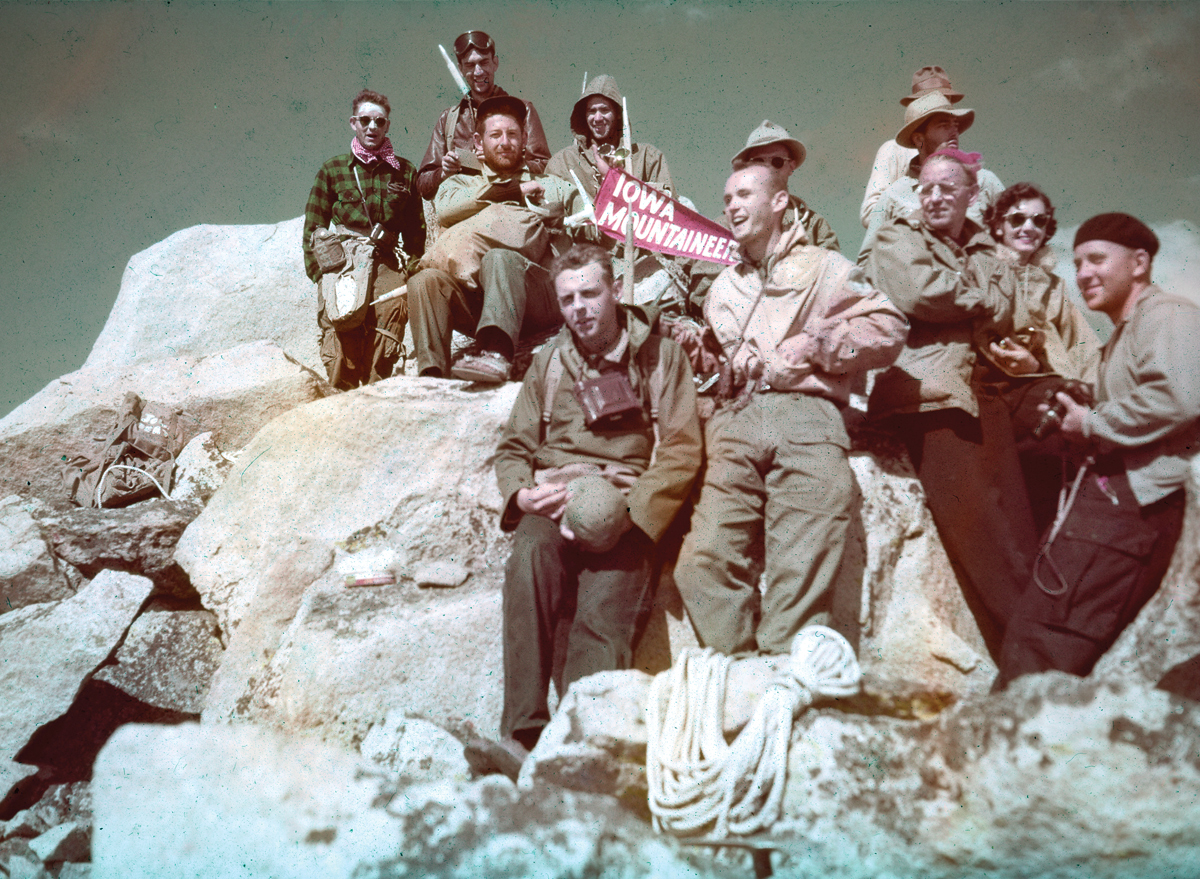
    The Iowa Mountaineers climbing club was a major player in the in early Sawtooth Range exploration. The club was founded by John and Ede Ebert in 1940, as the University of Iowa Mountaineering Club. The club later incorporated as a not-for-profit Iowa corporation and became a major force in sponsoring climber education and expeditions throughout the world.

    Schwartz Pinnacle, Harriets Pinnacle, Mount Bruce, Mount Ebert, the Elephants Perch and, of course, Mount Iowa all owe their names to the Iowa Mountaineers. You can read about the Club’s Sawtooth explorations and first ascents on Page 19 of the book as well as in numerous entries in the Sawtooth Range chapter. A 2018 article in the University of Iowa Alumni magazine provides a good history of the Club: Mountain Roots by Josh O’Leary.

    Photo courtesy of the University of Iowa Alumni Magazine and the Ebert Family.
    Photo courtesy of the University of Iowa Alumni Magazine and the Ebert Family.
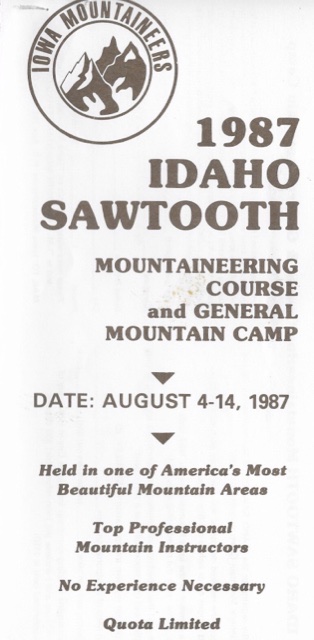
    This is the front page from a 1987 brochure advertising the club’s upcoming climbing school in the Sawtooth Range.

    Other Resources

    Iowa Mountaineers, Inc. website.

    theIowaMountaineers.blogspot

  • Robert Limbert (1885-1933)

    Robert Limbert (1885-1933)

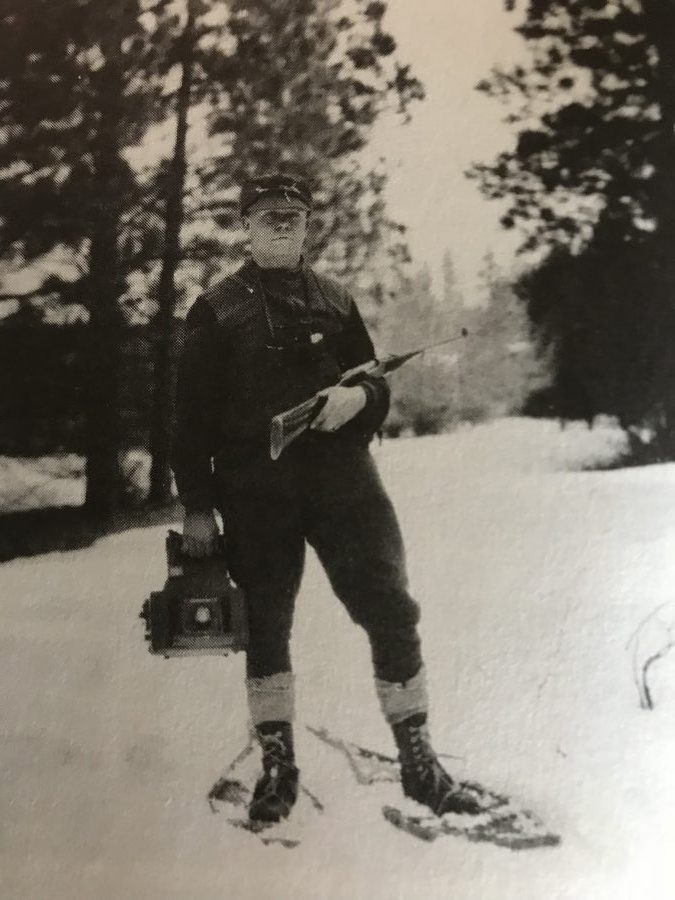
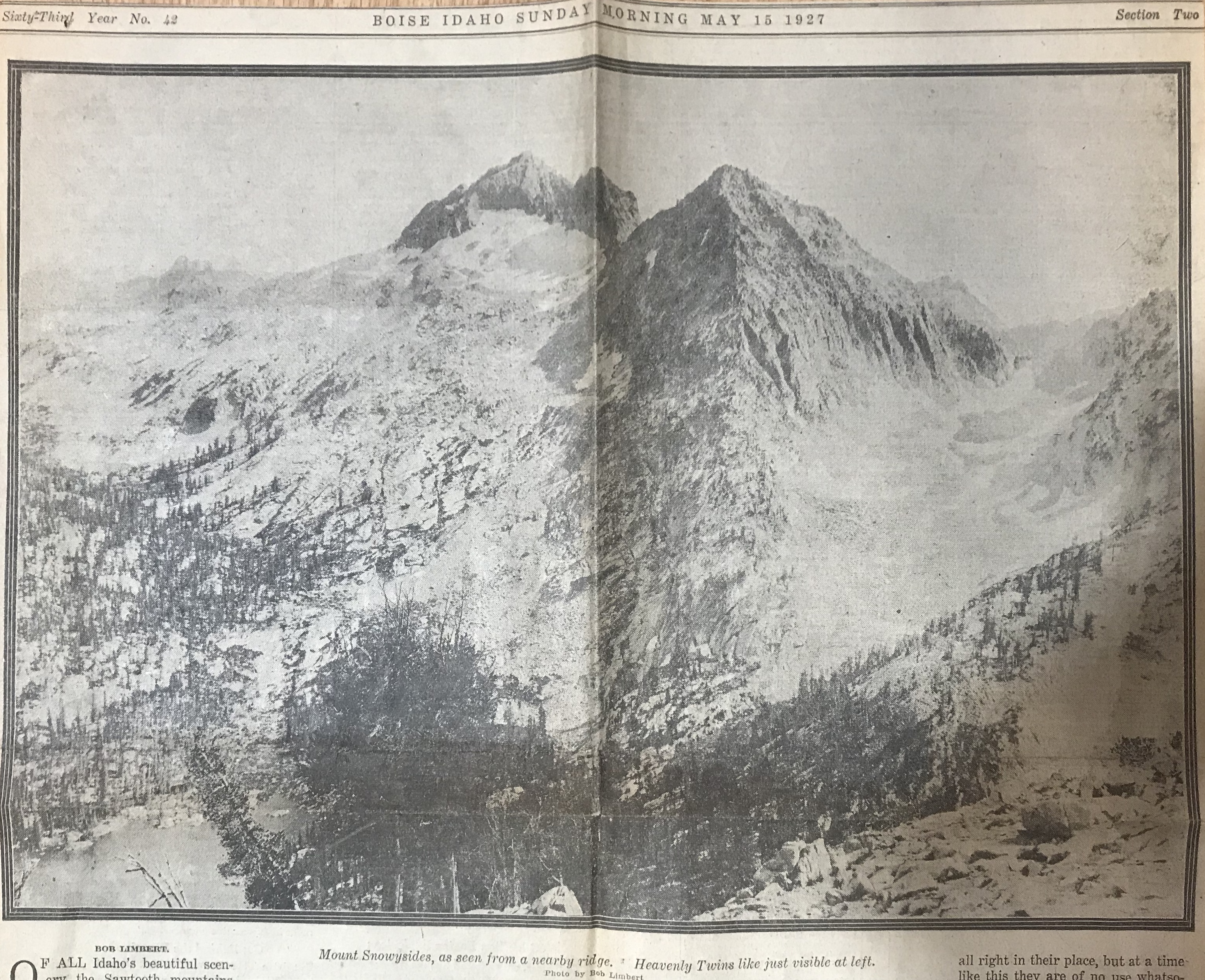
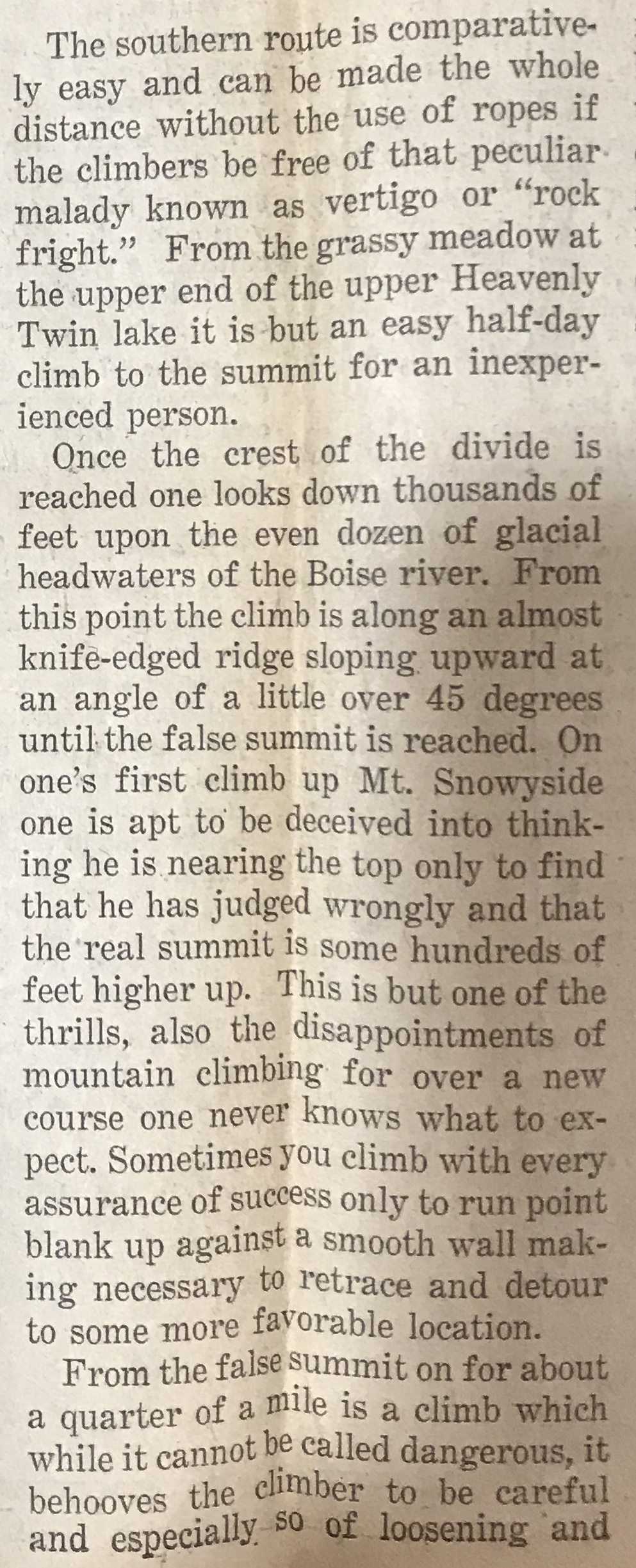
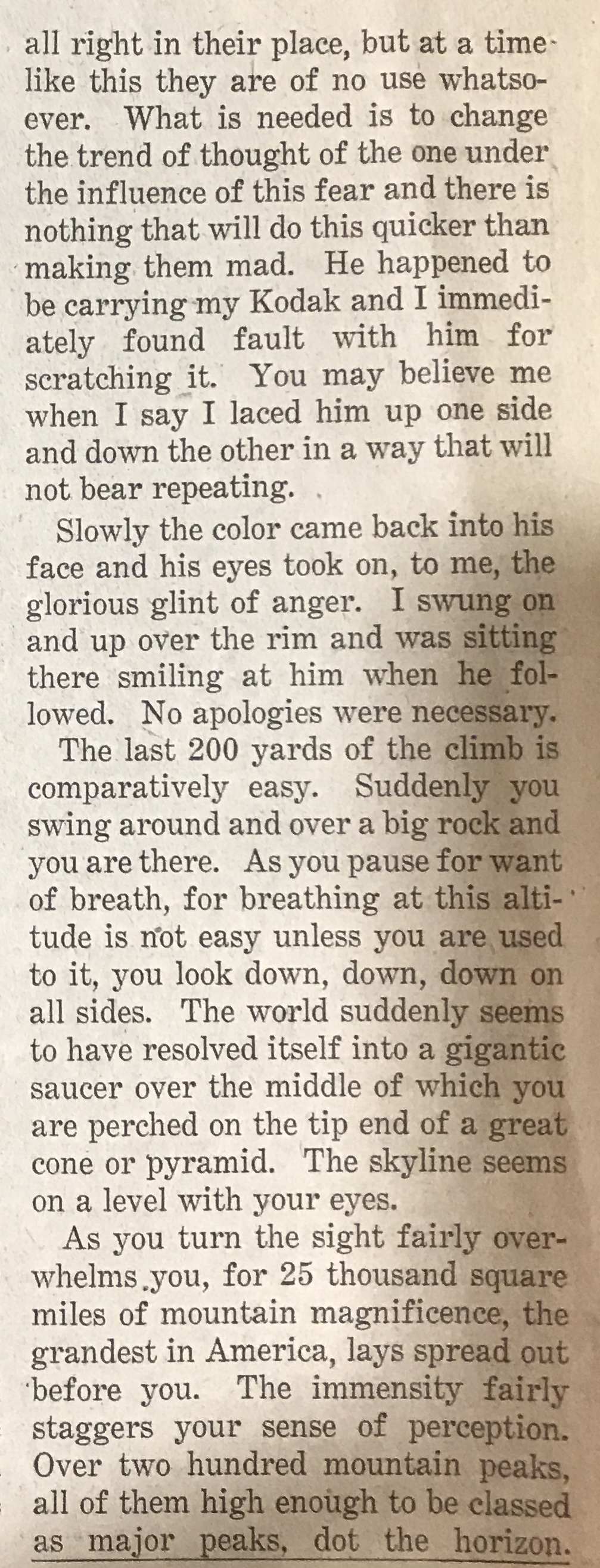
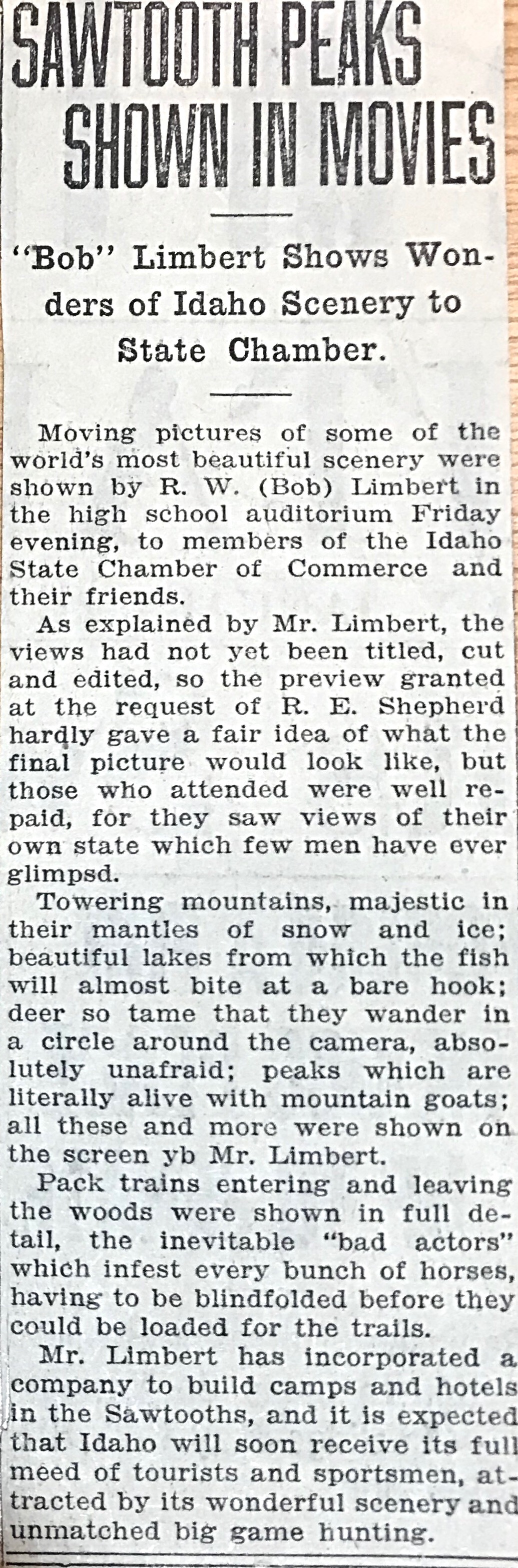
    “Two Gun” Robert Limbert is probably the most interesting personality associated with Idaho Climbing History. You can read about his climbing-related accomplishments on Pages 15-16 of the book. His accomplishments and interests extended far beyond mountaineering. Robert developed Redfish Lodge and he is credited as the moving force behind the establishment of Craters of the Moon National Monument. In fact, the Visitors Center at the monument is named after him.

    Other Resources

    Self Portrait, Robert Limbert (Courtesy Robert Limbert Collection, Boise State University Library.)
    Self portrait of Robert Limbert. Courtesy Robert Limbert Collection, Boise State University Library

    Limbert’s May 25, 1927 article about climbing Snowyside Peak. Click on the photos to enlarge.

    From the Idaho Statesman.
    From the Idaho Statesman.

    A newspaper article about Robert Limbert.

    This article was undated when I found it but more than likely is from late 1920.
    This article was undated when I found it but more than likely is from late 1920.
  • Robert Underhill (1889-1983)

    Robert Underhill (1889-1983)

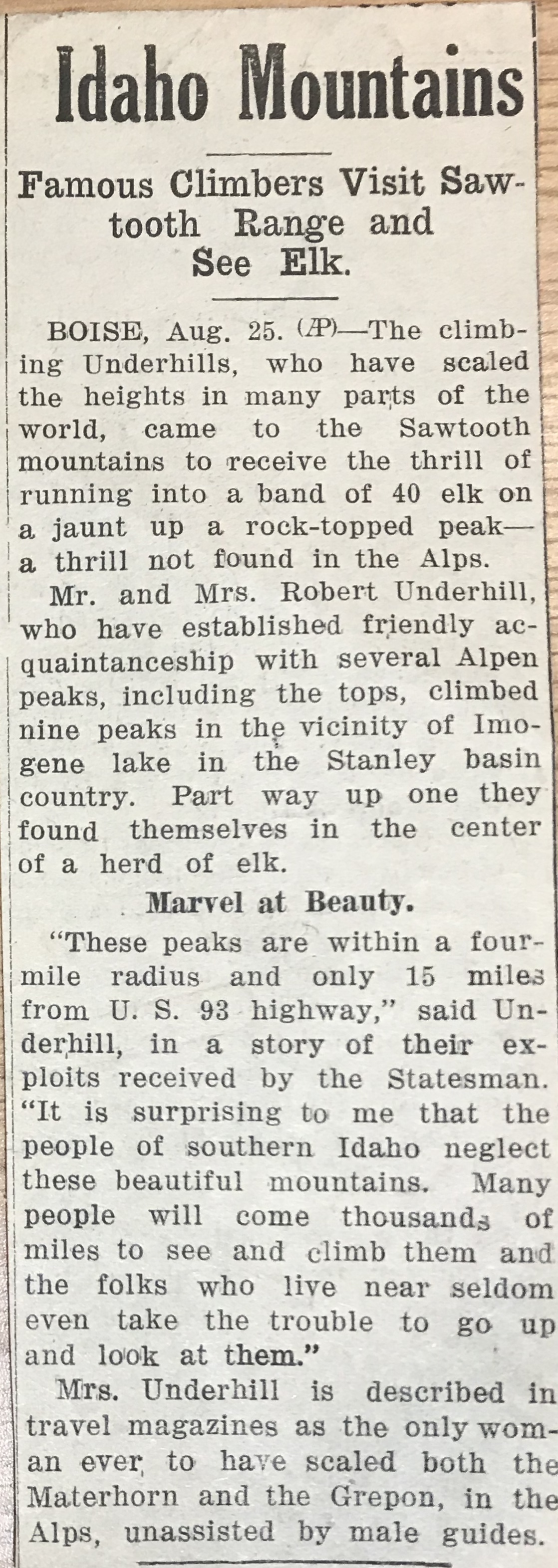
    Robert Underhill and his wife Miriam were outstanding alpinists. They are credited with bringing modern climbing techniques to the Sawtooth Range. During 1934 and 1935, the couple made many first ascents in the Sawtooths. You can read about their Idaho exploits on Pages 17-18 of the book.

    Other Resources

    These article clippings from the Idaho Statesman acknowledge the Underhills’ visit to Idaho.