Category: Backcountry Skiing

  • Sawtooth Mountaineering by Frank Florence

    Sawtooth Mountaineering by Frank Florence

    Editor’s Note: Sawtooth Mountaineering was Boise’s first climbing shop. It was founded by Lou and Frank Florence. The shop was an important link between many of Idaho’s premier climbers and the development of Idaho’s technical climbing scene. Bob Boyles (quoted on Page 23 of the book) noted the shop’s importance as a hub for local climbers, stating “The thirty or so most dedicated climbers in the Boise Valley often hung out at Sawtooth Mountaineering to share stories . . ..” This group of climbers, centered on the shop, are credited with some of the most challenging first ascents in Idaho. In this article, Frank recounts his and the shop’s history.


    I grew up on Long Island (New York), hardly a mountainous setting. My early camping and hiking trips were in the Appalachian and Adirondack Mountains and I was introduced to mountaineering in 1970 as a student in NOLS. I stayed on with NOLS, eventually working as a course instructor in Wyoming and Washington State.
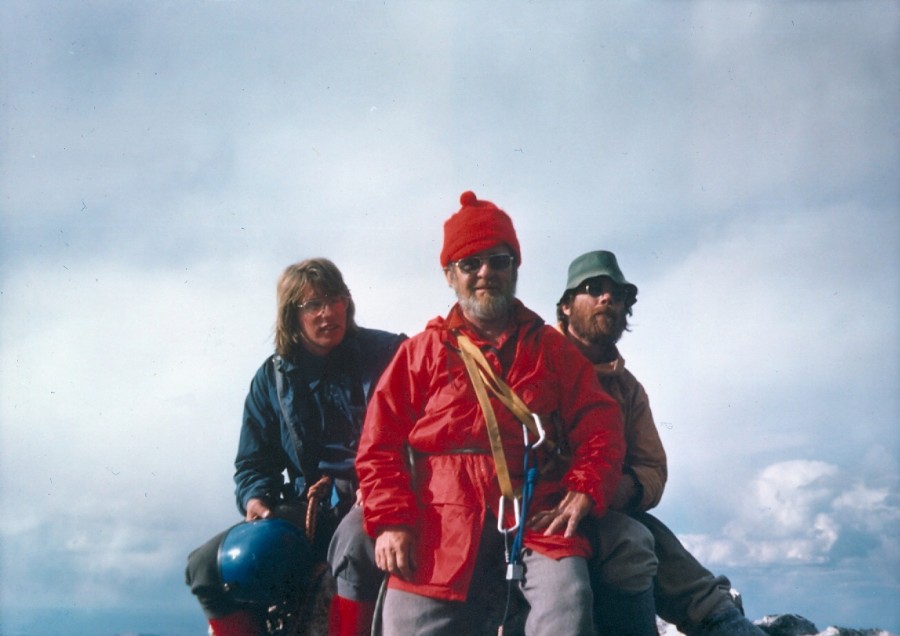
    Bob Boyles, Lou and Frank Florence on the summit of the Grand Teton (photo by Mike Weber).
    Bob Boyles and Lou and Frank Florence on the summit of Grand Teton. Mike Weber Photo

    In 1972, I joined my father, Lou Florence, in bringing a small outdoor recreation equipment store to Boise. Our business (Sawtooth Mountaineering) promoted climbing, hiking, and cross-country skiing across Southern Idaho, from Slick Rock to the Lost River Range.  We offered introductory climbing classes and fostered enthusiasm for climbing by hosting a speaker series with some of the leading climbers and alpinists of the day, including Royal Robbins, Henry Barber, Doug Scott, Bill March, and Sawtooth pioneer Louis Stur.


    British Mountaineer Doug Scott lectured twice at our shop. The first time was in 1975. Scott came to Boise to give a talk about his recent ascent of the Southwest Face of Everest. He wanted to get in some climbing while in town and a posse quickly assembled. We went out to the Black Cliffs for what turned out to be a toasty day. Scott asked what had been done and what hadn’t and then led through a couple of each.

    Scott came through Boise again in 1977 to give a slide show at the shop after his epic descent off The Ogre. And again I and a few others got a chance to climb with a famous alpinist. That time we returned to the Cliffs and he led what is now called the Doug Scott Route. Nice route, too. I remember Scott stopped at one point after trying a move and then pondered it a bit before he led through the sequence. When he came down, I asked him what he thought about it, especially that one section. “It’s all there,” he replied. “Just a lack of balls.”

    1975 Doug Scott at the Black Cliffs. Left to right Bob Boyles, Bob Henry, Doug Scott, and myself. Lou Florence photo.
    Doug Scott at the Black Cliffs (1975). Left to right Bob Boyles, Bob Henry, Doug Scott and myself. Lou Florence Photo

    Through Sawtooth Mountaineering, we conducted popular introductory clinics in cross-country skiing and helped develop an early network of ski trails around Idaho City. Long-time staff members Ray York and Gary Smith, as well as Lou and I, trained and volunteered with Idaho Mountain Search and Rescue. Days off were spent exploring the many crags local to Boise: Stack Rock, Slick Rock, Table Rock, Rocky Canyon, Morse Mountain and the Black Cliffs.

    I frequently partnered with Bob Boyles and Mike Weber on technical climbs, but in the mid 1970s, there was a free-wheeling mix of local climbers who swapped leads including Tom McLeod, John Platt, Art Troutner and Charley Crist. It was a time of discovery as there was little in the way of guide books and, championing clean climbing ethics, we clanged our way up the cliffs using hexes and stoppers. We became better climbers as we challenged one another on new routes locally and expanded our alpine skills into the Sawooths and Lost River Range. In the Winter of 1974, John Platt, Jerry Osborn, Walt Smith, and I skied across the White Cloud Mountains from Obsidan to Robinson Bar. In 1976, I summitted Denali with friends from Seattle and the following year made the first Winter ascent of Mount Borah’s North Face with Art Troutner, Mike Weber and Bob Boyles.

    Sawtooth Mountaineering closed in 1980 and I returned to college and a career in geology. That took me out of Boise but, from time to time over the years, it’s been my pleasure to renew my acquaintance with the Sawtooths and the Lost River Range and those same partners from back in the day.
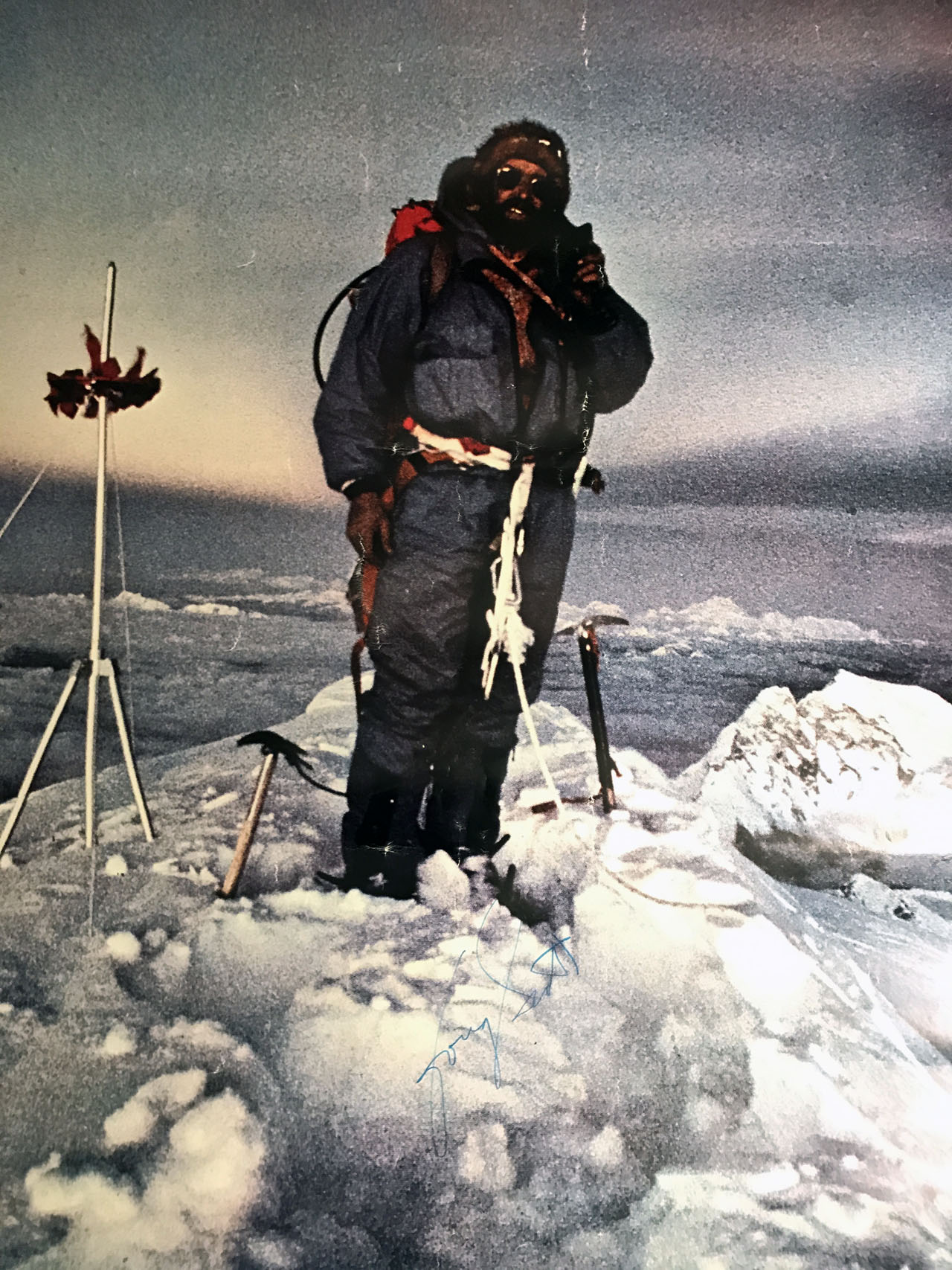
    During one of Doug Scott’s lectures at Sawtooth Mountaineering Bob Boyles secured a signed copy of the famous climber’s posters
    During one of Doug Scott’s lectures at Sawtooth Mountaineering, Bob Boyles secured a signed copy of the famous climber’s posters.
  • The First Winter Ascent of Mount Heyburn

    The First Winter Ascent of Mount Heyburn

    The first Winter ascent of Mount Heyburn was made by Gordon Williams, Mark Sheehan, Jacques Bordeleau, Chris Puchner and Joe Saviers on December 30, 1974. They climbed the peak from the fifth Bench Lake via the Northwest Ridge. Mark Sheehan recalls: “It was a real slog, breaking trail though waist deep powder on a 45 degree slope. Once we got onto the rock it was one pitch of 5.5 climbing.” [Use this link to see Jacques’ photos from the groups first Winter attempt: Mount Heyburn Attempt]

    The ascent crew after the first ascent. Left to right: Mark Sheehan, Joe Saviers, Gordon Williams and Chris Puchner. Photo Courtesy of Jacques Bordeleau
    The ascent crew after the first ascent. Left to right: Mark Sheehan, Joe Saviers, Gordon Williams and Chris Puchner. Photo courtesy of Jacques Bordeleau.

    John Miller was the sixth member of the expedition but he did not summit. Jacques Bordeleau remembered “All but one guy summitted in 1975. Milner sat in his tent whining about his cold toes all day and I haven’t seen him since. It was 2 degrees on the summit but the sun felt good once we had climbed up into it.”

    This is the Wilderness Permit issued to the climbers. Note the signature is David O. Lee, the long time backcountry ranger for the Sawtooths. A White Cloud Peak is named after him.
    This is the Wilderness Permit issued to the climbers. Note the signature is David O. Lee, the long time backcountry ranger for the Sawtooths. A White Cloud peak is named after him.
    Mount Heyburn covered in deep snow at the time of the climb. Mark Sheehan Photo
    Mount Heyburn covered in deep snow at the time of the climb. Mark Sheehan Photo


  • The First Winter Ascent of Mount Regan

    The First Winter Ascent of Mount Regan

    The following newspaper article covers the first Winter ascent of Mount Regan. Joe Leonard has written an extensive account of this climb. See The Lost and Wandering to read Joe’s account which is an excerpt from his  2016 memoir The Son of Madam of the Mustang Ranch. Read more about Joe in the Contributors Section of this website.

    Click on the article for a larger version

  • The First Idaho Guidebook: Sun Valley Ski Guide

    The First Idaho Guidebook: Sun Valley Ski Guide

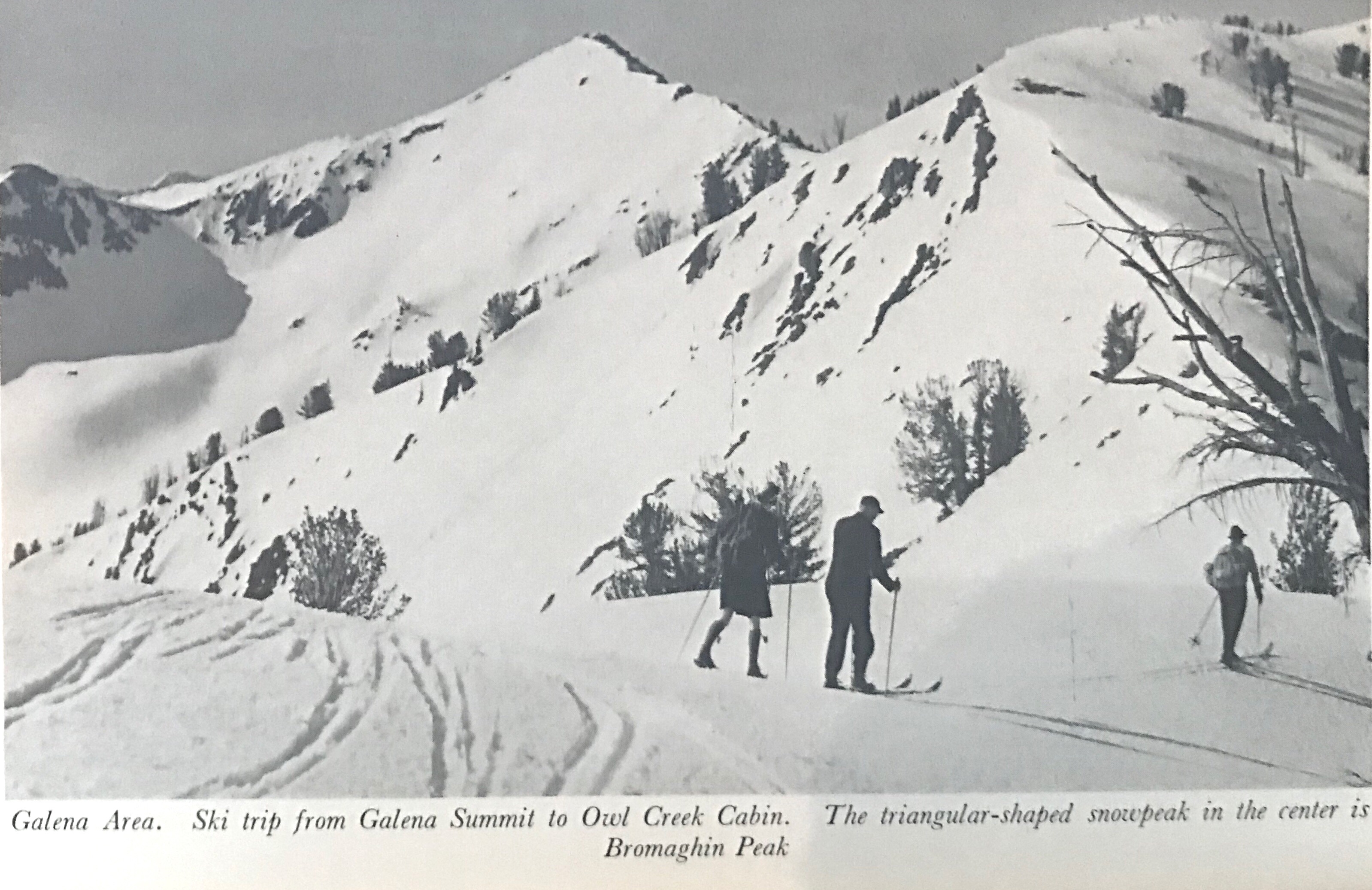
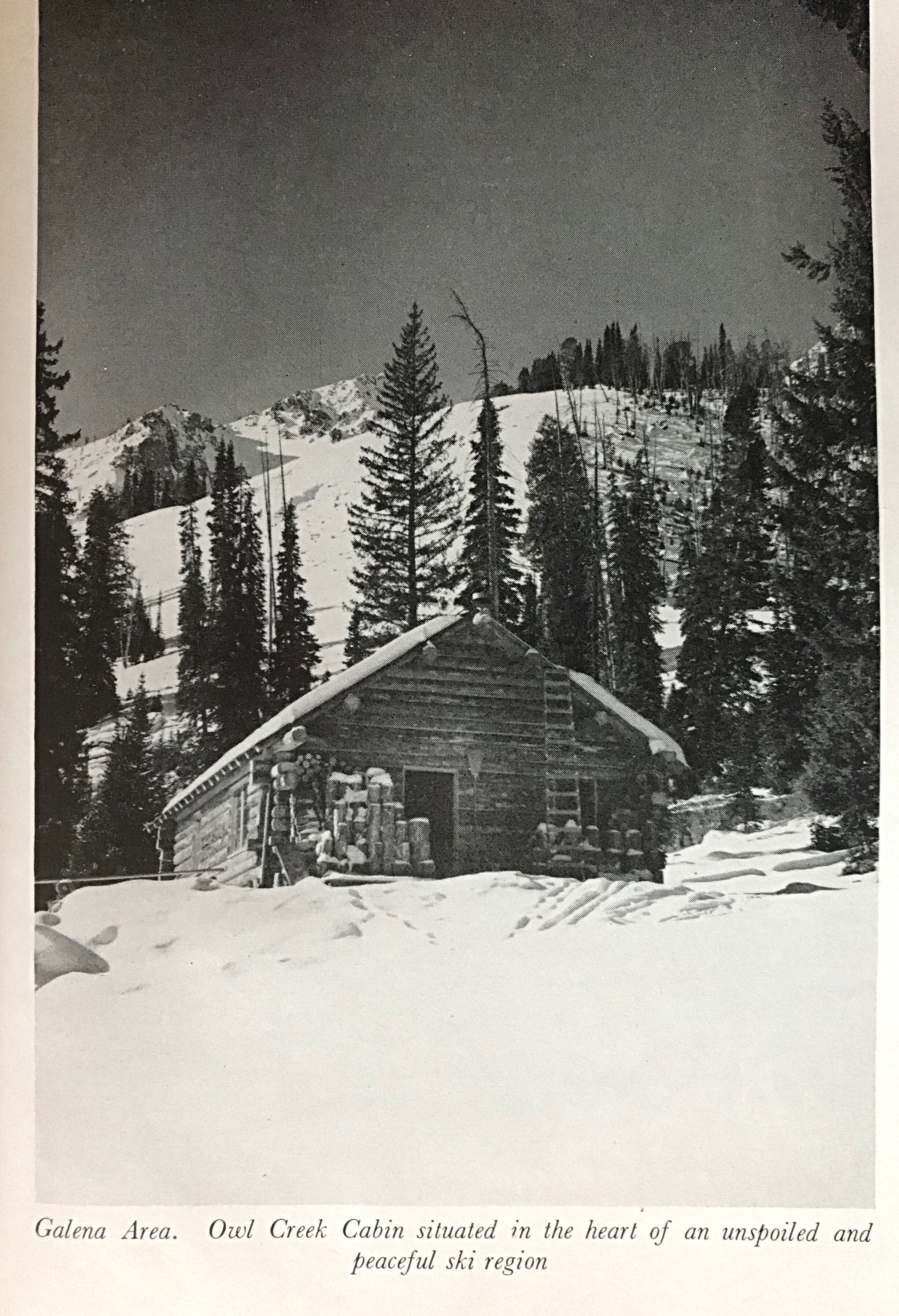
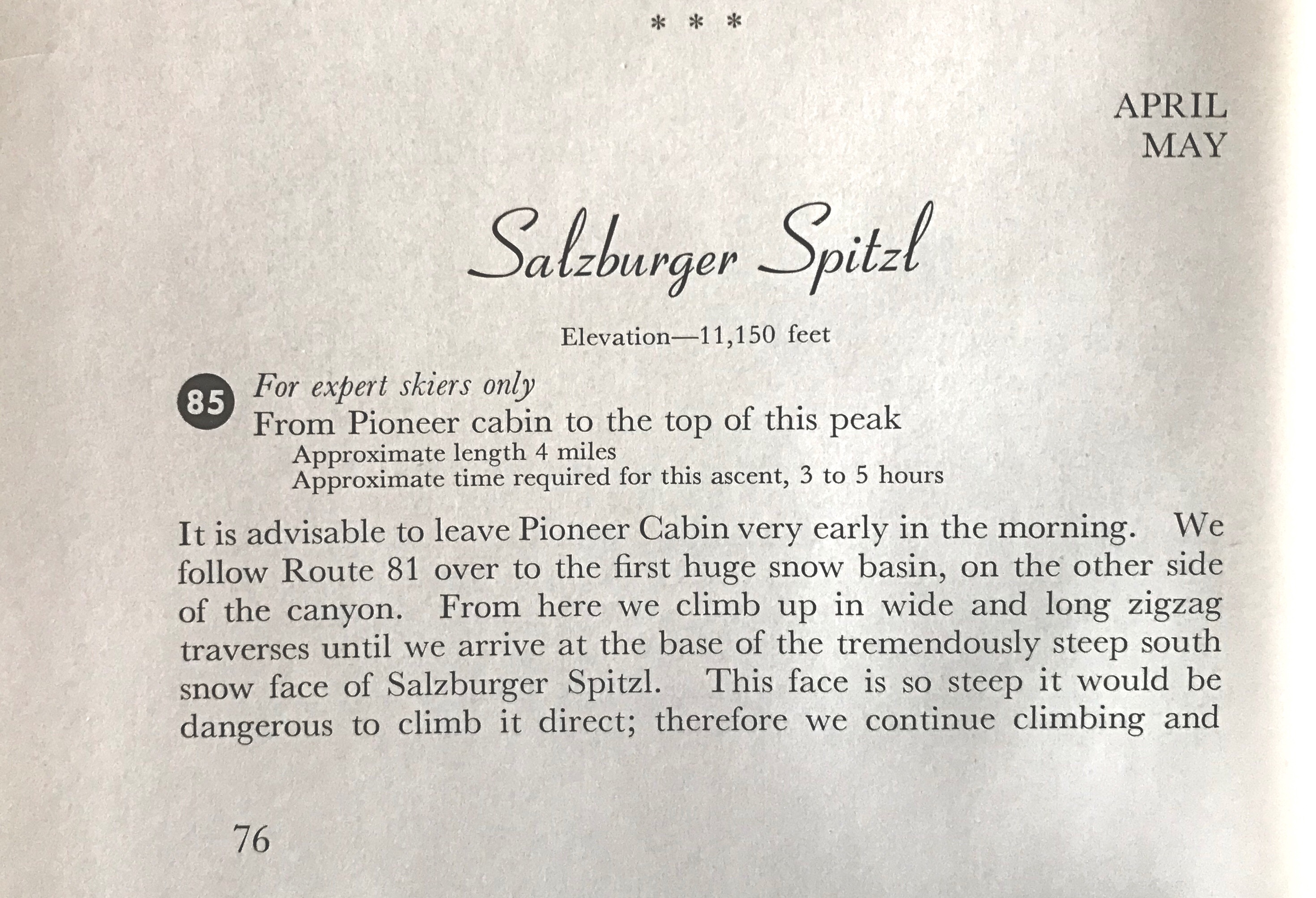
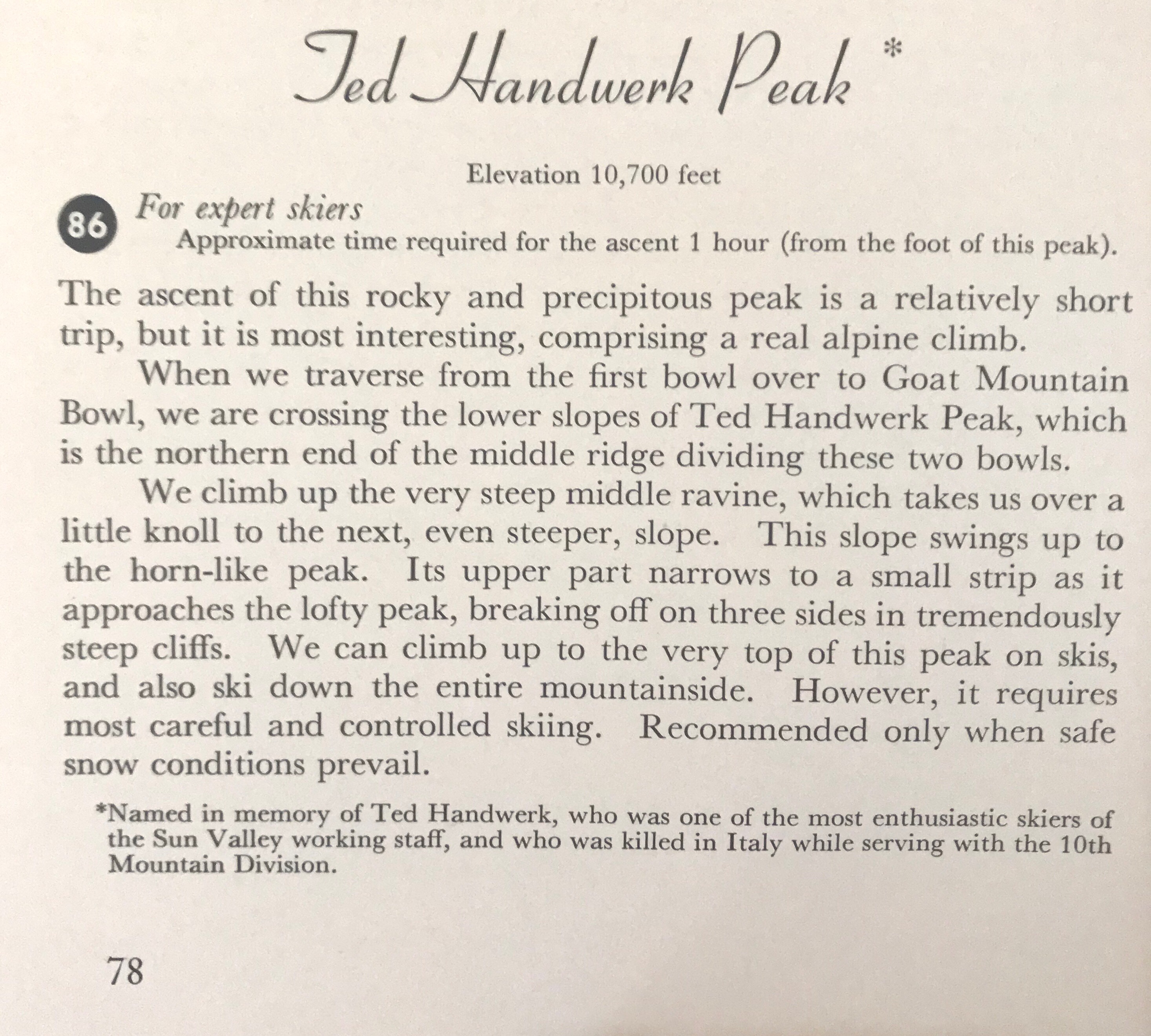
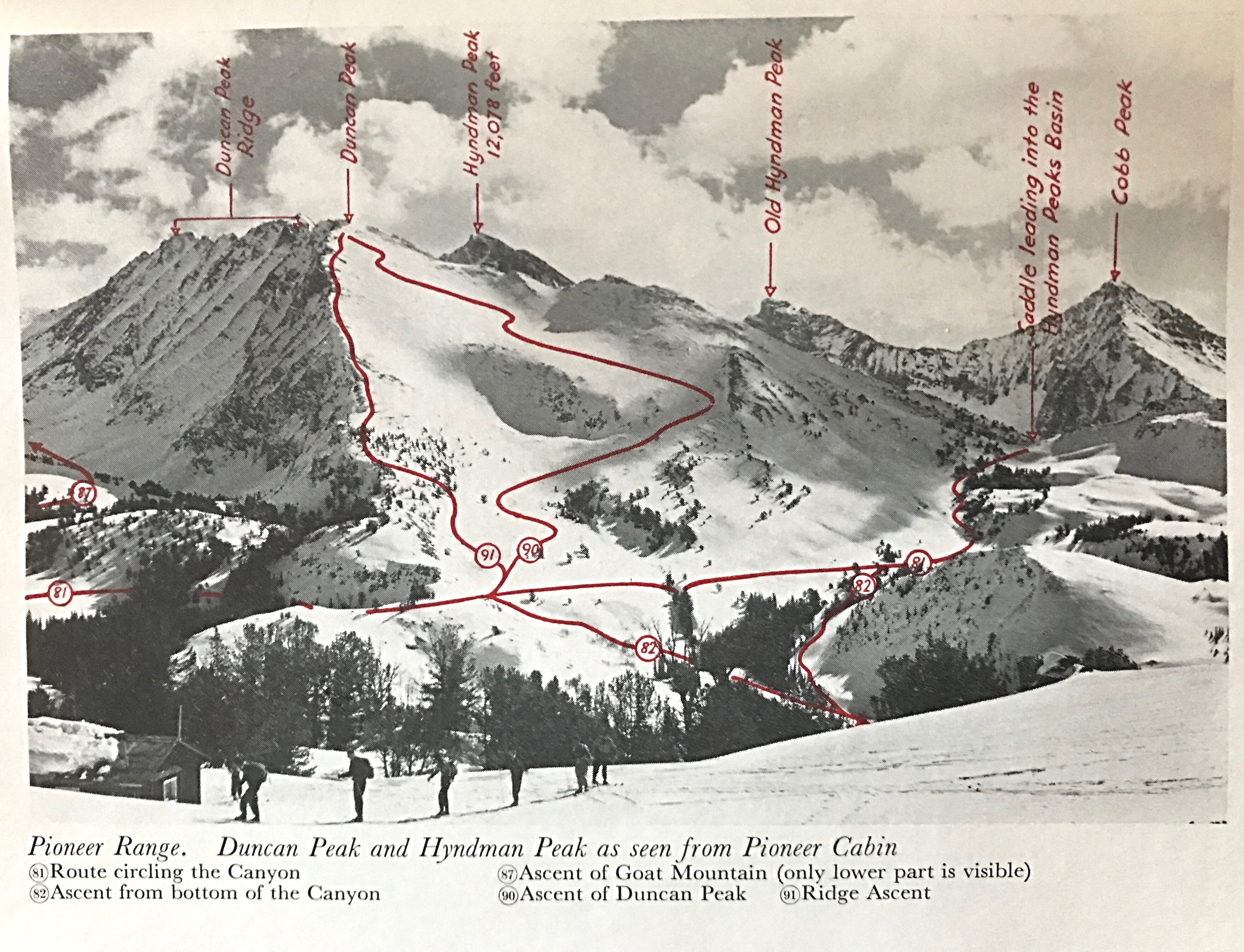
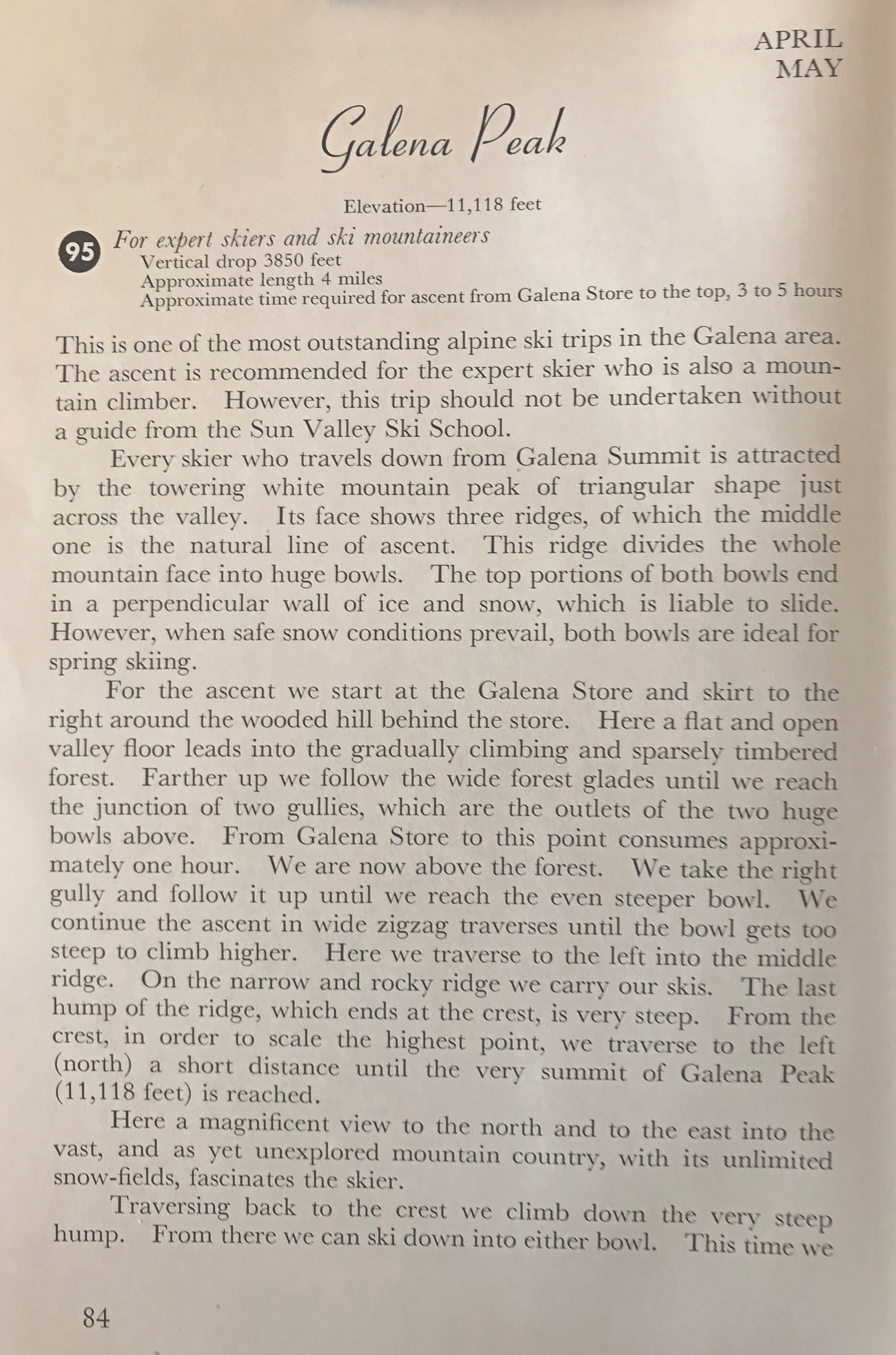
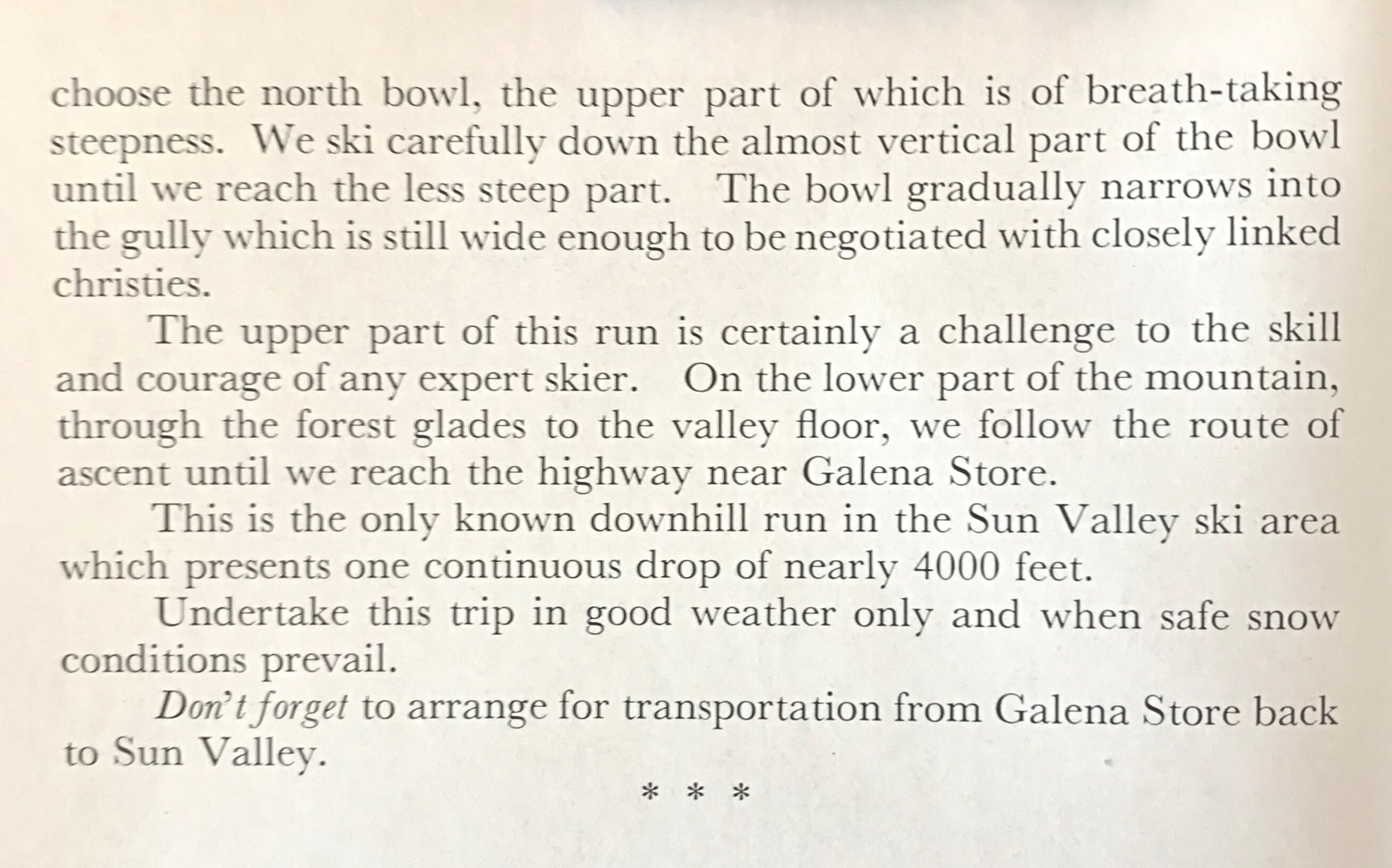
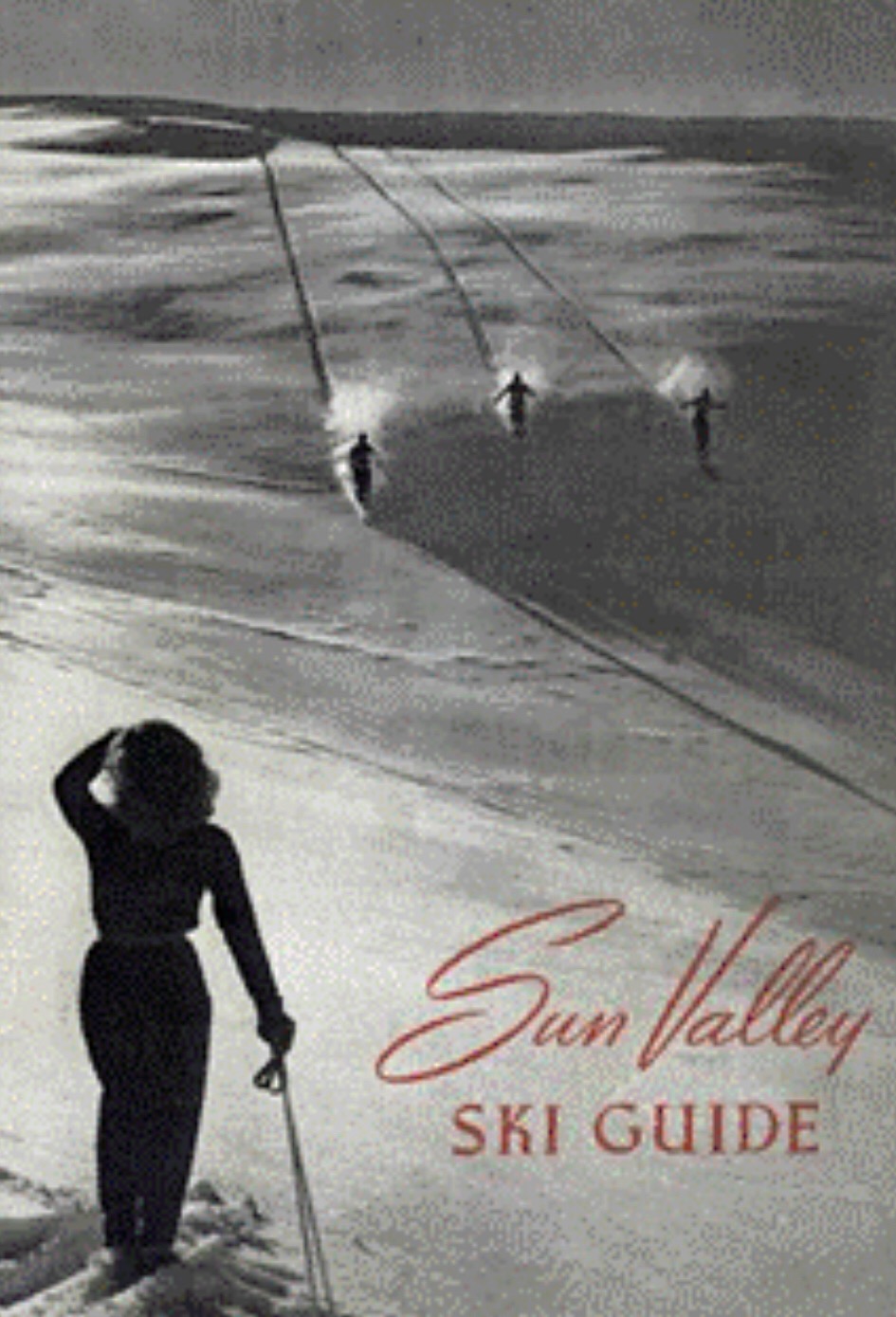
    The first Idaho backcountry skiing and Winter climbing guidebook, “Sun Valley Ski Guide,” was published in 1948. The book was authored by Andy Henning and published by the Union Pacific Railroad, the owner of the Sun Valley Resort. The book is long out of print and is hard, if not impossible, to find. However, there is a copy at the Ketchum library.

    The first section of the book describes the developed ski areas including Proctor Mountain, Ruud Mountain, Dollar Mountain and Baldy as they existed in 1948. The second section, entitled Spring and Summer Skiing, includes routes in the Smoky Mountains, the Boulder Mountains and the Pioneer Mountains. The book demonstrates that the mostly European ski guides hired by Sun Valley likely made the first Winter ascents of many of the peaks in these ranges.

    The following excerpts from the book are courtesy of Basil Service. (Click on the photos to enlarge)

  • Death on Castle Peak

    Death on Castle Peak

    Fatal mountaineering accidents are rare in Idaho, but they do occur. Rarer still are fatalities from Summertime avalanches. Most people associate avalanches with Wintertime, and Winter is when most avalanches do occur. However, for climbers, it’s the Summertime avalanche that can be an overlooked risk.

    Stanley, Idaho resident Jared Spear died on Castle Peak in a rare Summertime avalanche. His friends discovered that he was missing and initiated a search. An air search located his truck at the Castle Peak trailhead on July 6 and spotted a fresh avalanche on Castle Peak. Jarad was an experienced snowboarder.

    Sawtooth National Forest Avalanche Center Report

    Saturday, July 2, 2005, a snowboarder (male, 31 years old) was killed while doing a solo, one-day ascent and snowboard descent of 11,815-foot Castle Peak. He was descending late in the afternoon and tracks show that he completed 3 or 4 turns below the summit and triggered a point release, wet slide that grew in size. The slide was triggered and ran in steep, rocky terrain and dropped over 1,000 feet. The debris consisted of snow, dirt, and many loose rocks that had been entrained in the slide, indicating a full-depth wet release. Deep posthole tracks were observed climbing up sections of the face so he was aware of the wet, loose nature of the snowpack.

    The victim was not buried and appeared to have died of trauma and exposure. He was reported missing on Wednesday, when he did not show up for work after the holiday weekend. His body was located Thursday morning (July 7) by a group of local friends and searchers and evacuated by Sawtooth Forest helicopter Thursday afternoon. The slide was on the North Face of the 11,815-foot peak and the victim was found at 10,600 feet.

    Although point release, wet slides are always a Summertime concern, the high mountain snowpack has been unusually loose and wet at high elevations this Summer. We have not seen the development of a typically denser Spring and Summer snowpack this year. This is due to a combination of a weak shallow snowpack throughout the entire Winter, large amounts of snow at high elevations during May and very poor overnight freezes since early June.  Reported by Janet Kellam, Director, Sawtooth National Forest Avalanche Center.

    Idaho Mountain Express and Guide Article

    Seve Benson of the Idaho Mountain Express and Guide  [Sun Valley’s retired newspaper (2014)] wrote the following article about the incident and the effort to create a Search and Rescue team as a result of Spear’s death. The full 2005 article is located below and also in the paper’s online archive, currently located here.

    Wednesday, July 27, 2005

    Stanley seeks to start search-and-rescue team

    Friends of deceased snowboarder criticize rescue effort


    By STEVE BENSON
    Express Staff Writer

    Friends of Jared Spear, a Stanley man who died after triggering a wet-snow avalanche on Castle Peak on July 2, are leading efforts to form an official search-and-rescue team in Custer County.

    During a meeting with local law enforcement agencies in Stanley on Monday morning, several of Spear’s friends criticized the Custer County Sheriff’s Department for its limited role in the search and recovery of Spear’s body from the peak in White Cloud Mountains.

    Spear’s friends were responsible for organizing the search and locating his body. They felt the Sheriff’s office could have done more in the early stages of the search and displayed poor communication throughout the ordeal. They also blasted Custer County Sheriff Tim Eikens for providing information to the media before members of the search party had conducted their own reports of the incident.

    Eikens commended the search party, but also reminded all in attendance that his office was not notified that Spear was missing until the afternoon of July 6. He added that his office did all it could under the circumstances. “Before we put anybody at risk (in a search process), we have to know all of the information and there wasn’t a lot of information,” he said, adding that he did not even know the identities of the people in the search party.

    Addressing the communication issue, Custer County Sheriff’s deputy Mike Talbot said it was not intentional as technical difficulties hampered radio communications. But Eikens did not want to argue about what happened and focused instead on how to improve search-and-rescue efforts in the future. “We’re here out of respect for Jared,” Eikens said. “We’re trying to make something positive out of something negative. “This is not fun, it’s a traumatic event … but we need to support each other, and get your people to become part of the team.”

    Custer County, unlike Blaine County, does not have an official search-and-rescue team that acts in conjunction with the Sheriff’s office. The search party—comprised of 10 of Spears friends—found his body in the early morning hours of July 7. Upon discovering he had been missing for several days, they organized an impromptu search party on the afternoon of July 6. A reconnaissance flight over the area on the afternoon of July 6 located Spear’s truck at a Castle Peak trailhead—deep in the White Cloud Mountains—and spotted avalanche debris from a large wet slide on the peak’s North Face. Not knowing whether Spear was alive or dead, the party coordinated an all-night effort that included travel on foot and motorbikes. Spear was found in a boulder field about a thousand feet below the summit. He was 31 years old.

    According to a report written by Sean Tajkowski, who was a member of the search party, the avalanche ran about a thousand feet through steep, rocky terrain. Tajkowski said Spear was never buried by the debris and was not immediately caught by the slide. He added that Spear filmed part of his descent with a hand-held video camera and that the recovered footage supports his conclusions.

    Pete Isner, Custer County Deputy Coroner and a member of the Stanley Police Department, said Spear died from trauma suffered in the slide. Isner said his investigation remains open since he has not received all of the information from the field, but he believes Spear died soon after the slide, squashing any rumors that he may have survived as long as 24-48 hours after the accident.

    Kirk Bachman, founder of Sawtooth Mountain Guides, acted as the coordinator of the search for Spear. He did not criticize the Sheriff’s office and expressed his support of the creation of a Custer County search-and-rescue team. He also commended Eikens for being supportive of such an endeavor. “The Sheriff’s office is the legal authority on any search and we want to work with you guys,” he said.

    Eikens said when he first came into office two years ago he tried to create a Custer County search-and-rescue team but found little interest from local residents. After three hours of discussion, which included the full reading of a separate report prepared by Bachman and Tajkowski, Talbot passed around search-and-rescue applications. Almost all of the dozen or so citizens in attendance filled out an application.

    Talbot encouraged those who wished only to lend resources, such as all-terrain vehicles, horses, boats or aircraft to search-and-rescue missions, to sign up and specify their potential contributions. “We’re moving in the right direction,” Bachman said during a break in the meeting. “We’ll hold more meetings and focus on training and better communication.”

  • Andy Henning

    Andy Henning

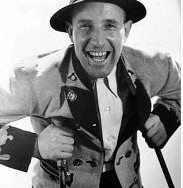
    Andy Henning was the author of the first Idaho backcountry ski guidebook, “Sun Valley Ski Guide,” which was published in 1948. Unfortunately, the guide is long out of print and is hard, if not impossible, to find. There is a preserved copy at the Ketchum library. Henning moved to Sun Valley prior to WWII to work as a guide for the Sun Valley Company. During the war, he served with the famous 10th Mountain Division.

    The cover of the Sun Valley Ski Guide Andy Henning. Basil Service Collection
    The cover of the Sun Valley Ski Guide Andy Henning. Basil Service Collection

    Basil Service, a friend of Henning, notes that “Henning was from Salzburg, Austria …[he] had an extraordinary love of climbing as well as skiing. To Andreas Henning, “a mountain was a gift of nature to man king, something to be admired and to be awed by.” Before he came to Sun Valley, Henning had quite a reputation as a ski mountaineer and rock climber in the Alps, with an enviable collection of first ascents to his credit. I first had a chat with Andy in 1976 when he recommended as my first Sun Valley Ski Mountaineering descent, Johnston Peak by way of Uncle John’s Gulch, in the Pioneer Mountains. After that, I was hooked. Through the 1980s and early 1990s, I skied hundreds of Andy’s routes which he generously provided to me. Andy passed away in my hometown of Pocatello, Idaho in 1993. Today, I am still skiing Andy’s ski routes.”

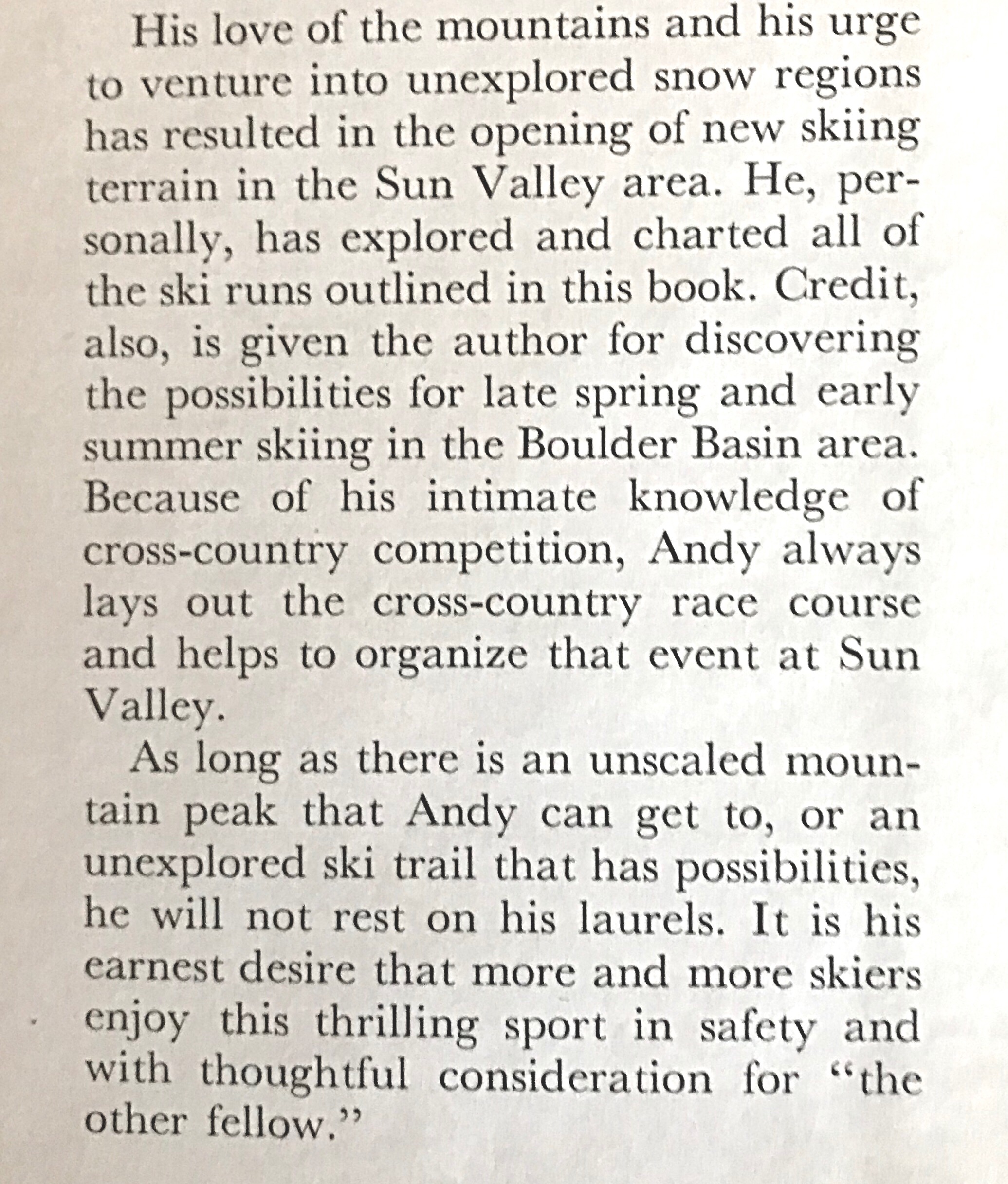
    The following is from the dust cover of Henning’s book.

    You can read more about Andy Henning on Pages 18-19 of the book and at Basil’s website where he has an extensive discussion of Sun Valley’s European guides at this link: Alpine Touring /Ski Mountaineering Ski History of Sun Valley.