Category: Borah

  • T.M. Bannon by Rick Baugher

    T.M. Bannon by Rick Baugher

    Thomas M. Bannon was also a self-taught mountaineer. Although his name is not widely known in mountaineering circles, during his surveying career from 1889 to 1917 he climbed nearly one thousand summits in the American West. More than two hundred of these summits were in Idaho. Bannon’s cryptic reports, supplemented by the rock Cairns, Wooden triangulation signals, chiseled cross-reference marks; and brass benchmarks that he left behind tell his fascinating story. More than one hundred of his Idaho ascents were probably first ascents. These climbs included many of Idaho’s highest and most famous peaks, including Mount Borah (which he called Beauty), Leatherman Peak, and Invisible Mountain in the Lost River Range; Diamond Peak (which he called Thumb), Bell Mountain (Bannon’s Finger), Lem Peak, and May Mountain (Bannon’s Hi Peak) in the Lemhi Range; Standhope Peak and Smiley Mountain in the Pioneers; Castle Peak in the White Clouds); and Mount McGuire in the Salmon River Mountains. Bannon’s death at 48 cut short an extremely active life.

    I spent a good part of the 1990’s investigating pioneer government surveyors in the Idaho and western US mountains. This involved recovering some 100 mountain top triangulation stations placed by Bannon & party in Idaho from 1911-1915. In his career as USGS Topographical Engineer 1894-1917 T.M. Bannon had a hand in making ~50 topographic maps.

    Having grown up myself in Maryland, a highpoint was a July 1995 pilgrimage to the Bannon burial plot at St Lawrence Martyr R.C. Church in Jessup. Bannon family monument (like T.M.’s triangulation monuments) occupies a prominent position in the church graveyard.

    Photo on right is T.M.B. gravestone. Rick Baugher Photo

    Obituary notice from Washington Evening Star, Feb 6, 1917:

    THOMAS M. BANNON DIES AFTER A BRIEF ILLNESS

     Was Engineer of Topographic Branch Geological Survey- Funeral Thursday at Jessups, Md.

    Thomas M. Bannon, engineer of the Topographic Branch of the geological survey and a prominent resident of Anne Arundel county, Md, died Sunday evening at Maryland University Hospital in Baltimore. Mr Bannon had been ill only a short time. [Author’s Note: USGS said field worker deaths at that time often attributed to typhoid fever].

    Mr. Bannon had been connected with the geological survey since 1888, the greater portion of his service having been given to topographic and geodetic surveys in different western states.

    Prior to the organization of the United States reclamation service, Mr Bannon was detailed to collect the data which that organization used in connection with the development of its projects in Idaho and Utah [Author’s Note: chiefly Bear River drainage].

    In 1908 he was detailed to the Porto Rican government and placed in charge of surveys in developing irrigation of the semi-arid portion of the island.

    During the last few years Mr Bannon’s efforts had been directed to the extension of geodetic work in western Montana and eastern Idaho and in mapping portions of the national forests in Idaho.

    In addition to his official duties with the government Mr Bannon served seven years as a member of the board of governors of the Maryland board of correction and was active in many local and charitable organizations of Anne Arundel county.

    Mr Bannon was unmarried, is survived by two sisters, Mary and Francis Key Bannon, and three brothers, James T., Phillip M., and Joseph Bannon.

    Final notes: It is believed Bannon thru his mother Evaline was related to Francis Scott Key. Bannon’s federal appointment as an 18 year old was thru Rep. Barnes Compton, also an F.S. Key relative. Survey director John Wesley Powell was chided for hiring “Congressmen’s nephews”. Bannon estate in Jessup was demolished in 1950 to make way for Baltimore Washington Expressway.

    See also: Appendicitis Hill and T.M. Bannon and 1929 Borah Declared Idaho’s Highest Peak

  • Lightning Strike on Borah 1954

    Lightning Strike on Borah 1954

    The Idaho Statesman reported this accident in its September 3, 1954 edition.


    Lightning Hits Climbers

    MACKAY, A lightining bolt struck a mountain climbing party near the top of 12,655 foot Mt. Borah Thursday iatternoon, causing the disappearance of one man and temporarily paralyzing another. A third escaped unhurt. Missing is John Landenberger, 18, son or J. C.Landenberger, superintendent or the Utah division the Kennecott Copper company, Salt Lake City. Robert A. Je‘ster, 20, of Salt Lake‘ City, who later recovered the use of his limbs, was helped to the valley floor by the third member or. the party, Greorge  Pierce, 28, of Trenton, N.J. Pierce told officials here that the party had reached the top of the peak and was starting down when the storm hit; They attempted to slide down one of the snow fields on, the mountain to escape the storm, when the lightning bolt struck.  In the following confusion Jester and Pierce lost track or Landenberger. Pierce told officers that he made a hurried search of the area near him trying to find the lost climber but couldn’t. He then packed the injured Jester to the base or the mountain and to the Fulton ranch 20 miles north or there on U. S. highway 93.  Jester’s only injuries were a. few cuts and bruises from the descent and a burned toe.  A party of searchers was organized Thursday night and began searching for the‘ missing Landenberger. Friday an additional party will make the ascent, lead by Custer County Sheriff Lee Clark Blaine County Sheriff Les Outz and two experienced Sun Valley climbers. The three victims were employed at Sun Valley.

  • Seeing Idaho from Borah Peak by Robert Fulton

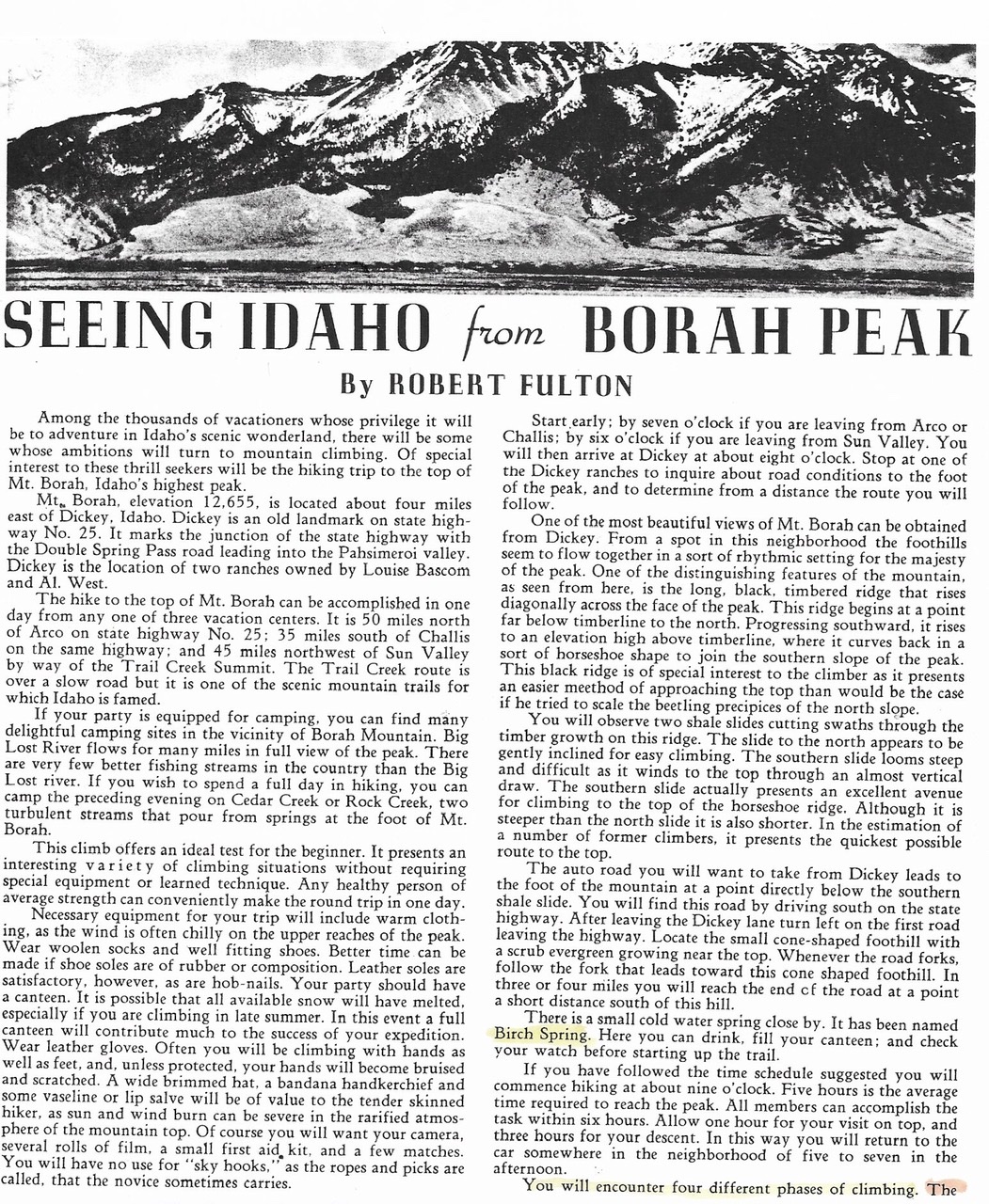
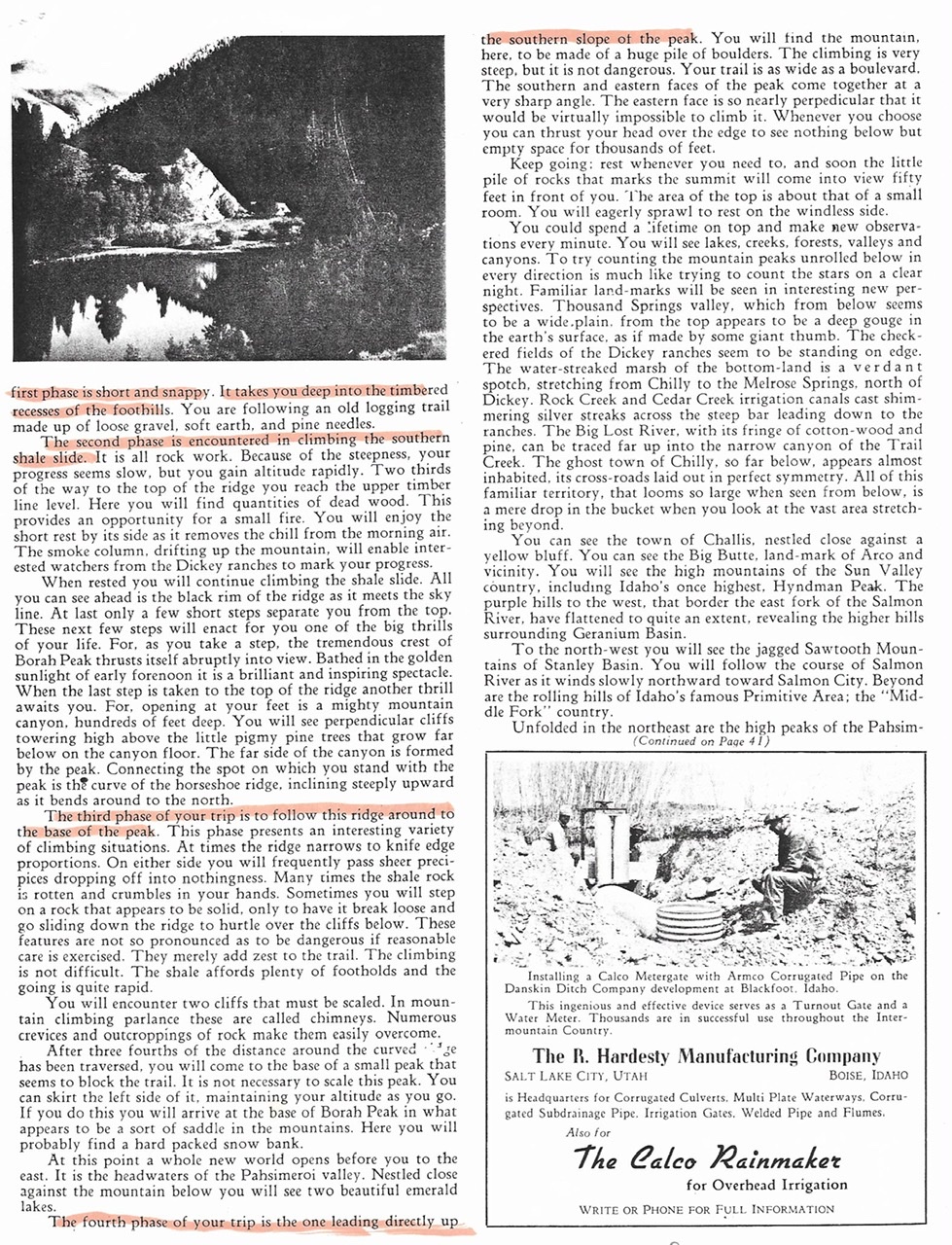
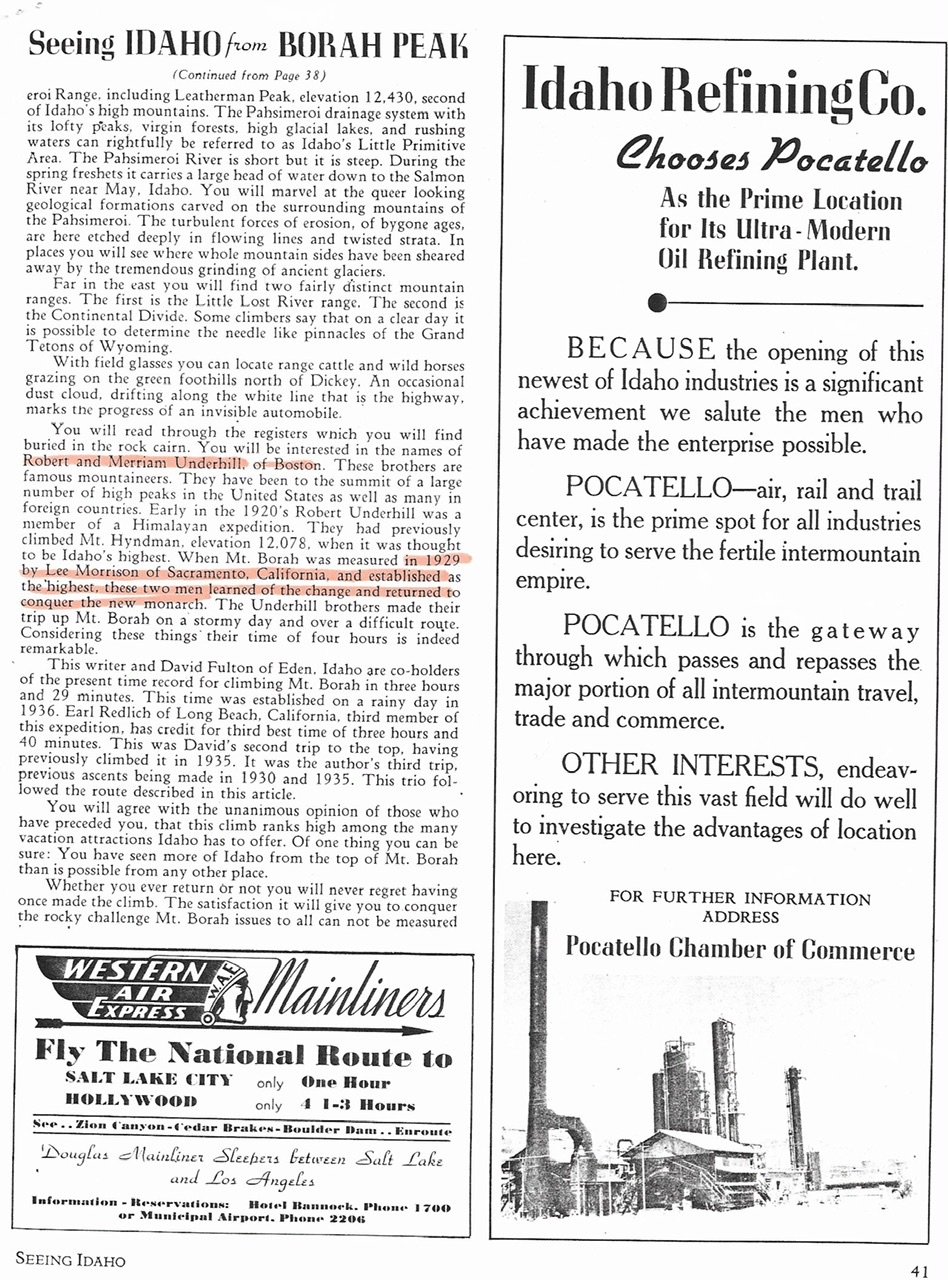
    Seeing Idaho from Borah Peak by Robert Fulton

    [Editor’s Note: In 1938, Robert Fulton published this article in Seeing Idaho, a long defunct magazine that focused on the state’s wonders. Clicking on a page will provide a larger version of the page.]

    Page 37
    Page 38
    Page 41
  • Mount Borah: Dirty Traverse and Northeast Ridge Variation – East Face by Bob Boyles

    Mount Borah: Dirty Traverse and Northeast Ridge Variation – East Face by Bob Boyles

    Bob Boyles provided the following history and, with Wes Collins, the route descriptions (below) for these two East Face Routes.

    I first visited the East Side of the Lost River Range (The Pahsimeroi Valley) in 1972, while working on a helicopter contract for the Forest Service. Flying through the range provided me a view that few ever get to see. While all of the range is impressive from the eastern side, one face stood out from the others.

    When our contract with the USFS finished at the end of Summer, I took a break from the 24/7 aviation life I was accustomed to. During this down time, I happened to notice an ad for an introductory rock climbing class and thought, “Wow. Cool. Ropes and everything, I’m game for this!” I talked a couple of friends into joining me for the class. After completing our class, we were ready to test our newly-learned skills on a real mountain but Winter soon arrived and we put our plans aside until the next Summer.
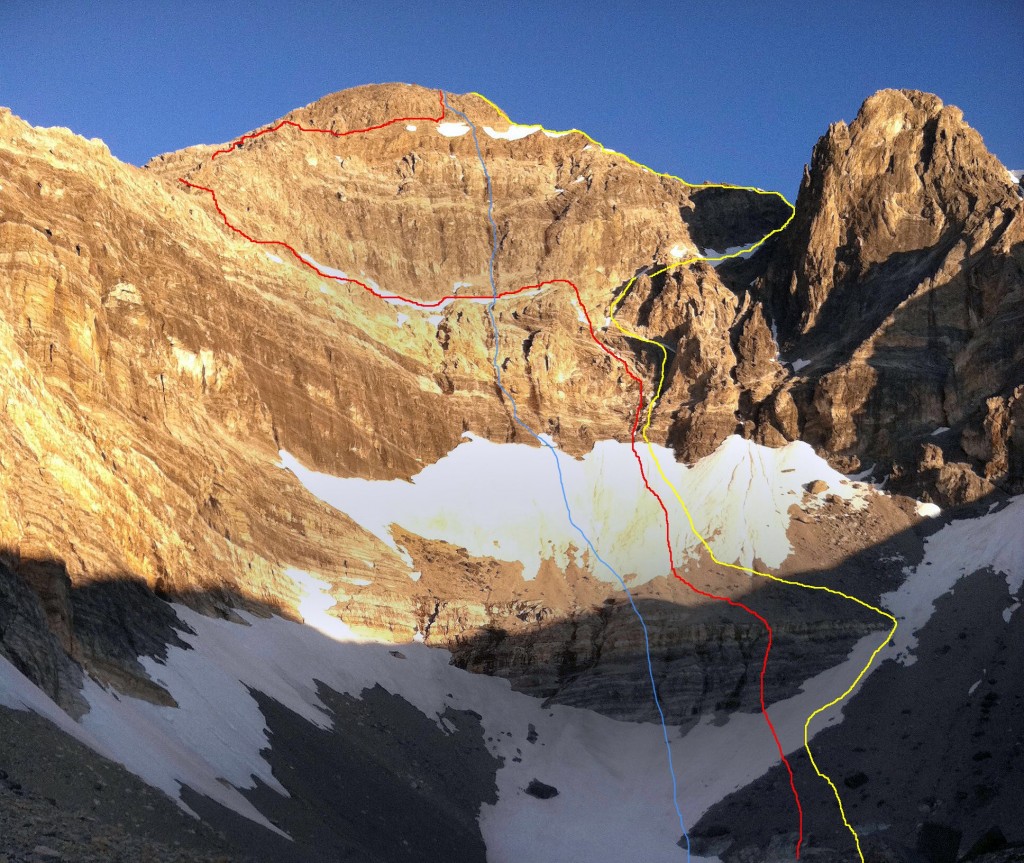
    East Face Routes. The blue line is the Direct, red the Dirty Traverse and yellow the East Face variation. Photo - Wes Collins

    East Face Routes. The Direct East Face (blue line), the Dirty Traverse (red line) and the Northeast Face Variation (yellow). Wes Collins Photo

    Summer came late in 1973. It wasn’t until the end of June that we were able to get in for a closer look at the East Face. As the morning sun warmed the snow high in the cirque, we watched slide after slide tear loose and nail virtually every approach to the mountain. Along with the snow slides came a lot of rock fall as well. After sitting and studying the face, it looked to be climbable. There was no doubt, however, that the attempt would have to be made during the dry season. In 1974, we returned for another exploratory trip and picked out a line on the face that followed some water streaks in a nearly straight path to the summit. We decided that this was the route we would attempt on our next visit.

    A couple of years passed. In trying to sell potential climbing partners, I described this face as “Idaho’s Eiger” but at the time, the range had no technical rock routes. Idaho has so much fine granite it was hard to justify a trip to the Lost Rivers, where the limestone rock had a reputation for being nothing but choss.

    In the Fall of 1975, Mike Weber and I decided to throw caution to the wind and give this face a serious attempt. We loaded up all of the gear we thought we’d need and made the brutal drive to the end of the road up the West Fork of the Pahsimeroi River. Hiking through open sagebrush, we made quick work of the approach and found a nice grass-covered spot for our camp at the lower tarn just above timberline. Curious to see the face up close, we grabbed our crampons and axes and headed up the snow and ice to where the bare rock began.

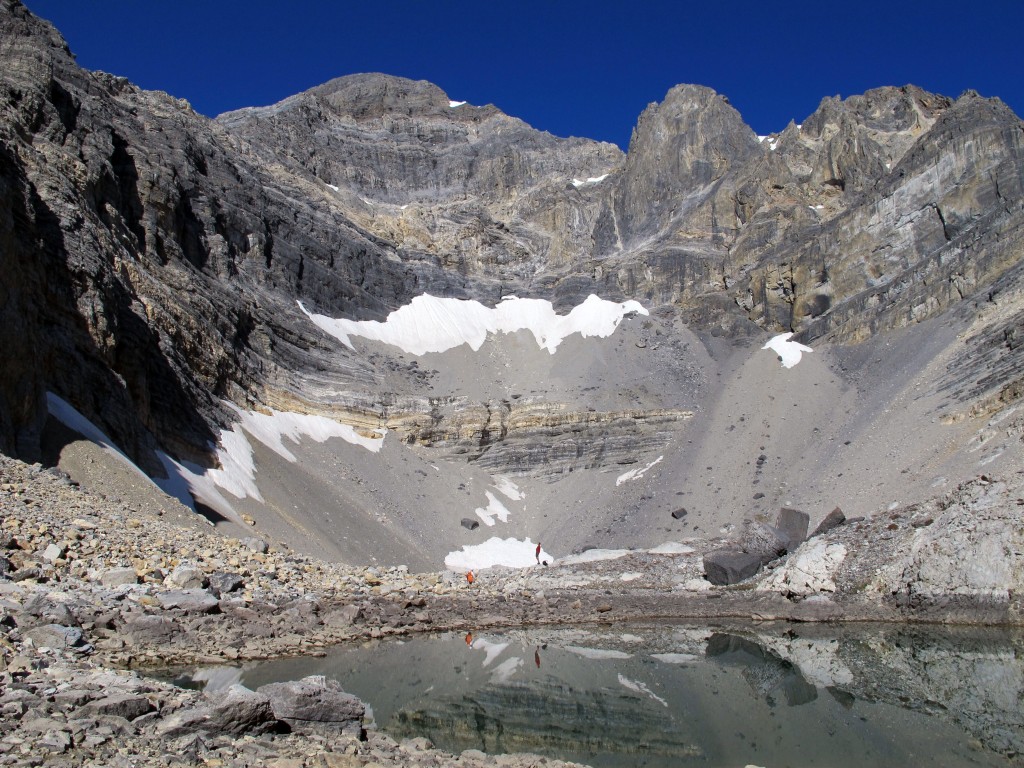
    A picture perfect September day in the Lost River range. Wes is deep in contemplation over the route that he and Kevin will use for their intended climb. The vertical rise from the lake to the summit is 2440′.” Lost River Range – Mt Borah, Idaho Sept 24, 2011 (photo by Bob Boyles)

    A picture-perfect September day in the Lost River Range (9/24/11). The vertical rise from the lake to the summit is 2,440 feet. Bob Boyles Photo

    Just as we were approaching the final section of snow and the start of our proposed route, we heard a rumble from above, freezing us in our tracks. A Volkswagen-sized rock was flip-flopping down the face. Within seconds, it reached terminal velocity bouncing back and forth down the face. We stood motionless in our stances trying to figure out if we should go left, right, or just clasp our hands and pray. Fortunately, the rock deflected about 40 feet to our right. We just stood there watching it tear up snow and bounce to the flats and the tarn at the bottom of the cirque.

    We tried to convince each other that the face would be frozen up by morning but neither of us was to be convinced. Around 2:00AM, we were startled awake by a blinding flash of light and, milliseconds later, a rumble of thunder. We both knew our chances to climb were most likely over, so we pretended to go back to sleep. Within minutes, the rain was falling at a rate of an inch or two an hour, and shortly afterward our campsite became a flood zone. We stayed in the tent until it was surrounded by flowing water, our cue to get the hell out of there.

    For decades after that ill-fated attempt, my climbing partners and I continued to explore and put up routes in the range. Despite those many visits, we never made it back to the cirque. I pretty much wrote off the East Face as being a very dangerous place and that kind of risk no longer appealed to me. Also, as time progressed, I gained the impression that sport climbing and bolted routes on established climbs were the “new norm” and the pioneering of new alpine routes seemed to have gone by the wayside. It wasn’t until the Spring of 2011, during a discussion of Lost River climbs on the Idaho Summits web forum that a new spark of interest began. When I first described the East Face Cirque, most local climbers did not know what I was talking about. This, despite most of them having climbed Mount Borah multiple times. One did, though.

    After reading my description of the face, Wes Collins, a local climber and native of the area, immediately became interested. Soon, a new discussion started about taking a trip to the cirque.


    Route Information

    The Dirty Traverse

    First Ascent –  Wes Collins (solo) July 2011
    Rating: Grade III 5.4
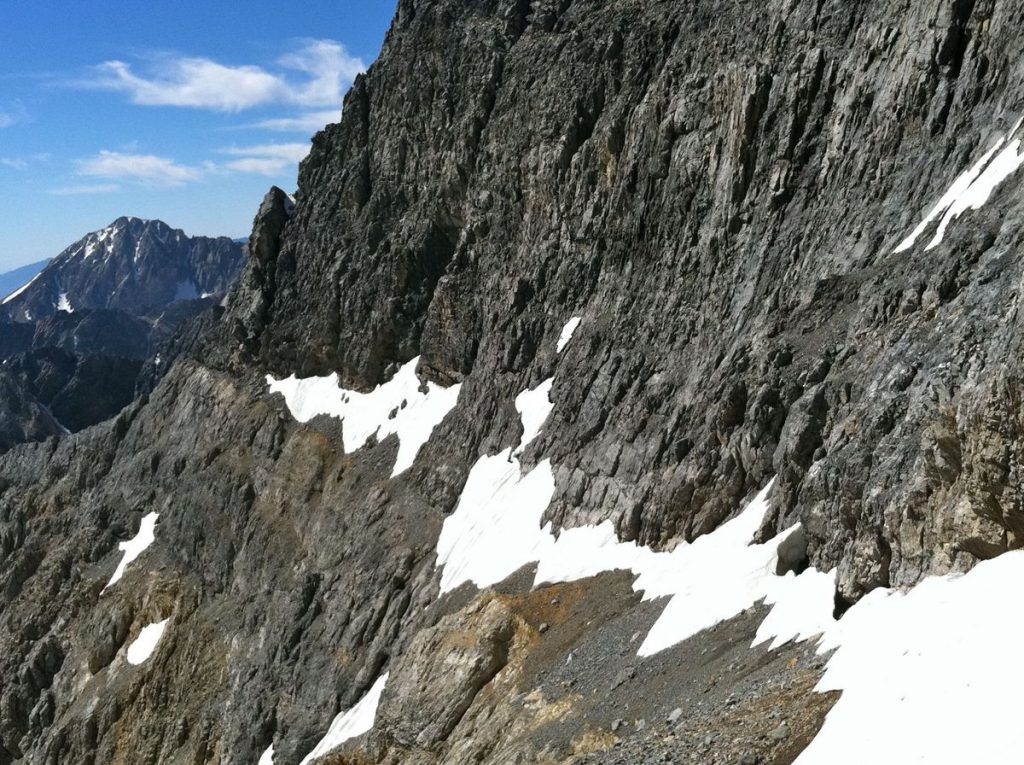
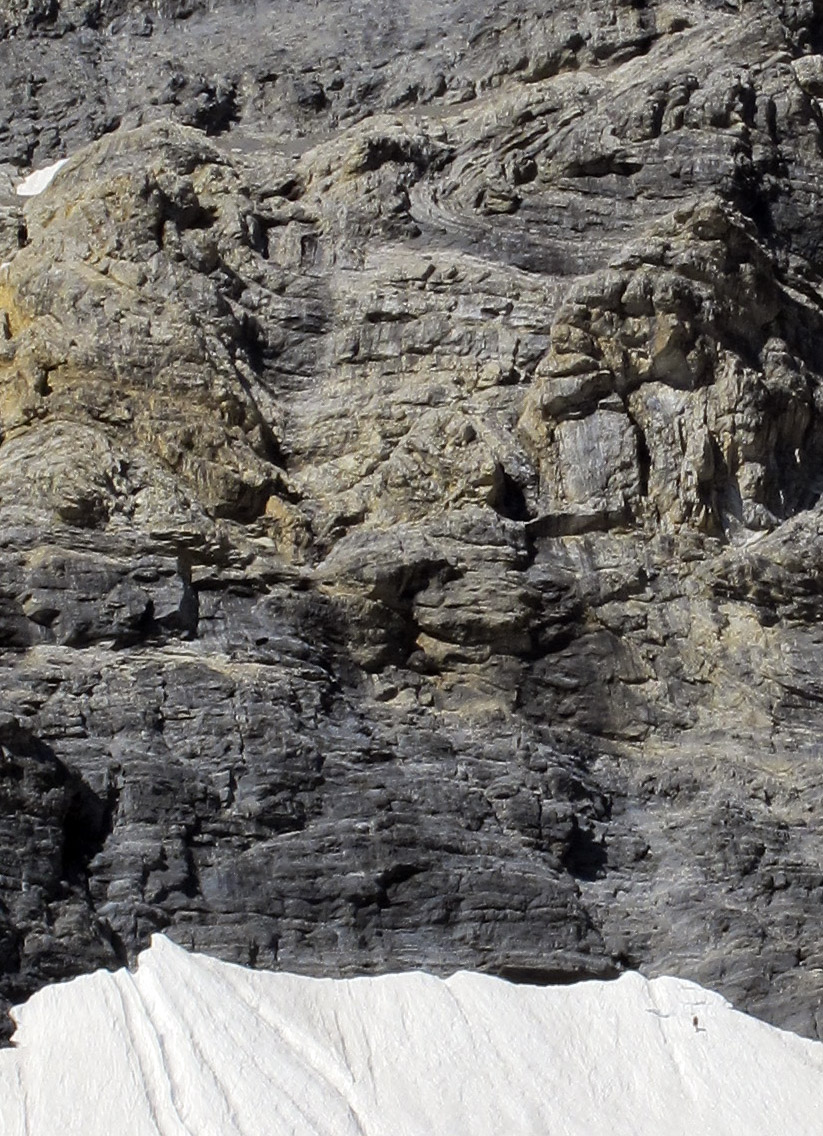
    The Dirty Traverse ledge leading out to the East Ridge from the center of the face. Photo - Wes Collins

    The Dirty Traverse ledge leading out to the East Ridge from the center of the face. Wes Collins Photo

    Wes couldn’t wait to see the face up close so he took off on an exploratory trip with his wife and dog. This trip in 2011 started as a recon, but Wes found himself drawn to the face like a magnet. The following is Wes’ account of the first ascent.

    Bob got me all fired up to get a look at the East Cirque and what he described as Idaho’s Eiger. I certainly wasn’t disappointed. Susan and I planned the trip as a leisurely backpack into Lake 10204 to take in the views, but I tossed an axe and some light crampons in the truck just in case.
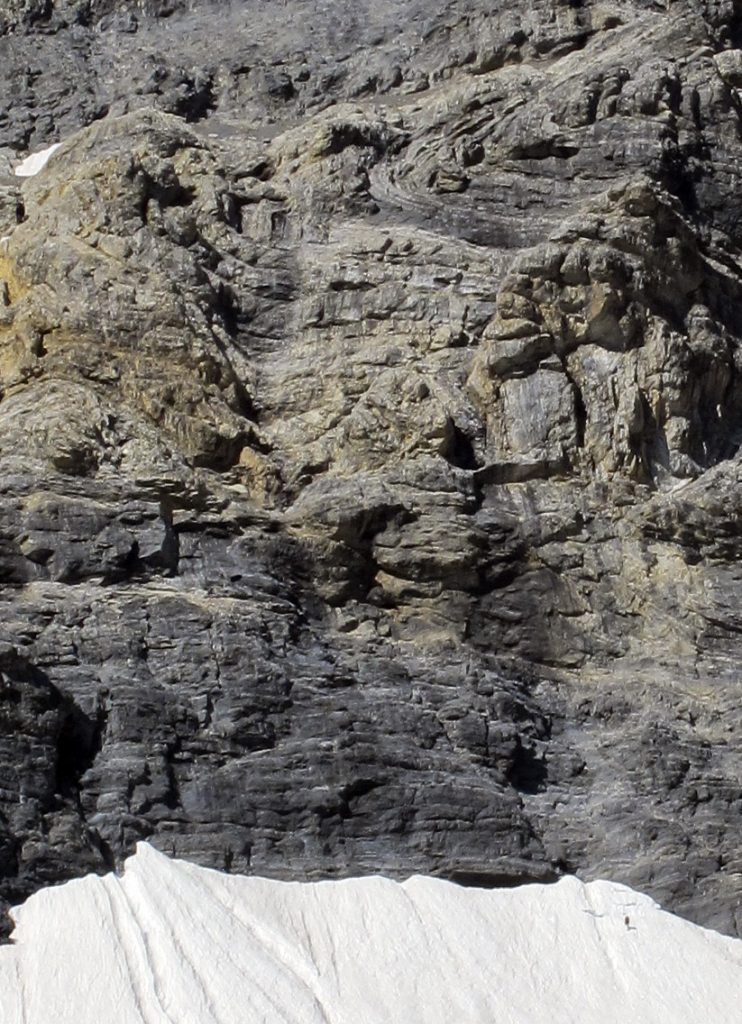
    Dirty Traverse-1 Standing on the last of the snow slopes below the first wall. Photo - Susan Collins

    Dirty Traverse-1
    Standing on the last of the snow slopes below the first wall. Susan Collins Photo


    I spent a lot of time looking at the face before I even thought about a spot for the tent. Stupidly, I’d left my axe and spikes in the truck, but at this point I knew I was going to make a serious try for the summit. It didn’t take long to pick out a couple possibilities, but the most probable line would involve a long traverse across a talus-covered ledge on the lower face. I started thinking of the route as the Dirty Traverse before I even put my boots on it. Morning was an easy laid-back affair. We sipped coffee and we watched the sun line slowly make its way down the mountain. I had to wait until nearly 10:00AM before the snow softened enough for step-kicking. The first, lower snowfield was pretty firm, but the second was much softer.

    I’d found a nice, tooth-shaped chunk of limestone that probably wouldn’t have done much more than keep my feet down hill if I took a fall. I was on my own, but it was still embarrassing to have the damn thing in my hand and I had to keep fighting the urge to hide it in my pocket. At the top of the snow, the randkluft was several meters deep and the first tentative moves on rock over the blackness below felt pretty exposed. The rock, however, was surprisingly solid and clean.
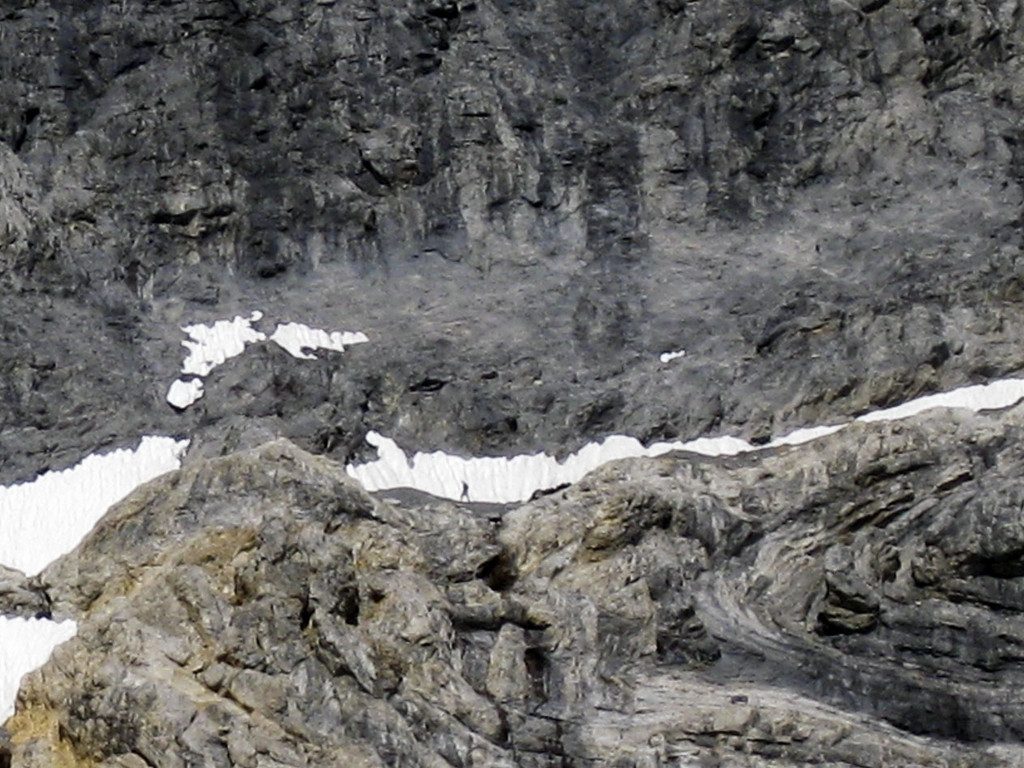
    Wes Collins about a third of the way across the traverse. Photo - Susan Collins

    Wes Collins about a third of the way across the traverse. Susan Collins Photo


    The scramble to the traverse ledge was fairly sustained Class 4, but the rock was good enough to make me forget about the exposure and enjoy the ride. The traverse ledge was quite tedious though and I wasn’t sure it would go all the way to the ridge until I got there. Once on the ridge, I made my way up an easy Class 5, 70-foot buttress but it could have been easily bypassed by scrambling around its West Side. Most of the ridge above the traverse is Class 3 or easier.

    The key to the climb. A tiny col where the East Ridge meets the upper East face. Cross the snow field "sky ledge" to get to the summit. Photo - Wes Collins

    The key to the climb. A tiny col where the East Ridge meets the Upper East Face. Cross the snow field “sky ledge” to get to the summit. Wes Collins Photo


    As I continued up the ridge, my doubts got bigger. The entire North Side of the East Ridge is very tall and overhung in several places. More and more I suspected it would dead-end into the headwall but, at the last possible minute, a tiny col opened up onto the uppermost ledge (which we named the “sky ledge”) that crosses the East Face. It wasn’t until that moment that I knew the ridge would go all the way. John Platt summed it up nicely in his trip report of JT peak as the almost magical opening of doors as you climb. This was one of the most fun parts of this outing. I couldn’t agree more.

    The descent follows the standard route down the mountain to the big saddle at 11,800 feet. From there, I dropped into the cirque that takes in the South Side of Mount Borah and Mount Sacajawea. There are several sections of Class 3-4 scrambling over short but loose cliff bands and several linkable snowfields, but the glissade run-out potential is pretty dangerous on most of the snowfields. At the 10,400-foot contour, the angle eases up. From there I hiked down and around the bottom of the East Ridge and finally back up to camp.

    This link will take you to an astounding video of the route by Mediocre Amature: Dirty Traverse Video.


    East Face/Northeast Ridge Variation

    Rating: Grade III 5.6 WI2
    First Ascent – July 25, 2012 Bob Boyles, Frank Florence

    While this route is not overly difficult, it does require a willingness to climb with long run-outs and minimal protection both at belays and while leading. Many of our belays were protected with a single piece of gear and most pitches only allowed for a few placements. Rockfall, both self-initiated and trundled from the summit, is an ever-present danger on this route.
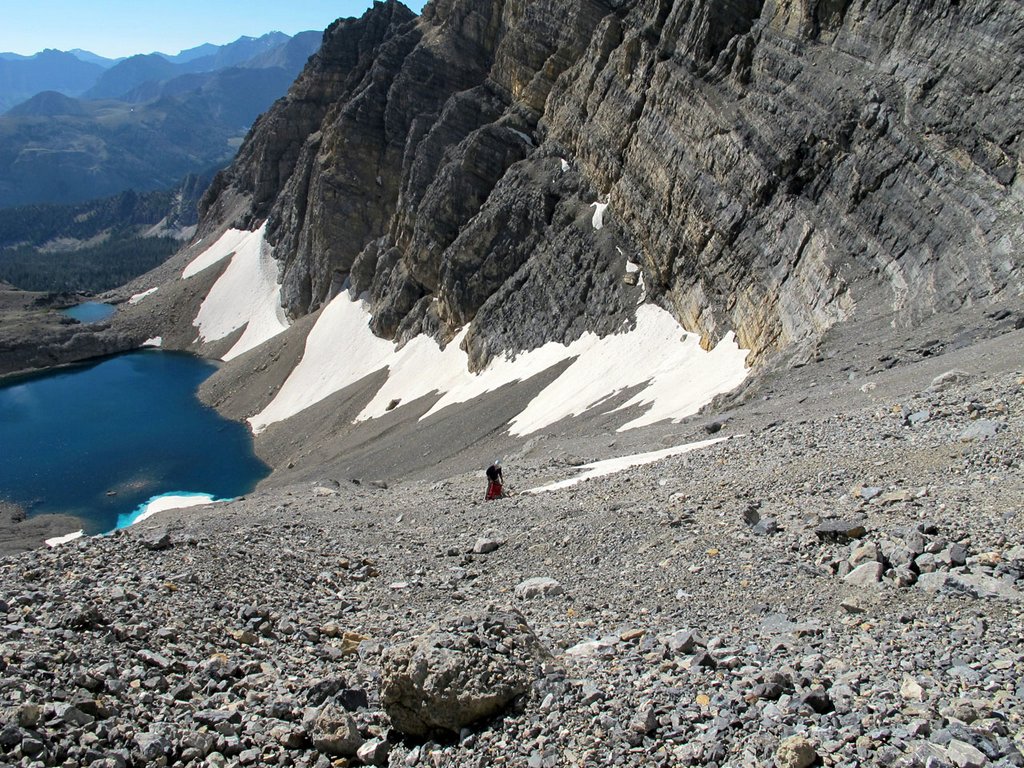
    Frank on the approach to the East Face of Mt Borah.

    Frank on the approach to the East Face of Mount Borah. Bob Boyles Photo

    The route starts slightly to the right of Wes Collins’ Dirty Traverse Route and follows the slab like ramps for about 6 pitches of Class 4 and low-to-moderate Class 5 climbing until you reach the ledge system that allows for an exit to the Northeast Ridge.

    From there we climbed two pitches of very steep snow and joined the ridge. On the Northeast Ridge, we encountered a short section of water ice (WI2) and several more pitches of moderate Class 5 climbing until just below the summit, where it turns to easy, but very loose, Class 3 and Class 4 climbing.

    Frank on the short snow pitch that leads to the Dirty Traverse ledge.

    Frank on the short snow pitch that leads to the Dirty Traverse ledge. Bob Boyles Photo

    This route is probably best done when there is some remaining snow to cover loose scree and talus (June/July) and, during some years, it may not be climbable at all due to the large cornice that can form and block the narrow exit to the Northeast Ridge. Parties willing to solo or simu-climb can reduce the overall number of pitches required on this route.

    East Face-Northeast Ridge Variation. Bob Boyles Photo

    East Face-Northeast Ridge Variation. Bob Boyles Photo

    Return to the main Mount Borah page. 

  • 1987 Death on Borah

    1987 Death on Borah

    In 1987, an experienced climber descending Mount Borah fell on the snowpack and lost control of his self-arrest. He landed just above a water chute/water-melt tunnel as the avalanche he triggered pushed him into the chute and buried him.

    Water Chutes/Water-Melt Tunnels

    When temperatures warm, water melts below the snow surface and flows in river-like patterns downhill. As the water flows, a tunnel of air forms and melts the snow from underneath. On steep slopes, and in areas with deep gullies, larger chutes/tunnels may form. Much like a crevasse, these chutes/tunnels may not be evident on the snow surface, though sometimes the snow appears thinner or is of a different color. You may also hear water flowing underneath as you near a chute/tunnel area. Like a crevasse, if the tunnel is large enough, a climber can fall through the weakened snow surface and be buried and/or swept by the water under the snow down the tunnel. A fall into the tunnel on a steep slope can also precipitate backfill of snow from above into the tunnel as the melting, weakened snow surface moves to stabilize itself.

    Water-melt tunnels can be large permanent features below established glaciers and year-round snowfields, or short-lived, more shallow features on seasonal snowfields. Accidents and fatalities from falling into water-melt chutes/tunnels are rare, though these melt features are common. However, risk a chute/tunnel posses to a climber is related to a multitude of factors including: the steepness of the slope, the thickness of the snowpack, the terrain below the snow, the amount of melting occurring, whether a tunnel already exists or is forming, and if a chute/tunnel is large enough and close enough to the surface to collapse and fall into.

    An important lesson from this unfortunate accident is that water-melt chutes/tunnels are features that may exist under the snowpack. Take this possibility into account when choosing a descent path and when searching for a missing team member.

    Here are links to a few photos of chutes/tunnels from places outside of Idaho that gives you an idea of what the feature looks like to help you assess this risk on your climbs.

    The accident report was published by the American Alpine Club (AAC) in Accidents in North American Mountaineering, 1988. Read the full article below, or click on the title to read it on the AAC website.


    FALL ON SNOW, LOSS OF CONTROL—VOLUNTARY GLISSADE, AVALANCHE, INADEQUATE EQUIPMENT, WEATHER

    Idaho, Mount Borah

    On June 13, 1987, David Probst (38), who was a member of the Idaho Mountain Search and Rescue Unit for several years, was descending Mount Borah (3,950 meters) with three friends when he fell 150 meters to his death.

    Accident

    They had started late in the morning, around 0900. Knowing there was very little snow, they carried only one ice ax with them. They reached the summit at 1800. Then they started down and, when they reached the saddle between the summit and false summit, they changed to the Rock Creek descent. The first two, Linda Claiborne (30) and Ben Childlaw (35) with the ice ax, started ahead of Probst and Jennifer Smith (31). Probst used a rock as a dagger for control on the snow while Smith waited in the rocks above. Probst lost control while trying to self-arrest. He disappeared around a bend in the snowfield.

    At this time Claiborne and Childlaw were down at the fourth snowfield. They saw a large mass of snow coming down the chute, but no sign of anyone. They climbed back up to Smith. At this point they searched for Probst and, finding his hat at the second snowfield, they started probing for him. They also probed the first snowfield but stopped when it got too dark to work. They spent ten hours climbing down and hiking out for help.

    The local sheriff’s rescue group from Mackay responded but were initially not able to get to the victim’s location because they had no experience or equipment. The 3-person team arrived wearing tennis shoes and jeans, carrying one rope and a carton of Pepsi-Cola. A deputy accompanied them. Idaho Mountain Rescue personnel were on hand at the staging area. The sheriff indicated that he would have his team go up the mountain and assess the situation first to see what resources were needed. As night neared, the sheriff got a MAST helicopter to drop sleeping bags and food for his team. The helicopter flew to 4700 meters and dropped the supplies. The supplies were well scattered after their 1250 meter descent.

    On June 15, an electrical storm hit, and the sheriff ordered everyone off the mountain, suspending the search until later in the week. The sheriff’s team and Idaho Mountain Rescue returned on June 19. The next day, June 20, rescue teams fine-probed the first snowfield. Course probes and tunnels were dug on the second field. An avalanche dog was used but alerted many times on the snowfields. When teams started searching snowfield three, the body was spotted under the snow above a water chute which Probst had slid into with the loose snow. [Sources: various newspaper reports; Larry Novak and Bob Meridith of Idaho Mountain Search and Rescue; and Merle King]

    Analysis

    The late start, an apparently festive group with an experienced leader, and a clear day that deteriorated late in the afternoon led to the circumstances that turned this situation around. Choosing a technical descent route without having adequate equipment put the group at risk. That Probst used a rock for an ice dagger for self-arrest aid indicates the level of concern he had.

    While it seems likely that Probst died quickly, the rescue response was apparently not handled properly. If the victim had survived the fall, he most likely would have died by the time he was finally reached. Technical rescue resources were available but do not appear to have been used appropriately. [Source: J. Williamson]

  • Lyman Marden

    Lyman Marden

    Lyman Marden was a member of the USGS team that surveyed the Borah Peak quadrangle. He wrote an article entitled Climbing the Slopes of Mount Borah—the Dean of Idaho Peaks about the survey. This article appeared in the Idaho Statesman in 1935. In 1950, he wrote the following report for the Boise Public Library.


    —An account given to the Boise Public Library on April 15, 1950 by Colonel Lyman Marden, a member of the party that surveyed the Borah Peak quadrangle and placed the benchmark on the top (September 13, 1934).

    Located halfway between Mackay and Challis, Idaho. Elevation 12,665 feet above sea level. Highest in the State. Approached via Highway 93 to Challis and Highway 93 toward Mackay or via Highway 20 to Arco, thence to Mackay and toward Challis.  

    The Challis approach is enriched by the Salmon River country through which Highway 93 runs. 

    The Arco-Mackay approach is one of great contrast. The Lost River Range, which culminates in Borah Peak, begins as low hills near Arco on the edge of the Snake River Plain. From there, the Range rises to a long series of peaks over 11,300 feet and several over 12,000 feet. See United States Geological Survey, Topographic Map, Borah Peak Quadrangle 1934-35.  

    A road crosses the mountains just a few miles from Borah Peak through Doublespring Pass and gives access to beautiful country at the headwaters of the Pahsimeroi River, one fork of which rises from the North and East Faces of Borah Peak. These headwaters are scenic with long, grassy slopes called Horse Heaven and at a higher elevation Goat Heaven, and a backdrop of perpendicular mountain faces carved out by glacier action. Small caves may be found at surprising places in the high ridge between the forks of the Pahsimeroi. Good but limited camp spots are available. Obtain Forest Service advice at Challis or Mackay and local ranchers’ advice on springs, streams, wooded areas, etc. 

    Rivers and creeks in the near vicinity of Borah Peak are of the Lost River type and are apt to lose themselves in the gravel of the valleys for many miles only to reappear. Big Lost River and Little Lost River lose themselves in the Snake River Plain.

    The Pahsimeroi River reappears just before emptying into the Salmon River. Fishermen say it is a peculiar shock to run out of water while fishing downstream. There are many interesting phenomena in the general area. Almost certainly some of the peaks have never been climbed. There are castle rocks and pinnacles, hanging lakes, big springs, and distorted and twisted strata. Just north of Borah Peak on the edge of the Pahsimeroi Valley and east of Doublespring is an old volcanic crater containing a crater lake, part of the volcanic action represented by the Craters of the Moon National Monument many miles to the south. It is believed that a large meteor left a wide pockmark in the Pahsimeroi Valley near the upper edge of a distinctive alluvial fan close to the North Face of the Pahsimeroi Mountains. Those who desire to climb Idaho’s highest peak are advised to seek a road to the base of the mountain that leaves the Challis-Mackay Highway 93 quite close to the Dickey Ranch and Post Office. The view of Borah Peak from Dickey will reveal a long, curved ridge ascending to the top. The base of the ridge nearest Dickey is divided by a shallow draw slightly darkened by scrub timber. Ascend the shallow draw and continue along the converged, sharpened ridge to the top.

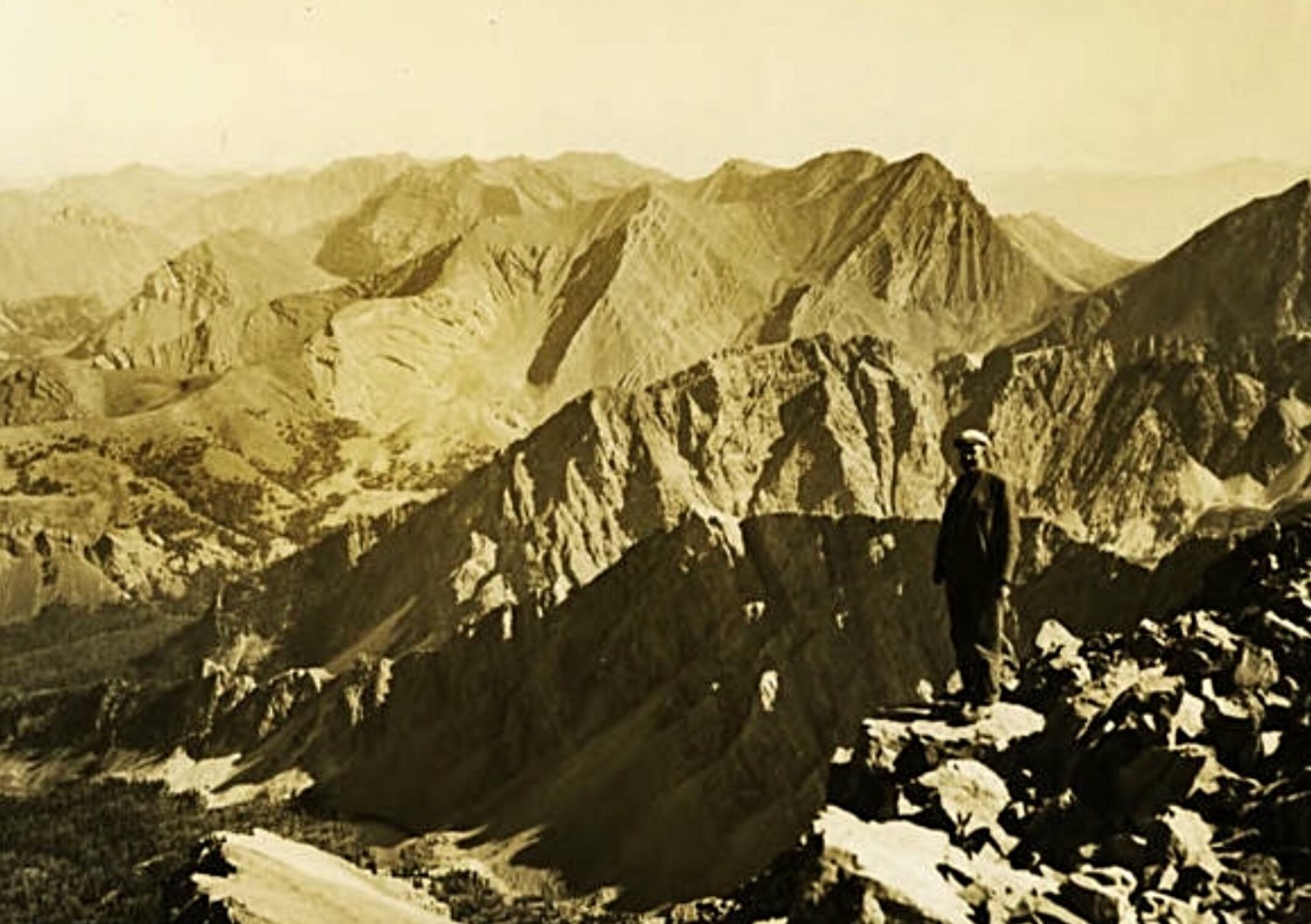
    The Lost River Range viewed from the summit of Mount Borah by Lyman Marden, USGS 1934.
    The Lost River Range as viewed from the summit of Mount Borah by Lyman Marden (USGS 1934).