Category: Boyles

  • Kong and Us by Bob Boyles

    Kong and Us by Bob Boyles

    [This article was first published in Idaho Magazine, July 2022.]

    The Peak That Got Away

    Lady and I gotten along just fine for about half of the five-day horseback trip up the South Fork of the Payette River, until she bolted off the trail into Lodgepole pines. She was at full gallop and I had to lie flat on the saddle to keep from getting knocked off by low-lying tree limbs. After I finally managed to stop her and we trotted back up to the trail, the outfitters quickly found the cause of her behavior. A yellow jacket had burrowed under her saddle blanket and she was getting stung repeatedly. Other than this incident, Lady and I became good friends, and she impressed me with her calm demeanor and backcountry skills. I had ridden a few times in my youth but had never spent a full eight hours on the back of a horse, so I was in for a surprise after dismounting at the end of a long day. It took me a full day to walk normally again and by then, I had nothing but respect for those who make a living on horseback.

    This was September 1973, and I had been invited on the trip by the Carson family. When the outfitter assigned the horses that we would ride based on our experience and the personalities of the animals, he told me, “You’ll ride Lady. She’s a little feisty but she’s a good, sure-footed horse.” We started from the stables at Grandjean, from where we would ride a loop around Virginia, Edna, and Vernon Lakes in the Tenlake Basin before reaching base camp at Ardeth Lake.

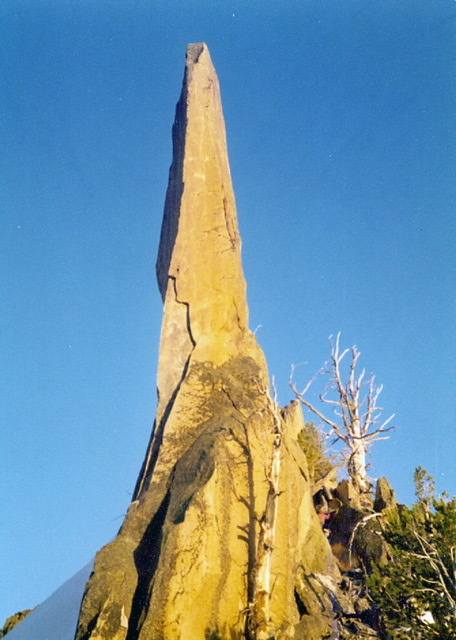
    Our trip was one year after I had started rock climbing, and because we had pack mules to haul our loads on this trip, I had decided to take my rock gear along. I also kept an eye out for opportunities for future trips and wasn’t disappointed once we passed Fern Falls on the South Fork of the Payette River. As we rode farther up the trail, I gawked at the granite formations on the east side of the valley and thought, “Wow.” One formation in particular stood out. I shot photos and vowed to come back to it with my rock-climbing buddies. The first name for it that occurred to me was King Kong, which stuck, although we later shortened it to Kong.
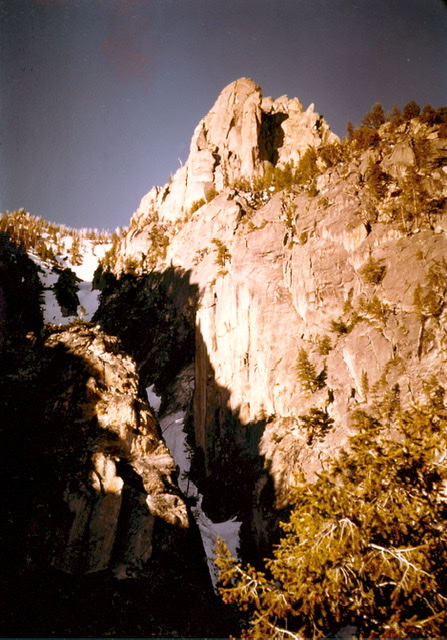
    The Kong

    After a long day in the saddle, we arrived at Ardeth Lake. Our outfitters had previously set up wall tents, so it was kind of like arriving at a motel in the wilderness. The pack mules had ensured there was just about nothing that didn’t get packed, including a couple of coolers full of drinks and comfort food like steaks and burgers. I wasn’t used to this kind of backcountry camping but quickly adapted after being offered an ice-cold beer. The early fall weather had been perfect for the ride up to camp but the next morning we woke to the surprise that it had snowed a couple of inches overnight.
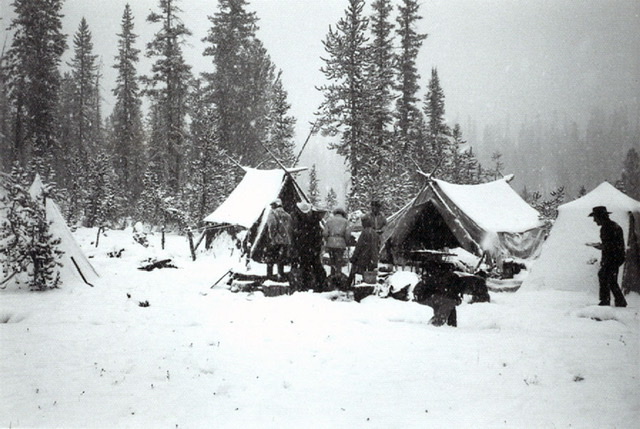
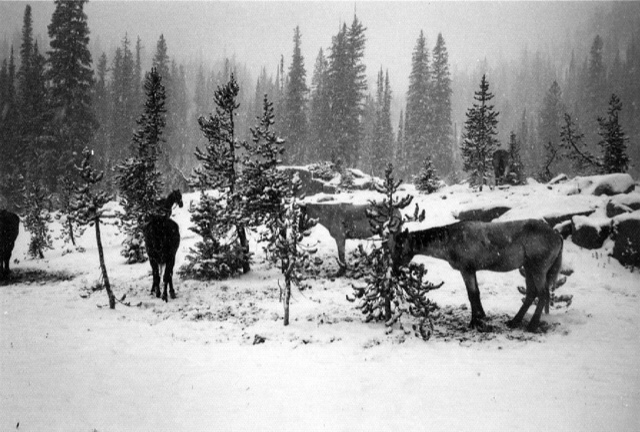
    Lady (foreground) with the other packhorses.

    Typically for fall, the weather improved by evening and the next day promised to be much better. The morning was clear and cold but by afternoon it had warmed into the lows seventies , and the dusting of snow had all but melted. The Carson kids, Bruce, Jackie, and Guy, headed up Tenlake Trail with me, and after about a half-mile we spotted a worthy climbing objective: the eastern face of Point 8590.
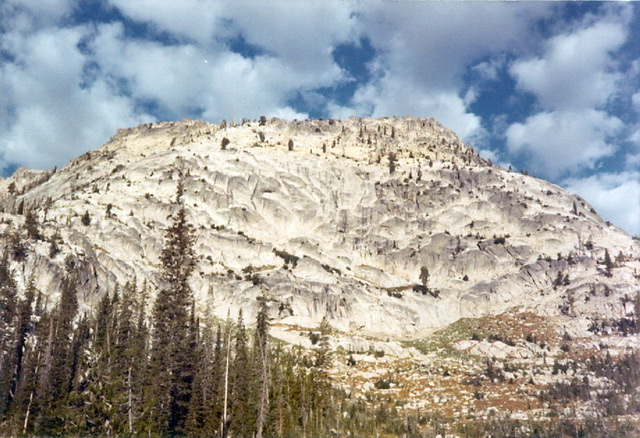
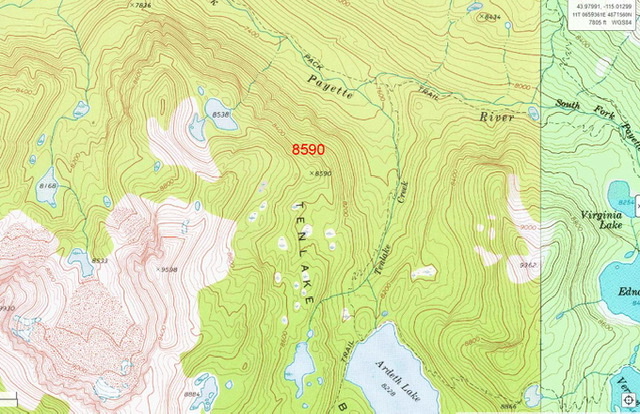
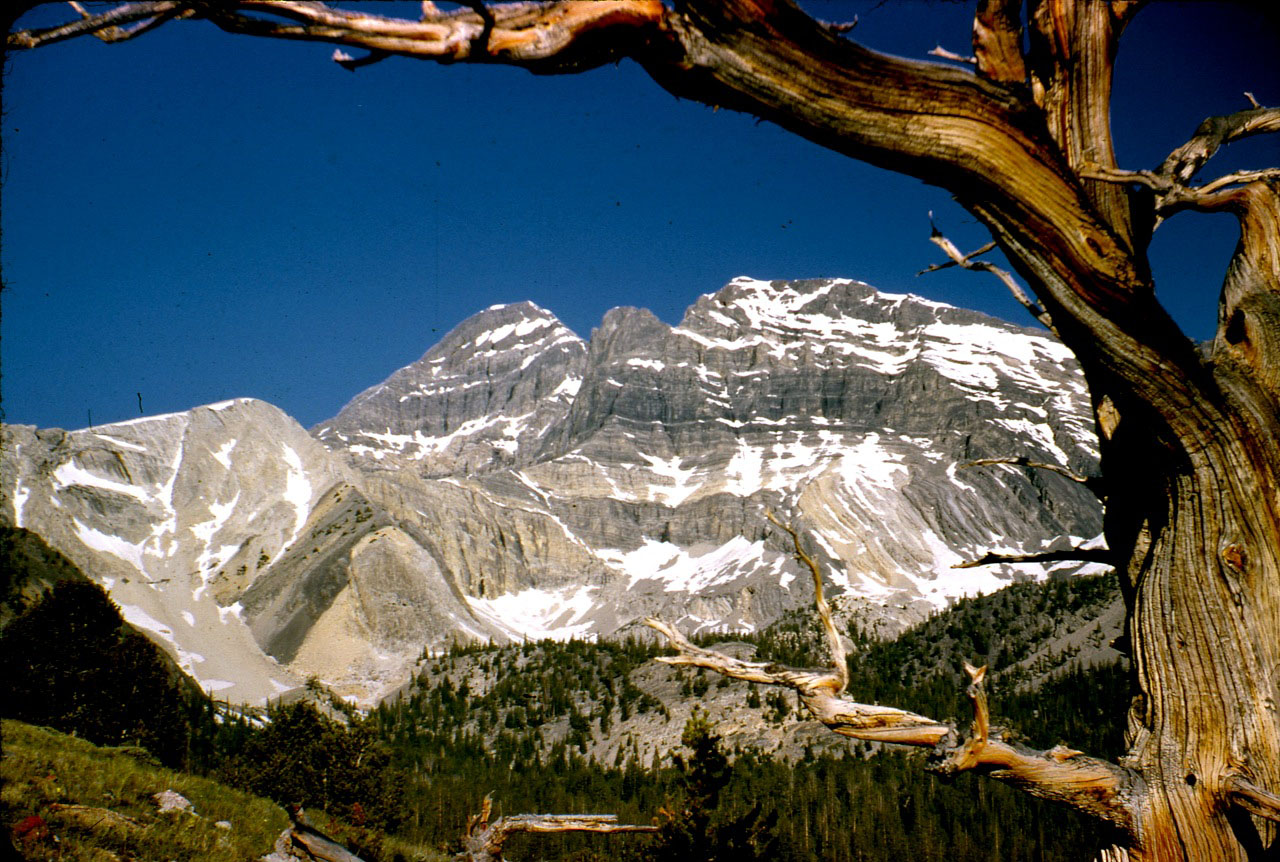
    Point 8590.
    Point 8590.

    It was getting late in the afternoon so we went back to camp, our plans for the next day now set. After a big breakfast along with real cowboy coffee, in which the grounds are dumped right into the water and boiled over an open campfire, the four of us headed back up Tenlake Trail, this time loaded with rock-climbing gear and a rope. We found a series of ledges that started out as second class but turned to fourth class higher up the face. At that point, Jackie decided she had had enough rock-climbing and went back down. Bruce, Guy, and I continued up until we finally reached a point where a rope and belay were in order. I led the first pitch, a delightful 5.4 (of a maximum 5.15 class rating) on near-perfect granite. After I brought Bruce and Guy up, we stayed roped and finished with another pitch of fun climbing. Below the top it turned to easier ground where we could scramble to the high point on the ridge and soak in views of the central Sawtooth Range.

    As soon as I got home from our pack trip, I started talking up with my climbing friends what I had seen on the Payette River. It didn’t take long to generate interest in Kong, and we made the trip in early October. This time we didn’t have horses, which meant our backs and legs took the load on the grueling hike above Fern Falls. After a hard day on the trail, we found a nice camping spot below our objective and spent the night. The next day we started looking for a way to get up the rock to the bottom of a massive slab that marked the beginning of final peak. There was an obvious gulley along the left of the climb but it was very steep, loose, and it looked like a death trap loaded with boulders that could tumble in a heartbeat. We found a fourth-class zigzagging rock route that led to a nice ledge (for camping or bivouacking) close to the base of the slab, but it also was out of the question, because we’d be carrying full climbing packs. It was getting late and we knew we’d have to do more exploring to figure out this challenge. We descended and decided to come back early the next summer, when the gulley would most likely be filled with snow.

    Not wanting to leave without some kind of summit, we decided to explore the top of the ridge and try to find the finish of our future climb. We were carrying only day packs, so we climbed up the gulley and along the ridge, where we spotted some interesting formations. There was a beautiful tower at the top of the gulley and we gave it a try. Mike made it all the way up to the last thirty feet, where the rock went blank. Lacking bolts or any way to protect ourselves, we called this one a near miss. Following the ridge that separates the Payette River and the Goat Creek drainages, we spotted a summit that looked reasonable and got to the top of it.
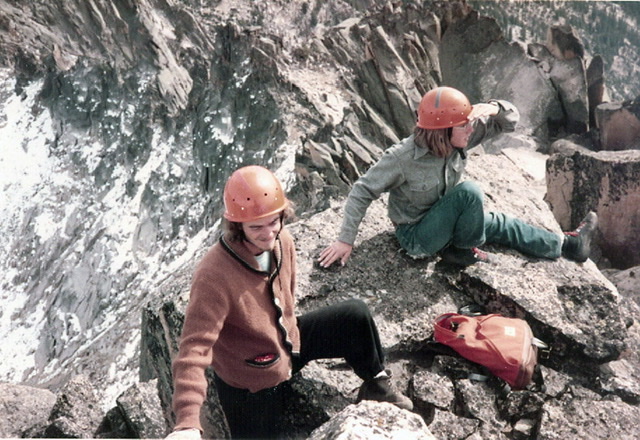
    Carl and the author on a ledge below the summit of The Kong.
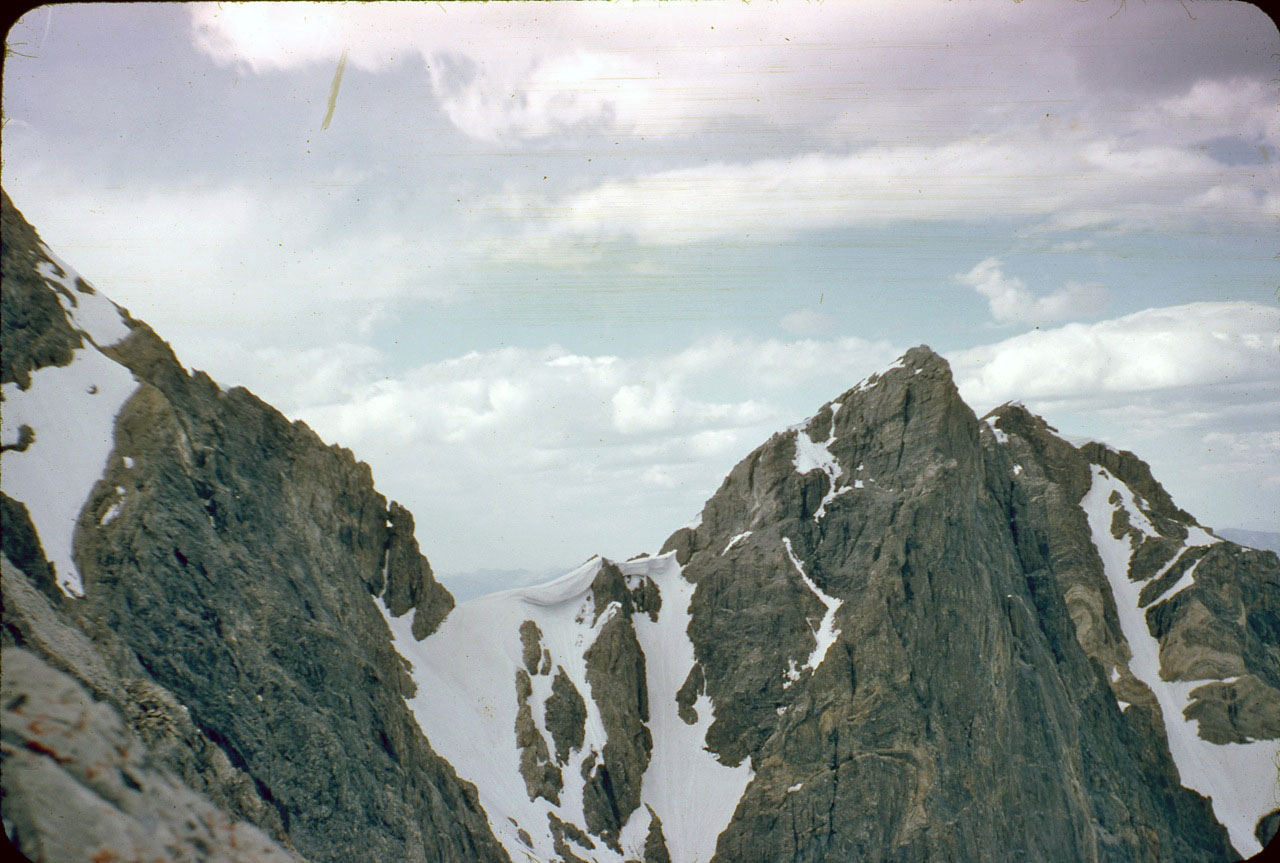
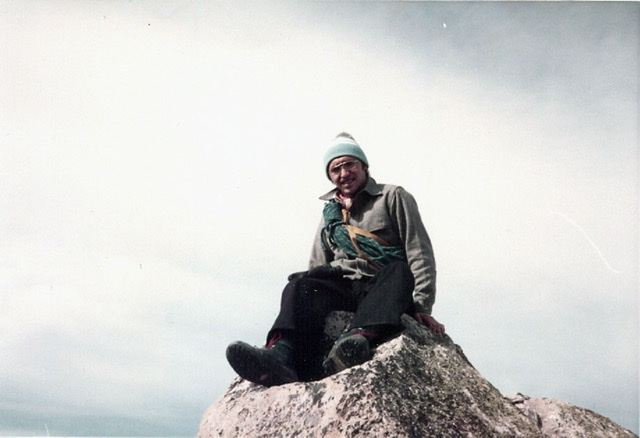
    Guy Carson on the summit of the unnamed point above the Kong.
    Mike climbed up to the last 30 feet on this pinnacle next to The Kong. The last 30 feet was without holds.

    When the time came in June 1974, we decided to do things a little differently. Instead of hiking up the South Fork of the Payette River and arriving in the heat of the afternoon, we would spent a night at the Grandjean campground and depart at 1:00 a.m., which should put us at our base camp early in the morning. Everything went as expected and we arrived in time for breakfast and a good rest. We lounged around for most of the day, enjoying the scenery and exploring the Elk Lake area.
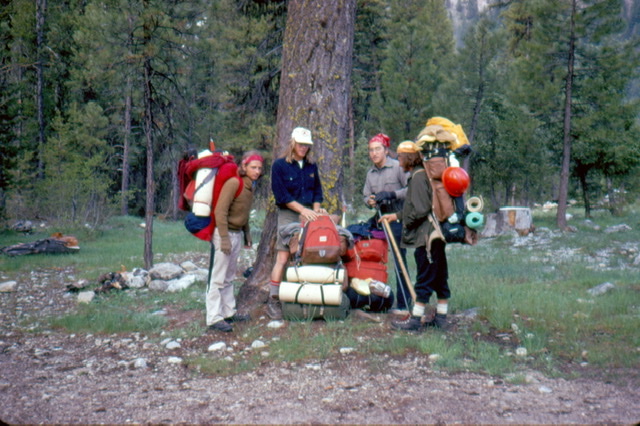
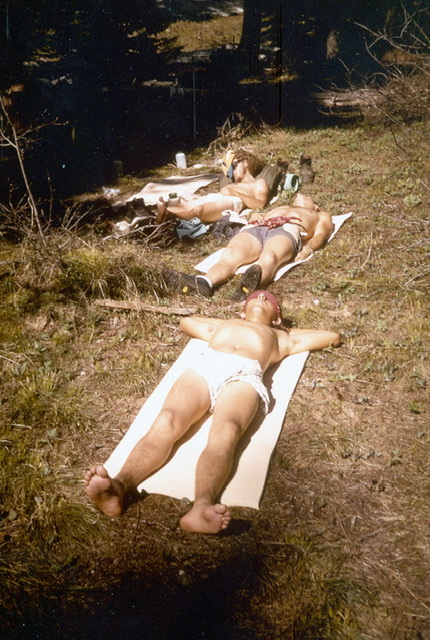
    (From left to right) Mike, Bob, Guy and Carl ready to roll at the Grandjean trailhead.
    Mike, Guy and Carl rest a few hours after the group’s all-night assault on The Kong.

    The weather was perfect and mosquitoes were non-existent, so we camped without bothering to put up a tent. Early the next morning, I awoke to the sound of something shuffling around our camp. I raised my head to the sight of a medium-sized black bear sniffing the foot of our sleeping bags. I sat up in and yelled to the guys, who woke all at once. My thought was that once the bear saw us, he’d bolt into the woods. Instead he slowly walked past us and stood on his hind legs to show us how big he was. A few minutes later, he took off into the brush and we didn’t see him again for the rest of the morning. We weren’t too worried about him, because we had plans to head up to our bivalve  ledge for the day so we loaded up our climbing packs and headed up the gulley. We had brought ice axes but no crampons, figuring the snow would soften up a bit by the time we got up the gulley. We were wrong.

    The gully was reasonably accessible, but we could see that a short climb up an incline of fifty-five-to-sixty degrees on hard snow to the biv site would require step-cutting and a lot of “pucker factor.” After reaching the bivy ledge we scrambled up to the start of the climb where Guy and Carl watched while Mike and I racked up and tried to find a continuous crack system up the face. We finally spotted a good-looking line and I led the first pitch. I led up maybe ninety feet to the bottom of an overhanging, left-leaning fist crack that flared into an arm-and-knee crack. I didn’t think I could free-climb it so I slapped in a couple of hexes (hexagonal nuts that can be placed without a hammer) and pulled out my aiders (short ladder slings). Once I rounded the lip, I went free, but it was still very awkward and hard. I made it over the edge and decided to set a belay (a pulley-like device to control the rope)so I could talk to Mike when he came up. He ascended to the start of the overhang and then decided to try free-climbing the rest of the way up. After a fair amount of swearing, grunting and sweating, he made it over the lip. We really didn’t know grading very well but we both thought that it was maybe a 5.10. It later proved to be the crux pitch of the climb. We went up another pitch to a ledge system along the crack, and the climbing was still fairly stiff. We had burned up quite a bit of time getting to the base and working out the first two pitches so we knew we had to make a decision. It was getting late in the afternoon and we still had to descend the gully to get back to our base camp so we rappelled off and decided to come back the next summer to try it again.

    After descending the gulley we hiked back to where our packs were stashed and discovered that our bear friend had made another visit. All our packs were untouched except for Guy’s. It was missing two of the outside pockets that had had food in them and his foam pad had a large bite taken out of it. It was rolled up and when he unrolled it, it reminded me of how we used to make paper dolls. He accused the bear of being out to get him and no-one else. We picked up our packs and headed back to our base camp. As we ate the last of our food and listened to Guy grumble about the bear, Carl came up with an idea for revenge. He had part of a loaf of bread, some honey and a tin of cayenne pepper, so he and I went into the brush to fix the bear a snack.

    We found a stump and Carl stacked bread as if they were pancakes. In between each layer of bread he dumped a couple of tablespoons of cayenne pepper and then topped it off with a generous helping of honey. Chuckling, we headed back to camp. Figuring the bear wouldn’t find the bread for a while, we sat around talking about our adventure. We were wrong again. It took the bear only about thirty minutes to discover his snack, and he was very annoyed. As he came out of the brush above our camp, he was ripping leaves off the bushes.  We could see he had a mouthful of leaves and the hair on his back stood up. He snorted around and wouldn’t leave, which made us nervous, so we decided to use the African bush-beating method we’d seen on TV to chase him off. We all picked up our ice axes and at the word “go,” we charged toward him. We got about halfway to where he was sitting when he reared up on his hind legs and charged us. We turned and ran as fast as we could back to our camp. Luckily, his charge was a bluff, but he would not let us out of his sight. We agreed that maybe it wasn’t a good idea to stay there for the night. Under the watchful glare of the bear, we packed and hiked back to Grandjean.
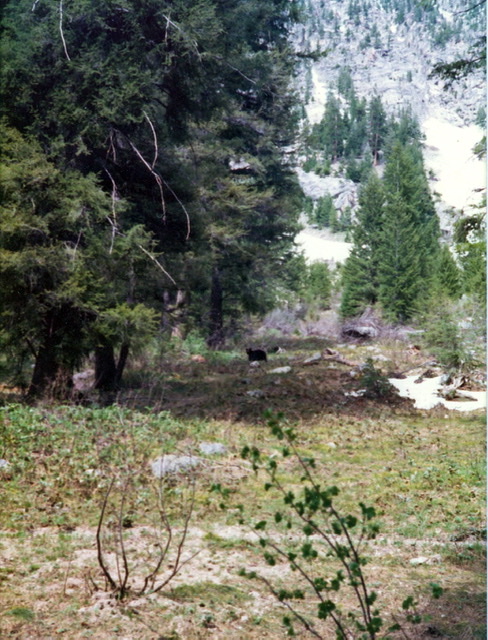
    Only hungry visitor casing our campsite.

    On our third trip at the beginning of July, 1975 we altered our plans once again. Instead of camping at the base and climbing the gully, we decided to haul all of our gear up to the bivy ledge both saving us time and avoiding any more encounters with our buddy, the bear. We couldn’t convince Guy to go back again so we recruited Mike’s cousin Sam to join us on our adventure. Carl was still interested so as a foursome we headed back up to Grandjean for the long grind up the Payette River. After a long day on the trail and a hard climb up the gully, we made it to our bivy spot below our climb.
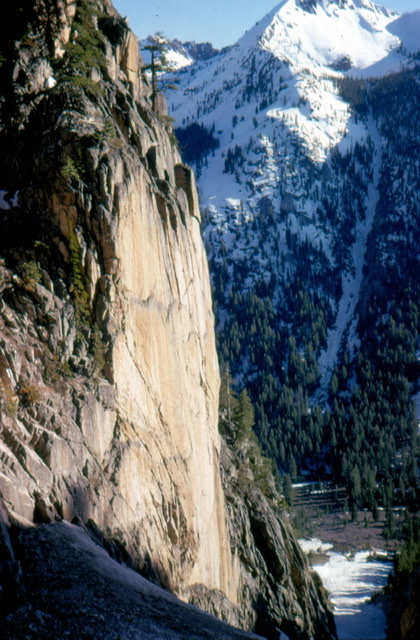
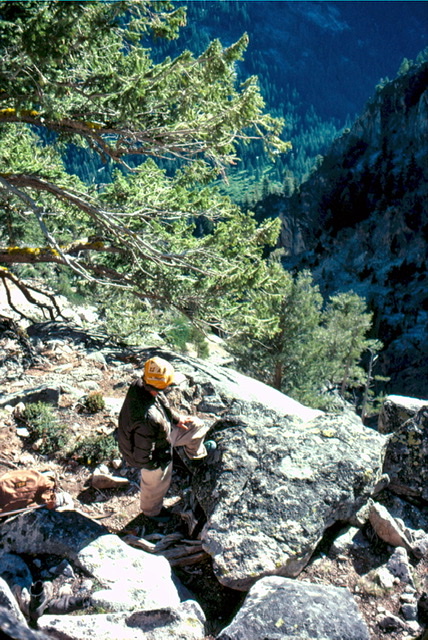
    The author and his friends bivouacked next to the tree at the top of this photo during the lightning storm.
    Carl on the bivy ledge.

    Early the next morning, Mike took the first lead up to the crux overhang. I had set a directional belay about twenty feet from the start in order to be able to watch him climb. Just as he was grunting his way over the bulge, he suddenly flew out of the crack and I heard him yell “falling.” As I was pulling in slack, his top piece of protection popped out and then my directional anchor gave way, leaving maybe thirty feet of slack in the rope. I watched him free-fall around forty feet until he came to a stop about thirty feet off the deck. As I lowered him, he cursed about having almost made it. I thought he’d pass me the lead after recovering but that’s not how Mike works. He quickly gathered himself and went right back up, more determined than ever. On this second try, he cracked the code of the crux and continued up to a nice belay ledge.
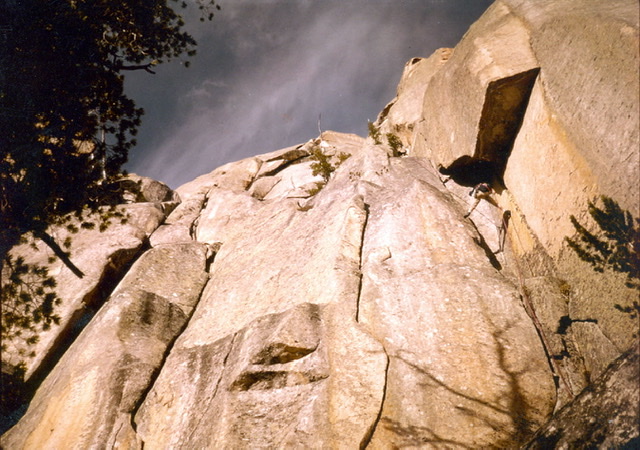
    Bob can be spotted on the right rappelling from the top of the first pitch.

    The next pitch led up to a dihedral (two planes of intersecting rock face). The climbing was on near-perfect granite that varied from hand-width to arm-width cracks. I led pitch three, which ended on a nice flat ledge midway up the dihedral. Mike took the fourth pitch, to the top of the dihedral, where we stopped to inspect the final short pitch to the top. There was no defined summit and from our ledge, we saw only two options for what we called the “H” pitch. To our left was a thirty-foot horizontal knife-blade crack that would require aid and led to places unknown. To our right was a large overhanging flared crack that would require very large pieces of gear to protect us. We didn’t have the right equipment for either approach, so we were stuck concerning how to finish the last fifty feet of rock. Bolts would have worked but we were devoted to the clean-climbing ethics of the time and neither of us owned that kind of hardware. We talked about cutting tree limbs for chocks and slinging them with webbing but it was too late in the day for that, so we called our high point good and began to rappel back down to our start.
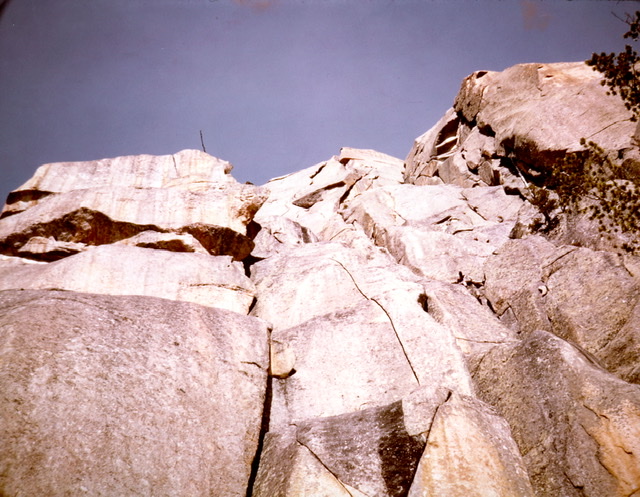
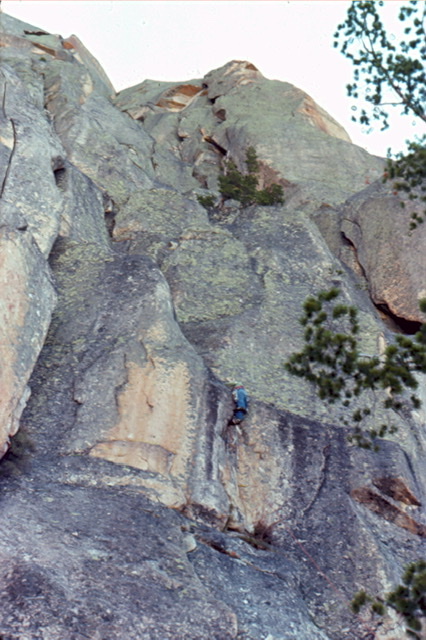
    The author cleaning P2.
    Mike is the tiny figure contorted on the crux pitch.

    The first rappel went a without hitch and we had only to leave a single sling behind on our way down. On the third rappel, things were looking good until I pulled the rope down. Just after the free end started to fall, it stopped. We pulled as hard as we could and realized it was jammed hard and would not budge. It was late in the day and clouds were building rapidly in the west. Ascending a stuck rope was completely out of the question and neither one of us wanted to lead that pitch again. We had two ropes with us, so along with the shortened end of the stuck rope, we still had enough rope to get down.  I free-climbed up as high as I could without aids and cut the rope, after which we descended to our bivy ledge for another night but soon discovered our adventure wasn’t over yet.
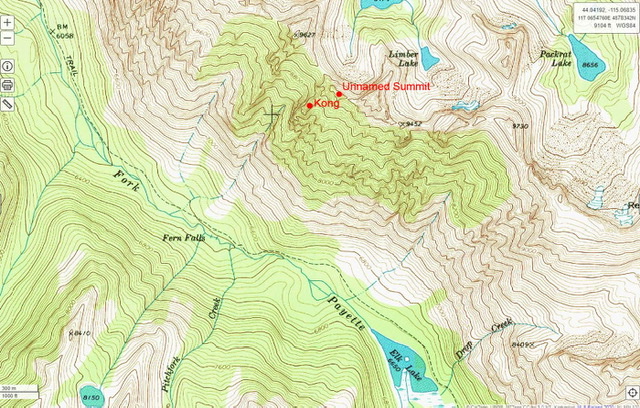
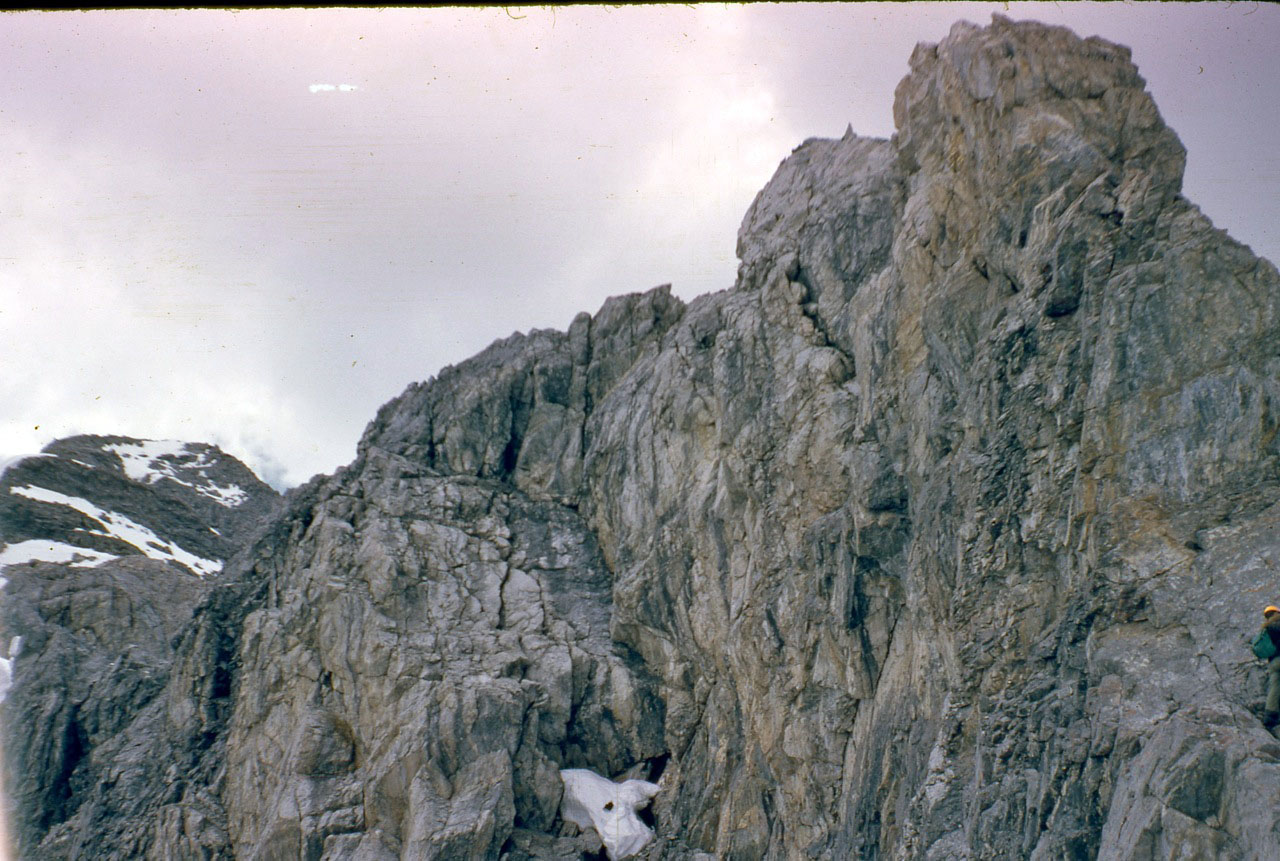
    The Kong.

    By the time the four of us down-climbed to our bivy ledge the sun was starting to set. We ate and settled into our respective spots. Soon it got dark and the wind began to blow in earnest. We saw the first of many flashes as a thunderstorm rolled in from the west. Rain poured down and the wind whipped up to about 50 m.p.h. We huddled in our spots and, in case we took a hit, we said goodbye to each other over the howling wind. Lightning struck below and above us. Rain hit the rocks in sheets and for maybe ten minutes it went up the mountain instead of down it. It then changed direction and poured downward for at least another half-hour. Lightning flashes that illuminated the entire mountainside left us temporarily blinded. There was no pause between the lightning and thunder, only loud explosions and an acrid smell in the air. Finally, the storm passed, and we were all okay. I later realized we had gone through a vertical wind shear, where the wind blows up one side of a thundercloud and down the other. We had experienced both sides of the storm.

    As chance would have it, it was the evening of July 4. In the morning, we not only were a little shaken from the excitement of the night before but realized we needed to rethink our hardware. We down-climbed and went back to Boise, where we read that a hiker had been killed by the same storm on the eastern side of the range.

    We always intended to go back and finish that last little bit of climbing to the top of Kong and retrieve the piece of stuck rope we had left hanging, but we were distracted by other Sawtooth climbs, such as the Finger of Fate and Elephant’s Perch. Around that time, we also started making regular trips to the Tetons and North Cascades. For us, Kong turned out to be the summit that got away.
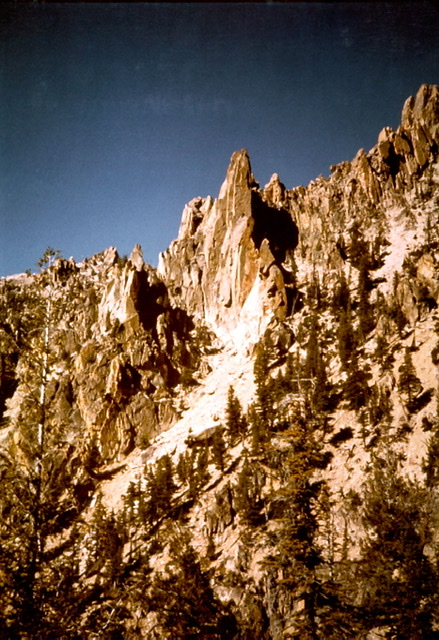
    An an unnamed tower that sits across the gully from the Kong.


  • Guffey Tower (as told by Tom McLeod) by Bob Boyles

    Guffey Tower (as told by Tom McLeod) by Bob Boyles

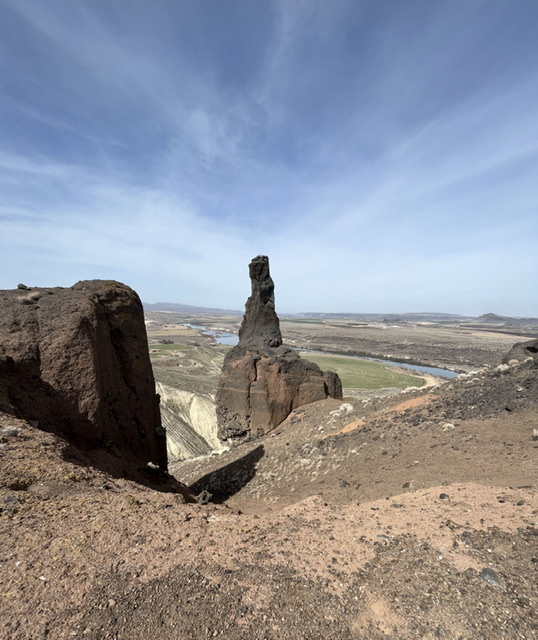
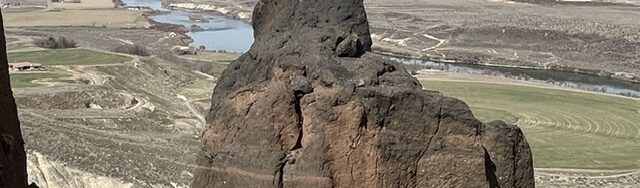
    Most anyone who has driven ID Highway 78 from Walter’s Ferry to Murphy will notice the large rhyolite tower that stands out on the west side of the Snake River below the nearby Guffey Butte. There are several free standing towers, or spires on the volcanic ridge but this one stands out as the tallest. For rock climbers, this spire seems to say, “Try me.”

    Guffey Tower Bob Boyles Photo

    In the early 70s a team of Boise climbers including Tom McLeod, Dan McHale, and Charlie Christ decided to give this a go. Celebration Park was years away from being established and the Guffey Bridge had yet to be converted into a foot bridge so they approached the tower from the highway 78 side of the river. The north side of the spire overhangs for most of its height and lacking the gear needed to do a long bolted aid climb, they decided to try the south side. They managed to free climb the lower part of the spire to the large ledge but the upper part required aid. Dan led the final pitch using a hand drill and quarter inch bolts. Lacking hangers and only having one nut for the bolts, Dan would drill a hole, sling a small nylon runner over the bolt and then put the nut on to secure the runner from slipping off. After drilling a new hole and placing a bolt, Dan removed the single nut from the lower bolt and placed it on the upper one while standing in etriers. He repeated this until he reached the top and then Tom and Charlie followed until they were all on the summit. Once on the summit they realized that there were no suitable places in which to secure anchors for their rappel so Dan placed another single bolt in the brittle rock and they rappelled off. Tom described the rappel as the “scariest he had ever done.”

  • Sawtooth Mountaineering by Frank Florence

    Sawtooth Mountaineering by Frank Florence

    Editor’s Note: Sawtooth Mountaineering was Boise’s first climbing shop. It was founded by Lou and Frank Florence. The shop was an important link between many of Idaho’s premier climbers and the development of Idaho’s technical climbing scene. Bob Boyles (quoted on Page 23 of the book) noted the shop’s importance as a hub for local climbers, stating “The thirty or so most dedicated climbers in the Boise Valley often hung out at Sawtooth Mountaineering to share stories . . ..” This group of climbers, centered on the shop, are credited with some of the most challenging first ascents in Idaho. In this article, Frank recounts his and the shop’s history.


    I grew up on Long Island (New York), hardly a mountainous setting. My early camping and hiking trips were in the Appalachian and Adirondack Mountains and I was introduced to mountaineering in 1970 as a student in NOLS. I stayed on with NOLS, eventually working as a course instructor in Wyoming and Washington State.

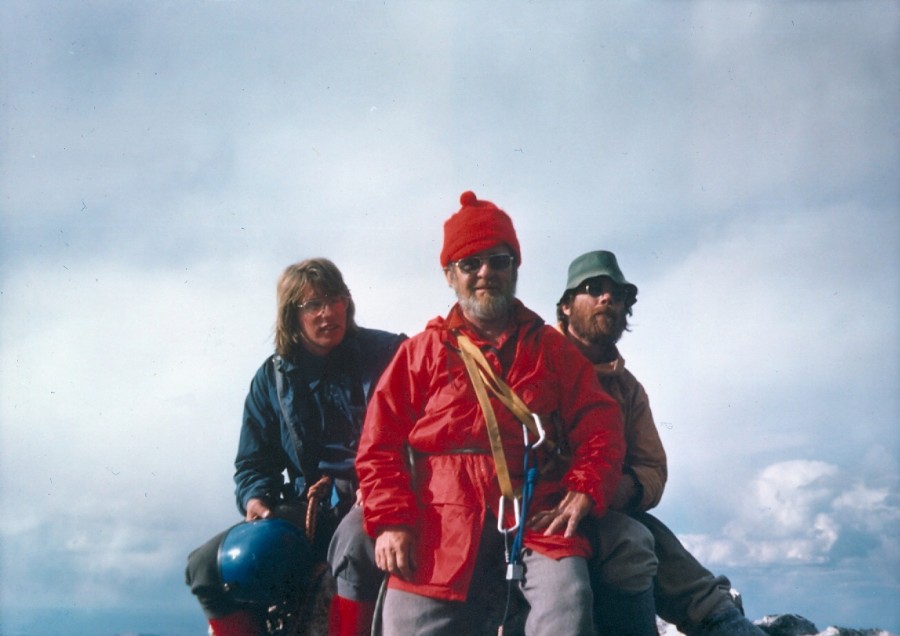
    Bob Boyles, Lou and Frank Florence on the summit of the Grand Teton (photo by Mike Weber).
    Bob Boyles and Lou and Frank Florence on the summit of Grand Teton. Mike Weber Photo

    In 1972, I joined my father, Lou Florence, in bringing a small outdoor recreation equipment store to Boise. Our business (Sawtooth Mountaineering) promoted climbing, hiking, and cross-country skiing across Southern Idaho, from Slick Rock to the Lost River Range.  We offered introductory climbing classes and fostered enthusiasm for climbing by hosting a speaker series with some of the leading climbers and alpinists of the day, including Royal Robbins, Henry Barber, Doug Scott, Bill March, and Sawtooth pioneer Louis Stur.


    British Mountaineer Doug Scott lectured twice at our shop. The first time was in 1975. Scott came to Boise to give a talk about his recent ascent of the Southwest Face of Everest. He wanted to get in some climbing while in town and a posse quickly assembled. We went out to the Black Cliffs for what turned out to be a toasty day. Scott asked what had been done and what hadn’t and then led through a couple of each.

    Scott came through Boise again in 1977 to give a slide show at the shop after his epic descent off The Ogre. And again I and a few others got a chance to climb with a famous alpinist. That time we returned to the Cliffs and he led what is now called the Doug Scott Route. Nice route, too. I remember Scott stopped at one point after trying a move and then pondered it a bit before he led through the sequence. When he came down, I asked him what he thought about it, especially that one section. “It’s all there,” he replied. “Just a lack of balls.”

    1975 Doug Scott at the Black Cliffs. Left to right Bob Boyles, Bob Henry, Doug Scott, and myself. Lou Florence photo.
    Doug Scott at the Black Cliffs (1975). Left to right Bob Boyles, Bob Henry, Doug Scott and myself. Lou Florence Photo

    Through Sawtooth Mountaineering, we conducted popular introductory clinics in cross-country skiing and helped develop an early network of ski trails around Idaho City. Long-time staff members Ray York and Gary Smith, as well as Lou and I, trained and volunteered with Idaho Mountain Search and Rescue. Days off were spent exploring the many crags local to Boise: Stack Rock, Slick Rock, Table Rock, Rocky Canyon, Morse Mountain and the Black Cliffs.

    I frequently partnered with Bob Boyles and Mike Weber on technical climbs, but in the mid 1970s, there was a free-wheeling mix of local climbers who swapped leads including Tom McLeod, John Platt, Art Troutner and Charley Crist. It was a time of discovery as there was little in the way of guide books and, championing clean climbing ethics, we clanged our way up the cliffs using hexes and stoppers. We became better climbers as we challenged one another on new routes locally and expanded our alpine skills into the Sawooths and Lost River Range. In the Winter of 1974, John Platt, Jerry Osborn, Walt Smith, and I skied across the White Cloud Mountains from Obsidan to Robinson Bar. In 1976, I summitted Denali with friends from Seattle and the following year made the first Winter ascent of Mount Borah’s North Face with Art Troutner, Mike Weber and Bob Boyles.

    Sawtooth Mountaineering closed in 1980 and I returned to college and a career in geology. That took me out of Boise but, from time to time over the years, it’s been my pleasure to renew my acquaintance with the Sawtooths and the Lost River Range and those same partners from back in the day.

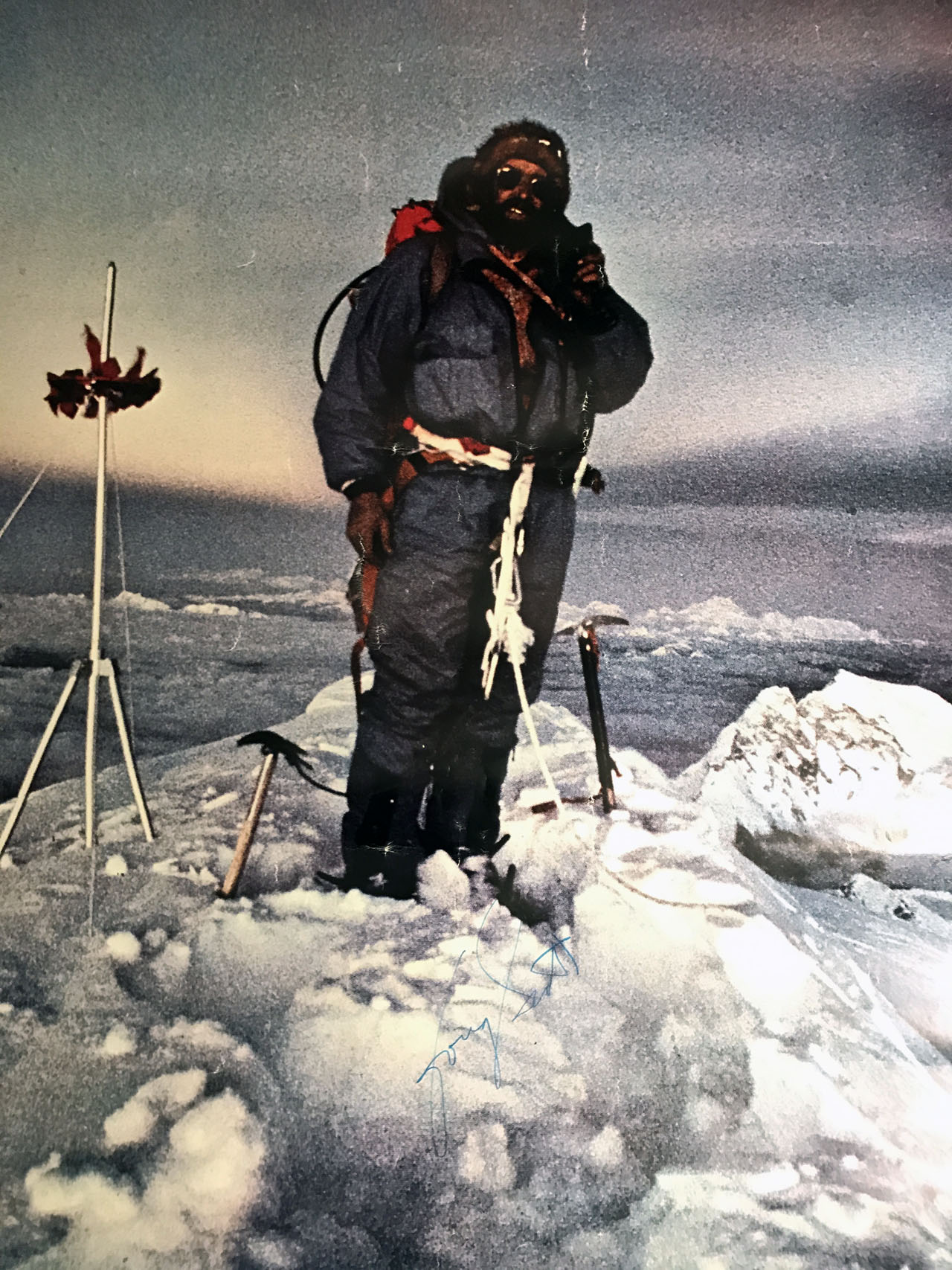
    During one of Doug Scott’s lectures at Sawtooth Mountaineering Bob Boyles secured a signed copy of the famous climber’s posters
    During one of Doug Scott’s lectures at Sawtooth Mountaineering, Bob Boyles secured a signed copy of the famous climber’s posters.
  • The End of the Last Idaho Ice Age By Bob Boyles

    The End of the Last Idaho Ice Age By Bob Boyles

    I first saw the North Face of Mount Borah in the Summer of 1972 while working under contract with the U.S. Forest Service. We were flying helicopters near Horseheaven Pass in the Upper Pahsimeroi Valley, where our daily flights offered unrivaled views of the north and east sides of the Lost River Range. But one face in particular stood out from all the others, and that was the North Face of Mount Borah. Lacking any snow, the face was a dark, steely gray color unlike anything I’d seen in Idaho before. I wasn’t a climber at the time but that was soon to change. I never forgot what I had seen that Summer.

    Two years later (1974), we made a reconnaissance hike into the cirque below the East Face of Mount Borah with the intent to find a climbing route that would lead to the summit. The lower part of the face held what looked like a large snowfield, but upon closer inspection, we found that it was more than just frozen snow. Underneath the snow was hard ice, the kind that only forms from years of accumulation, where the constant pressure slowly squeezes all of the air out of the ice, leaving it vivid blue in color. To a climber, this find was important because ice climbing generally requires specialized gear that one may not carry if expecting to only climb on snow. To the best of my knowledge, no study was ever made of this ice field before it disappeared.

    A year or two later, while attending Boise State University, I heard about Bruce Otto’s discovery of Idaho’s only known glacier on the North Side of Mount Borah. Bruce was a climber and Boise State University geology student who was familiar with Mount Borah and its perennial snowfields. In 1974, while doing research for a class project, he hiked into Borah’s North Face Cirque to study the snowfield and see how much it resembled an actual glacier. What he found in ice was much more than he expected. So the next year he returned with Monte Wilson, his professor and a specialist in the study of glaciers. They would return many times over the next ten years to study the glacier and its annual changes. Bruce’s description of the glacier talks about how it was over 200-feet thick, 1,000-feet wide and 1,200-feet long. He also describes how they determined the glacier was estimated to be 500 or even a few thousand years old. For a relatively short period of time, the glacier was known as the “Otto Glacier.”

    Beginning in 1973, my climbing partners and I embarked on an ice climbing binge, seeking ice wherever we could find it. We found a fair amount of seasonal, winter ice in the canyons of Southern Idaho, but rarely found the hard alpine ice we were craving. The Sawtooths were too low in elevation, and while the nearby Tetons were the most likely place to find alpine ice, we found the range’s ice seasonal and unreliable. While volcanos like Mounts Hood and Rainier had glacial ice, climbing into open-ended crevasses, just to practice, didn’t seem worth the effort for the risk. The Canadian Rockies did have what we were looking for, but were just too far away for poor students to consider. So based on my 1972 aerial observations, and with the knowledge of Bruce and Monte’s discovery, we turned to Mount Borah.

    In September 1976, Frank Florence and I made plans to climb Borah’s North Face, but a torrential thunderstorm turned us back before we reached the moraine below the face. Cloud cover obscured the mountain and all we saw was the lower snowfields, leading us to believe that was all we were going to find on this mountain. In late October, Mike Weber and I returned to give it another go. The weather was perfect this time and after climbing the lower cliff band, we finally got a good look at the North Face. The face was covered with a light dusting of snow from the first snowfall of the season. So until we reached the top of the moraine, we were expecting nothing more than a snow climb. At the top of the moraine, Mike and I geared up, and from the very first swing of our ice tools we knew we had finally found what we had been looking for. The ice was thick and rock hard, not brittle like so much of the Winter ice we had climbed before. We half expected the ice would turn to snow the higher we went but it did not. The ice continued all the way to just below the summit. Like Bruce and his discovery of the glacier, we found more than we ever expected.

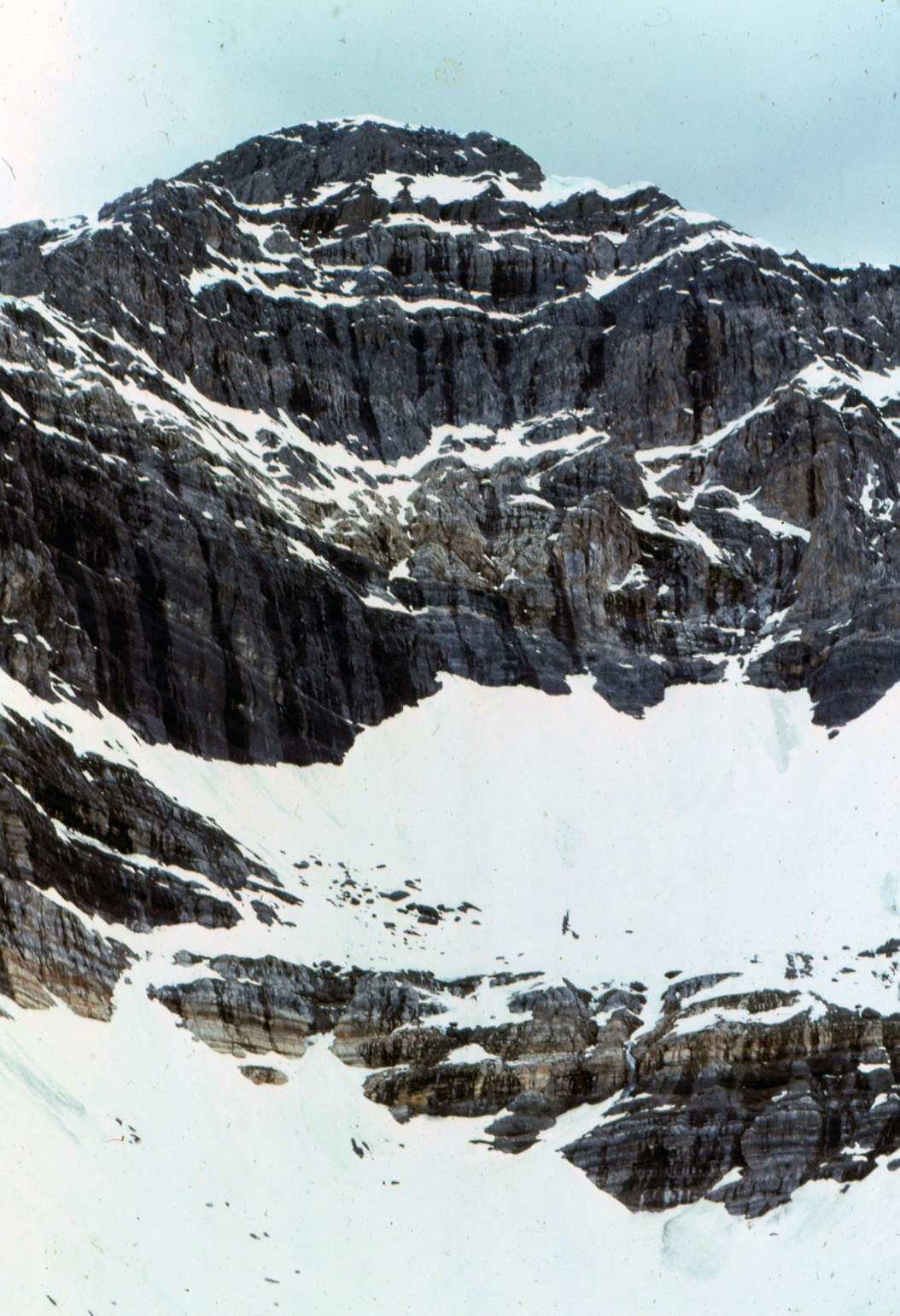
    If you look closely, you can see the old blue ice showing in places. Under the snow, the ice appeared to be over 50-feet thick. The East Face of Mount Borah – June 1974. Photo by Bob Boyles
    The East Face of Mount Borah (June 1974). If you look closely, you can see the old blue ice showing in places. Under the snow, the ice appeared to be over 50 feet thick. Bob Boyles Photo
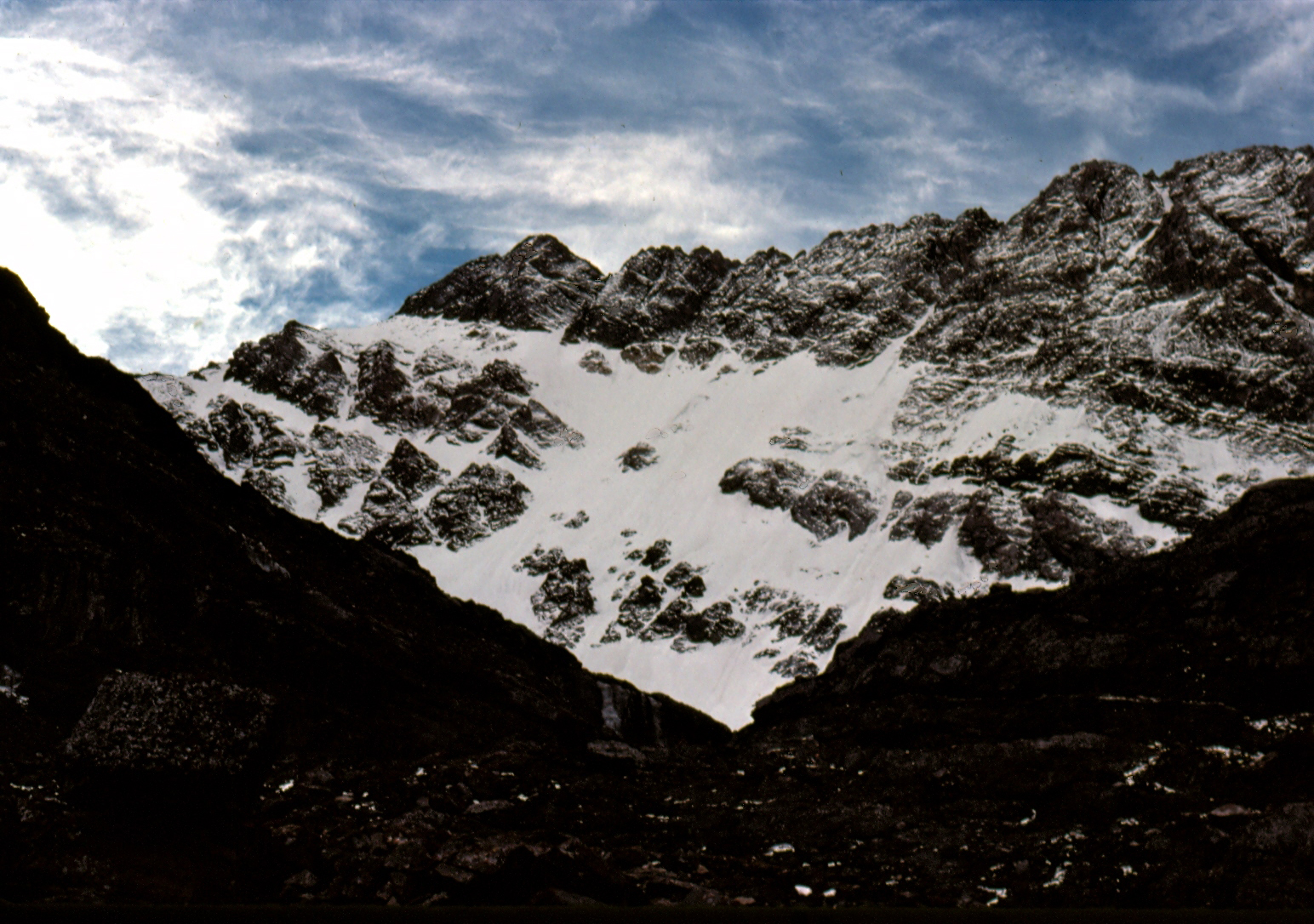
    North Face of Mt Borah - Oct, 1976. Photo by Bob Boyles
    The North Face of Mount Borah (October 1976). Bob Boyles Photo
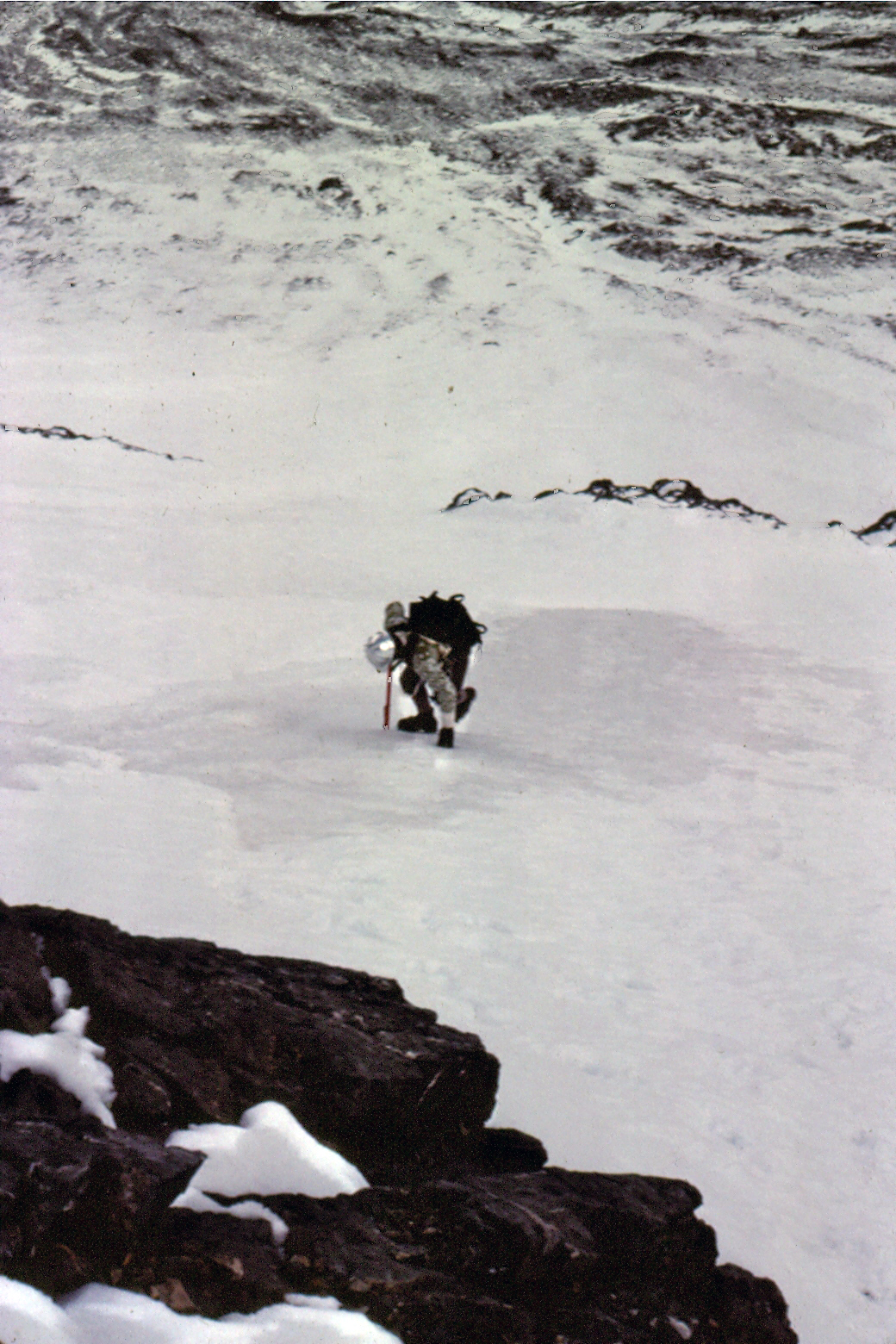
    Mike Weber showing off his French technique on the lower ice fields of Mt Borah. If you look closely, you can see the old blue ice showing in places.  Bob BoylesBob Boyles photo
    Mike Weber showing off his French technique on the lower ice fields of Mount Borah. If you look closely, you can see the old blue ice showing in places.  Bob Boyles Photo

    My partners and I continued to climb the North Face of Mount Borah throughout the 1980s and we just assumed the ice and glacier would always be there. During most of the year, the face was covered with snow but, by the Fall you could count on the underlying ice showing through. On one of our trips in the mid-1980s, we discovered that a massive avalanche had occurred, taking most of the previous Winter’s snowfall with it. Bruce’s snow measuring equipment was wiped out and was carried almost a mile down to where it now sits. Little did we know at the time that we would be part of a small group of climbers who actually got to see, stand, and climb on Idaho’s last, and perhaps only, remaining glacier.

    In September 1990, Mike Weber, Curt Olson, and I returned to the North Face expecting to find conditions similar to what we had found for the previous 14 years. We were quickly disappointed when we got close to the base of the North Face. The lower ice fields and the glacier were, for the most part, gone. There was still some remaining old blue ice left on the upper part of the North Face, but the bottom was mostly bare rock.

    The remains of Bruce and Monte’s snow measuring gauge Sept, 2010 Photo by John Platt
    The remains of Bruce and Monte’s snow-measuring gauge (September 2010). John Platt Photo
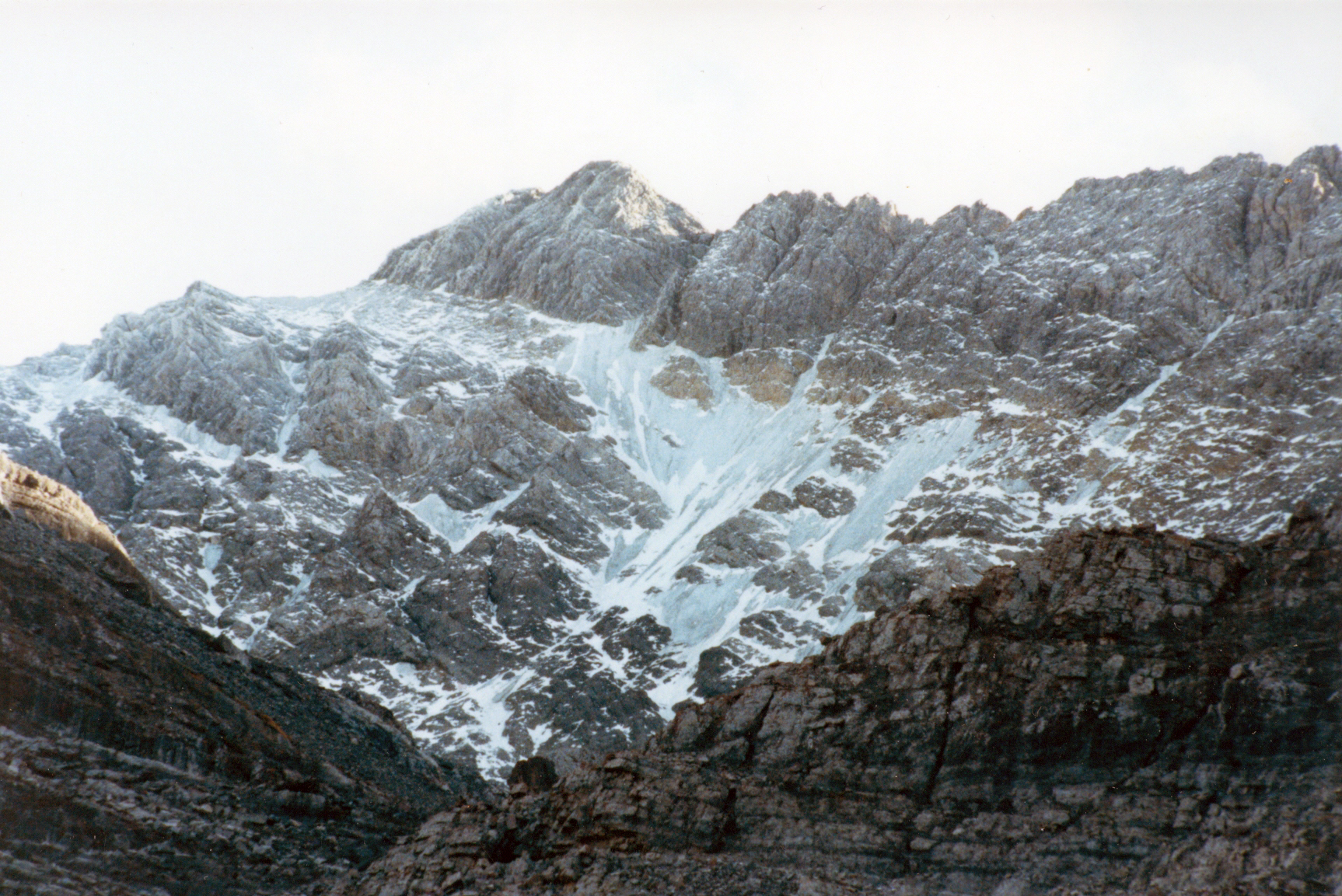
    The North Face of Mt Borah Sept, 1990 – Photo by Curt Olson We were in shock when we saw this. The glacier and lower ice fields were almost gone. This was the last photo we got of the old blue ice that was estimated to be over 500 years old or more.
    The North Face of Mount Borah (September 1990). Curt Olson Photo

    We were in shock. The glacier and lower ice fields were almost gone. This was the last photo we took of the old blue ice that was estimated to be over 500 years old. In 2009, I was contacted by geologists who were doing a study of the Glaciers of the American West, which included Idaho. As a result of that study, Idaho was found to have no remaining glaciers with the exception of perennial snow fields and a few rock glaciers where all of the ice is underground.

    In 2017, I was disappointed to read a trip report that highlighted the demise of snow and ice on the North Face. This news was especially troubling as the 2016-2017 winter resulted in a solid snowpack existing above 8,000 feet in the central mountains in June. Many high-elevation basins had more than twice the normal snowpack. I don’t know what it would take for the ice to come back short of another ice age.

  • Mount Borah: East Face, Dye-Boyer Route by Bob Boyles

    Mount Borah: East Face, Dye-Boyer Route by Bob Boyles

    Note from the Editor: This wonderful article, provided for the Climbing History Section of the website, includes information that can be used to plan an ascent of Mount Borah’s East Face Dye-Boyer Route. As such, we have also included it as part of the Online Borah Climbing Guide.


    Idaho – A Climbing Guide identified a route on the East Face of Mount Borah with a brief description of a climb that had been done in 1962 by Lyman Dye and Wayne Boyer, two pioneers of Idaho mountaineering. It read:

    “East Face (II, 5.2). Climb the face from the notch on the Northeast Ridge (between the summit and Point 12247). Climb to the notch from Rock Creek, which is just to the north. The crux of the climb is the first 90-foot pitch out of the notch. The angle decreases and the holds improve above this pitch. First ascent: L. Dye, W. Boyer in 1962

    For decades, I assumed that Dye and Boyer had gone up Rock Creek (the standard approach to the North Face) to reach Point 12247 and from there climbed the Northeast Ridge to the summit. While the Northeast Ridge does provide a great view of the upper East Face and there is a traverse that cuts across the face, it leads directly to the summit, so I never understood how they could call their route the “East Face.” After reading the above description dozen of times and closely studying a topo, I realized that they must have gone up Rock Creek on the Pahsimeroi (east) side of the range.

    Rock Creek leads to the upper East Face, one drainage north of the East Face Cirque where we had climbed in 2011 and 2012. Everything seemed clear to me now except for one detail and that was how they got to the notch between Point 12247 and the summit.

    Being more than curious at this point, I contacted Tom Lopez to see if he had any more information about this route. Unfortunately he had none, but he did tell me that Lyman was still alive and living in Idaho. Using this lead, I was able to get in contact with Lyman and he most graciously provided me with all of the pictures and information for this route page. He also told me that he last climbed Mount Borah in 2013, at the age of 80, but that would be his last trip due to his doctor’s orders.

    I was greatly honored that Lyman would share this little slice of Idaho’s early mountaineering history and am using his description and photos for the route information. Lyman perfected his discussion of the route with a bit of his early climbing history relating to his pioneering climbs in eastern Idaho and of the EE-DA-HOW Mountaineers. He writes:

    “I started climbing Borah in 1957, done it in Winter and helped with search for Guy Campbell and Vaughn Howard when they went missing after an attempt after Thanksgiving one year. Those were some of the most horrendous conditions I have ever seen on the mountain. Art Barnes and Wayne Boyer were with me on just about all of the climbs in the Little and Big Lost Rivers and the White Clouds. We had a climbing group called the EE-DA-HOW Mountaineers. Wayne, his sons and I were on Mount Borah a year ago (i.e., 2013) in August when I was 80. It had been 57 years ago we climbed it together for the first time. Doctor says no more high elevations for me, sadly enough. We have been on it in almost every condition you can imagine. Winter, Spring, Summer and Fall. Not many areas on the mountain I haven’t been on at least once. When I lived in Arco, Mount Borah or King Mountains were the conditioning climbs when each climbing season began in the Spring.”

    Lyman's sketch showing the Rock Creek approach to the East Face of Mt Borah. Photo - Lyman Dye
    Lyman’s sketch showing the Rock Creek approach to the East Face of Mount Borah. Lyman Dye Photo

    Lyman’s 2014 narrative continues:

    If you will look at the pictures I sent you together as a group, at the very first mailing to you. The first picture had the Mount Borah East Buttress and the ridge coming off to the left. There is an angular ascending snowfield up to the ridge out of the canyon. That is where we gained the ridge crest and dropped over the East Ridge then contoured over to the big lower snowfield at the base of the face.”

     Wayne Boyer Photo/Lyman Dye Collection
    Lyman in profile below the massive East Face Buttress. Wayne Boyer Photo/Lyman Dye Collection

    Lyman’s narrative concludes:

    “If you will look at the second picture in the group of pics I sent you, there is a pic of me in profile near the East Buttress. To the left of my shoulder, you will see two snow fingers protruding upward to the right like tepees. The second one of those has a small snow patch up in the couloir above and to the right. We went up the rock face above that little patch, in and out of the crack, on the left side up to the thin snow finger, that ascends upward to the right, at the head of the finger to the right. At that point, we left the snow and climbed up the cliff formation past the black rock outcropping to the upper snow field.

    There are two exit cracks that go up to the Northeast Ridge about halfway across the snowfield. I weighed taking one of those to the summit ridge but we had been out on that face for around three hours and we decided to go to the saddle and relax for a few minutes and have something to eat. I looked over the cliff formation and didn’t think it looked all that bad, and I put all my hardware in my pack and started up the cliff. I got about 40 feet up and got hung up under a little shelf. I could feel a crack with the tips of my fingers and would like to have had a piton or something to jam down in it for leverage, but everything was tucked away in my pack. I thought about down climbing and trying a different angle but didn’t like that feeling either. My legs were doing the piano dance by this time and so I figured I was probably going to peal out of there and fall or make a lunge for the crack and go for it.”

    “The rest of the way to the summit was uneventful, a breeze so to speak. We dropped off the summit to the south to the first notch, and then set up rappels to get back down off the face. If I had paid more attention to the picture of me with the buttress, I would have seen the route sooner I think. The snow in your picture of the face (2012) is not anywhere as definitive as it is in the second picture. We had bigger snowfields when we did it than when you were up there.”

    Lyman provided these additional photos taken during the first ascent of the Dye-Boyer Route on the East Face.

    Wayne Boyer climbing on the East Face. Photo - Lyman Dye
    Wayne Boyer climbing up the East Face. Lyman Dye Photo
    Wayne Boyer coming up over a ledge on the lower East Face. Photo - Lyman Dye
    Wayne Boyer coming up over a ledge on the lower East Face. Lyman Dye Photo
    Looking up the route. Wayne Boyer is barely visible on the right side of this photo. Photo - Lyman Dye
    Looking up the route. Wayne Boyer is barely visible on the right side of this photo. Lyman Dye Photo
    Looking up at the Northeast ridge and summit block (far left). Photo - Lyman Dye
    Looking up at the Northeast Ridge and summit block (far left). Lyman Dye Photo
    Looking down the col into the East Face cirque. This is where the East Face route joins the Northeast ridge. Photo - Lyman Dye
    Looking down the col into the East Face Cirque. This is where the East Face Route joins the Northeast Ridge. Lyman Dye Photo
    Lyman Dye climbing on the East Face of Mount Borah. Photo - Wayne Boyer. Lyman Dye Collection
    Lyman Dye climbing up the East Face of Mount Borah. Wayne Boyer Photo. Lyman Dye Collection
    Looking up at the Northeast ridge and summit block (far left). Photo - Lyman Dye
    Looking up at the Northeast Ridge and summit block (far left). Lyman Dye Photo
    Wayne and Lyman with the col and Northeast ridge in the background. Photo - Lyman Dye
    Wayne and Lyman with the col and Northeast Ridge in the background. Lyman Dye Photo
    Looking across the East Face (left-to-right) at the Northeast ridge, the col and what we call the "Super Buttress." Photo - Lyman Dye
    Looking across the East Face (left-to-right) at the Northeast Ridge, the col and what we call the “Super Buttress.” Lyman Dye Photo
    Lyman and Wayne on the summit of Mount Borah. Lyman Dye Collection
    Lyman and Wayne on the summit of Mount Borah. Lyman Dye Collection
    Wayne and Lyman on the 90-foot crux of the Northeast ridge. Photo - Lyman Dye
    Wayne and Lyman on the 90-foot crux of the Northeast Ridge. Lyman Dye Photo
    Wayne looking into the East Face cirque from the summit of Mount Borah. Photo - Lyman Dye
    Wayne looking into the East Face Cirque from the summit of Mount Borah. Lyman Dye Photo
    Rappelling down the East Face of Mount Borah. Photo - Lyman Dye
    Rappelling down the East Face of Mount Borah. Lyman Dye Photo
    Looking across the East Face (left-to-right) at the Northeast ridge, the col and what we call the "Super Buttress." Photo - Lyman Dye
    Looking across the East Face (left-to-right) at the Northeast Ridge, the col and what we call the “Super Buttress.” Lyman Dye Photo
    Wayne and Lyman at one of the East Face tarns. Photo - Lyman Dye
    Wayne and Lyman at one of the East Face tarns. Lyman Dye Photo
    A small tarn at the bottom of the East Face cirque. Photo - Lyman Dye
    A small tarn at the bottom of the East Face Cirque. Lyman Dye Photo

    Return to the Main Mount Borah Page.