Category: Diamond Peak

  • T.M. Bannon by Rick Baugher

    T.M. Bannon by Rick Baugher

    Thomas M. Bannon was also a self-taught mountaineer. Although his name is not widely known in mountaineering circles, during his surveying career from 1889 to 1917 he climbed nearly one thousand summits in the American West. More than two hundred of these summits were in Idaho. Bannon’s cryptic reports, supplemented by the rock Cairns, Wooden triangulation signals, chiseled cross-reference marks; and brass benchmarks that he left behind tell his fascinating story. More than one hundred of his Idaho ascents were probably first ascents. These climbs included many of Idaho’s highest and most famous peaks, including Mount Borah (which he called Beauty), Leatherman Peak, and Invisible Mountain in the Lost River Range; Diamond Peak (which he called Thumb), Bell Mountain (Bannon’s Finger), Lem Peak, and May Mountain (Bannon’s Hi Peak) in the Lemhi Range; Standhope Peak and Smiley Mountain in the Pioneers; Castle Peak in the White Clouds); and Mount McGuire in the Salmon River Mountains. Bannon’s death at 48 cut short an extremely active life.

    I spent a good part of the 1990’s investigating pioneer government surveyors in the Idaho and western US mountains. This involved recovering some 100 mountain top triangulation stations placed by Bannon & party in Idaho from 1911-1915. In his career as USGS Topographical Engineer 1894-1917 T.M. Bannon had a hand in making ~50 topographic maps.

    Having grown up myself in Maryland, a highpoint was a July 1995 pilgrimage to the Bannon burial plot at St Lawrence Martyr R.C. Church in Jessup. Bannon family monument (like T.M.’s triangulation monuments) occupies a prominent position in the church graveyard.

    Photo on right is T.M.B. gravestone. Rick Baugher Photo

    Obituary notice from Washington Evening Star, Feb 6, 1917:

    THOMAS M. BANNON DIES AFTER A BRIEF ILLNESS

     Was Engineer of Topographic Branch Geological Survey- Funeral Thursday at Jessups, Md.

    Thomas M. Bannon, engineer of the Topographic Branch of the geological survey and a prominent resident of Anne Arundel county, Md, died Sunday evening at Maryland University Hospital in Baltimore. Mr Bannon had been ill only a short time. [Author’s Note: USGS said field worker deaths at that time often attributed to typhoid fever].

    Mr. Bannon had been connected with the geological survey since 1888, the greater portion of his service having been given to topographic and geodetic surveys in different western states.

    Prior to the organization of the United States reclamation service, Mr Bannon was detailed to collect the data which that organization used in connection with the development of its projects in Idaho and Utah [Author’s Note: chiefly Bear River drainage].

    In 1908 he was detailed to the Porto Rican government and placed in charge of surveys in developing irrigation of the semi-arid portion of the island.

    During the last few years Mr Bannon’s efforts had been directed to the extension of geodetic work in western Montana and eastern Idaho and in mapping portions of the national forests in Idaho.

    In addition to his official duties with the government Mr Bannon served seven years as a member of the board of governors of the Maryland board of correction and was active in many local and charitable organizations of Anne Arundel county.

    Mr Bannon was unmarried, is survived by two sisters, Mary and Francis Key Bannon, and three brothers, James T., Phillip M., and Joseph Bannon.

    Final notes: It is believed Bannon thru his mother Evaline was related to Francis Scott Key. Bannon’s federal appointment as an 18 year old was thru Rep. Barnes Compton, also an F.S. Key relative. Survey director John Wesley Powell was chided for hiring “Congressmen’s nephews”. Bannon estate in Jessup was demolished in 1950 to make way for Baltimore Washington Expressway.

    See also: Appendicitis Hill and T.M. Bannon and 1929 Borah Declared Idaho’s Highest Peak
  • Southern Lemhi Traverse by Daniel Todd

    Southern Lemhi Traverse by Daniel Todd

    The Lemhi Range’s southern crest between Diamond Peak and Saddle Mountain perfectly frames the northern horizon when viewed from almost anyplace between Idaho Falls and American Falls. This stretch of high mountains with twelve 10ers was constantly on my mind. Sometime in the last few years, I got it in my head that I should traverse the whole thing in a single push.

    After some research, it appeared that this traverse had never been attempted or done. I asked Haylee Stocking if she would like to join me on the adventure and she agreed. Josh Smith heard about our plans and volunteered to provide support. His friend, Jenny I believe it is Woolstenhulme, signed on to the support team. With everything in place, we were ready to start Saturday, June 26, 2021.

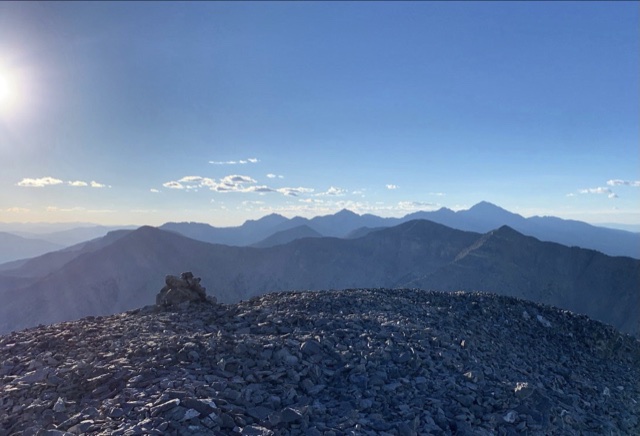
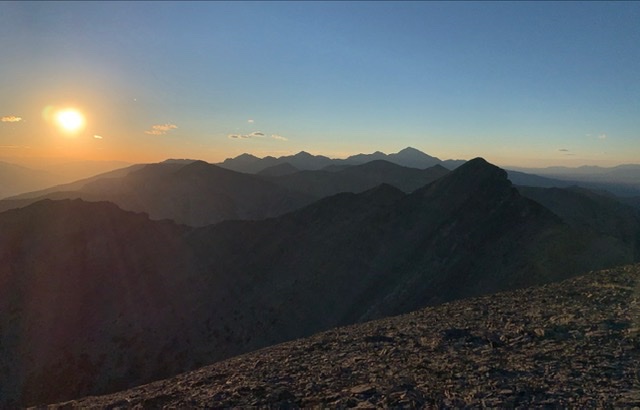
    We started the trip with an ascent of Diamond Peak. We reached its summit in 2 hours and 15 minutes, just in time to enjoy the sunrise.

    Sunrise on Diamond Peak

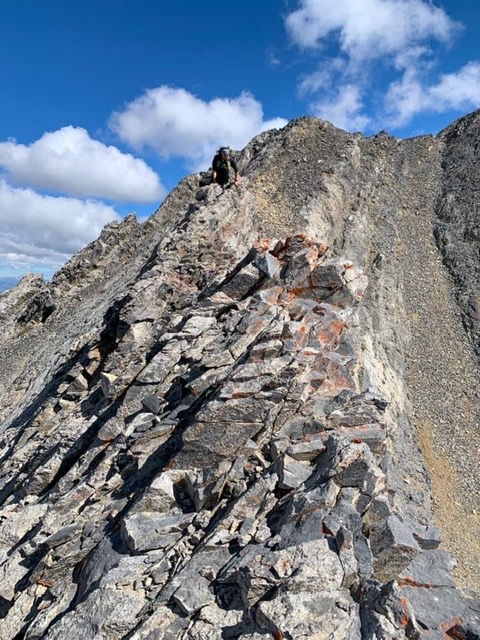
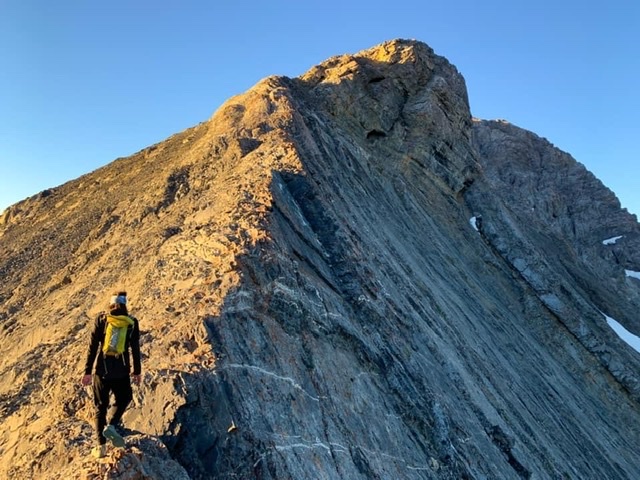
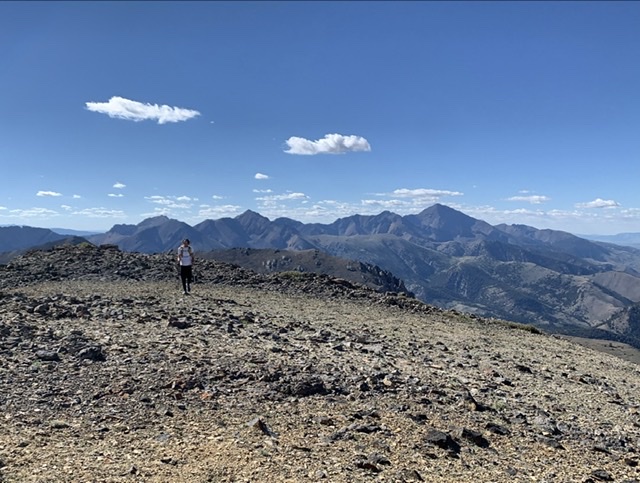
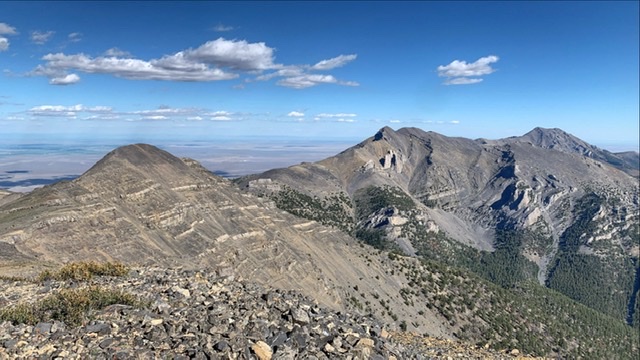
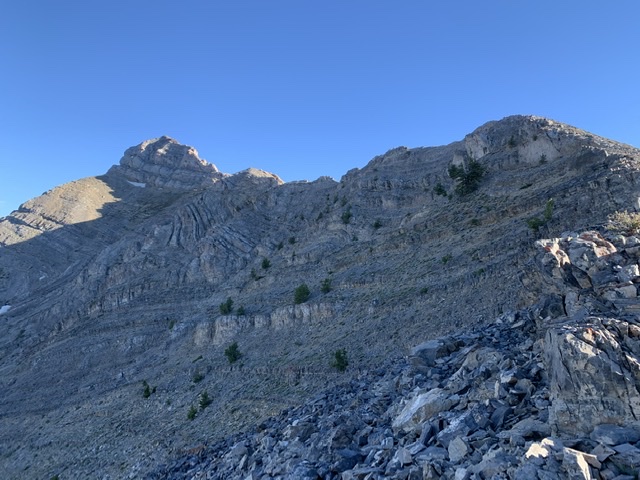
    The route south from Diamond Peak has no shortage of rugged/exposed terrain to make things entertaining. The traverse from Diamond to The Riddler was my favorite section of the traverse.

    Early morning light on The Riddler as we traverse over from Diamond Peak.
    Haylee scrambling between Diamond Peak and The Riddler
    Descending The Riddler was challenging at times.
    The late Larry Prescott called this section “close shave” as it is a steep slab on one side and an overhanging drop on the other. The picture doesn’t depict the exposure well, but there was plenty.

    The route across Big Boy, Shoshone John, and Black and White included numerous sections of knife-edge ridge walking on grippy limestone with a few places having lots of exposure.

    Typical terrain on the traverse north of Pass Creek Summit.

    Little Diamond Peak.

    Little Diamond Peak
    Looking back at The Riddler and Diamond Peak from Big Boy.

    Swanson Peak.

    Typical terrain on the traverse south of Little Diamond Peak.

    Josh met us on Pass Creek Summit and supplied us with water and energy supplies.

    South of Pass Creek Summit, the mountains just kept coming and we summited everyone of them before reaching Saddle Mountain. After refueling, our next peak was Marshalls Mount.

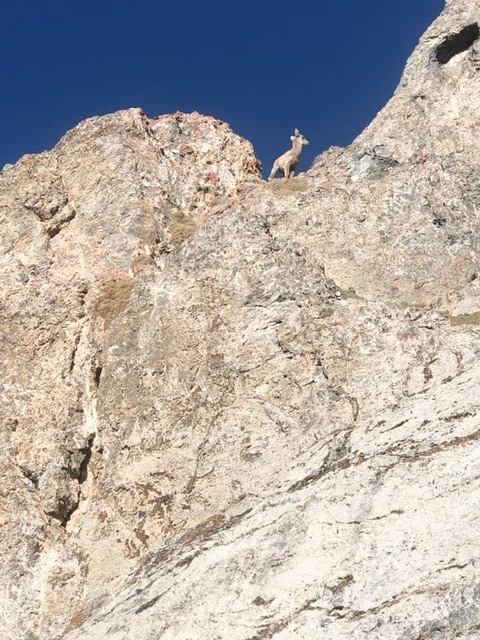
    We saw a ton of bighorn sheep throughout the day.

    As the day wore on, we crossed White Bird Peak, Dome Peak, Shril Benchmark, Tyler Peak and Mount Hoopes.

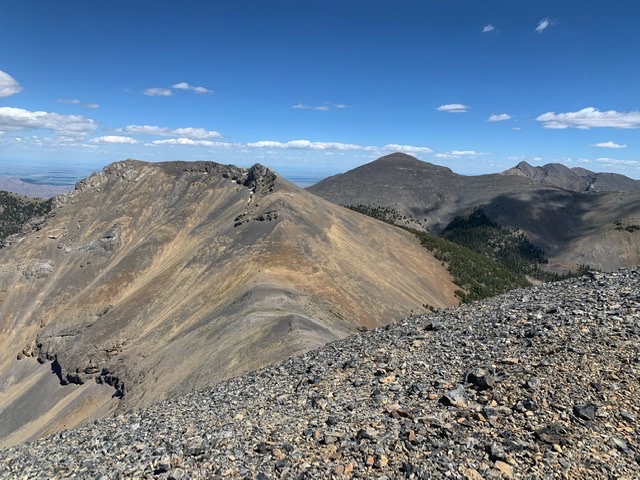
    Looking south from the summit of White Bird towards Dome, Shril and Tyler. Haylee Stocking Photo
    Daniel approaching summit of Shril Benchmark. Haylee Stocking Photo
    Gearing up for Striped, Tyler, Hoopes, and Saddle. Haylee Stocking Photo
    Looking at the ridge and summit of Tyler Peak. Haylee Stocking Photo
    The day is waning as the shadows spread out from Tyler Peak’s summit. Haylee Stocking Photo
    Looking north from the summit of Tyler Peak at everything we’ve climbed. Haylee Stocking Photo
    Late in the day from the summit of Hoopes. Haylee Stocking Photo
    Goats on Tyler Peak. Haylee Stocking Photo
    Somewhere on the crest :). Haylee Stocking Photo

    The final test was Saddle Mountain. We knew this would be a test after so many hours above tree line. Our enthusiasm was bolstered because we knew that Josh had climbed Saddle Mountain earlier in the day and left us a cache of food and water. Climbing the north ridge of saddle in the dark was not physically hard with just a few Class 3 sections. However, it was psychologically taxing since we couldn’t see what was above us. Neither of us had climbed Saddle before and I finished my water while climbing Tyler Peak.

    Saddle Mountain awaits us. Haylee Stocking Photo

    Our effort progressed smoothly with the exception of our descent off of Saddle Mountain in the dark. Finishing off the day with a long tiring slog through the deadfall in Middle Canyon was a chore. Haylee told me “I felt great all day and was loving life until we hit Middle Canyon. That was hell in the dark.”

    After 26 hours of climbing, we reached our vehicle and feasted on cold beverages and snacks.

    Final Thoughts

    Our traverse was 90 percent off-trail and covered a lot of undocumented terrain. As a result, a substantial portion of the traverse involved route finding and scrambling improvised as we traveled. In total, there were three technical cruxes: the traverse between Diamond Peak and The Riddler, the exposure on the south side of Shoshone John, and  a short knife-edge between Black and White and Little Diamond. None of this was difficult climbing–just exposed scrambling on sometimes questionable rock. Josh’s logistical support was essential since there was no water or snow along the route.

    Haylee told me she really enjoyed her summit time and the “hardest part besides the actual climbing was not being able to stay as long as I wanted on the summits.” In retrospect, the hardest part for Haylee was probably that she constantly had to wait for me. She is a powerhouse in the mountains. Haylee offers the following advice for those thinking about following our route: “Arrange a couple more aid drops so your pack is lighter which will allow you to move a little faster on the easy ‘runnable’ sections.”

    Trip Statistics

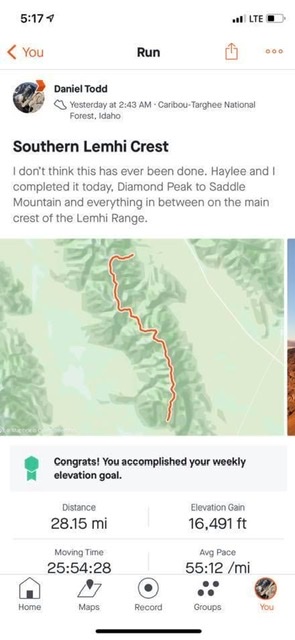
    Distance: 28.15 miles

    Elevation Gain: 16,491 feet

    Time: 25 hours, 54 minutes, 28 seconds.

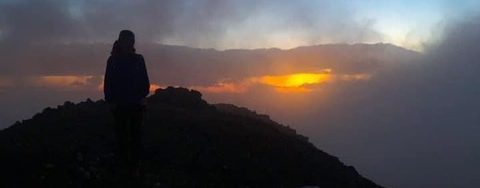
    Haylee and Daniel during their 26-hour extravaganza looking no worse for the wear.