Category: First Ascents

  • Kong and Us by Bob Boyles

    Kong and Us by Bob Boyles

    [This article was first published in Idaho Magazine, July 2022.]

    The Peak That Got Away

    Lady and I gotten along just fine for about half of the five-day horseback trip up the South Fork of the Payette River, until she bolted off the trail into Lodgepole pines. She was at full gallop and I had to lie flat on the saddle to keep from getting knocked off by low-lying tree limbs. After I finally managed to stop her and we trotted back up to the trail, the outfitters quickly found the cause of her behavior. A yellow jacket had burrowed under her saddle blanket and she was getting stung repeatedly. Other than this incident, Lady and I became good friends, and she impressed me with her calm demeanor and backcountry skills. I had ridden a few times in my youth but had never spent a full eight hours on the back of a horse, so I was in for a surprise after dismounting at the end of a long day. It took me a full day to walk normally again and by then, I had nothing but respect for those who make a living on horseback.

    This was September 1973, and I had been invited on the trip by the Carson family. When the outfitter assigned the horses that we would ride based on our experience and the personalities of the animals, he told me, “You’ll ride Lady. She’s a little feisty but she’s a good, sure-footed horse.” We started from the stables at Grandjean, from where we would ride a loop around Virginia, Edna, and Vernon Lakes in the Tenlake Basin before reaching base camp at Ardeth Lake.

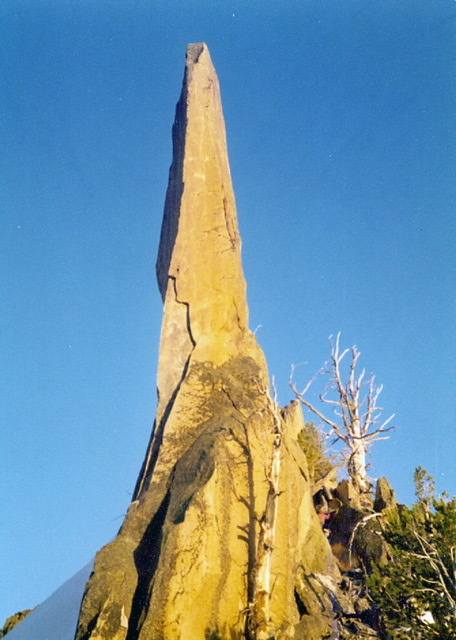
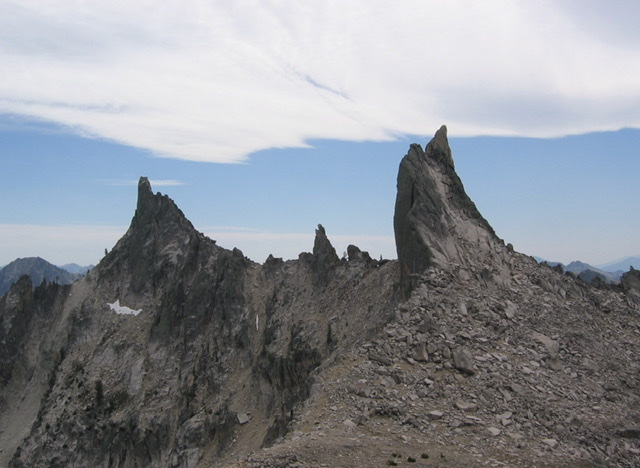
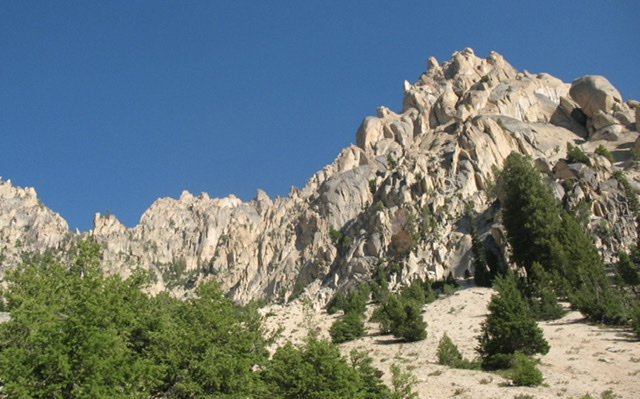
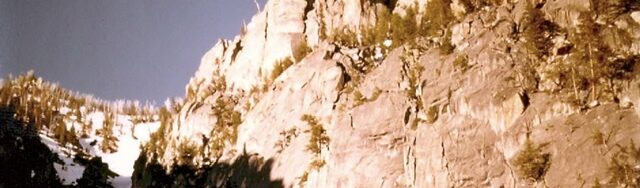
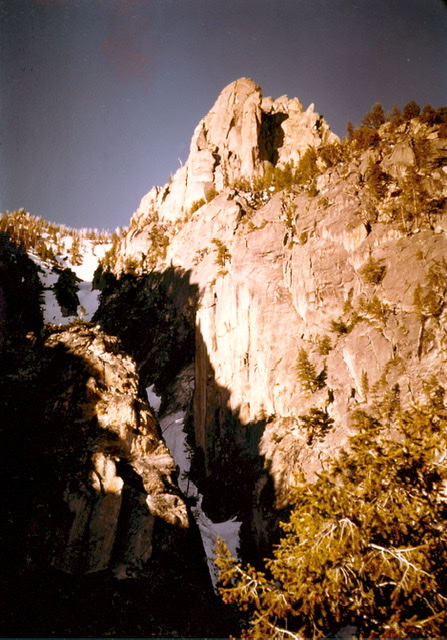
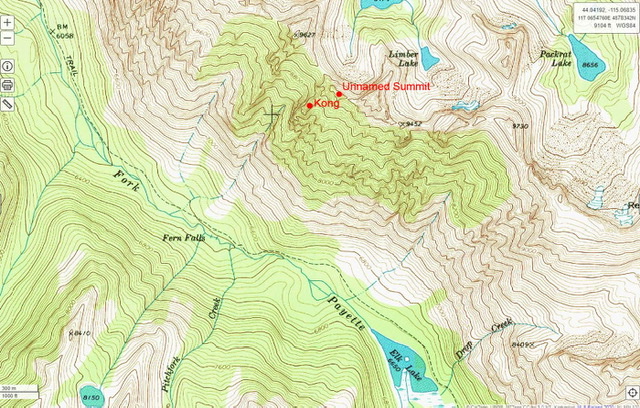
    Our trip was one year after I had started rock climbing, and because we had pack mules to haul our loads on this trip, I had decided to take my rock gear along. I also kept an eye out for opportunities for future trips and wasn’t disappointed once we passed Fern Falls on the South Fork of the Payette River. As we rode farther up the trail, I gawked at the granite formations on the east side of the valley and thought, “Wow.” One formation in particular stood out. I shot photos and vowed to come back to it with my rock-climbing buddies. The first name for it that occurred to me was King Kong, which stuck, although we later shortened it to Kong.
    The Kong

    After a long day in the saddle, we arrived at Ardeth Lake. Our outfitters had previously set up wall tents, so it was kind of like arriving at a motel in the wilderness. The pack mules had ensured there was just about nothing that didn’t get packed, including a couple of coolers full of drinks and comfort food like steaks and burgers. I wasn’t used to this kind of backcountry camping but quickly adapted after being offered an ice-cold beer. The early fall weather had been perfect for the ride up to camp but the next morning we woke to the surprise that it had snowed a couple of inches overnight.
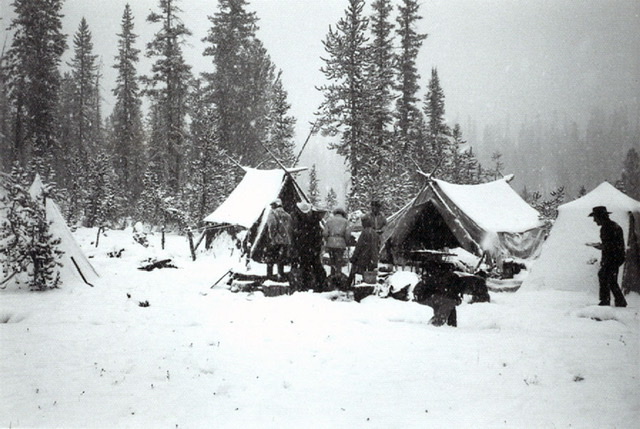
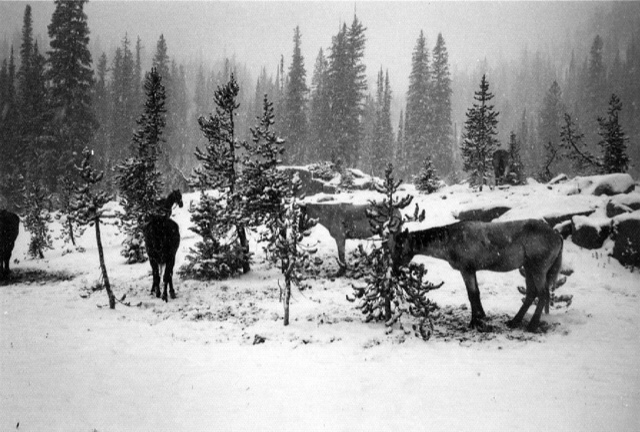
    Lady (foreground) with the other packhorses.

    Typically for fall, the weather improved by evening and the next day promised to be much better. The morning was clear and cold but by afternoon it had warmed into the lows seventies , and the dusting of snow had all but melted. The Carson kids, Bruce, Jackie, and Guy, headed up Tenlake Trail with me, and after about a half-mile we spotted a worthy climbing objective: the eastern face of Point 8590.
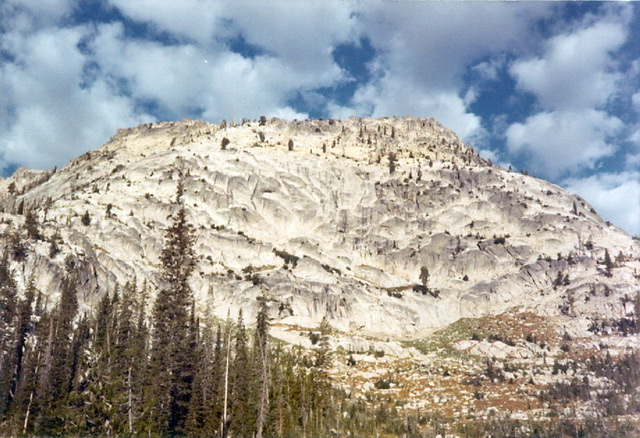
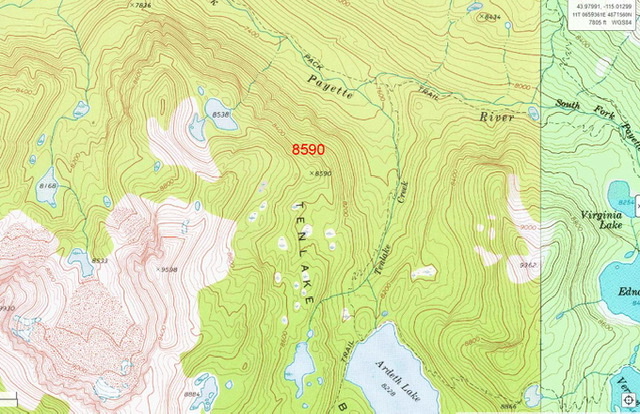
    Point 8590.
    Point 8590.

    It was getting late in the afternoon so we went back to camp, our plans for the next day now set. After a big breakfast along with real cowboy coffee, in which the grounds are dumped right into the water and boiled over an open campfire, the four of us headed back up Tenlake Trail, this time loaded with rock-climbing gear and a rope. We found a series of ledges that started out as second class but turned to fourth class higher up the face. At that point, Jackie decided she had had enough rock-climbing and went back down. Bruce, Guy, and I continued up until we finally reached a point where a rope and belay were in order. I led the first pitch, a delightful 5.4 (of a maximum 5.15 class rating) on near-perfect granite. After I brought Bruce and Guy up, we stayed roped and finished with another pitch of fun climbing. Below the top it turned to easier ground where we could scramble to the high point on the ridge and soak in views of the central Sawtooth Range.

    As soon as I got home from our pack trip, I started talking up with my climbing friends what I had seen on the Payette River. It didn’t take long to generate interest in Kong, and we made the trip in early October. This time we didn’t have horses, which meant our backs and legs took the load on the grueling hike above Fern Falls. After a hard day on the trail, we found a nice camping spot below our objective and spent the night. The next day we started looking for a way to get up the rock to the bottom of a massive slab that marked the beginning of final peak. There was an obvious gulley along the left of the climb but it was very steep, loose, and it looked like a death trap loaded with boulders that could tumble in a heartbeat. We found a fourth-class zigzagging rock route that led to a nice ledge (for camping or bivouacking) close to the base of the slab, but it also was out of the question, because we’d be carrying full climbing packs. It was getting late and we knew we’d have to do more exploring to figure out this challenge. We descended and decided to come back early the next summer, when the gulley would most likely be filled with snow.

    Not wanting to leave without some kind of summit, we decided to explore the top of the ridge and try to find the finish of our future climb. We were carrying only day packs, so we climbed up the gulley and along the ridge, where we spotted some interesting formations. There was a beautiful tower at the top of the gulley and we gave it a try. Mike made it all the way up to the last thirty feet, where the rock went blank. Lacking bolts or any way to protect ourselves, we called this one a near miss. Following the ridge that separates the Payette River and the Goat Creek drainages, we spotted a summit that looked reasonable and got to the top of it.
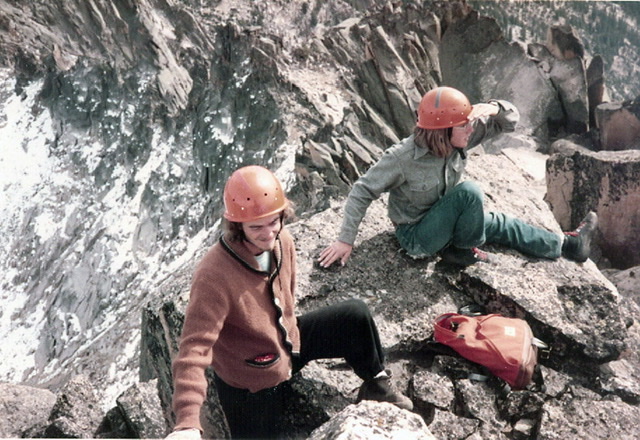
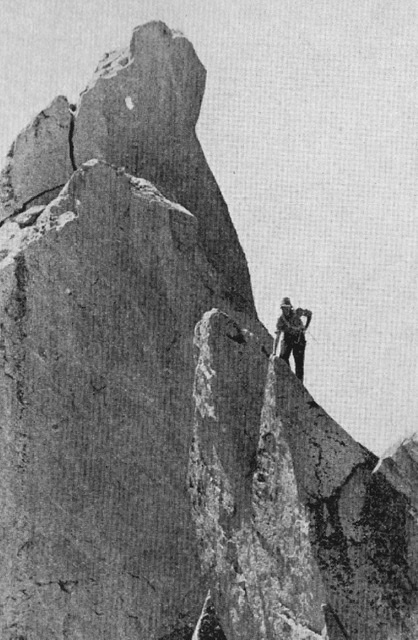
    Carl and the author on a ledge below the summit of The Kong.
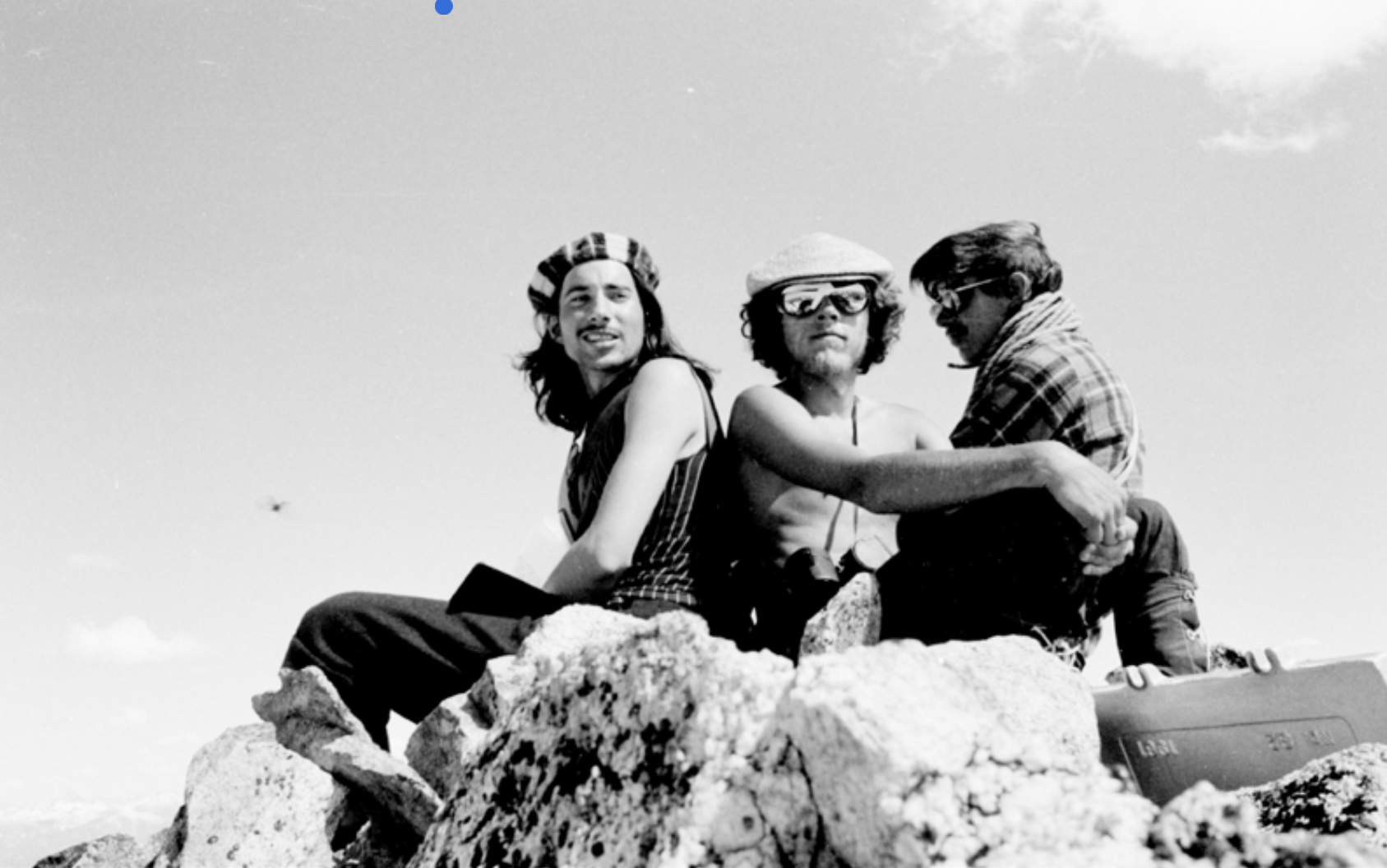
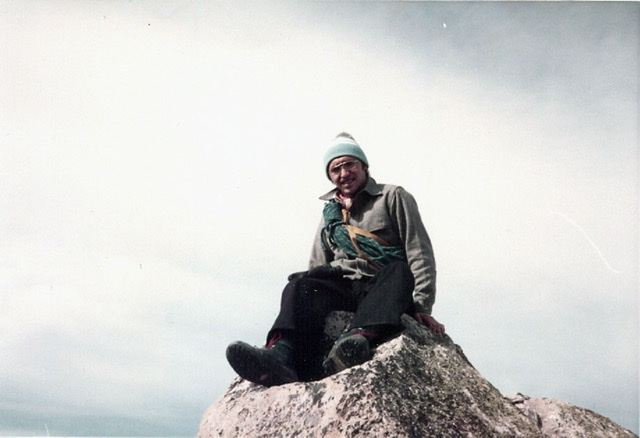
    Guy Carson on the summit of the unnamed point above the Kong.
    Mike climbed up to the last 30 feet on this pinnacle next to The Kong. The last 30 feet was without holds.

    When the time came in June 1974, we decided to do things a little differently. Instead of hiking up the South Fork of the Payette River and arriving in the heat of the afternoon, we would spent a night at the Grandjean campground and depart at 1:00 a.m., which should put us at our base camp early in the morning. Everything went as expected and we arrived in time for breakfast and a good rest. We lounged around for most of the day, enjoying the scenery and exploring the Elk Lake area.
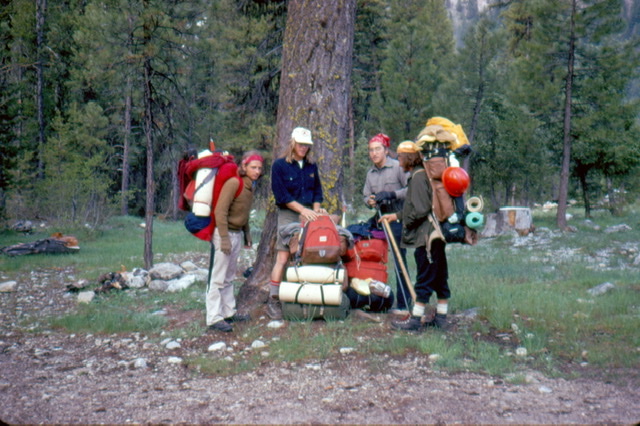
    (From left to right) Mike, Bob, Guy and Carl ready to roll at the Grandjean trailhead.
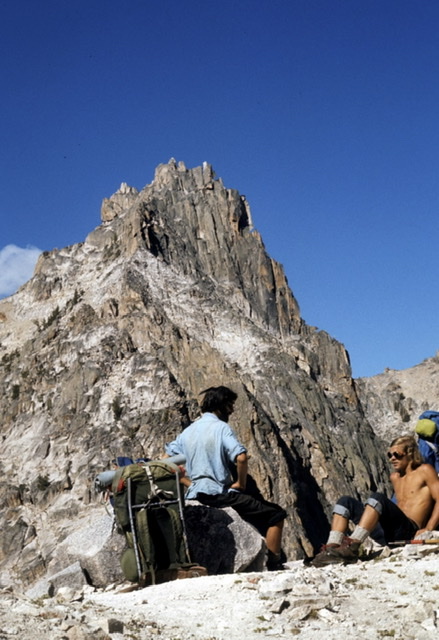
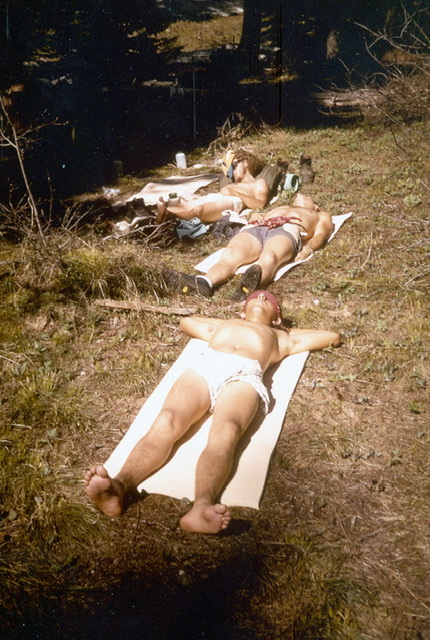
    Mike, Guy and Carl rest a few hours after the group’s all-night assault on The Kong.

    The weather was perfect and mosquitoes were non-existent, so we camped without bothering to put up a tent. Early the next morning, I awoke to the sound of something shuffling around our camp. I raised my head to the sight of a medium-sized black bear sniffing the foot of our sleeping bags. I sat up in and yelled to the guys, who woke all at once. My thought was that once the bear saw us, he’d bolt into the woods. Instead he slowly walked past us and stood on his hind legs to show us how big he was. A few minutes later, he took off into the brush and we didn’t see him again for the rest of the morning. We weren’t too worried about him, because we had plans to head up to our bivalve  ledge for the day so we loaded up our climbing packs and headed up the gulley. We had brought ice axes but no crampons, figuring the snow would soften up a bit by the time we got up the gulley. We were wrong.

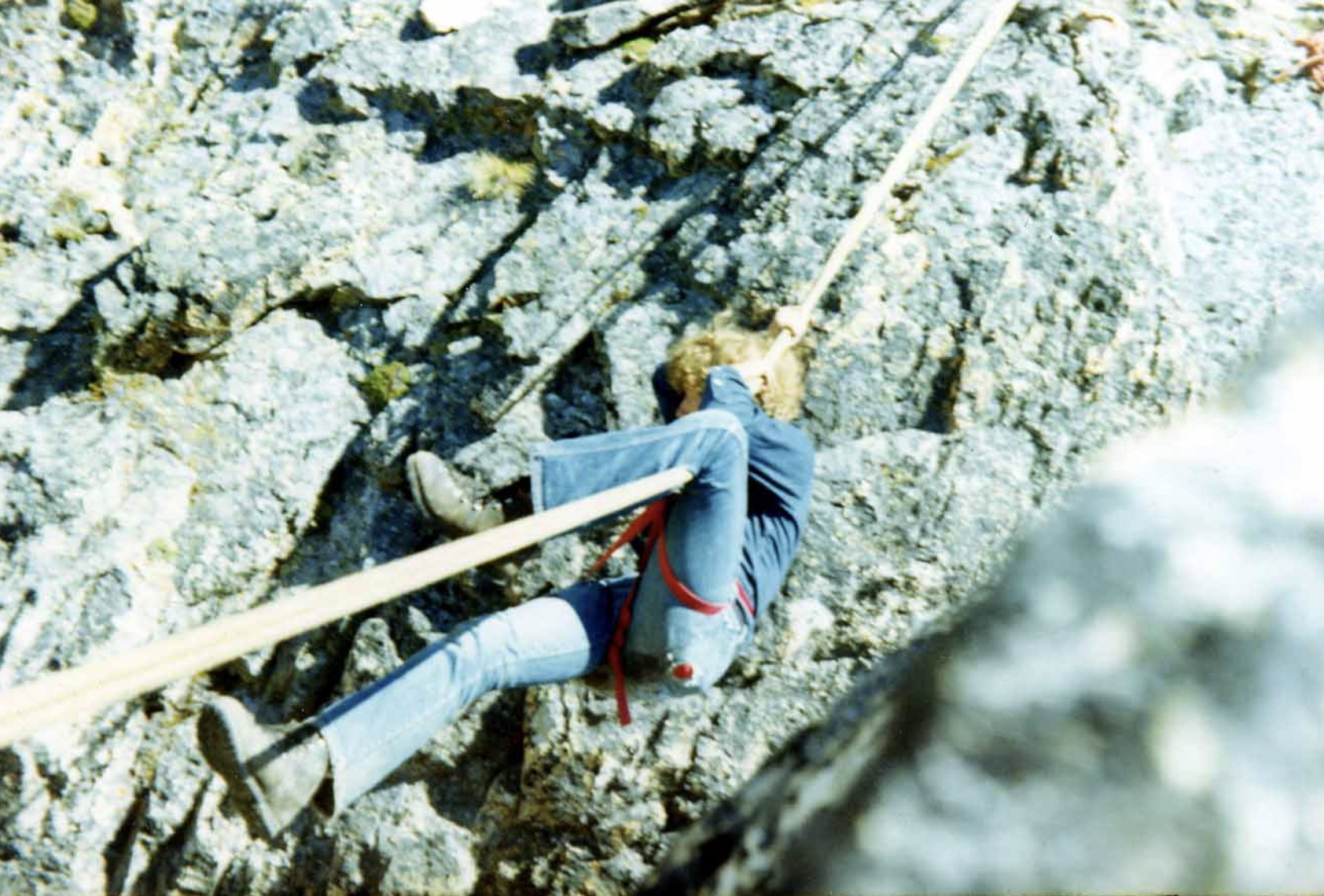
    The gully was reasonably accessible, but we could see that a short climb up an incline of fifty-five-to-sixty degrees on hard snow to the biv site would require step-cutting and a lot of “pucker factor.” After reaching the bivy ledge we scrambled up to the start of the climb where Guy and Carl watched while Mike and I racked up and tried to find a continuous crack system up the face. We finally spotted a good-looking line and I led the first pitch. I led up maybe ninety feet to the bottom of an overhanging, left-leaning fist crack that flared into an arm-and-knee crack. I didn’t think I could free-climb it so I slapped in a couple of hexes (hexagonal nuts that can be placed without a hammer) and pulled out my aiders (short ladder slings). Once I rounded the lip, I went free, but it was still very awkward and hard. I made it over the edge and decided to set a belay (a pulley-like device to control the rope)so I could talk to Mike when he came up. He ascended to the start of the overhang and then decided to try free-climbing the rest of the way up. After a fair amount of swearing, grunting and sweating, he made it over the lip. We really didn’t know grading very well but we both thought that it was maybe a 5.10. It later proved to be the crux pitch of the climb. We went up another pitch to a ledge system along the crack, and the climbing was still fairly stiff. We had burned up quite a bit of time getting to the base and working out the first two pitches so we knew we had to make a decision. It was getting late in the afternoon and we still had to descend the gully to get back to our base camp so we rappelled off and decided to come back the next summer to try it again.

    After descending the gulley we hiked back to where our packs were stashed and discovered that our bear friend had made another visit. All our packs were untouched except for Guy’s. It was missing two of the outside pockets that had had food in them and his foam pad had a large bite taken out of it. It was rolled up and when he unrolled it, it reminded me of how we used to make paper dolls. He accused the bear of being out to get him and no-one else. We picked up our packs and headed back to our base camp. As we ate the last of our food and listened to Guy grumble about the bear, Carl came up with an idea for revenge. He had part of a loaf of bread, some honey and a tin of cayenne pepper, so he and I went into the brush to fix the bear a snack.

    We found a stump and Carl stacked bread as if they were pancakes. In between each layer of bread he dumped a couple of tablespoons of cayenne pepper and then topped it off with a generous helping of honey. Chuckling, we headed back to camp. Figuring the bear wouldn’t find the bread for a while, we sat around talking about our adventure. We were wrong again. It took the bear only about thirty minutes to discover his snack, and he was very annoyed. As he came out of the brush above our camp, he was ripping leaves off the bushes.  We could see he had a mouthful of leaves and the hair on his back stood up. He snorted around and wouldn’t leave, which made us nervous, so we decided to use the African bush-beating method we’d seen on TV to chase him off. We all picked up our ice axes and at the word “go,” we charged toward him. We got about halfway to where he was sitting when he reared up on his hind legs and charged us. We turned and ran as fast as we could back to our camp. Luckily, his charge was a bluff, but he would not let us out of his sight. We agreed that maybe it wasn’t a good idea to stay there for the night. Under the watchful glare of the bear, we packed and hiked back to Grandjean.
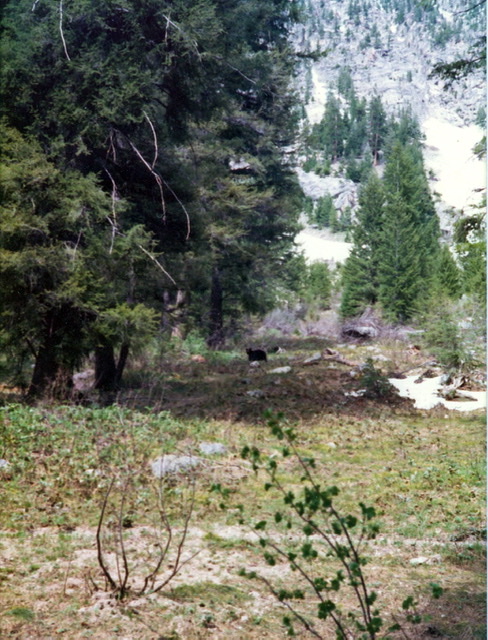
    Only hungry visitor casing our campsite.

    On our third trip at the beginning of July, 1975 we altered our plans once again. Instead of camping at the base and climbing the gully, we decided to haul all of our gear up to the bivy ledge both saving us time and avoiding any more encounters with our buddy, the bear. We couldn’t convince Guy to go back again so we recruited Mike’s cousin Sam to join us on our adventure. Carl was still interested so as a foursome we headed back up to Grandjean for the long grind up the Payette River. After a long day on the trail and a hard climb up the gully, we made it to our bivy spot below our climb.
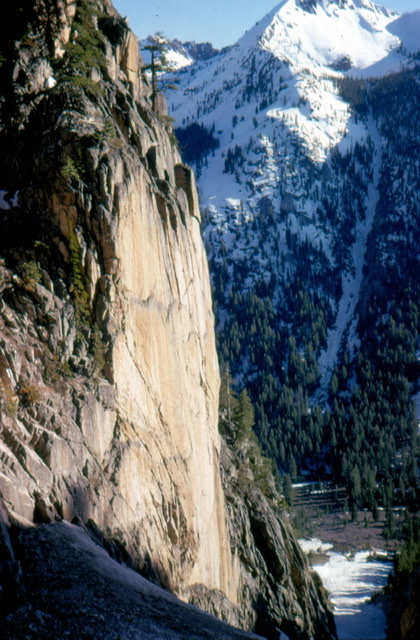
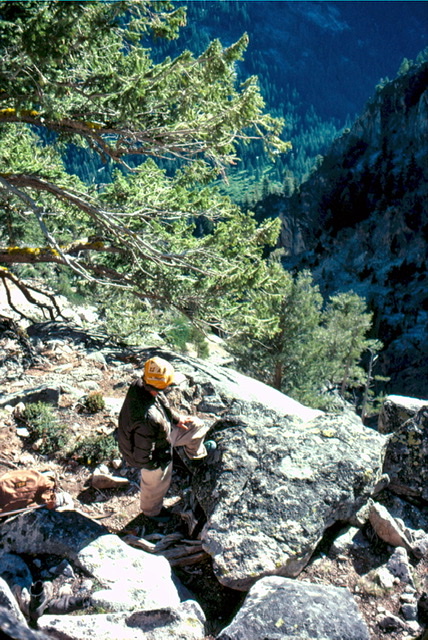
    The author and his friends bivouacked next to the tree at the top of this photo during the lightning storm.
    Carl on the bivy ledge.

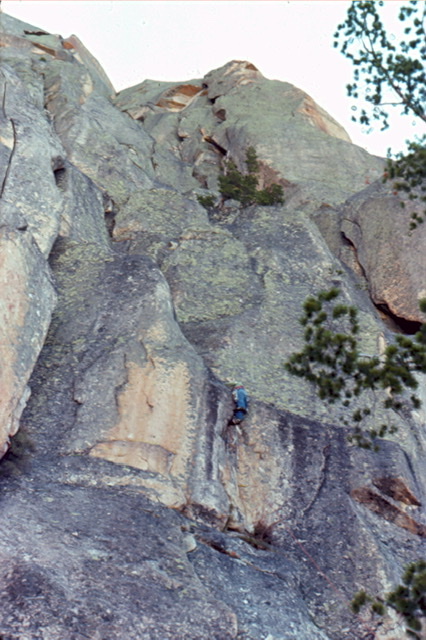
    Early the next morning, Mike took the first lead up to the crux overhang. I had set a directional belay about twenty feet from the start in order to be able to watch him climb. Just as he was grunting his way over the bulge, he suddenly flew out of the crack and I heard him yell “falling.” As I was pulling in slack, his top piece of protection popped out and then my directional anchor gave way, leaving maybe thirty feet of slack in the rope. I watched him free-fall around forty feet until he came to a stop about thirty feet off the deck. As I lowered him, he cursed about having almost made it. I thought he’d pass me the lead after recovering but that’s not how Mike works. He quickly gathered himself and went right back up, more determined than ever. On this second try, he cracked the code of the crux and continued up to a nice belay ledge.
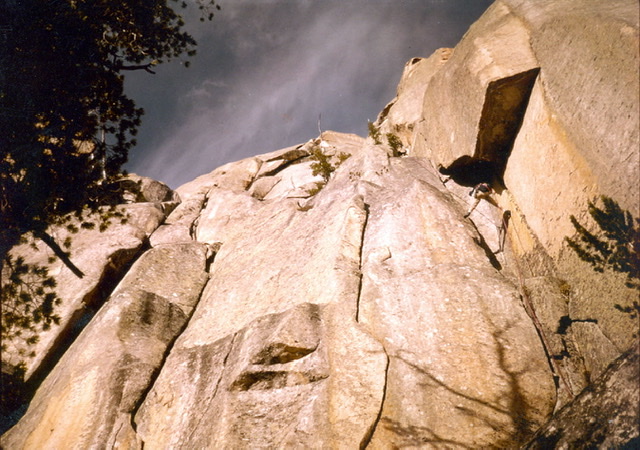
    Bob can be spotted on the right rappelling from the top of the first pitch.

    The next pitch led up to a dihedral (two planes of intersecting rock face). The climbing was on near-perfect granite that varied from hand-width to arm-width cracks. I led pitch three, which ended on a nice flat ledge midway up the dihedral. Mike took the fourth pitch, to the top of the dihedral, where we stopped to inspect the final short pitch to the top. There was no defined summit and from our ledge, we saw only two options for what we called the “H” pitch. To our left was a thirty-foot horizontal knife-blade crack that would require aid and led to places unknown. To our right was a large overhanging flared crack that would require very large pieces of gear to protect us. We didn’t have the right equipment for either approach, so we were stuck concerning how to finish the last fifty feet of rock. Bolts would have worked but we were devoted to the clean-climbing ethics of the time and neither of us owned that kind of hardware. We talked about cutting tree limbs for chocks and slinging them with webbing but it was too late in the day for that, so we called our high point good and began to rappel back down to our start.
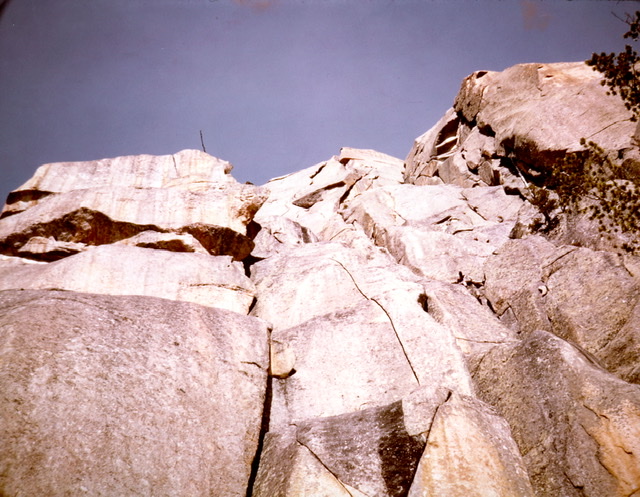
    The author cleaning P2.
    Mike is the tiny figure contorted on the crux pitch.

    The first rappel went a without hitch and we had only to leave a single sling behind on our way down. On the third rappel, things were looking good until I pulled the rope down. Just after the free end started to fall, it stopped. We pulled as hard as we could and realized it was jammed hard and would not budge. It was late in the day and clouds were building rapidly in the west. Ascending a stuck rope was completely out of the question and neither one of us wanted to lead that pitch again. We had two ropes with us, so along with the shortened end of the stuck rope, we still had enough rope to get down.  I free-climbed up as high as I could without aids and cut the rope, after which we descended to our bivy ledge for another night but soon discovered our adventure wasn’t over yet.
    The Kong.

    By the time the four of us down-climbed to our bivy ledge the sun was starting to set. We ate and settled into our respective spots. Soon it got dark and the wind began to blow in earnest. We saw the first of many flashes as a thunderstorm rolled in from the west. Rain poured down and the wind whipped up to about 50 m.p.h. We huddled in our spots and, in case we took a hit, we said goodbye to each other over the howling wind. Lightning struck below and above us. Rain hit the rocks in sheets and for maybe ten minutes it went up the mountain instead of down it. It then changed direction and poured downward for at least another half-hour. Lightning flashes that illuminated the entire mountainside left us temporarily blinded. There was no pause between the lightning and thunder, only loud explosions and an acrid smell in the air. Finally, the storm passed, and we were all okay. I later realized we had gone through a vertical wind shear, where the wind blows up one side of a thundercloud and down the other. We had experienced both sides of the storm.

    As chance would have it, it was the evening of July 4. In the morning, we not only were a little shaken from the excitement of the night before but realized we needed to rethink our hardware. We down-climbed and went back to Boise, where we read that a hiker had been killed by the same storm on the eastern side of the range.

    We always intended to go back and finish that last little bit of climbing to the top of Kong and retrieve the piece of stuck rope we had left hanging, but we were distracted by other Sawtooth climbs, such as the Finger of Fate and Elephant’s Perch. Around that time, we also started making regular trips to the Tetons and North Cascades. For us, Kong turned out to be the summit that got away.
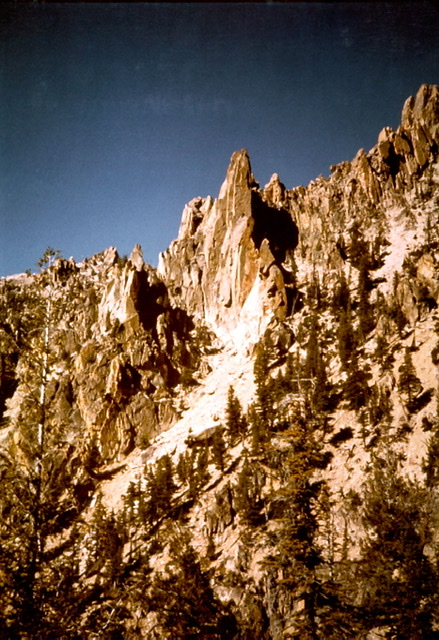
    An an unnamed tower that sits across the gully from the Kong.


  • Guffey Tower (as told by Tom McLeod) by Bob Boyles

    Guffey Tower (as told by Tom McLeod) by Bob Boyles

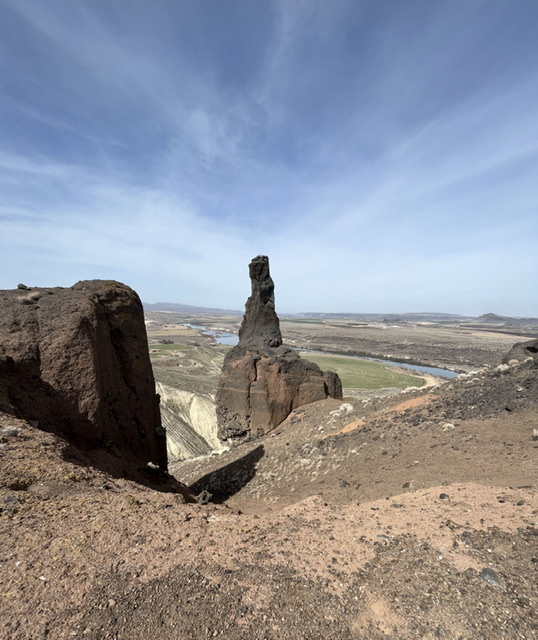
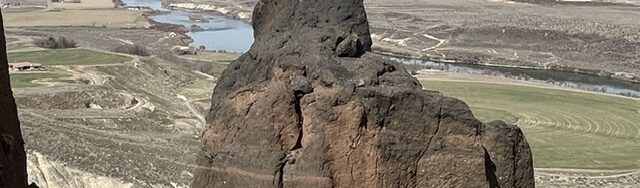
    Most anyone who has driven ID Highway 78 from Walter’s Ferry to Murphy will notice the large rhyolite tower that stands out on the west side of the Snake River below the nearby Guffey Butte. There are several free standing towers, or spires on the volcanic ridge but this one stands out as the tallest. For rock climbers, this spire seems to say, “Try me.”

    Guffey Tower Bob Boyles Photo

    In the early 70s a team of Boise climbers including Tom McLeod, Dan McHale, and Charlie Christ decided to give this a go. Celebration Park was years away from being established and the Guffey Bridge had yet to be converted into a foot bridge so they approached the tower from the highway 78 side of the river. The north side of the spire overhangs for most of its height and lacking the gear needed to do a long bolted aid climb, they decided to try the south side. They managed to free climb the lower part of the spire to the large ledge but the upper part required aid. Dan led the final pitch using a hand drill and quarter inch bolts. Lacking hangers and only having one nut for the bolts, Dan would drill a hole, sling a small nylon runner over the bolt and then put the nut on to secure the runner from slipping off. After drilling a new hole and placing a bolt, Dan removed the single nut from the lower bolt and placed it on the upper one while standing in etriers. He repeated this until he reached the top and then Tom and Charlie followed until they were all on the summit. Once on the summit they realized that there were no suitable places in which to secure anchors for their rappel so Dan placed another single bolt in the brittle rock and they rappelled off. Tom described the rappel as the “scariest he had ever done.”

  • First Female Ascent of Mount McCaleb

    First Female Ascent of Mount McCaleb

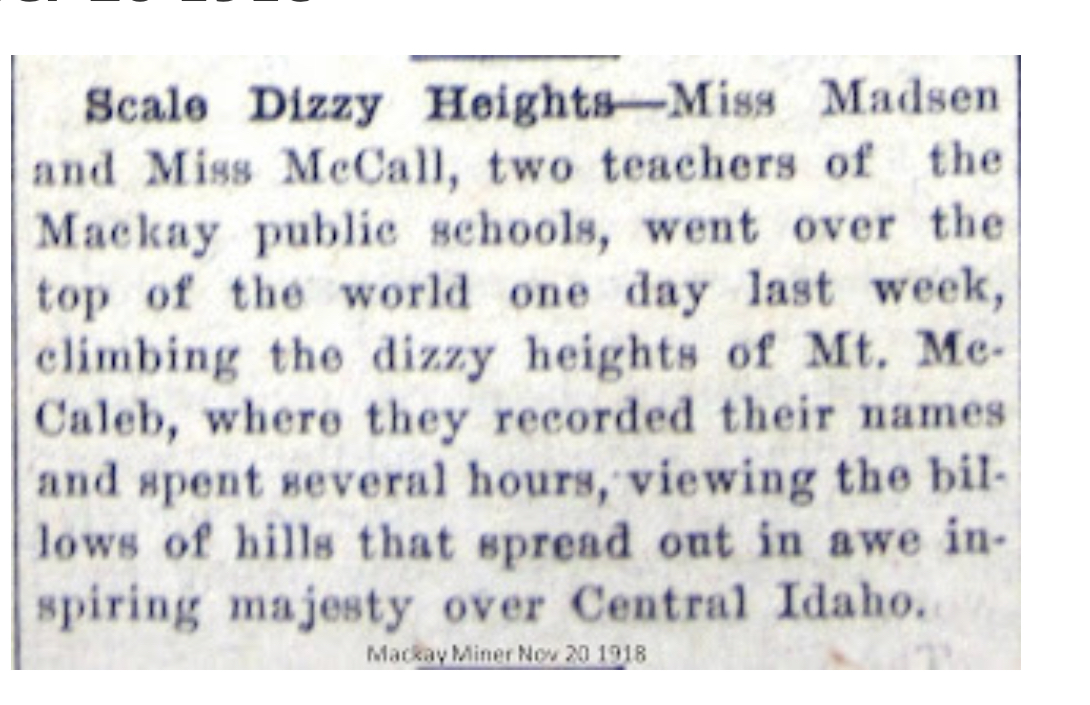
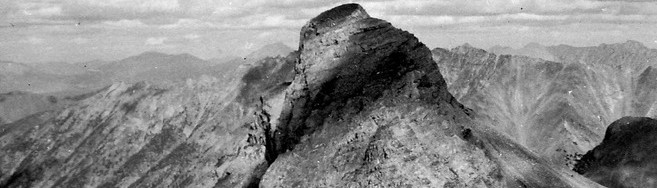
    Mount McCaleb dominates the view eastward from Mackay, Idaho. J.D Martin made the first known ascent of the peak in 1884. The clipping below documents the first ascent by women. Unfortunately,  their first name are unknown.

  • Wood River Peak-13,000 feet?

    Wood River Peak-13,000 feet?

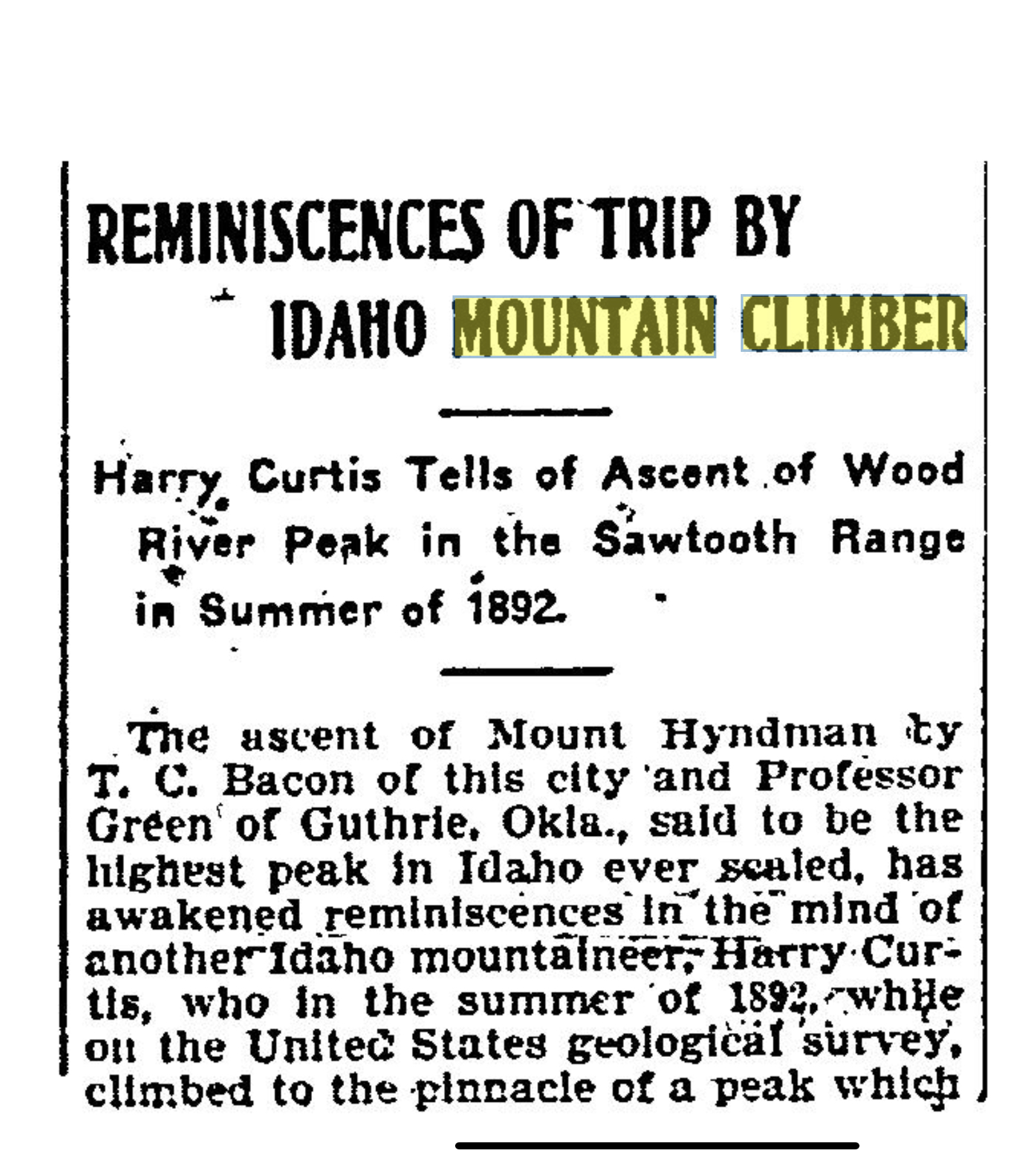
    In this article Harry Curtis claims that in 1892 he climbed a peak at the head of Wood and Big Lost rivers that was a thousand feet higher than Hyndman Peak. Interesting he did so with E.T. Perkins of the USGS. While the story seems based on a confused recollection it does demonstrate how little was known about Idaho’s mountains before the state was completely mapped.

  • T.M. Bannon by Rick Baugher

    T.M. Bannon by Rick Baugher

    Thomas M. Bannon was also a self-taught mountaineer. Although his name is not widely known in mountaineering circles, during his surveying career from 1889 to 1917 he climbed nearly one thousand summits in the American West. More than two hundred of these summits were in Idaho. Bannon’s cryptic reports, supplemented by the rock Cairns, Wooden triangulation signals, chiseled cross-reference marks; and brass benchmarks that he left behind tell his fascinating story. More than one hundred of his Idaho ascents were probably first ascents. These climbs included many of Idaho’s highest and most famous peaks, including Mount Borah (which he called Beauty), Leatherman Peak, and Invisible Mountain in the Lost River Range; Diamond Peak (which he called Thumb), Bell Mountain (Bannon’s Finger), Lem Peak, and May Mountain (Bannon’s Hi Peak) in the Lemhi Range; Standhope Peak and Smiley Mountain in the Pioneers; Castle Peak in the White Clouds); and Mount McGuire in the Salmon River Mountains. Bannon’s death at 48 cut short an extremely active life.

    I spent a good part of the 1990’s investigating pioneer government surveyors in the Idaho and western US mountains. This involved recovering some 100 mountain top triangulation stations placed by Bannon & party in Idaho from 1911-1915. In his career as USGS Topographical Engineer 1894-1917 T.M. Bannon had a hand in making ~50 topographic maps.

    Having grown up myself in Maryland, a highpoint was a July 1995 pilgrimage to the Bannon burial plot at St Lawrence Martyr R.C. Church in Jessup. Bannon family monument (like T.M.’s triangulation monuments) occupies a prominent position in the church graveyard.

    Photo on right is T.M.B. gravestone. Rick Baugher Photo

    Obituary notice from Washington Evening Star, Feb 6, 1917:

    THOMAS M. BANNON DIES AFTER A BRIEF ILLNESS

     Was Engineer of Topographic Branch Geological Survey- Funeral Thursday at Jessups, Md.

    Thomas M. Bannon, engineer of the Topographic Branch of the geological survey and a prominent resident of Anne Arundel county, Md, died Sunday evening at Maryland University Hospital in Baltimore. Mr Bannon had been ill only a short time. [Author’s Note: USGS said field worker deaths at that time often attributed to typhoid fever].

    Mr. Bannon had been connected with the geological survey since 1888, the greater portion of his service having been given to topographic and geodetic surveys in different western states.

    Prior to the organization of the United States reclamation service, Mr Bannon was detailed to collect the data which that organization used in connection with the development of its projects in Idaho and Utah [Author’s Note: chiefly Bear River drainage].

    In 1908 he was detailed to the Porto Rican government and placed in charge of surveys in developing irrigation of the semi-arid portion of the island.

    During the last few years Mr Bannon’s efforts had been directed to the extension of geodetic work in western Montana and eastern Idaho and in mapping portions of the national forests in Idaho.

    In addition to his official duties with the government Mr Bannon served seven years as a member of the board of governors of the Maryland board of correction and was active in many local and charitable organizations of Anne Arundel county.

    Mr Bannon was unmarried, is survived by two sisters, Mary and Francis Key Bannon, and three brothers, James T., Phillip M., and Joseph Bannon.

    Final notes: It is believed Bannon thru his mother Evaline was related to Francis Scott Key. Bannon’s federal appointment as an 18 year old was thru Rep. Barnes Compton, also an F.S. Key relative. Survey director John Wesley Powell was chided for hiring “Congressmen’s nephews”. Bannon estate in Jessup was demolished in 1950 to make way for Baltimore Washington Expressway.

    See also: Appendicitis Hill and T.M. Bannon and 1929 Borah Declared Idaho’s Highest Peak

  • The Underhill Sawtooth Story by Ray Brooks

    The Underhill Sawtooth Story by Ray Brooks

    “Rugged country. Awful rugged country. Miles and miles of sharp jagged pinnacles of firm granite.” A painter-friend of Bob Underhill told him that about Idaho’s Sawtooth Mountains in the early 1930s, when Bob was in the Tetons for a few weeks pioneering big new routes on the Grand Teton and other nearby peaks. Although the painter isn’t named, it almost certainly was Idaho native Archie Teater, who had hiked the Sawtooth mountains for weeks with a pack burro, painting and prospecting for gold. Archie started spending summers at Jenny Lake at the base of the Tetons in 1929, painting pictures of the mountains and selling his paintings to tourists.  Archie Teater’s campmates at Jenny Lake included early Teton climbers Glenn Exum and Paul Petzoldt.

    Bob Underhill and his climber-wife Miriam were interested. What they discovered, by researching climbing club journals, was that the Sawtooth Mountains were unknown to the climbing world. Their subsequent adventures in the Sawtooths captivated me, as a climber who has summited many of the peaks that the Underhills were the first to conquer in the 1930s. I found the couple’s writings on their Sawtooth adventures captivating.

    Miriam Underhill’s article on their 1934 trip, titled “Leading a Cat by Its Tail,” was in the December 1934 edition of Appalachia magazine. Robert Underhill wrote a summary of both their trips into the Sawtooths, aptly title “The Sawtooth Mountains of Idaho,” for the December 1937 issue of Appalachia Magazine and Miriam writes about both their Sawtooth adventures in Chapter 9 of her 1956 climbing autobiography “Give Me The Hills.”

    They were each uniquely qualified to climb difficult, unexplored, and unclimbed peaks. Both were from upper middle-class families and both had much experience climbing difficult peaks in the Alps. They had met during Appalachian Mountain Club trips to mountains in New Hampshire but, for the most part, climbed separately in the Alps. Miriam’s access to wide areas of the Alps, in France, Switzerland, and Italy’s Dolomite Mountains was enhanced by a Buick touring car her parents shipped over to France for her use. By the late 1920s, both Miriam and Bob Underhill had established reputations as some of the best climbers in the world and they had started occasionally climbing together in the Alps by 1928.

    Courtesy of the Adventure Journal.
    Courtesy of the Adventure Journal

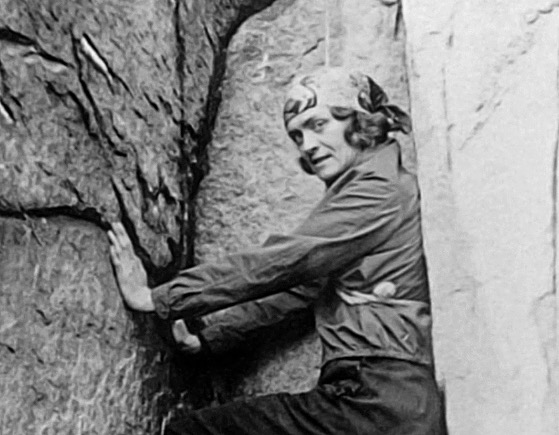
    As Miriam gained climbing experience, she suffered, first with alpine guides who would never let a woman lead, then after she started leading more difficult climbs with more tolerant guides, by the attitudes of the time, that women were too “frail” to be trusted as an equal climbing partner. She started climbing with like-minded women and did some very difficult climbs. In the 1920s, climbers tied themselves together with hemp ropes, but leaders led without driving pitons into cracks to “protect” themselves if they fell. The rule was “the leader must not fall” and Miriam led some very hard climbs without falling including a “test-piece” that only a few Chamonix guides would lead, the famed Mummery Crack (currently rated as a French 5b, or 5.8 – 5.9 by U.S. difficulty ratings) on the Grepon. A photo essay and her article about what she and her friends termed “Manless Climbing” was published in the August 1934 issue of National Geographic Magazine, two years after she married Bob Underhill, and suddenly they were not only the best, but the best-known climbers in America. Bob Underhill was not as famous, but in addition to his new routes in the Tetons, he wrote a 22-page article “On the Use and Management of the Rope in Rock Work,” which was published in the Sierra Club Bulletin in 1931. He then taught modern rope techniques to Sierra Club members in California and did two big first ascents in the Sierra with his best students. The Robert and Miriam Underhill Award is given annually by the American Alpine Club “to a person who, in the opinion of the selection committee, has demonstrated the highest level of skill in the mountaineering arts and who, through the application of this skill, courage, and perseverance, has achieved outstanding success in the various fields of mountaineering endeavor.”

    Acknowledgment: from Wikipedia which secured the photo from Glen Dawson. Who kindly agreed to make those photos from his private collection publicly available. If you use or copy any of the pictures, please quote the source as "From Glen Dawson Collection".
    Acknowledgment: from Wikipedia which secured the photo from Glen Dawson. Who kindly agreed to make those photos from his private collection publicly available. If you use or copy any of the pictures, please quote the source as “From Glen Dawson Collection.”

    In June of 1934, the Underhills made the long drive from Boston to Idaho and first stopped in Hailey at the Sawtooth National Forest headquarters to inquire about available horse packers for their Sawtooth adventures (Hailey does not now have an active ranger station). They were referred to a prosperous Sawtooth Valley rancher named Dave Williams and after explaining their needs to him, Dave jumped at the opportunity to share in their adventure. In fact, they could start the following afternoon. Miriam explained: “In the morning he’d have to round up and shoe us some horses, of which he owned large numbers; he wasn’t sure how many, since he hadn’t caught them all that Spring.” Dave had gone to the “school of hard knocks” and had first worked in the area carrying mail twice a week over 8,750-foot Galena Summit from Ketchum to Stanley. The road was closed by snow for six months a year and then Dave rode a horse, or drove a dog team, or wore skis, to make the 61-mile journey. The Sawtooth Valley was mostly ranched by folks on small “starvation-ranches,” but Dave had managed to prosper, supplementing his income from cattle ranching with income from leading pack trips into nearby mountains for fishing or hunting.

    The next afternoon at 4:00 P.M., the three started for the mountains with three riding horses, two pack horses, and one of the pack horses an unweaned colt. Dave led the better-trained pack horse, but “Diamond, the other and a most ornery beast, was left to run loose and it was up to Bob to see that she came along.” After Dave warned Miriam that her horse would buck if brush or clothing touched its rear, she also got to avoid the colt, who would dash in front of the other horses and practice bucking. Miriam wrote, “I felt sure that when he grew up to be a big horse, he too would be a splendid bucker.”

    Somehow, they made it up the barely discernable Hell Roaring Creek Trail to Imogene Lake by dusk and camped for the night. Dave led the belled horses to a pasture at a small lake above camp and warned the Underhills to be alert for the horses trying to sneak past them in the night, to return to his ranch. Nothing bad happened in the night and the next morning Dave and the Underhills hiked up to round up the horses. “Searching for the horses, we hiked up a turbulent little stream, Bob on its right bank and Dave and I on its left. The horses appeared on Bob’s side. Dave shouted across the stream that Diamond would be the only one likely to let Bob get up on her. Bob was to mount Diamond and drive the others across the stream. No one would have guessed that as Bob swung up on that big, round, slippery horse, unsaddled and unbridled, that he was doing this for the first time. But from then on, things went less well. ‘Just go after them like you was roundin’ up some cattle, Dave instructed.’“

    “Bob’s primary difficulty lay in steering Diamond, but even when he managed that, and charged up to the other horses, they continued their placid grazing in complete indifference. An expression of increasing amazement grew on Dave’s face as he watched the ineptness of this eastern dude. ‘It’s a funny thing, he observed to me, but I guess there’s something to learn about most anything.’ In the end, Dave had to wade the stream and do the job himself.“

    Later that day, they went over a high pass just south of Imogene Lake and in a thunderstorm, worked through scenic, but trail-less, steep and rough country to Toxaway Lake, where they camped for three nights. Miriam mentions one of the more exciting parts of their descent. “We all walked most of the most of the way, sloshing along in oilskins. At one point, Diamond, who always knew better than the other horses, or even Dave himself, what route to take, started down a sloping slab of rock which the rest of us had skirted. She fell at once and slid – a sitting glissade. Noticing that my horse was then in line at the bottom of the slab and that I was slightly below it, I expected momentarily to be covered up by two horses. But although Diamond did slide into him, he stood his ground.”

    At the bottom of the mountain, they found a trail that came up from Yellowbelly Lake and followed it to Toxaway. Three lads from Salt Lake City were fishing there and during the ensuing conversation they expressed wonderment that anyone would come into the Sawtooths just to climb. Subsequently, the Underhills learned that Dave had often carried containers with live trout up to fishless Sawtooth Lakes so he could later make money hauling people up to those lakes to catch trout.

    Toxaway Lake (1971). Ray Brooks Photo

    The next day, they climbed Snowyside Peak (10,651 feet), one of the tallest Sawtooth Peaks. It had been climbed previously by USGS map-makers on a survey of the Sawtooths and was the only peak the Underhills and Dave ascended that Summer that was not a first ascent. I climbed Snowyside’s east ridge in 1971, which is likely the route the Underhills and Dave Williams took up the peak.

    East Ridge Snowyside Peak (1971). Ray Brooks Photo

    Dave was athletic and had spent a lot of time in the mountains hunting goats. He wanted to climb with the vastly more-experienced Underhills and did a great job, although he did not trust their ropes. On their descent from a ridge extending north from Snowyside, they needed to do several rappels to descend a steep part about 200 feet high. Miriam writes: “How uneasy Dave felt! Those thin little ropes did not look like they could hold him. To reassure himself, before starting, he peered over the edge to the valley below and observed if worse came to worst, he could make it in about two jumps.”

    From the top of Snowyside, they noted, far to the northwest, what they called “The Red Finger,” now named The North Raker. They found it so striking that they wanted to go there, even though Dave thought the South Fork Payette River Valley between them and it did not have a trail. However, he knew a pass he could get his horses over and he was willing to try to get them to the North Raker.

    The next day, they went south and climbed an imposing peak above Alice Lake, later named El Capitan, finding a route up its east side that was not entirely satisfactory, due to much loose rock. The peak was unclimbed and Dave, with his usual enthusiasm, built a huge summit cairn.

    Alice Lake and the north face of El Capitan (1971). Ray Brooks Photo

    The following day, they bushwhacked over Dave’s pass into the upper South Fork Payette Basin. They went over a trail-less low pass west of Toxaway Lake to Vernon Lake. Then they had to follow twisty elk trails at a slow pace for miles down the South Fork Payette Valley until they were almost to where they would need to cross the river to go up to the Rakers. At that point, they intersected a beautiful, newly-cleared Forest Service trail which they had likely been next to for several miles. One-half mile above Elk Lake, they camped in a meadow and the next day Bob and Dave hiked about 3,700 vertical feet up steep slopes to the east and made a first ascent of another big mountain, Elk Peak (10,582 feet). I had an easier time of it in 1971 when Harry Bowron and I camped in the Upper Redfish Lakes basin at about 8,700 feet, northeast of Elk Peak, and the next day chased a mountain goat up the north ridge of Elk Peak. Although Bob and Dave are credited with having climbed the east ridge, we all most likely hiked the north ridge which is an obvious route and the first one they would have come to.

    Elk Peak at top center-right and Upper Redfish Lakes from Packrat Peak (1972). Ray Brooks Photo

    From the top of Elk Peak, Bob and Dave were able to clearly see the least difficult way to access the Rakers, which was up aptly named Fall Creek, just above their camp. Dave did not believe he could take his horses up there so they first planned to go up with minimal overnight gear, bivouac just below the Rakers, and climb the next day. During a rest day, they ended up deciding to do the trip in one day with an early-morning start. The first obstacle the next morning, was the deep and fast-flowing South Fork Payette. Dave solved the problem by cutting down a tree for a bridge with an axe he just happened to be carrying. It took them about 3-1/2 hours to make the hike up to the north side of the Rakers. I went up the same way in 2009 with my wife Dorita and our fit friends Jerry and Angie Richardson, but we backpacked all our camping gear up the trail-less, steep, and brushy lower part of Fall Creek. From there, we followed game trails up more open terrain to the Rakers.

    North Raker at right and South Raker at left. Ray Brooks Photo

    The Underhills and Dave were able to scramble nearly to the top of the North Raker, but were defeated by a steep, holdless, and rotten tower that was its southern high point. However, they were able to do a first ascent on the smaller South Raker as well as some much smaller summits between them.

    Bob Underhill at their 1934 high point on the North Raker. Miriam Underhill Photo

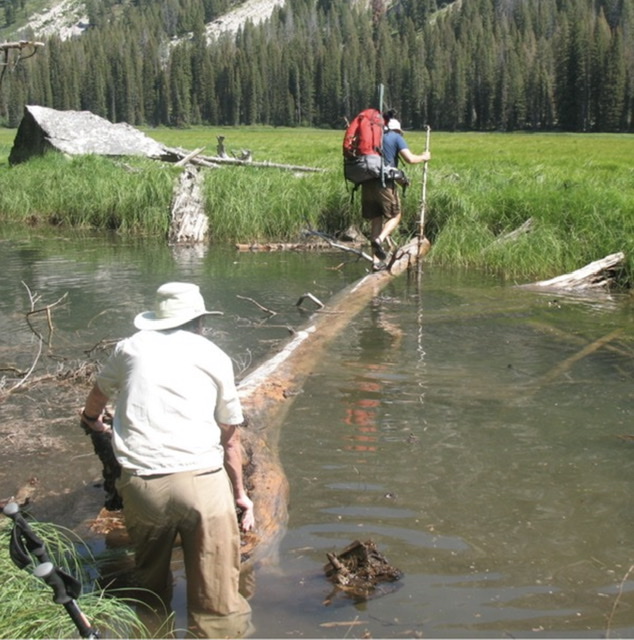
    Dave and the Underhills were able to go up to the Rakers, have their climbing adventure, and make it back to their camp on the South Fork Payette in one long day. In 2009, we hiked around the Rakers and spent another day exploring peaks on the east side of Fall Creek. Unfortunately, when we went back down to the South Fork Payette, we ended up descending steep terrain a little ways down-river from where we had gone up. We discovered a bottomless side-channel, but we were able to cross by breaking a floating Spruce log loose from our side, which Jerry pulled and I pushed to make a floating bridge.

    Ray Brooks and Jerry Richardson. Dorita Hoff Photo (2009)

    The food box Dave and the Underhills had packed for eight days was nearly empty, but they decided to stretch their food and go down the South Fork Payette Trail to Grandjean, then up Trail Creek to near 10,190-foot Mount Regan and climb it before going out to Stanley Lake and roads. They discovered Trail Creek was badly named and they had more adventures getting their horses up it. After camping west of Mount Regan, they tried to climb Mount Regan by the northwest ridge the next day, but were defeated on their first attempt by what Miriam describes as a 20-foot wide gap. They had to go back down, circle the mountain, and make a first ascent of it by the southeast ridge.

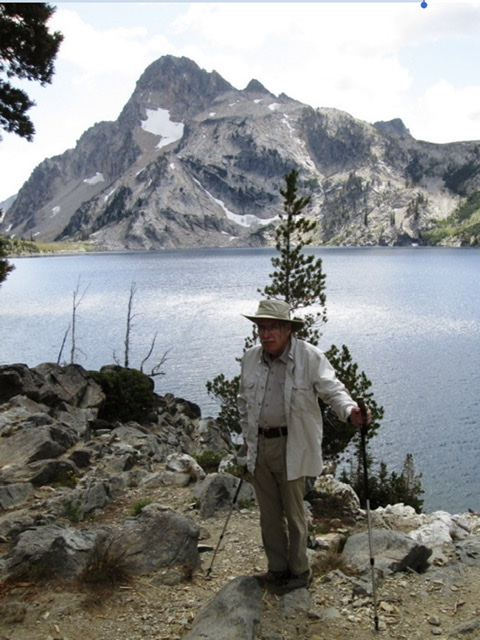
    Mount Regan at center, its northwest ridge at right, Sawtooth Lake, and the author. Dorita Hoff Photo (2019)

    I climbed Mount Regan via the northwest ridge in August of 1970 with three friends. It was my first Sawtooth peak and all we knew about it was that it had been climbed. We found it on a Forest Service map, hiked up a good trail to Sawtooth Lake and camped under the east side of Mount Regan. During the evening, we agreed on a likely route and the next morning, we scrambled up the peak. We had a 120-foot Goldline rope and some climbing gear with us and our best climber, Harry Bowron, did a little engineering to rig our rope across the gap that stopped the Underhills and Dave, so the rest of us could slide across the rope in what’s now called a “Tyrolean Traverse.” I was somewhat surprised to learn a few years back, that minor obstacle had stopped the Underhills. What is more interesting is Bob Underhill posted this footnote to their climb in his 1938 article on their Sawtooth adventures in Appalachia Magazine. “Nor do I think it could be crossed by a rope traverse at least at any point we investigated.”

    Gordon Williams on our Tyrolean Traverse on the Northwest Ridge of Mount Regan. Ray Brooks Photo (1970)

    The Underhills and Dave Williams were from very different backgrounds, but they had shared a grand 10-day adventure and were now lifelong friends. Before they parted, they were already planning another pack trip to explore the peaks of the Sawtooth Mountains. Bob Underhill was employed as a Harvard instructor, first in Mathematics, then he became a philosophy professor there and perhaps those responsibilities led to him and Miriam not being able to visit the area again until early September 1935.

    Dave Williams met them at the Shoshone train station, 118 miles south of Stanley. This year, they only had a 3-week break from responsibilities and had journeyed by train to Idaho from Boston. Dave had plans to pack along a larger tent and a camp stove he carried when packing hunting parties, to deal with cold Fall nights in the mountains. Miriam noted one of Dave’s lighthearted remarks on the drive from Shoshone to his ranch. “I can’t understand you Bob, he observed thoughtfully. In my experience there’s just two reasons for a man to go off into the woods. One is to get away from his wife and the other is to get drunk. But you bring your wife with you and you don’t bring no whiskey.”

    The first 1935 trip objective was Mount Heyburn just west of Redfish Lake. The Underhills and Dave Williams went up the long decomposing granite slopes on the south side of Mount Heyburn from Redfish Lake Creek and after exploring three of Heyburn’s possible high points, succeeded in making a first ascent of the highest summit via the 5.6-difficulty Southwest Ridge Route. Bob was moved to describe the crumbly granite on the ridge: “The smooth gables and humps which formed the crest of the ridge were surfaced with a gravelly material that crumbled off like well-caked mud.” Later Sawtooth climbers would describe the southern slopes of Mount Heyburn as being composed of “ball-bearing granite.”

    The complex and often rotten south side of Mount Heyburn. Ray Brooks Photo (2011)

    During the two days they spent exploring Mt. Heyburn’s rotten rock, Bob was also most impressed with what were later named the Black and Grand Aiguilles, located in a small cirque adjacent to and just southwest of Heyburn.

    Bob wrote that they were genuine Chamonix-type aiguilles that would provide magnificent ascents if they could be climbed without artificial aids. That conclusion was reached after they made attempts on each summit. These aiguilles and others nearby, were later considered major Sawtooth challenges and most of them were climbed in the 1940s by routes not considered difficult by modern standards. I never visited them until my wife Dorita and I hiked up to the Grand Aiguille in 2011 with a light rack of climbing gear and a 9mm rope, expecting to “knock-off” the 5.4 route it was first climbed by in 1946. When I got up close to the Grand Aiguille, I was suddenly just as impressed with it as Bob Underhill was in 1934. I simply could not see an easy route up it and notes from the 1946 first ascent mentioning “The third pitch leads to some large granite flakes out on the face. (These flakes are shaky when pulled outward, but are secure when downward pressure is placed directly on them.)” were worrisome to me. I found myself wondering just how shaky those flakes now were, 66 years after the first ascent. It was a nice scenic cirque and Dorita and I spent the rest of the afternoon exploring it and enjoying the views after I gave up on the climb.

    North face and northwest ridge of the Grand Aiguille. Ray Brooks Photo (2011)

    From their camp below Mount Heyburn, Dave’s horses carried them up Redfish Lake Creek to another camp spot. They spent two days exploring peaks to the northwest and made a first ascent of another of the highest and most scenic peaks in the range, Packrat Peak (10,240 feet). Bob mentions an attempt on another peak bordering Redfish Lake Creek which they could not complete, since they had neglected to bring a rope and Miriam mentions achieving other ascents “up Redfish Creek.” Although I can’t find any specific mention in the Underhill’s Sawtooth stories, they are also credited with a first ascent of the next peak south of Packrat. The 10,160-foot peak is now named Mount Underhill in their honor. Both Bob and Miriam stayed discretely silent about the many unclimbed sharp and technical summits just north of Packrat Peak. Perhaps they planned on another Sawtooth trip that never happened?

    Harry Bowron and David Thomas with Packrat Peak in the background. We and the Underhill party climbed the camera-facing east side of the peak. Ray Brooks Photo (1972)

    Then Dave and the Underhills traveled back down to Redfish Lake and up Fishhook Creek, the other main tributary stream of Redfish Lake, and camped. From there, they made the first recorded ascent of the highest of the Sawtooth Mountains, 10,751-foot Thompson Peak. It is difficult for me to follow Bob’s description of how they approached and climbed Thompson, so I won’t attempt to share it. Dave and the Underhills also hiked 0.8 mile north from the summit of Thompson and made the first ascent of what is now named Williams Peak in honor of Dave Williams. Thompson was the second Sawtooth peak I climbed in June 1971 with my friends Harry Bowron and Gordon Williams, and we managed a summit group portrait.

    On the summit. Ray Brooks Photo

    That was it for the Underhills in the Sawtooth Range. On their 1935 visit, they also made the second ascent of nearby 11,815-foot Castle Peak in the White Cloud Mountains. However, their visits were noted by Idaho’s largest newspaper in two articles and their Appalachia Magazine articles were noted by other U.S. climbers. They had “opened up the range” and other climbers would slowly follow them after the Great Depression and WWII ended.

    With that future in mind, Bob also wrote some notes on the Sawtooth Mountains in his 1937 Appalachia article aptly titled  “The Sawtooth Mountains of Idaho.” “The major Sawtooth peaks are between 10,000 and 11,000 feet high. The mountain valleys from which those peaks rise immediately may be situated anywhere from 8,000 to 9,000 feet. In point of elevation, therefore the climbs generally amount to very little.   Furthermore, it may as well be confessed at once that on the average they are not difficult…”

    “Much of the climbing pleasure the Sawtooth region can afford is therefore reserved exclusively for its first explorer, for whom everything has at least the fascination of being unknown and problematic. Nevertheless, I think there is quite a lot here to engage the interest of the rock climber as such – though to be sure he should be a rock climber who is willing for the moment to turn aside from long expeditions to shorter days spent largely in the lighter exercise of his craft—and preferably one who is content to accept as part of his reward the great charm of the country and of the camp life it permits…”

    Bob Underhill’s thoughts led to a strong local climber ethic about the Sawtooths that my friends and I embraced when we started climbing there in the early 1970s. Simply stated, it was “Don’t ask, don’t tell.” We all knew the fun in the Sawtooth Mountain lay in the adventure and too much knowledge of the area ruined the adventure.

    Jumping forward to 2020, it is increasingly more difficult to maintain the adventure, for those who want to discover their own new valleys, new peaks, and new routes in the Sawtooth Mountains. I realize many younger climbers crave “beta” (information and details) on routes, like we used to crave adventure. However, folks can climb in other mountain ranges and enjoy exact details on approaches, peaks, and routes. In the Sawtooths, it is still a lot of fun to just go in, pick out a peak, and attempt to climb it.

    Try it, you might like it.

    My thanks to Christine Woodside and Becky Fullerton at Appalachia Magazine for their assistance with sharing Miriam Underhill’s 1934 article, and to Tom Lopez, author of Idaho A Climbing Guide for his assistance.

    Ray Brooks. Copyright March 5, 2020