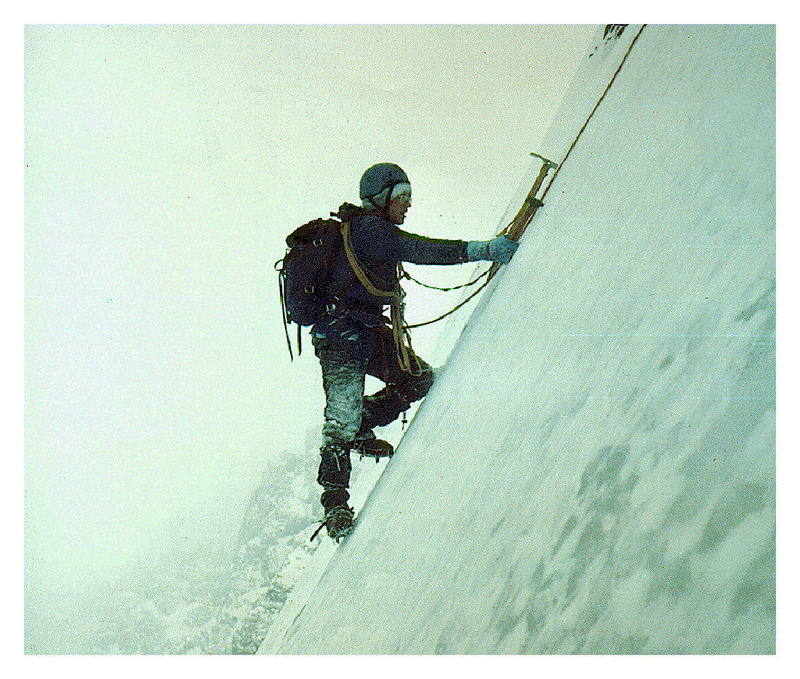
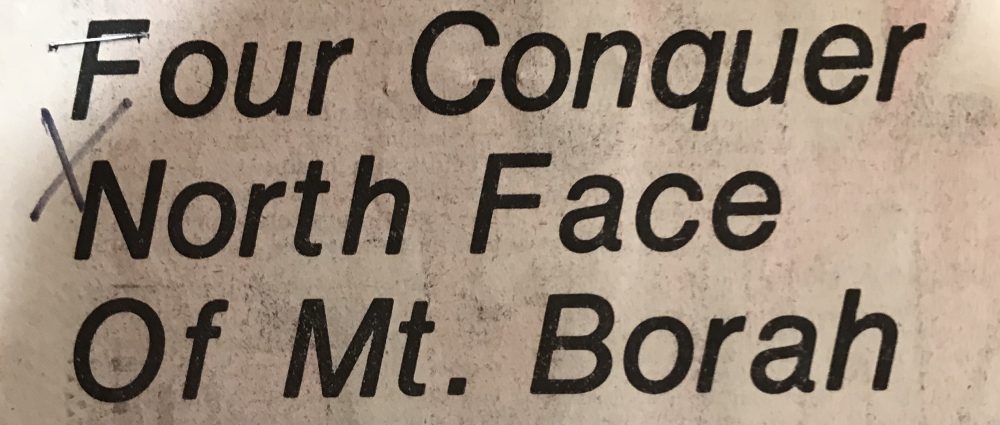
Bob Boyles, Mike Weber, Art Troutner and Frank Florence made the first Winter ascent of Borah’s North Face. Below you will find one of the few photos they took during the 16.5 hours they climbed and photocopies of 2 Idaho Statesman articles published at the time. Below you will find reminiscences of the climb from Bob Boyles and 3 Idaho Statesman articles which covered the climb.
Bob Boyles offered these details:
We climbed the North Face on January 8-9, 1977. The only reason we even considered doing the face in Winter was the drought of 1976-1977. The Winter started out very cold and dry, and it had only snowed a couple of times before we went. So we rolled the dice and hoped the face wouldn’t be loaded up and, luckily, it wasn’t. We got into waist-deep unconsolidated sugar snow on our descent, but it went all the way down to the rocks below and wouldn’t slide. It was weird because when you walked through it, it would push the snow 10-20 feet in front of you.
When asked about avalanche danger Bob pointed out that:
The North Face of Mount Borah has only been climbed two times in Winter to my knowledge and both were in 1977, two weeks apart. We did it first and another team from Ketchum (or maybe it was Idaho Falls) did it two weeks later after the cold spell passed. It never got cold again all that Winter.
What made the climb possible was the drought of 1976-77. During a normal Winter, the cirque would be a pretty risky place to climb. A couple of years after our Winter ascent, we went up in late September and, over a mile from the face, ran into the avalanche debris that carried Bruce Otto’s snow measuring equipment out of the cirque.
When we got over the cliff band and got a close look at the face, we could see that the whole thing had slabbed off leaving behind a 6-foot crown. The bivy site where we usually stayed was covered in maybe 30 feet of rubble. Realizing that more of the slab might come off, we hugged the left side of the moraine and did a different route far to the left of the face.
Curt and I did the North Face Direct the next year and the crown was still there presenting a short, vertical step that we had to climbed over. A few years later, another one came down the gully that crosses the main trail to Chicken-Out Ridge. Most people walk right through it without realizing what it is. That slide snapped 4-foot trees like toothpicks and ran at least a mile.
Bob pointed out the 1977 conditions were an extremely rare occurrence:
I fish for salmon and monitor the USGS Idaho streamflow site daily during the season. From USGS records, most of the all-time low streamflow rates for Idaho rivers were set in 1977. Those kind of conditions don’t happen very often and we knew it before we went for the North Face. We figured we’d get snowed out before we could get a climb in that Winter. If we had waited one more week the temperatures warmed (for the rest of the Winter) and we would have missed the arctic air mass that had set in. But…no one expected we’d see that kind of drought, and the face could have safely been climbed all Winter.
Bob also warns that “In a normal Winter,like we’re seeing this year, I would not go up on the face. One might be able to make it up the far left side of the cirque to gain the ridge, but that would bypass the entire face.”
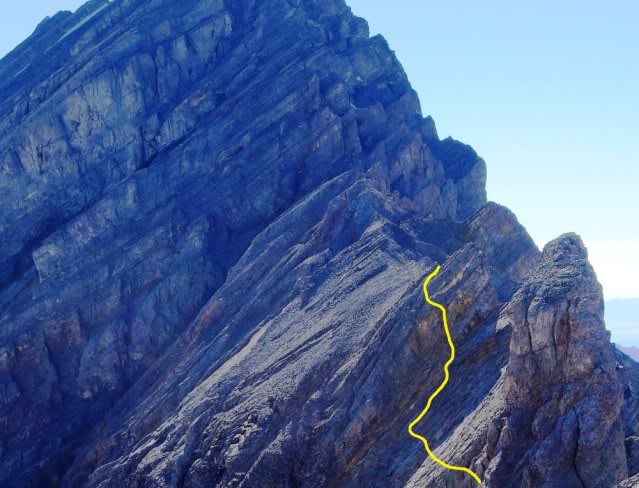
Bob Boyles supplied this photo, the only photo his team took on their Winter ascent of the North Face in January 1977. Frank Florence Photo
The first article discussed the upcoming attempt.
Idaho Statesman Article
The second article covered was an announcement that the climbers had succeeded. My copy was not in good enough shape to photograph so it is transcribed here:
By TOM GROTE
The Idaho Statesman
Four Boiseans Saturday successfully reached the summit of Mt. Borah, Idaho’s tallest mountain, the father of one the climbers said.Lou Florence, president of Sawtooth Mountaineering, said his son Frank Florence, Bob Boyles, Art Troutner and Mike Weber completed the climb in the dark about 5:30AM [Editor’s note: The original article listed the climbers addresses.]
The climb was completed a day earlier than planned, Florence said, because the four did not have to ski part of the way to the mountain. “The wind had blown away the snow and they tookadvantage of the good weather,” he said.Three of the 4 weatheredin good condition. Boyles suffered frostbite on 3 fingers. “We won’t know how bad until we see them,” Florence said.
The climb to the top of the 12,622 foot summit was believed to be the first Winter ascent along Mt. Borah’s North Face. The climb began about 1:30AM Friday, Florence said his son told him during a telephone call from Arco after the climb. “They ran into a snowstorm a few hours after they started, but the weather then cleared,” he said.Two hours into the climb, the party ran into winds of 20-30 miles per hour, adding a significant chill to the 15-degree temperature, he said. All 4 climbers made the summit after. 28 straight hours of climbing, twice as long as expected.
The climbers did not stay long at the top and left no mementos, Florence said. “They were very elated when they reached the top,” he said, “but the bad weather forcedthem to a take another way down than they had planned.”The four ate snacks during the climb. They were driving toward Boise late Saturday and were expected back around midnight, he said.
The usual Winter route to the summit ridge is on the Southwest Face, Florence said. Although the climbers were taking the more difficult route, they did not have the worst conditions possible. Deeper snow and colder temperatures hamper climbers in February and March, but a January ascent still qualifies as a Winter climb, Florence said.All four are experienced climbers, but only Frank Florence had prior experience on Mount Borah. In January 1973, he reached the top but lost the tips of 3 toes to frostbite.Another group tried to climb themountain in July, but was forceddown by winds up to 55 miles per hour.
Below you will find Bob Boyles’ favorite photos from the first ascent of the Direct North Face of Borah (October 1976). The North Face of Mount Borah is considered by some to be one of the finest alpine climbs in Idaho and one of the few faces that holds ice during most years. The lower face starts at around 45 degrees and steepens to around 55 degrees below the summit pyramid. This route takes the left branch of the main couloir until it ends at the short steep rock step (Class 5.7) and then follows low Class 5, Class 4, and Class 3 steps directly to the summit. In the early season (late Spring and Summer), this route is usually a steep snow climb. In late season (late Summer and early Fall), this route can be all hard alpine ice (10 pitches, WI3). In good conditions, this route can be climbed in a few hours. In poor conditions, this route can take all day. The Southwest (Chicken-Out) Ridge is often used for descent.
Mount Borah’s North Face Direct Route. Bob Boyles PhotoMike Weber “frenching up” on hard ice.Bob Boyles high on the North Face.Mike Weber at the start of the main couloir.Mike Weber on belay below the crux pitch.Bob Boyles topping out on the North Face Direct Route.Mike on the summit of Mount Borah.Bob on the summit of Mount Borah.
Editor’s Note: The following report by Wes Collins documents his remarkable Lost River Range traverse. His effort no doubt included a number of first ascents. His achievement is one for the ages. All the photos are by Wes.
Last Winter, I traded several emails with Bob Boyles and Frank Florence who both planned on making the trip with me. We decided to hammer it out in a leisurely 4-day trip in late Spring while we could still melt snow for water. However, life kept interfering with our 3 different schedules while Spring came and went as did the snow and the end of our plans. Reluctantly, we decided to put it off for another year but when September rolled around, I made a snap decision to drop everything and solo the traverse. Prior to this time, I had stashed water along the route and only had to iron things out with my own schedule. On a Saturday (3 days later), I was on my way up Mount Borah after leaving a rig parked at the base of Lost River Mountain. The trailhead parking/camping lot was overflowing and there were cars parked on the road all the way past the outhouse. A few hundred yards up the trail I ran into 3 climbers from Idaho (Tracy, Nate and Nashina) and I chatted with them all the way up. The newly-finished trail makes the approach much nicer.
The first hiccup in the trip happened when we got to Chicken-Out saddle, I was climbing down the last little rock knob when my only Nalgene bottle popped out of my pack pocket and took a long, LONG tumble out of sight down the South Side of the col. I immediately thought I’m not going down there to look for that. I had a one liter disposable water bottle that I could make due and I was in a hurry to start the trip beyond Mount Borah.
I stashed my heavy pack on the South Side of Chicken-Out Saddle and, with the load off my back, I practically floated to the summit where a large crowd was lounging in the sun. My adopted crew must have felt bad for me sans pack and plied me with food and drink. Cody Feuz even chipped in. I only stayed on the summit for a few minutes. I always enjoy the company of other mountain people and knew I’d be solo for days but I was anxious to be on my way. Too anxious perhaps. Fifteen minutes after leaving the summit and nearly to the big saddle, I tripped over my own feet and face-planted in a rare patch of soft gravel. My only fall, thankfully.
When I got back to Chicken-Out Saddle, I hopped off the South Col without giving it a second thought. I knew I needed that damn Nalgene bottle but, more than that, I was not going to leave trash on the mountain. I found it WAY down the chute. It had tumbled at least 150 yards but was miraculously intact. I made it back to my pack just in time to see Tracy, Nate and Nashina cruise over Chicken-Out Saddle on their way down.
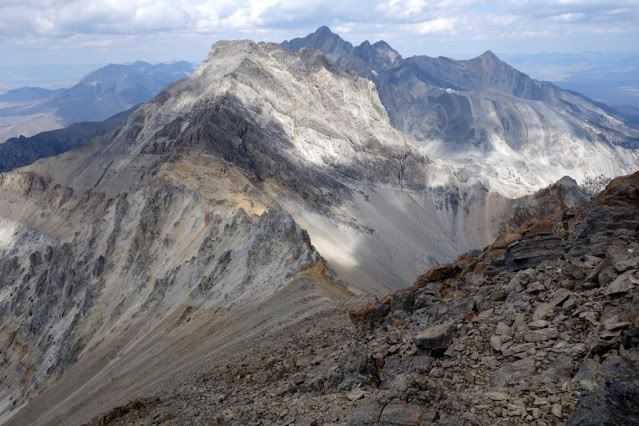
The ridge to Sacajawea from near Chicken-Out Saddle. Mount Idaho is on the right and White Cap Peak is in the middle.
The trip over to Sacajawea was uneventful but fun. There are a few alternatives to get to the top but they all involve Class 4 scrambling. My favorite is to stick to the ridge. The rock quality is great and the exposure is awesome.
A closer look at the Class 4 sections of the ridge.
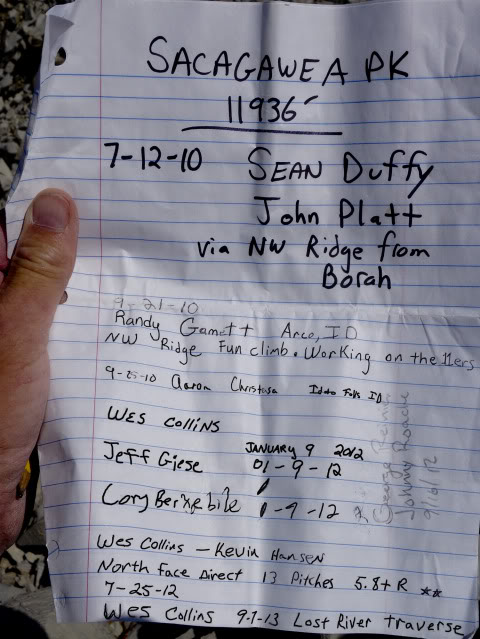
This was one of the few registers I opened in 4 days. I shouldn’t be mystified by this summit’s lack of visitors even though its right next-door to Mount Borah. There are other mountains to climb. Bigger mountains in different states. I should be more mystified by my own lack of imagination. What can I say. This range has an addictive nature and it still seems vast to me.
Sacajawea Register
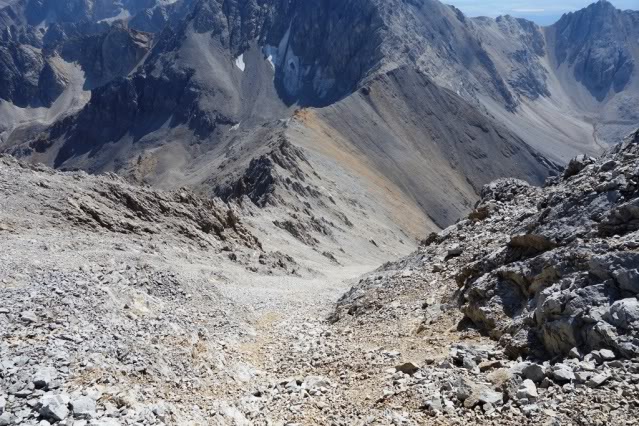
This descent to the Mount Idaho saddle looks like a straightforward scree-ski but sections of slab rock lie just under the surface, making this a slow and dreary slog. I had been down this side twice before and both times had been lured to the more stable-looking rocks on the ridge, but they are quite rotten and even slower going. This time, I just put my head down and followed the chute.
The descent off the South Side of Sacajawea.The descent route goes all the way down to the level of the big saddle and then crosses over. This chute is begging for a ski descent, probably a first ski descent from the mountain. Spring is coming!
I visited Merriam Lake several times in May through July and, on one of those trips, I stashed 3 gallons of water collected from snow melt just above the upper lake and then packed them up to the ridge. With plenty of water and a great view, camp below Mount Idaho was pretty comfortable.
Camp below Mount Idaho. Sun setting off the North Shoulder at 11,308 feet.
In the morning, I stayed in my sleeping bag until the sun warmed things up a bit and then headed up the ridge toward the summit of Mount Idaho. Several years ago, my first trip to the top of this mountain was up the North Face and I climbed/rappelled down the North Ridge so I knew what to expect. To avoid those steep sections, I climbed out onto the Northwest Side. There are several sections of Class 4 climbing and some Class 5 but the rock was pretty nice. With good route finding, most of that steeper stuff could be avoided especially if you stayed closer to a broken gully system near the North Ridge.
The North Ridge of Mount Idaho as viewed from camp.Looking back to Mount Borah from the summit of Mount Idaho.
The ridge from Idaho to the summit Peak 11967 was all new ground to me. I’d looked at it several times in the past and, although there are a few jagged sections, it looked passable. I tried to stay close to the ridgeline and mounted several Class 4-5 sections, but all of that could be traded for Class 3 on the West Side of the crest.
Looking at the North Summit of Peak 11967 from the saddle below Mount Idaho.Some of the nasty ridgeline to Peak 11967.More ridge pinnacles with Mount Idaho in the background.Looking back to Mount Idaho and Mount Borah from the North Summit of Peak 11967.White Cap Peak as viewed from the North Summit of Peak 11967.
I burned up a good part of the day in the pinnacles and didn’t cross the South Summit of Peak 11967 until about 2:00PM. To save time, I avoided the worst parts of the ridge to White Cap Peak by staying on the West Side.
Looking back at the South Summit of Peak 11967 from the saddle below White Cap Peak.
Some of the ridge sections were unavoidable without a down-climb out onto the West Side. The East Side of the crest was generally too steep throughout this trip. There were a few mandatory Class 4 sections but I was able to avoid anything steeper.
Looking toward the summit of White Cap Peak.From the top of White Cap Peak looking back at the South and North Summits of Peak 11967.White Cap Peak to Leatherman Peak.
I filled 3 gallons of water earlier from a spring above the Elkhorn trailhead and stashed them at Leatherman Pass. I put a few drops of bleach in two of the jugs and planned on using the other jug for cooking and coffee. The unpurified jug had a different lid so I wasn’t worried about accidentally drinking out of it. By the time I got to the summit of White Cap Peak, I was dehydrated. I hustled down to the stash and immediately took a good long pull off the first jug I came to. I only realized my mistake after I’d drunk at least a quart of the unpurified spring water. I wasn’t too worried though. It smelled OK and tasted fine.
I cooked a double-sized Mountain House meal and decided that I had time to get over the top of Leatherman Peak and into the saddle below Bad Rock Peak. By the time I hit the summit, I was feeling a little off my game. I told myself that it was just altitude combined with letting myself get a little dehydrated, but I was thinking I may have screwed up. Two years earlier, I’d seen mountain sheep drinking from the origins of that spring a few hundred yards above my collection point. There wasn’t anything I could do about it. If I got sick, I’d have to go down no matter which side of the peak I was on.
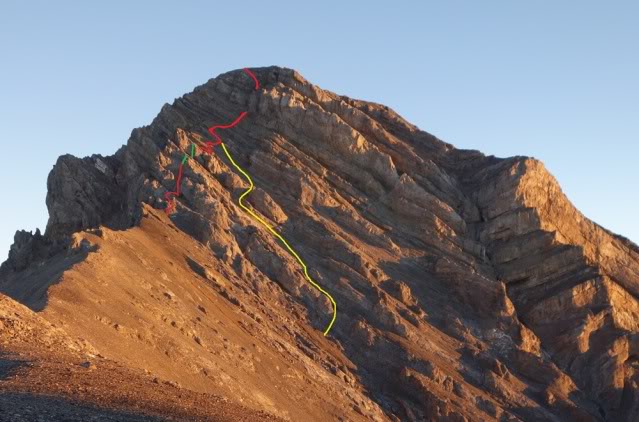
It was getting late and having been down the South Side of Leatherman Peak twice before, I knew the next several hundred yards would be tricky and slow. The trick is to avoid getting cliffed out and having to climb back up for a re-do. Usually this involves ignoring the obvious somewhat easier path half way down and sticking to a few rotten Class 4 cliff bands to your left. In my case, I used a rope and made 2 key rappels on the ridge proper.
Looking back at Leatherman Peak from the Bad Rock Peak saddle. Yellow (hikers route), red (my route), green (rappels).
Bad Rock camp was pretty comfortable and, like the first night, there was very little wind. I found a nice wide sheep bed to sleep on. In the morning, I woke up to a heavy layer of frost on my bag but it was another bluebird day. My stomach was still off but I definitely had not caught a bug like giardia. I forced a couple granola bars down and headed off, knowing this would be the toughest stretch.
Bad Rock Peak as viewed from the Leatherman Saddle. I have climbed this ridge twice and I knew that although it looks tough, its only Class 3. I made quick work of it.
I looked for a register on the summit of Bad Rock Peak but it’s gone missing. I have descended the South Face several years earlier and its every bit as difficult as the descent on Leatherman Peak. The same rule applies: stay on the ridge or face a long climb back up to the crest. I sat on the summit looking at the ridge beyond for a long time. I knew that it had been done in the past and that put me at ease. I REALLY wanted the summit of Mount Church from the ridge. I’ve heard rumors of it being climbed and was eager to follow.
Thirteen years ago, I traversed from Leatherman Peak to Mount Church by dropping off Bad Rock Peak and climbing Mount Church via its North Face which is an easier/faster alternative. On that trip, I studied the ridge to the summit and decided that it was impossible. However, when I got to the summit I read in the register that a solo mountaineer a few weeks ahead of me had done just that. I was bitterly disappointed in not giving it a chance and vowed to return and finish it.
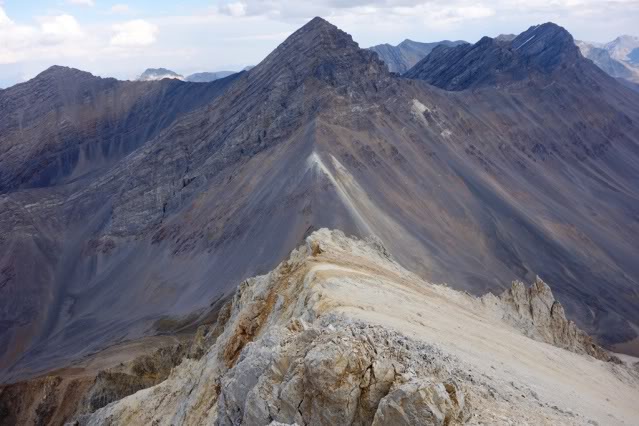
Mount Church as viewed from Bad Rock Peak and the second half of the ridge. The long, jagged slab sections and two rotten-looking towers make this the most wild part of the traverse.The first half of the ridge.
I cliffed out twice while trying to get to the start of the ridge and both times involved a pretty long climb back up to start over. Once on the ridge, the big slab towers I was worried about along the first two-thirds of the traverse proved nothing more than easy Class 3 and I made good time by traversing on their Northeast slabs. The last two (and biggest) were much worse. I skipped the first one by cutting around its Northeast Side but the last one would have none of that and it turned out to be the sketchiest bit of the whole trip.
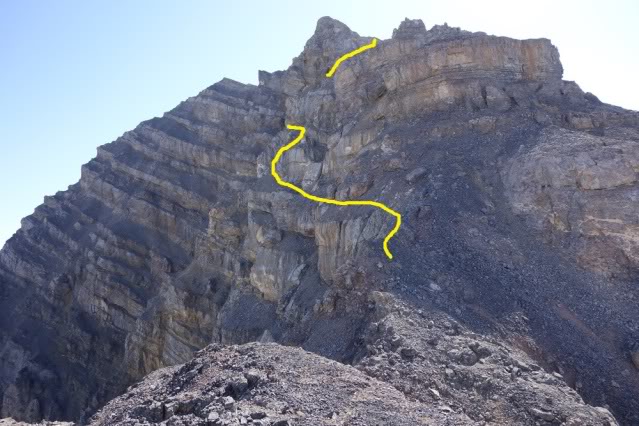
I planned on climbing right into the col between the towers but the closer I got, the more I realized it was a dead end. From the col, the ridge was blocked by a steep 80-foot buttress. To top it off, the rock quality was terrible. Instead of going all the way to the col, I managed to make my way up a line of weakness just below the crest. But there was a sequence of easy, but exposed, Class 5 steps and holds that could have (should have) blown out. By the time I got back to easier ground, I was pretty rattled. An easier solution would have been to traverse 30 feet lower and past the buttress.
My route up Rotten Tower #2. The possible lower traverse is partly shown at the bottom of the photo.
Back on the ridge, I continued right up to the face and found a place to choke down a handful of cookies. I studied possible lines but was absolutely unable to find anything suitable to start up. I knew if I could make it past the first cliff band, I’d have a good shot at the upper mountain. But that first 30-40 feet of rotten nastiness over a fatal fall zone really needed a belay. I worked my way back and forth across the ridge, hoping to find the key but it just did not materialize.
On one foray, I continued well out onto the West Side of the crest thinking there might be something, but finally admitted defeat. I may have been too demoralized by clawing my way up the rotten tower and felt I’d pushed my luck far enough for this trip. But as I write this, I still believe I made the right choice. At any rate, it was a huge letdown. I traversed the entire West Face looking for a break in the cliffs but, for the most part, they just got bigger and steeper. This long side hill took an enormous amount of time and, in the end, I was close enough to the Church/Donaldson tarn (located on the standard route at 8,600 feet) that I dropped down and tanked up at the greenish pond.
I finished off the water in my trusty Nalgene bottle and filled it along with the gallon jug I had stashed in my pack with boiled water. It was then that I found a split in the bottom of the now-useless jug and realized things were going to get tougher. I climbed back to the crest, dumped everything but the stove, Nalgene bottle and cooker out of my pack and cruised to the top of Mount Church. Earlier, while on top of Bad Rock Peak, I spotted a small snow patch near the summit of Mount Church and I was able to refill again there. I made it to the summit of Donaldson Peak in mid-afternoon.
Donaldson Peak to Mount Church.
Although I intended to make another water cache in the saddle between Donaldson Peak and No Regret Peak, I got lazy and never made it happen. I was still on familiar ground and made quick work out of the long ridge to the summit of No Regret Peak. There are several small sections of Class 3 surprises along this segment and, luckily, I remembered to traverse around the one 70-foot drop-off at the start of the final climb up to the top. If you miss this, it’s a substantial down-climb to get back around it.
Donaldson Peak to No Regret Peak. Class 3 and rotten.
From the top of No Regret Peak to the base of Mount Breitenbach, I was on my second and final stretch of unfamiliar ground. I planned on camping on the ridge just below the big 200-foot tower that blocks access to the top from the ridge. I did not make it far before I came to the first mandatory rappel. It was an easy 40-footer but I had to leave a nut and loop of 6MM cord behind. I pulled my rope and continued to the second and (what I thought) last rappel.
It was too long to do as a double-rope rappel, so I wound up leaving my rope as well as a large nut and small cam attached to the anchor. I knew this meant a return trip in the near future to collect gear, but it would have meant a long down-and-up climb to bypass the drop. I continued on and, as luck would have it, bumped into another straight 30-foot drop. I had to do the long back-and-forth after all. In fact, there were several tough spots on the way to Mount Breitenbach and it eventually ate up the rest of the afternoon.
No Regret Peak as viewed from the ridge to Mount Breitenbach.
With less than 200 yards to go, I ran into yet another 50-foot impassable drop. Again, the only way past it would require a long descent and return. I really wanted to sleep on the crest but there was not a suitable place in sight. I shot one last photo of Peak 11280 and headed down. What the hell, I needed water and I knew Jones Creek started pretty high up.
Triple Peak as viewed from the last drop to Mount Breitenbach. Beyond is Bell Mountain and a section of the Lemhi Range.
The descent went pretty slow because I was still looking for a short way around the drop and back to the crest. By the time I hit the first springs, it was pretty dark. I was sick from not drinking enough water and worse from drinking Leatherman water. I stuck my head in the creek and took a good long pull, then filled and drank a Nalgene bottle. To hell with boiling it. I continued downward, looking for a place to bivy and noticed my headlamp needed new batteries.
I pulled my spares out and found they were dead. I returned the dying ones and made the best of them, but it was not long until I was blindly stumbling around in the boulders. Just about the time I was admitting to myself I’d be doing a dreaded sitting-bivy, I found a flat rock on the lip of a 10-foot waterfall and, after moving a few rocks, I had a nice little nest. For dinner, I ate a handful of cookies as my stomach could not do another freeze-dried feast.
Sleeping that close to the creek was music to my dehydrated ears and, despite the rough bivy spot, I slept very well. I had descended a long way down from the crest and, while drifting off to sleep, I started entertaining the thought of bailing out for the truck at first light. My headlamp was dead, my water container was inadequate, and I was feeling pretty ill.
Jones Creek Camp.
In the morning, I laughed at the idea of bailing. I had a good night’s sleep and a handful of almonds with my coffee improved my disposition even more. I hung around camp for a good 3 hours, drinking water and reading the book I brought. Eventually I gathered up my gear (including the useless water jug) and was standing on top of Mount Breitenbach in just over 2 hours.
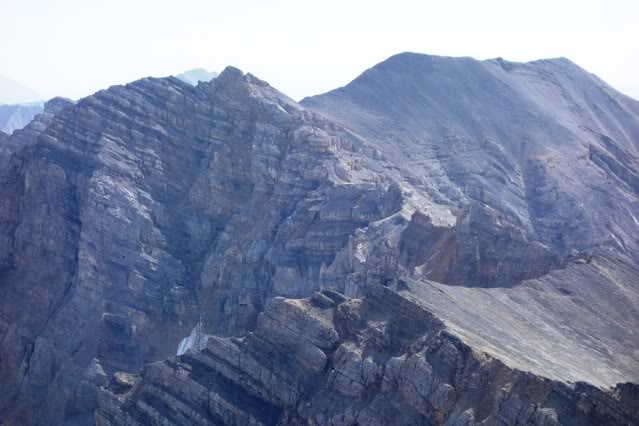
No Regret Peak as viewed from below the summit of Mount Breitenbach. The cliff bands made this part of the traverse pretty disheartening and, if I had to do it again, I’d drop 600 feet off the West Side of the summit and do the long side-hill traverse all the way over to Mount Breitenbach. The hike around this cliff on the way to the top (A). The first rappel (B). The second rappel (C). The first hike down and back up (D). The Second down and up (E). The last impassable cliff (F).
In my hurry the night before, I forgot to take a photo of Mount Breitenbach from the last cliff but I’d been between the summit and the last cliff several years earlier. There is a 200-foot steep buttress that is bypassed on its West Side by a short but exposed Class 4 wiggle.
The home stretch, Mount Breitenbach to Lost River Mountain.
I was on familiar ground once again. This section is easily the longest stretch of ridge between peaks and, although a good portion of it is easy hiking, there are several sections of Class 3- 4 rottenness. A broken sheep trail covers much of the distance on the West Side of the crest, making things even easier.
The last quarter of the ridge to Lost River Mountain.
The meat of this segment starts just before the final slopes to the summit and staying on or near the ridge can be perplexing. I’d describe it as climbing layer cakes of crap by finding the way up short cliffs and then searching for a way back down on the other side. There are a few places one has to leave the ridge (usually to the West Slopes) and climb around towers and obstacles but its all Class 3-4 unless you want to make it harder. On a previous trip, I’d bypassed this crux by climbing out to the right of the cliffs. This time I decided to explore to the left. It was all pretty rotten but fairly straightforward excluding one 15-foot section of rotten Class 5 over a steep scree-covered ledge. Beyond this tower, its Class 2 all the way to the truck.
The crux section.Looking back at Mount Breitenbach from just below the summit of Lost River Mountain. Mount Borah is visible in the upper left in the distance.
I was in fairly poor shape at this point. My water was long gone and all I was able to eat was the little pack of almonds. I sat on top and forced down some gorp for the descent while thinking about my return to things less significant than watching every step. I wondered how many miles I had covered and then decided it didn’t really matter. The miles covered up there are like dog years–1 seems like 7. A week later, I was back on top of No Regret Peak to retrieve my rope and gear. Three weeks after that, I collected my empty water jugs at Leatherman Pass as well as a golf club I brought down from the top of White Cap Peak. The water bottles below Mount Idaho will have to wait until Spring, I guess.
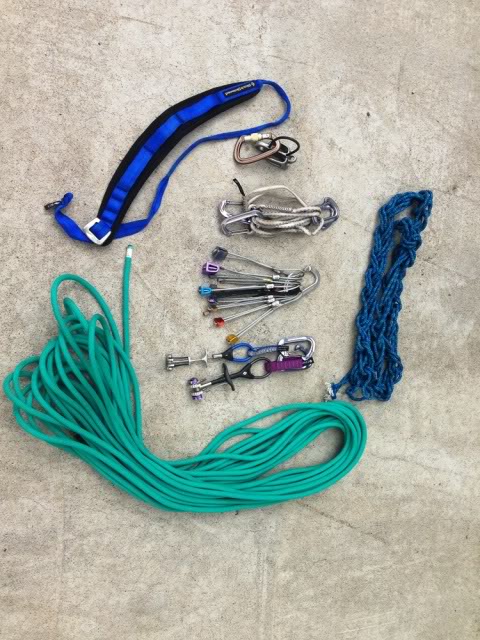
My gear
This was the kit I took and I only used it for rappels. The only place I’d have used it as a self-belay was at the base of Mount Church but I’d have had to set the base anchor pretty far from the climbing. The rope is a 9.1MM I’ve had for years and never used. I cut it in half to save weight. I used the blue gear sling as a swami belt and cut up pieces of the 6MM line for rap anchors.
Author’s Note. This is part trip report and part guide. I’ve left out a good many details in the hopes of preserving some of its mystique but I included reduced size photos of the entire ridge system. Get a hold of me if you want to see a larger version of any of them. (20MB)
Many of us have talked and schemed about doing this traverse and although there’s a lot of information out there, it mostly deals with individual sections. I know some have finished it and many have finished sections of it. If it’s on your wish list, I can tell you that it’s well worth the time and effort.
First Ascent: Bob Boyles, Mike Weber and Curtis Olsen
Rating: Grade III, 5.8, A2
Description
Provided by Curtis Olson, Mountain Guides Inc., Boise, Idaho (as published in the American Alpine Journal, Idaho, 1983)
Mount Breitenbach, North Face, Lost River Range
From July 13 to 16, Bob Boyles, Mike Weber and I made the first ascent of the North Face of Mount Breitenbach. Bill March had told me that some years ago his party was turned back by very severe rock climbing at the top of a large couloir. We easily identified the couloir and rock band.
We also discovered a possible route to the west of that couloir but still east of the summit. We pieced our climb together. It consisted of small, steep snowfields intermixed with steep limestone. The crux was a short aid pitch next to a waterfall which led us into a 900-foot long, 10-15 foot-wide hairline couloir that we followed to a bivouac on the skyline just east of the summit. In the dawn, we descended the East-Northeast Ridge in 2 hours of Class 4 climbing.
On the second ascent of this route, Duane Monte and Kevin Sweigert bypassed the aid on the overhanging waterfall (A2) by using a free variation to the east (Class 5.8).
Photo Essay by Bob Boyles
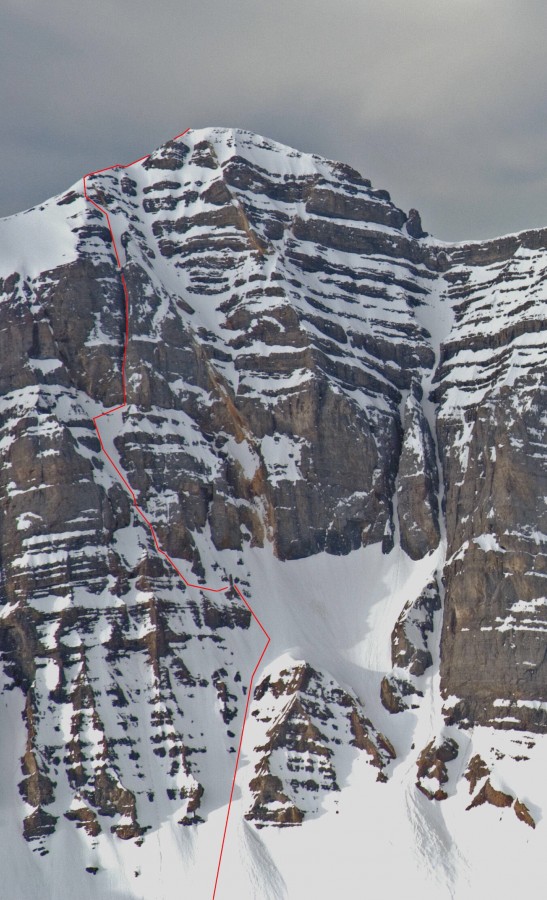
The North Face of Mount Breitenbach showing the Grand Chockstone Route. Wes Collins Photo
The Grand Chockstone Route on the North Face of Mount Breitenbach is shown above in red. There is a freestanding limestone stack about one-third of the way up the route where the route bends 90 degrees.
The stack. Curt Olson Photo
Amazingly, this stack appears to have survived the 1983 Borah Peak earthquake (magnitude 6.9) totally intact. This location is where the technical climbing begins.
Mike on the rock band pitch. Curt Olson Photo
This photo shows Mike on the rock band pitch between 2 hanging snow fields. All 3 of us rated this pitch as a dicey Class 5.8. And from this point on, retreat is not a very good option.
Mike topping out. Curt Olson Photo
Here, Mike is topping out at a marginal belay spot. Curt had 7 pieces of protection that consisted of copperheads and #1 and #2 stoppers strung together with equal tension slings on this belay. I clipped in and didn’t look at the anchors again until Mike finished this pitch. Faith be with us….
Mike on the traverse. Curt Olson Photo
This photo shows Mike traversing one of the hanging snowfields to the waterfall pitch.
Idaho has nine summits that reach over 12,000 feet and all but two lie within the Lost River Range in central Idaho. Idaho’s tallest and most visited peak, Mt Borah (12,662’), is located in the central section of the range. As the state highpoint, it is also very popular. During the summer months, it is not unusual to see a full parking lot and 50 or more people attempting to climb the mountain by its most popular route, the Southwest Ridge, or “Chicken-Out-Ridge” as it is more commonly known. For some classic snow or ice climbing, Borah also offers several hidden gems on its North Face, including routes written up in past editions of this journal. In spite of all of the traffic the mountain has seen, the remote East Face remained relatively unexplored and unclimbed until the summer of 2011.
Geology
Idaho’s Lost River Range is an actively uplifting fault-block at the northern end of the Basin and Range province. Extensional faulting has lifted the range relative to the down-dropped Big Lost River basin on its west side, producing steep ridges and slopes essentially devoid of foothills. Interior and eastern regions of the range are deeply incised by the Pahsimeroi and Little Lost Rivers. Most of the range, particularly in the central and southern regions, consists of thick layers of Paleozoic limestone and dolomite. Multiple episodes of tectonic deformation have resulted in dramatic open to isoclinal folding at a scale of meters to kilometers. Glaciation has carved numerous cirques throughout the range and alpine lake basins are scattered in the central and eastern portions. These combined activities have created an impressive assortment of large, high angled faces with western, northern, and eastern aspects.
Background
I first visited the eastern side of the Lost River Range (The Pahsimeroi Valley) in 1972, while working on a helicopter contract for the Forest Service. Flying through the range provided me a view that few ever get to see. While all of the range is impressive from the eastern side, one face stood out from the others. When our contract with the USFS finished at the end of summer, I took a break from the 24/7 aviation life I was accustomed to. During this down-time, I happened to notice an ad for an introductory rock climbing class and thought, “Wow. Cool. Ropes and everything, I’m game for this!” I talked a couple of friends into joining me for the class. After completing our class, we were ready to test our newly learned skills on a real mountain but winter soon arrived and we put our plans aside until the next summer.
Summer came late in 1973. It wasn’t until the end of June that we were able to get in for a closer look at the East Face. As the morning sun warmed the snow high in the cirque, we watched slide after slide tear loose and nail virtually every approach to the mountain. Along with the snow slides came a lot of rock fall as well. After sitting and studying the face, it looked to be climbable. There was no doubt, however, that the attempt would have to be made during the dry season. In 1974 we returned for another exploratory trip and picked out a line on the face that followed some water streaks in a nearly straight path to the summit. We decided that this was the route we would attempt on our next visit.
A couple of years passed. In trying to sell potential climbing partners, I described this face as “Idaho’s Eiger” but at the time, the range had no technical rock routes. Idaho has so much fine granite it was hard to justify a trip to the Lost Rivers, where the limestone rock had a reputation for being nothing but choss. In the fall of 1975, Mike Weber and I decided to throw caution to the wind and give this face a serious attempt. We loaded up all of the gear we thought we’d need and made the brutal drive to the end of the road up the West Fork of the Pahsimeroi River. Hiking through open sagebrush, we made quick work of the approach and found a nice grass-covered spot for our camp at the lower tarn just above timberline. Curious to see the face up close, we grabbed our crampons and axes and headed up the snow and ice to where the bare rock began. Just as we were approaching the final section of snow and the start of our proposed route, we heard a rumble from above, freezing us in our tracks. A Volkswagen-sized rock was flip-flopping down the face. Within seconds, it reached terminal velocity bouncing back and forth down the face. We stood motionless in our stances trying to figure out if we should go left, right, or just clasp our hands and pray. Fortunately, the rock deflected about 40 feet to our right. We just stood there watching it tear up snow and bounce to the flats and the tarn at the bottom of the cirque. We tried to convince each other that the face would be frozen up by morning but neither of us was to be convinced. Around 2:00 am we were startled awake by a blinding flash of light and milliseconds later, a rumble of thunder. We both knew our chances to climb were most likely over, so we pretended to go back to sleep. Within minutes, the rain was falling at a rate of an inch or two an hour, and shortly afterward our campsite became a flood zone. We stayed in the tent until it was surrounded by flowing water, our cue to get the hell out of there.
For decades after that ill-fated attempt, my climbing partners and I continued to explore and put up routes in the range. Despite those many visits, we never made it back to the cirque. I pretty much wrote off the East Face as being a very dangerous place and that kind of risk no longer appealed to me. Also, as time progressed, I gained the impression that sport climbing and bolted routes on established climbs were the “new norm” and the pioneering of new alpine routes seemed to have gone by the wayside. It wasn’t until the spring of 2011, during a discussion of Lost River climbs on the Idaho Summits web forum that a new spark of interest began. When I first described the East Face cirque, most local climbers did not know what I was talking about. This, despite most of them having climbed Mt Borah multiple times. One did, though. After reading my description of the face, Wes Collins, a local climber and native of the area, immediately became interested. Soon, a new discussion started about taking a trip to the cirque.
First Ascent – The Dirty Traverse Grade III 5.4
Wes Collins (solo) July 2011
Wes couldn’t wait to see the face up close so he took off on an exploratory trip with his wife and dog. This trip in 2011 started as a recon, but Wes found himself drawn to the face like a magnet. The following is Wes’ account of the first ascent.
Bob got me all fired up to get a look at the eastern cirque and what he described as Idaho’s Eiger. I certainly wasn’t disappointed. Susan and I planned the trip as a leisurely backpack into Lake 10,204 to take in the views, but I tossed an axe and some light crampons in the truck just in case.
I spent a lot of time looking at the face before I even thought about a spot for the tent. Stupidly, I’d left my axe and spikes in the truck, but at this point I knew I was going to make a serious try for the summit. It didn’t take long to pick out a couple possibilities, but the most probable line would involve a long traverse across a talus-covered ledge on the lower face. I started thinking of the route as the Dirty Traverse before I even put my boots on it. Morning was an easy laid-back affair. We sipped coffee and we watched the sun line slowly make its way down the mountain. I had to wait until nearly 10:00 before the snow softened enough for step kicking. The first, lower snowfield was pretty firm, but the second was much softer.
I’d found a nice tooth-shaped chunk of limestone that probably wouldn’t have done much more than keep my feet down hill if I took a fall. I was on my own, but it was still embarrassing to have the damn thing in my hand and I had to keep fighting the urge to hide it in my pocket. At the top of the snow, the randkluft was several meters deep and the first tentative moves on rock over the blackness below felt pretty exposed. The rock, however, was surprisingly solid and clean.
The scramble to the traverse ledge was fairly sustained Class 4, but the rock was good enough to make me forget about the exposure and enjoy the ride. The traverse ledge was quite tedious though and I wasn’t sure it would go all the way to the ridge until I got there.
Once on the ridge I made my way up an easy Class 5 seventy foot buttress but it could have been easily bypassed by scrambling around its west side. Most of the ridge above the traverse is Class 3 or easier.
As I continued up the ridge, my doubts got bigger. The entire north side of the East Ridge is very tall and overhung in several places. More and more I suspected it would dead-end into the headwall but at the last possible minute, a tiny col opened up onto the uppermost ledge that crosses the East Face. It wasn’t till that moment that I knew the ridge would go all the way. Splattski summed it up nicely in his trip report of JT peak as the almost magical opening of doors as you climb. This was one of the most fun parts of this outing. I couldn’t agree more.
The descent follows the standard route down the mountain to the big saddle at 11,800. From there, I dropped into the cirque that takes in the south side of Borah and Mt. Sacajawea. There are several sections of Class 3/4 scrambling over short but loose cliff bands and several linkable snowfields, but the glissade run-out potential is pretty dangerous on most of the snowfields. At the 10,400 contour the angle eases up. From there I hiked down and around the bottom of the East Ridge and finally back up to camp.
The East Face Direct III 5.9
First Ascent Sept 24, 2011 Wes Collins, Kevin Hansen
Second Ascent Sept 19, 2013 Kevin Hansen, Larry Kloepfer
Start at the highest glacial lake in the East cirque and walk around the north side of the lake for easiest access. Angle your way around the bottom snow field and trudge your way up the scree until you reach the first rock band. This is an easy Class 2-3 scramble for 20 meters or so. Once on top, pick your path of least suffering up the scree to the bottom of the snowfield. Depending on where you choose, this class 2 scree slope is not friendly. Loose dirt and gravel are stacked at a 50 degree angle for a few hundred feet. Once at the toe of the snow field, find a place to strap on your spikes. The slope is around 45 degrees and it is wise to bring crampons. Depending on snow conditions, an alpine ice axe could help. Hop the randkluft and get onto the face. From here the world is yours. At first sight it looks like 80 percent of the East Face is 5.6 to 5.7 climbing which is a good rating for the first 4-5 pitches. East Face Direct follows a dark water streak that passes just left of the top of the “Super S” as Kevin called it. The “Super S” is a large obvious fold in the rock strata that composes the lower right quarter of the East Face. At any time, a team could climb side ways (off route) to the right or left a few hundred feet to avoid the more difficult sections. The direct route stays plumb with the top, following the dark water streak to find the best rock. Because most of the climbing is 5.6 – 5.7, groups may choose to simu-climb many of the pitches. Teams that wish to set up a solid anchor every rope length could discover the route is close to 9-10 pitches. As with all mountaineering, speed is safety. Several class 2-3 scree slopes divide the rock pitches. One short pitch was a solid 5.9 with a protection less small overhang. It’s the finest part of the route. Once past the final head wall, put the rope away and enjoy the last 300 feet of class 2-3 scrambling to the summit.
East Face/Northeast Ridge Variation III 5.6 WI2
First Ascent – July 25, 2012 Bob Boyles, Frank Florence
While this route is not overly difficult, it does require a willingness to climb with long run-outs and minimal protection both at belays and while leading. Many of our belays were protected with a single piece of gear and most pitches only allowed for a few placements. Rockfall, both self-initiated and trundled from the summit is an ever present danger on this route.
The route starts slightly to the right of Wes Collins’ Dirty Traverse route and follows the slab like ramps for about 6 pitches of 4th and low to moderate 5th class climbing until you reach the ledge system that allows for an exit to the Northeast Ridge. From there we climbed 2 pitches of very steep snow and joined the ridge. On the Northeast Ridge we encountered a short section of water ice (WI2) and several more pitches of moderate 5th class climbing until just below the summit, where it turns to easy, but very loose 3rd and 4th class climbing.
This route is probably best done when there is some remaining snow to cover loose scree and talus (June – July) and during some years it may not be climbable at all due to the large cornice that can form and block the narrow exit to the Northeast Ridge. Parties willing to solo or simu-climb can reduce the overall number of pitches required on this route.