Category: Jack Schwabland

  • FIFTY YEARS OF SAWTOOTH CLIMBING 1934-1984 By Dave Bingham

    FIFTY YEARS OF SAWTOOTH CLIMBING 1934-1984 By Dave Bingham

    When Robert and Miriam Underhill first gazed from the top of Galena Summit in Idaho’s Sawtooth Wilderness, before them stretched a wild mountain panorama never before seen by mountaineers. It was 1934 and in those days the road past the future site of Sun Valley to the summit was little more than a rutted sheep wagon track. Approaching the remote and rugged central Idaho mountains was a long, slow trip, but the Underhills were keenly aware of the once-in-a-lifetime opportunity awaiting them in the Sawtooths.

    The educated and well-to-do Underhill was hardly a newcomer to mountaineering. He had an impressive resume of ascents in the Alps to his credit, and is generally regarded as one of America’s most influential early climbers. As editor of the outdoor journal “Appalachia”, Underhill spread his enthusiasm and knowledge of technical climbing through the pages of his journal and on his frequent climbing trips to the Rockies and the Canadian mountains.

    Underhill became “a driving force” in Wyoming’s Teton Range, establishing the bold North Ridge route on the Grand Teton in 1931, a climb that was considered the most difficult in the country at the time. Having made his mark on the well-trodden Tetons, the insightful Underhill ventured north to the unexplored Sawtooths, lured perhaps by rumors of virgin peaks and soaring rock towers.

    After a long journey, Robert and his wife Miriam finally made their way to the glacially- sculpted Sawtooth Valley, where they recruited local homesteader and mountain-lover Dave Williams to serve as outfitter and guide. In a few short weeks, the three adventurers pioneered the first ascents of over twenty of the Sawtooths highest peaks, including Mt. Thompson [10,759 feet] and the formidable Mt. Heyburn [10,229 feet].

    Williams turned out to be not only a fine companion but quite an able cragsman who reportedly preferred to climb the more difficult pitches barefoot!  Although they usually took the easiest route up the peaks, their pioneering efforts and sheer quantity of first ascents stands out as a fine accomplishment of rare opportunity.

    Returning to work as editor of “Appalacia”, Underhill wrote of the Sawtooths: “I think there is quite a lot to engage the interest of the rock climber…“ and “two of the summits we could not master, nor do I believe that they are surmountable except by throwing a rope since they are sheer monoliths.” Underhill also reported “Rock towers of the genuine Chamonix aiguille type, each several hundred feet high which would provide magnificent ascents if they could be climbed at all.”

    The situation in the 1930’s was a far cry from today, yet it seems the motives of the early climbers haven’t changed much over the years. When L.G. Darling made a trip to the Sawtooths in 1940 he commented, “we all agreed on two very important points: we all wanted to get to the top of Mt. Heyburn and we all liked to eat.”

    The range was mostly quiet for several years following the Underhills visit, and World War II put a stop to what little climbing activity there was. Two notable Teton climbers (Dick and Jack Durrance) did manage a quick visit in 1940, to attempt the higher of the two “aiguilles“ described by Underhill. They reportedly came close to making the summit but were turned back by oncoming darkness.

    It wasn’t until 1946 that a group of Iowa Mountaineers, guided by Teton hardman Paul Petzolt, made any significant ascents. On the club outing, they succeeded in a number of climbs including a landmark ascent of one of the Sawtooths most-ominous towers, the spectacular Warbonnet Peak. After some difficulty in finding a feasible route from the west  side, the group of six (with Petzolt and Bill Echo in the lead) made the top via an exposed summit ridge [Class 5.6].

    The ascent of Warbonnet was an ambitious project for the day. A later climber described the final pitch like this: “The sheer walls on either side of the rooftop overhang menacingly into nothingness below. Holds are a bare minimum and piton cracks zero.” The first ascent party also wrote that Warbonnet “should be classified with the few really difficult summits in this country.“

    Warbonnet is located in the rugged heart of the Sawtooths, surrounded by numerous peaks and smaller rock towers beyond the abilities of the Iowa Mountaineers. The group did name several peaks though, including “Fishhook Tower“, “La Fiama”, and a monolithic peak they dubbed “Old Smoothie”. Of the latter they wrote: “One of the most striking rock pinnacles in the country; a smooth spire of granite topped by an obelisk that has an overhang on all four sides”.

    In those days, pitons were just beginning to gain wide acceptance, and aid climbing was even considered something of a cheat. Modern aid techniques were unknown, so when Petzolt did a new route on Mount Heyburn using a controversial two-rope tension system, it was heralded as “the latest development in technical climbing.”

    Following their 1947 Sawtooth outing, the Iowa Mountaineers devoted several articles on the range in their annual club journal. There were stunning photos of the spires in the Warbonnet area and maps of their approaches. The word on the Sawtooths was out and spreading among the country’s top climbers. It was now only a matter of time before the arrival of Fred Beckey.

    In 1949, Beckey descended on the Sawtooths. In typical fashion, Beckey eliminated dozens of aesthetic and difficult routes from his first ascent list. Ruthlessly exploring nearly every corner of the range, Beckey brought with him a level of energy and ability far above the mere mortals who came before.

    Unlike many of his conservative predecessors, he used pitons, bolts, and direct aid liberally. On his first ascent of “Old Smoothie“, Beckey surmounted the flawless summit block with a 22-bolt ladder! This marathon drilling session is unequaled in the range and possibly unrepeated due to removed bolts.

    A lot has been said about the poor quality of Sawtooth granite. At its best, the stone is as good as any in the world, while much of the rock, especially on the easier routes, is decomposing and gravelly. The “ball bearing“ granite can certainly be discouraging and has been described as having a texture “more like that of a stale donut.” But the abundance of bad rock did little to deter Beckey, who on his ascent of Underhill’s “Grand Aiguille“ reportedly drove his aid pitons directly into the rock!

    In the Sawtooths as elsewhere, Beckey preferred not to climb any route that was not a first ascent. The following story, told by one of Fred’s Sawtooth partners, Louis Stur, illustrates: “We were climbing a route on a little tower called Silicon Peak, near Warbonnet. We assumed that the route was a first ascent but as I was leading the last pitch, probably not more than 30 feet from the summit, when I discovered a piton. I had to call down to Fred and Jim Ball and say, Gentlemen, I’m sorry to say but I’ve found a piton! Beckey got absolutely furious! He said “You should have known this peak had been climbed! You guys are locals! So Fred wouldn’t go on to the top, he just announced “We’re going down.”

    As it turned out, they had actually made the first ascent of a new route, a route that joined Colorado climber Harvey Carter’s first ascent route just short of the summit. Carter had come to the Sawtooths in 1956 with a returning group of Iowa Mountaineers. The outing that year included such noteworthy climbers as Herb and Jan Conn, who pioneered routes in New Hampshire and in the Needles of South Dakota. Also on the team were Joe and Paul Stettner, the “working  class climbers” who made important explorations on Colorado’s  East Face of Longs Peak.

    Carter and a partner hiked into the pristine Baron Lakes drainage, where they made the ascent on Silicon Peak and several other smaller towers. The rest of the group kept busy doing repeat ascents in the Heyburn and Thompson areas, plus a first ascent of the unusually-shaped Chockstone Peak. Still, the outing was essentially a pleasure trip and did little to advance local standards.

    Around the same time, skier-climber types, who worked at the nearby ski resort of Sun Valley, began to establish more difficult routes on the peaks. Louis Stur, a charming native Hungarian and now manager of the Sun Valley lodge, was one of the most active. Unaware of any prior mountaineering activity, Stur and friends re-explored the range and made numerous ascents. In 1958, Stur established a route on Mt. Heyburn that has since become the most popular route on the mountain due to its relatively high-quality rock. Louis also teamed up with Beckey on several occasions until the time when Beckey, according to Stur, “went on to bigger and better things.”

    It was the summer of 1963 when Beckey did just that. Together with Steve Marts and Herb Swedlund, Beckey tackled the most formidable wall in the Sawtooths: a unique Yosemite-like face known as the “Elephant’s Perch.” This 1,200-foot wall was climbed with much aid and with ropes fixed over nearly the entire route. It was the first Grade V in the range, and represented a giant leap in scope and technical difficulty over any other Sawtooth peak. So despite the fixed ropes and several bolts, the route stands as a fine achievement, not far from the standards being set in comfortable Yosemite, yet in a remote wilderness setting. A typical Beckey route, it follows a beautiful natural line up the highest part of the face. The grade, also typically Beckey, is Class 5.8/A2, of course.

    A couple years later, in 1965, the Iowa Mountaineers  returned for a third time. Unlike on their previous visits, the mountaineers placed their base camp at the far end of Redfish Lake, where access to the peaks was much better. Hans Gmoser, an Austrian guide living in Canada, was hired and led a number of new routes out of Redfish Creek. Among these was the Eagle Perch, a classic rock tower that Gmoser likened to the Piz Badile in the Alps.

    Teaming up with Bill Echo and others, Gmoser made another first: an airy aid climb up the intimidating pillar of Flatrock Needle. Still, nothing was done that equaled Beckey’s route on the Elephant’s Perch. Interestingly, the group even reported in their journal that they had made the first ascent of the Perch that year, via a scramble up the northwest slopes!

    Beckey returned to the Sawtooths several more times over the years, always adding new routes. Louis Stur, with various partners, circled Warbonnet with routes. But with the majority of peaks and spires having been climbed, the scene was stagnating. The time had come for new blood in the Sawtooths and a new concept of what climbing was all about.

    It was the late 1960’s, and California’s Yosemite Valley was the breeding ground for a host of new ideas, energy, and equipment. Somehow, a few stray Yosemite climbers found their way to Idaho where their influence took root. No longer interested in peak-bagging, the new arrivals focused their attention on the most Yosemite-like feature in the range: the Elephant’s Perch.

    Gordon Webster had moved to Sun Valley and was one of the first of the Yosemite clan to recognize the possibilities in the Sawtooths. In California, Webster had established a number of fine free climbs in the Valley and elsewhere, including the first ascent of the classic “Travelers Buttress” [Class 5.9] at Lovers Leap.

    In 1968, Yosemite guidebook author Steve Roper teamed up with Webster for a trip to the Elephant’s Perch. They chose a bold line on the East Face, a clean five hundred foot high dihedral they named “the Sunrise Book” [A3+]. Over the next two summers, Gordon and friends established two more Grade V routes on the main wall and a few shorter lines. One of Websters partners was Rob Kiessel, who went on to partake in the first winter ascent of the Northwest Face of Half Dome, and later became head coach of the U.S. National Nordic Ski Team. Nut protection was just catching on when Jeff Lowe and Dick Dorworth made a “clean” ascent of the Beckey Route, which had required 110 piton on the first ascent.

    It should be noted that although the rock type and actual climbing on the Perch was similar to that in Yosemite, the remote wilderness setting made the climbing far more committing and serious. No trails lead to the wall and climbers were forced to traverse the 5-mile Redfish Lake by boat, follow the creek for a few more miles, and finally haul their loads up 1,500 feet of rock slabs and talus slopes. Any effort on the Perch entailed a multi-day effort with no hope of rescue in case of a mishap.

    Nonetheless, more and more climbers took up residence in the Sun Valley area and the list of routes on the Perch steadily grew. Other smaller crags were also explored, purely for their free-climbing potential.

    It was not until 1976, however, that the first Class 5.10 came to the Sawtooths. That summer, two young climbers (Jeff Hall and Jim Catlin) visited the Perch, establishing two major routes on the main wall. “Myopia” and “Hook and Ladder” both required sophisticated aid techniques as well as hard free climbing. Tragically, Jeff Hall was killed in Yosemite a few years later in a climbing accident.

    The following year (1977) marked the arrival of a young thrillseeker from Georgia who was to become the Perch’s most prolific route developer. Reid Dowdle had spent several summers in Yosemite, the Tetons and elsewhere, working the usual odd jobs to support his climbing and skiing habits. When Dowdle discovered the Sawtooths and the great backcountry skiing to be had in the winter months, he was hooked. He decided to make Sun Valley/Ketchum his home.

    Since then, Dowdle has repeated all of the Perch’s established routes and added at least seven others. In his characteristic independent manner, Reid would haul loads of food and climbing gear up to a bivouac at the base of the rock, waiting for the outside chance that someone would show up needing a partner. If no one showed, Dowdle would simply rope solo his chosen Grade V.  Other local climbers made their mark on the Sawtooths, although often on shorter routes of moderate difficulty. Olympic downhill skier Pete Patterson was active and, with four time “Survival of the Fittest“ contest winner Kevin Swigert, climbed several off-the-beaten-path routes.

    Jeff Lowe returned in 1981, enlisting Swigert for a new route on the North Face of Warbonnet Peak. Their “Black Crystal Route” has several Class 5.10 pitches followed by a free version of Beckey’s bolt ladder on the summit block at Class 5.11+. Although the climb was considerably harder than anything done before, it remained an isolated incident. The major new route activity was still firmly dominated by Dowdle and friends. But just when Dowdle’s dominance seemed assured, a pair of talented and aggressive hotshots from the east arrived to stir things up.

    Honed and psyched, Jeff Gruenburg and Gene Smith hit the Perch intent on, in their words, “rape and pillage.” Armed with cheap Chablis, strong fingers, and strict Shawangunks ethics, the “gunkies” went directly to Beckey’s original route, set on making it a free climb. They succeeded in their goal except for a ten-foot tension traverse on the first  pitch, creating a superbly sustained free climb with six Class 5.10 pitches in a row followed by more Class 5.9 and Class 5.10.

    When the team came into the local mountain shop announcing that they had made the first free ascent of the Beckey Route, they were surprised to learn that Dowdle had made the same ascent the week before! A small controversy was stirred up when the New Yorkers expressed doubt whether the locals had done the route in clean style. Questioning if rests were taken on protection, they stated “Where we come from, when we say free, we mean free-free!”

    Despite a few hard feelings, who gets credit for the first free ascent of the Beckey Route is of little consequence. What is important is that the New Yorkers had stirred up the local scene and encouraged development of a higher standard of free climbing. Before they left, the gunkies free climbed the Catlin-Hall route “Myopia” at a thinly protected Class 5.11, and added a three pitch Class 5.11+ pitch they dubbed “the Wendy.”

    The next year (1983), Gruenburg returned to the Perch, this time with another Shawngunk regular, Jack Milesky. For the easterners, the prospect of clean, multi-pitch first free ascents was almost too good to be true. Describing his winter training program Gruenburg pantomimed doing pullups, saying “ten more…for the Perch!”.

    They began by cleaning up the remaining aid on Webster and Roper’s Sunrise Book, freeing the original A3+ dihedral at Class 5.11+, followed by the crux Class 5.12 pitch. The pair also pulled off an as-yet unrepeated new route consisting of thin discontinuous cracks with difficult sections of poorly-protected face. With no bolt kit, hammer, or pitons, they climbed in bold style a route that would likely have seen bolts had it been done by locals.

    In the past couple of years still more routes have been added to the Perch and surrounding peaks. February 1984 saw the first winter ascent* of the Perch, a siege of the Beckey Route. Most of the better quality aid routes in the range have been free climbed and the Perch has been free soloed.

    Still, there are always new routes to do, although the pioneering days are over. And even though climbers have been to every corner of the range, local climbers like to think of the Sawtooths, and especially the Perch, as a big secret. In a way it is, or at least it feels that way. But this is probably due more to Idaho’s remote location and a difficult approach than any other factor.

    For the locals, this is a good thing. We like the peace, solitude, and mosquitos of our backyard mountains. Over the years the climbers come and go, luckily without leaving many signs of their passing. The mountains themselves remain much the same as when Robert and Miriam Underhill first explored the peaks over fifty years ago.

    *[Editor’s Note: The winter ascent of the Perch was done by Paul Potters, Steve Morris (from Boulder) and Dave Bingham.]

  • Fred, Pete and Jack’s Big Sawtooth Adventure by Ray Brooks

    Fred, Pete and Jack’s Big Sawtooth Adventure by Ray Brooks

    The Summer of 1949: Fred Beckey, Pete Schoening and Jack Schwabland went into Idaho’s Sawtooth Range to finish “some business” with two peaks that had repulsed their climbing attempts the previous Summer. They also had a shopping list of other unclimbed peaks in the Sawtooths. Their “Idaho adventure” may well be the most exciting epic in Idaho’s climbing history.

    Fred Beckey passed away at age 94 in 2017, after becoming a “living legend” in climbing circles as the man who had done the most first ascents and new routes in North America. Pete Schoening is most famous for saving 5 of his team-mates when they fell on K-2 during a 1953 expedition. Pete was also part of the group that made the first ascent of Gasherbrum I in 1958, the only 8,000 meter peak first climbed by Americans. Jack Schwabland was a highly respected climber who took part in many first ascents in the Northwest.

    The only write-up I have been able to find of their Sawtooth adventures is an photo-less article by Jack Schwabland in the 1950 American Alpine Journal: “Sixth-Class Climbing in the Sawtooth Range.” To chronicle their “Big Sawtooth Adventure,” I will include extracts from that article along with my own photos and experiences on these peaks.

    Their “shopping list” for the trip included: Fishhook Spire (i.e., El Pima) and Big Baron Spire (i.e., Old Smoothy) in the Baron Creek drainage, Red Finger (i.e., North Raker) in the South Fork Payette drainage and The Grand Aiguille in the Redfish Lake drainage.

    Fred, Pete, and Jack entered the Sawtooths by boating across Redfish Lake, then hiking 5 steep miles to Alpine Lake, where they left their “base camp” with a reserve cache of food and equipment. Then, with somewhat less-heavy packs, they hiked north over a pass to Baron Lakes and their first objectives. This was the era of heavy war-surplus gear and canned food for climbing trips, so their original packs likely each weighed in the 70 pound range. In 1948, Fred and Jack had been part of a group that failed in attempts on both Fishhook Spire and Big Baron Spire. On this trip, they had bolt equipment and more gear. They planned on achieving first ascents of each.

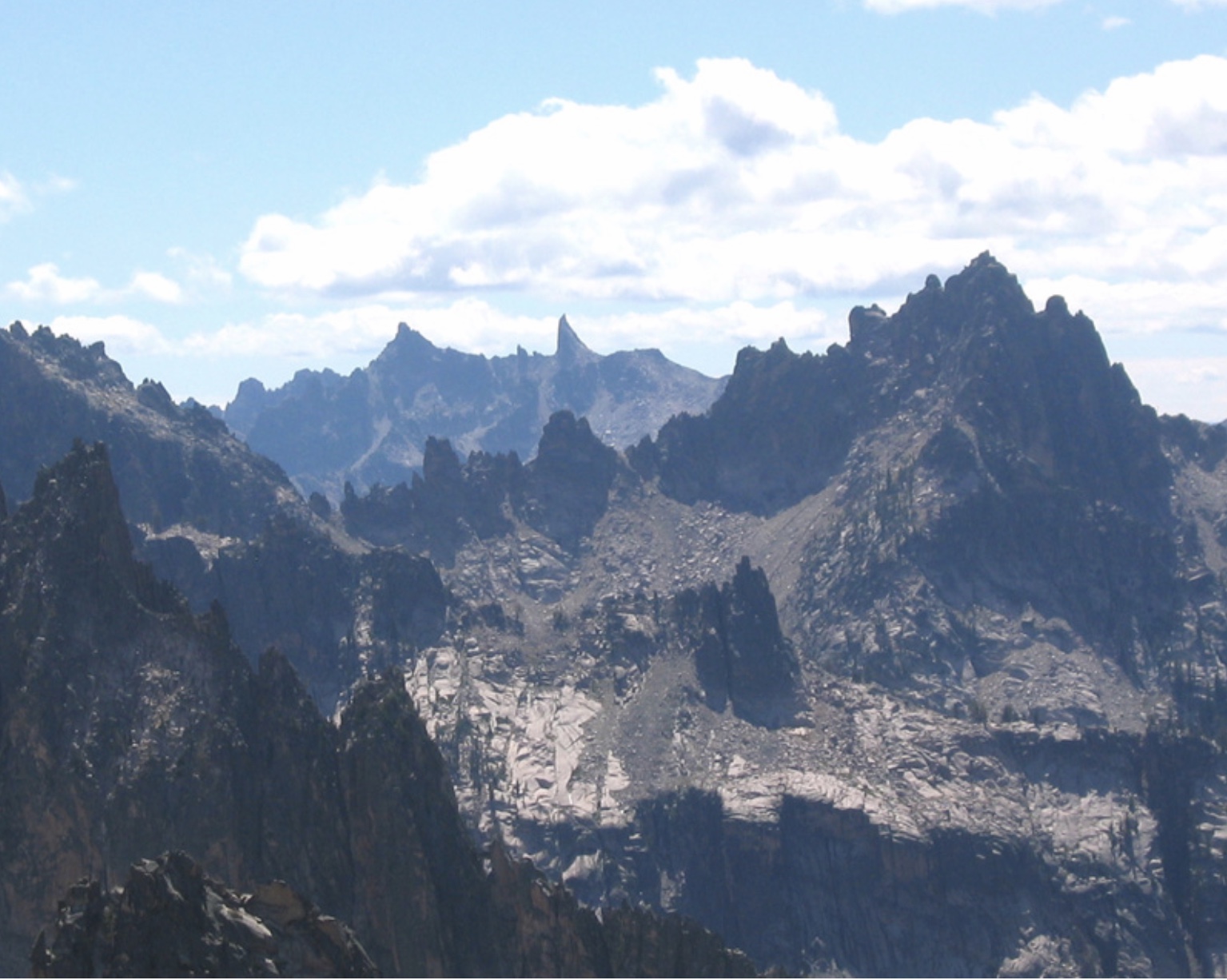
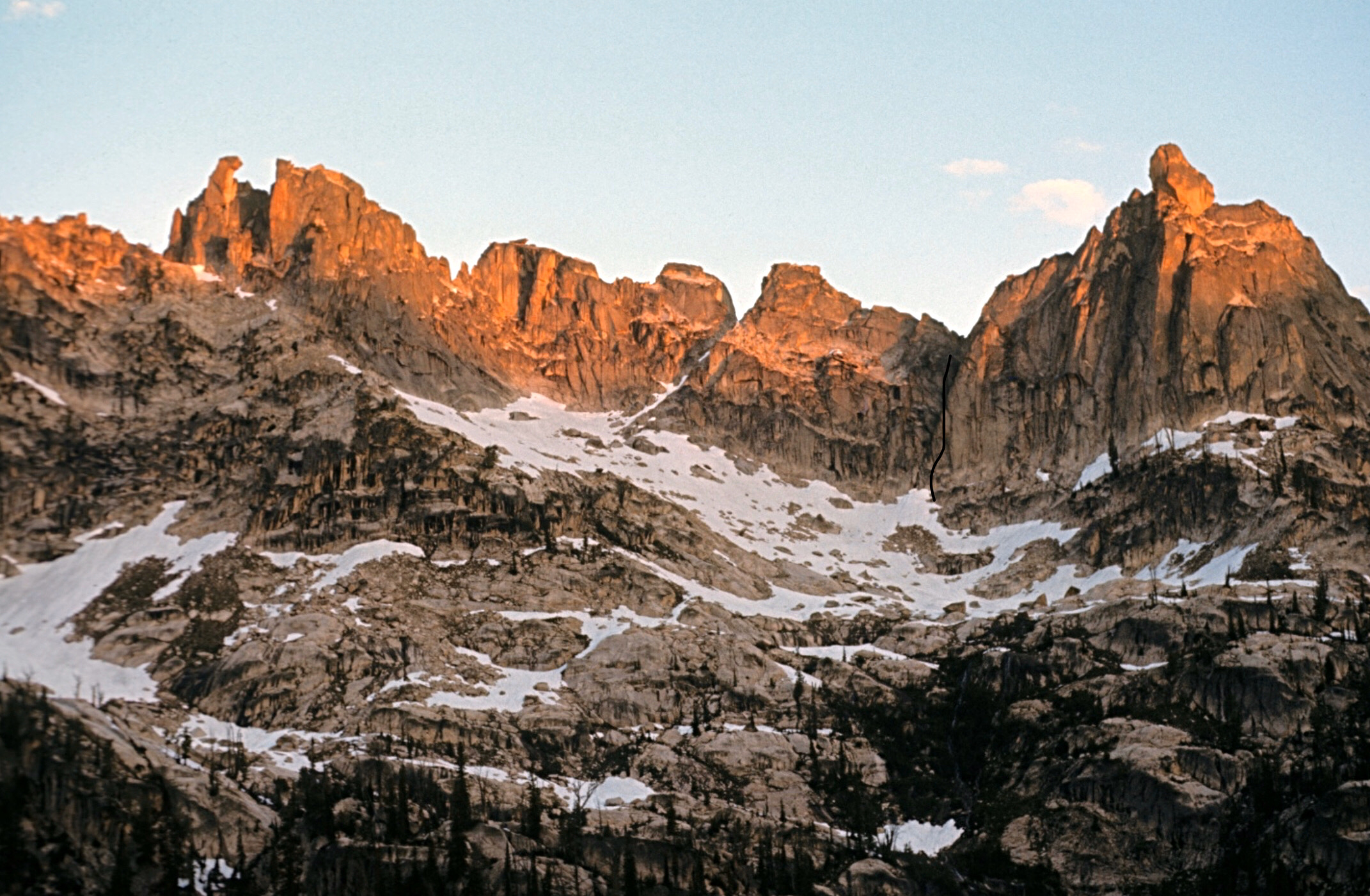
    View north from the Redfish Cr./Baron Creek divide of some of the many rock towers above Baron Lakes.   Fishhook Spire (now El Pima) at top left.  Big Baron Spire is on the far right. The 1949 route up Big Baron Spire starts below the V notch with snow, well left of Big Baron Spire, then traverses horizontally across the light colored area to the closer notch, and up the ridgeline. Ray Brooks Photo
    View north from the Redfish Creek/Baron Creek Divide of some of the many rock towers above Baron Lakes. Fishhook Spire (El Pima) is at top left. Big Baron Spire is on the far right. The 1949 route up Big Baron Spire starts below the V notch with snow, well left of Big Baron Spire. It then traverses horizontally across the light-colored area to the closer notch and up the ridgeline. Ray Brooks Photo
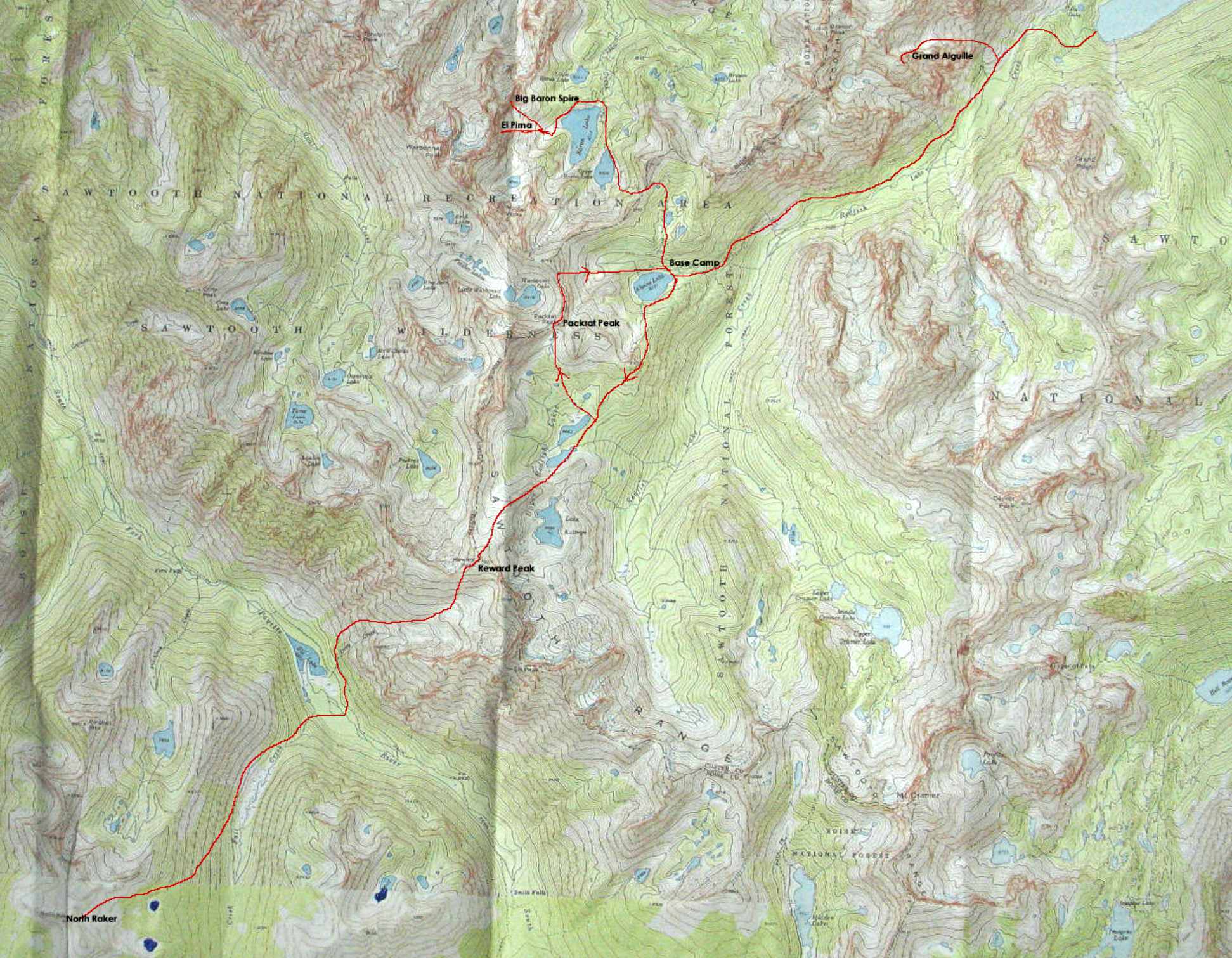
    Map of the Sawtooth adventure area with routes taken marked in red.  
    Map of the Sawtooth Adventure area with the routes marked in red.

    On the first day at Baron Lakes, they hiked up to Fishhook Spire’s East Face, donned tennis shoes and “wiggled up a series of steep dirt-filled chimneys to a tilted rock pile some hundred feet directly below the great overhang on the summit block.”

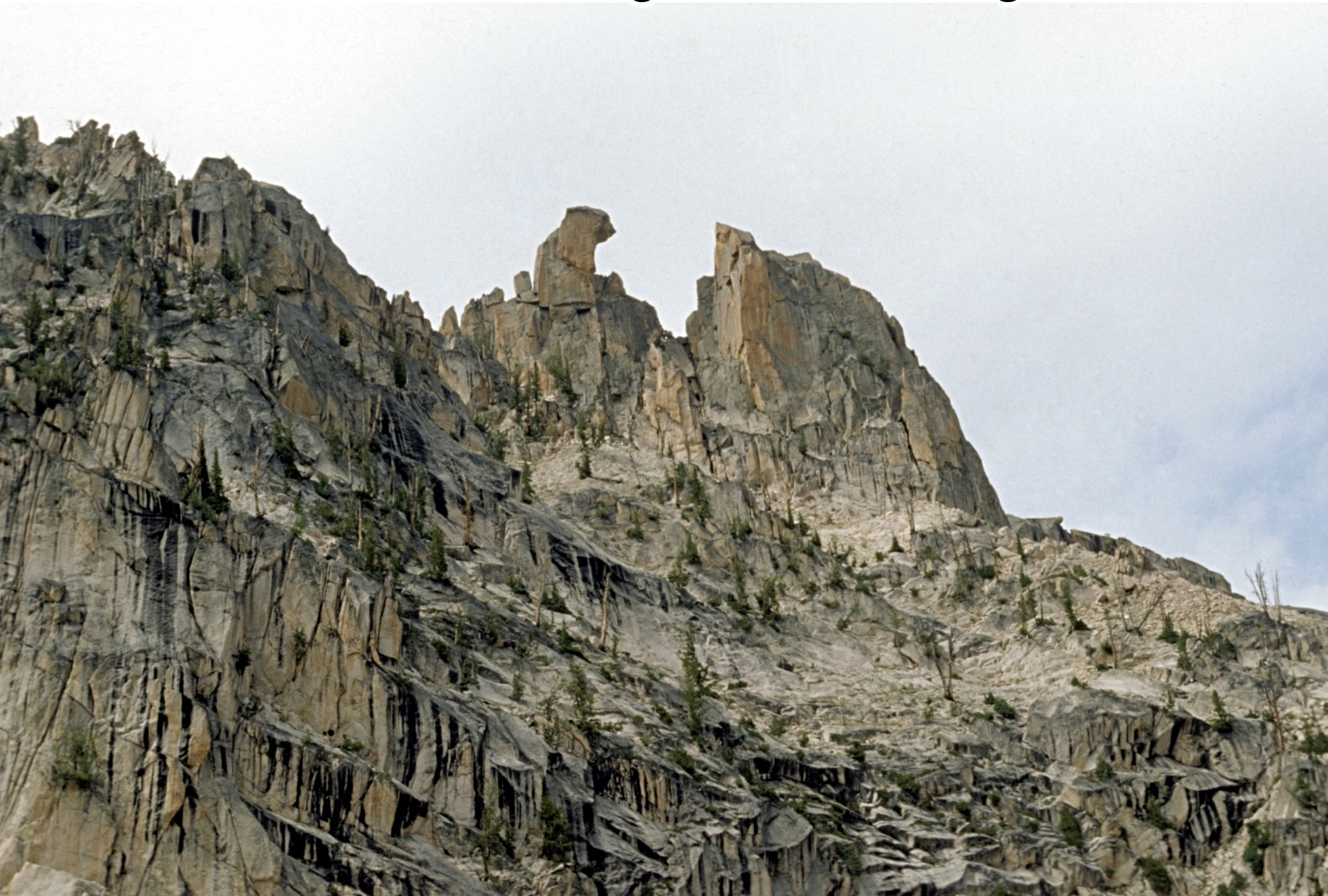
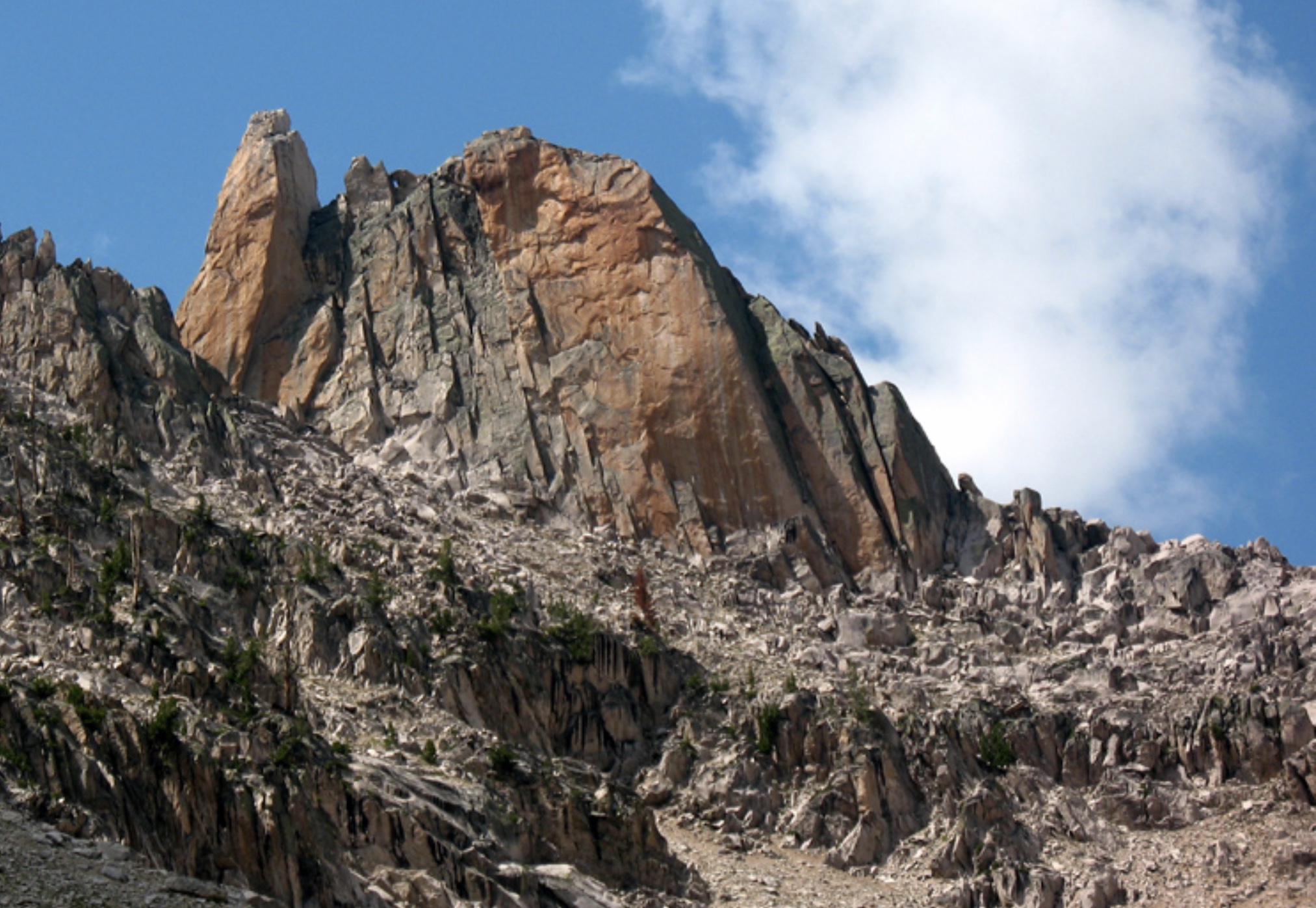
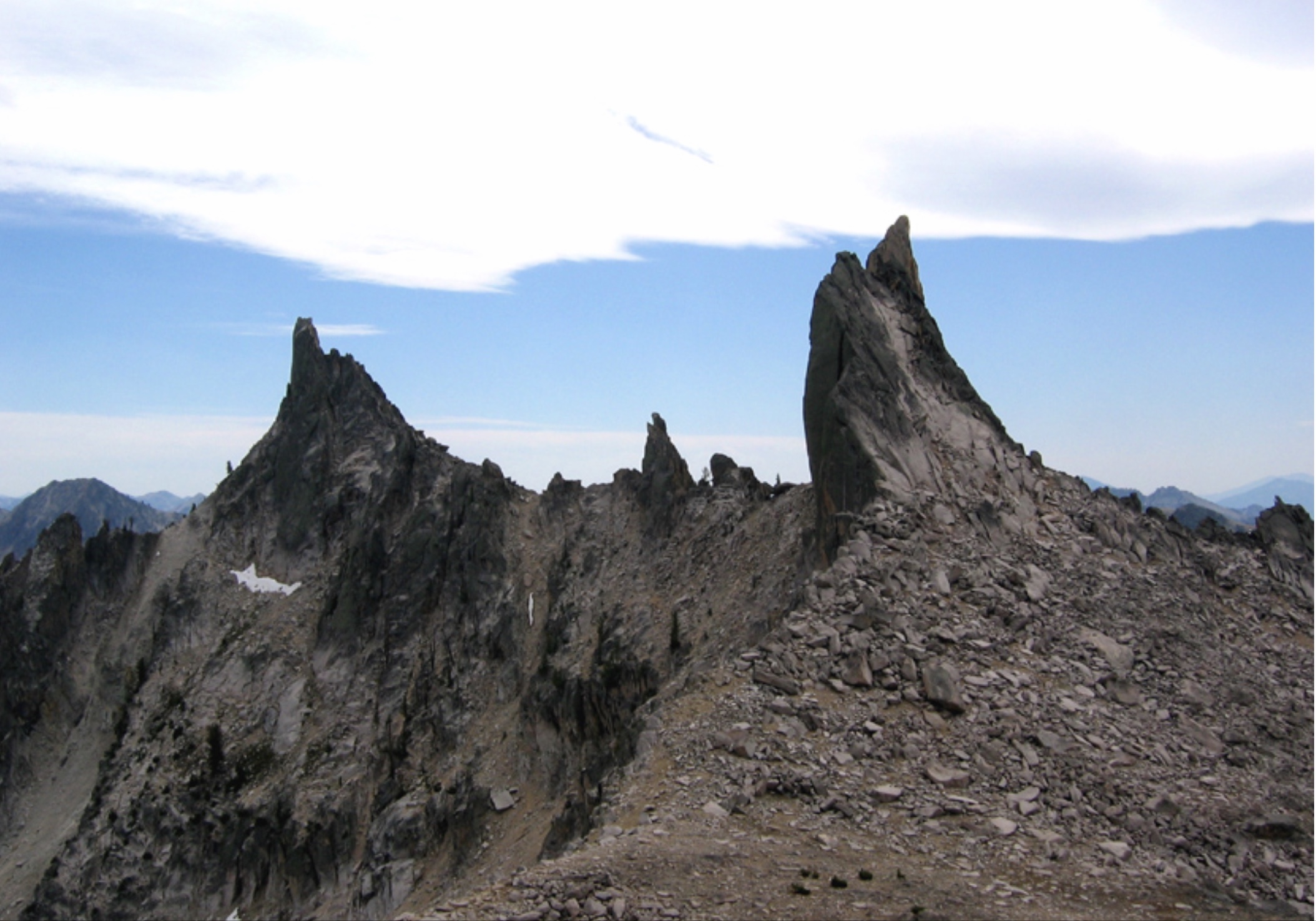
    The South-East-face of Fishhook Spire, at top center.  Becky route follows line of weakness to notch, at right of hook, then goes behind the spire. Ray Brooks Photo
    The Southeast Face of Fishhook Spire (El Pima) at top center. The Beckey Route follows the line of weakness to a notch at right of hook, then goes behind the spire. Ray Brooks Photo

    From there, they climbed a short jam crack and moved around to the North Side.

    “Pete gave Fred a shoulder stand from the chockstone. Fred appeared to be stymied for a moment. It was the sort of pitch you almost wanted to try to climb free, but didn’t quite think you’d make. We decide to give the pitch the benefit of the doubt and resort to direct aid. Fred gingerly stepped on top of Pete’s outstretched hands and managed to drive a spoon piton at the limit of his reach. It was only partially in, but seemed solid enough for tension, so Fred went up on it until he could reach another crack. Two more very insecure pitons and he was able to hunch himself around onto a sloping ledge at the right from where the route became easy. Pete and I swung rapidly up on the rope to find Fred reclining on a large slab. A quick shoulder stand put us on the exposed summit.”

    I climbed Fishhook Spire in 1971 with Harry Bowron by about the same route, although we knew nothing about the previous ascents. Toward the top,  I gave Harry a shoulder stand, and later he made one aid move using a postage stamp sized piton called a RURP (realized ultimate reality piton). Our ascent was only the 3rd one since 1949.

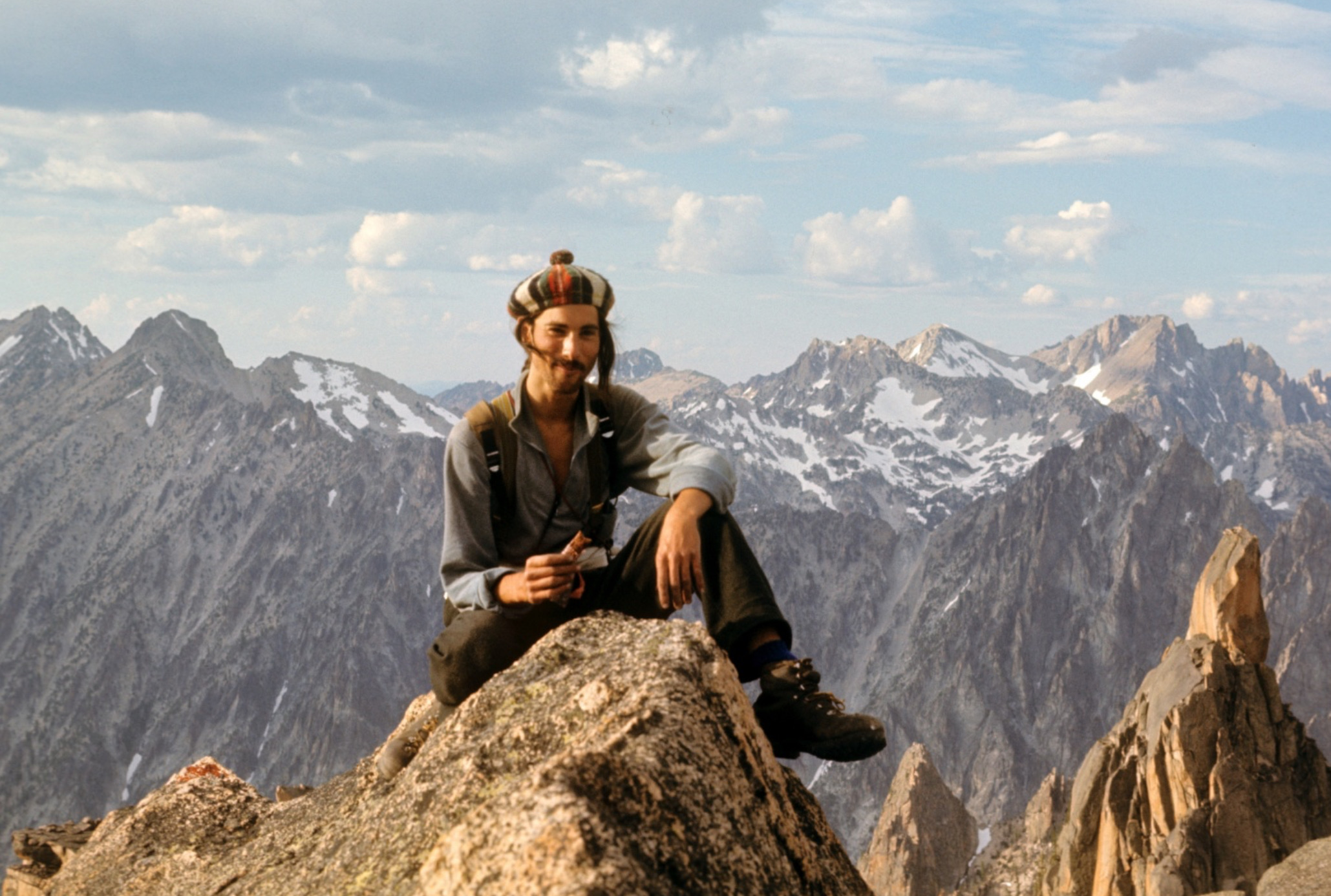
    Harry Bowron on top of Fishhook Spire, (now El Pima) 3rd ascent 1971.    Lower right side of picture shows the summit block of Big Barron Spire. Ray Brooks Photo
    Harry Bowron on top of Fishhook Spire (El Pima) on the 3rd ascent (1971). The lower right side of the photo shows the summit block of Big Baron Spire. Ray Brooks Photo

    Fred, Pete and Jack still had lots of time left in the day and decided to reconnoiter a route on Big Baron Spire. “We had no illusions about climbing it that day, but wanted to go as high as possible and find out what to expect.”

    Southeast side of Big Baron Spire. Becky route traverses to just below the notch from cliffs on left of photo, then stays near ridgeline to the summit block. Ray Brooks Photo
    The Southeast Side of Big Baron Spire. The Beckey Route traverses to just below the notch from cliffs on the left of the photo, then stays near the ridgeline to the summit block. Ray Brooks Photo

    Every approach looked difficult, but they found some surprising lines of weakness that took them to the notch below the final ridge without roping up. Even above the notch, out on the West Face, they were able to scramble still higher before finally wanting ropes for safety. They then had some difficult climbing to the bottom of the 110 feet-high summit monolith.

    “We found ourselves perched on the North Shoulder of the peak with smooth walls plunging away beneath us on 3 sides and the summit soaring directly above, some 110 feet away. As we looked up at the great block, we could understand why the Iowa Mountaineers had dubbed it ‘Old Smoothy.’  It was a magnificent piece of rock, resembling nothing so much as a monster egg standing on its end atop the rest of the mountain. It overhung all the way around and, search as we might, we could not find a single crack or hold anywhere. Reluctantly, we hauled out our drills and bolts and prepared to do battle.”

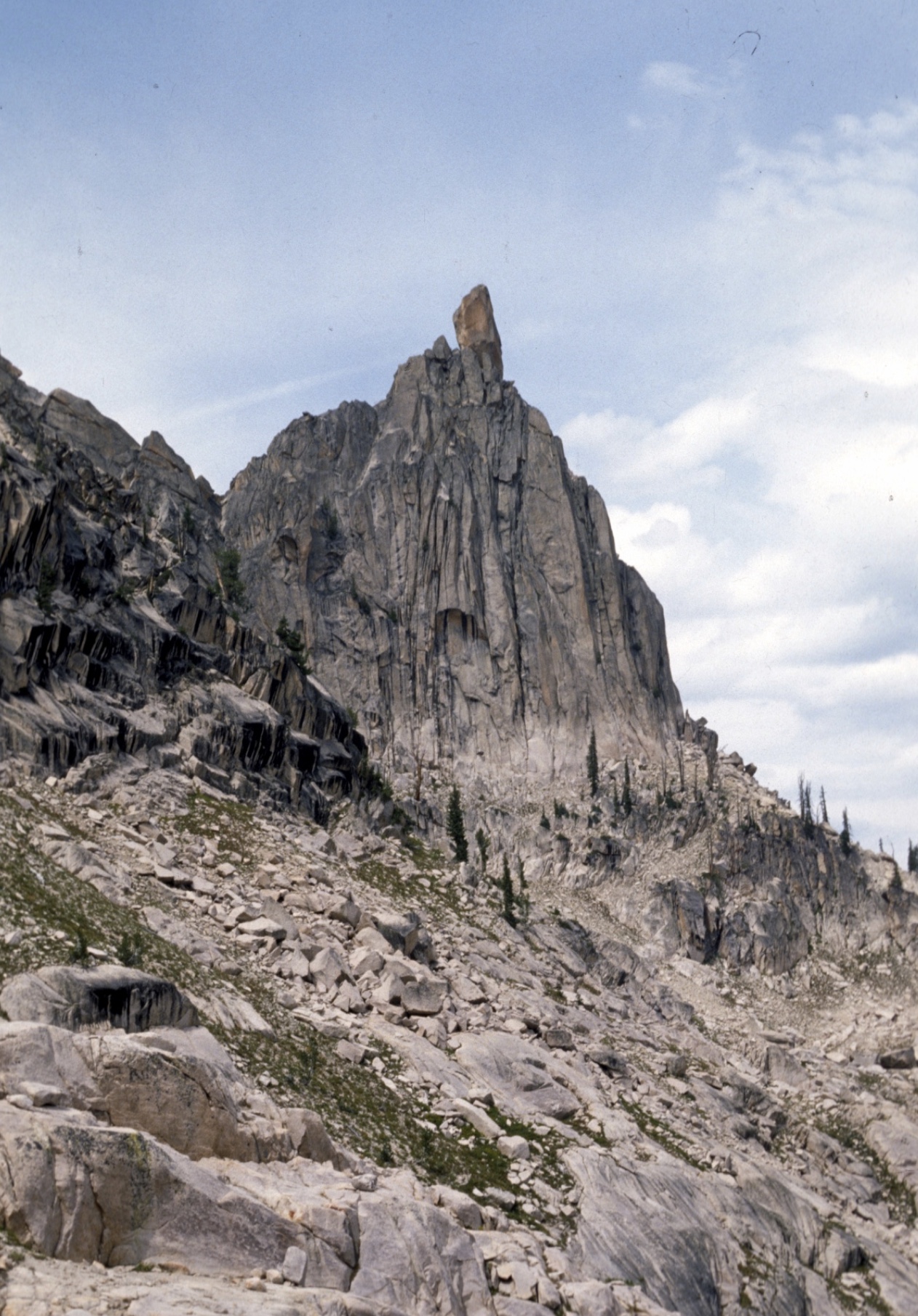
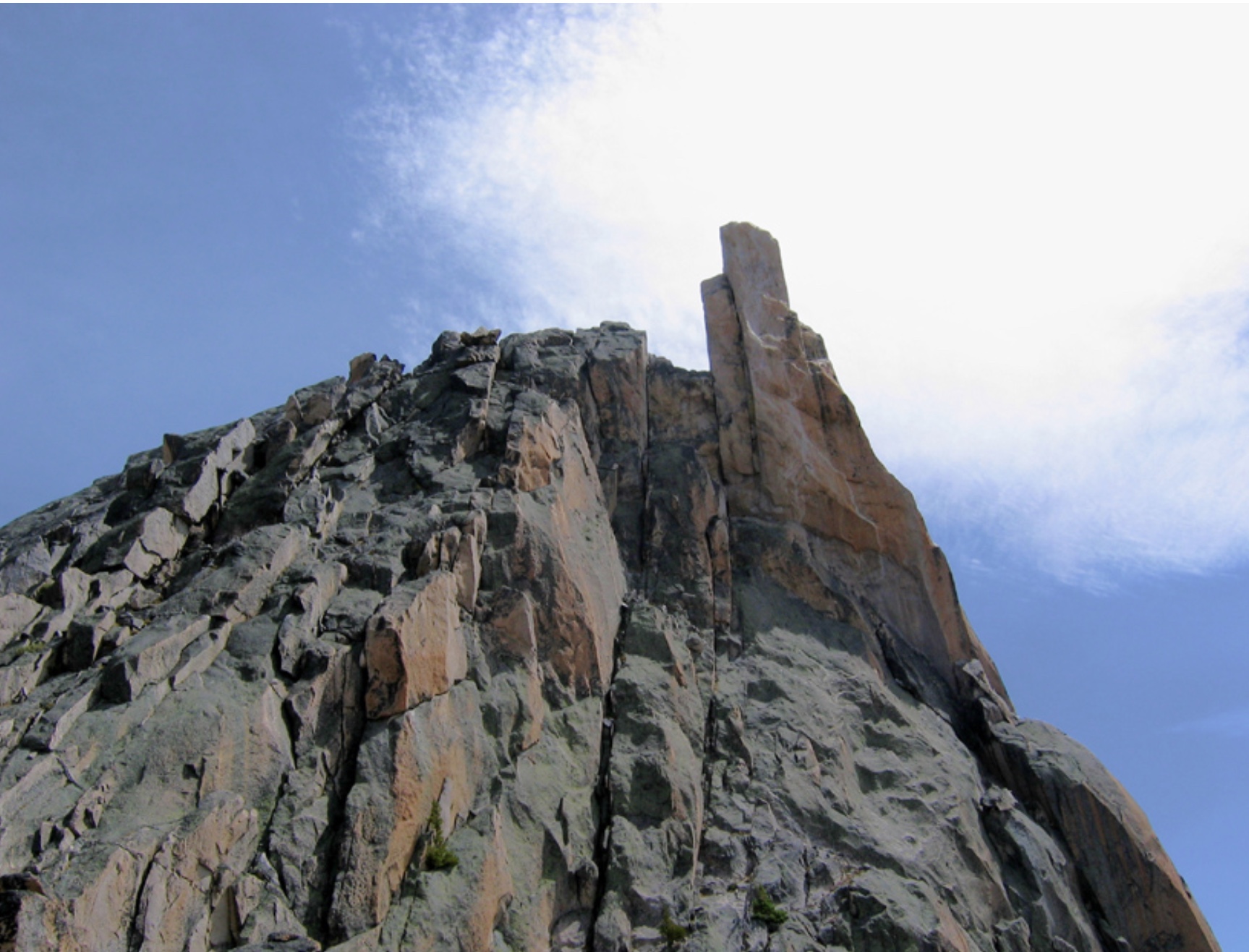
    The crack-less 110 Ft. high summit block of Big Baron Spire. The 1949 bolt ladder goes up it, near the left skyline. Ray Brooks Photo
    The crackless 110-foot summit block of Big Baron Spire. The 1949 bolt ladder goes up it, near the left skyline. Ray Brooks Photo

    “We decided to climb alongside the Northwest Corner, since that offered only 25 feet of overhang, followed by 35 feet of 75-degree slab, to a ridge where we hoped to find a hold or two. Pete mounted our shoulders to drill the first hole—-hurrying, because black clouds were rolling in from the southwest. Taking turns at drilling, we managed to place 7 bolts up the overhang and just get over onto the great slab before the rocks started buzzing with static electricity and an ominous rumbling informed us the storm was at hand.”

    “We huddled under an overhang for more than an hour while lighting crackled about us and hail danced off the rocks.  By the time the rock had dried enough to let us climb safely again, it was nearly dark. Leaving the hardware and one rope in place, we descended to camp, resolved to start early in the morning.”

    Day Two of the climb on Big Baron Spire was long and exciting, and nearly resulted in the deaths of the climbers.

    “As soon as it was light enough to see, we were pushing up the lower slopes again. The preliminary Class 3 and Class 4 rock climbing went rapidly and we found ourselves huddled on the shoulder once again while the sun was still near the horizon. Although it was bitterly cold, the weather was beautiful and we had high hopes of standing on the summit before sunset.”

    “The drilling took much longer now, as the drills were getting duller and duller with each hole.  We took turns at this unpleasant chore. Each man would place 2-3 bolts while the second man belayed and the third sharpened the extra drills.  Late in the morning, I placed the 14th bolt just under the crest of the ridge, then dropped on tension to the shoulder. Fred replaced me on the rope and was hauled up to the highest bolt. By working up the sling and using his hands for balance, he succeeded in standing on the bolt and hauling himself astride the steeply-pitched ridge. Fifteen feet away was a tilted depression where, it seemed, a man might stand. This ‘bowl’ was the closest thing to a belay point on the whole summit block. Fred wormed over to it and put in a bolt for an anchor. He peered upward and saw that the arête above steepened again almost to the vertical. There appeared to be an occasional hold, but it still looked like a bolt job all the way.“

    With the summit only 40 feet away, Fred had to rappel off the summit block when a new storm appeared.

    “We held a council of war and determined to wait and try to finish the climb when the storm blew over. Hours passed by, while hail and freezing rain soaked us to the skin and lightning flashed in the murky sky. Finally we could see that it was getting dark and we decided to make a run for camp while we still could.  We skidded around the slabby corner and raced down the ledge toward the wall above the finger traverse.”

    “The rock was running with water, and every hold was packed with hail as we climbed down the wall. Pete started across the traverse just as the storm picked up in intensity. Lightning struck within 200 feet of us 3 times in quick succession. Pete reared back, blinded by the flashes, and it was several minutes before he could go on.”

    “As the storm increased in fury, we all wondered whether we were to get down alive. The ’V’ crack was a terrible thing with water sluicing down its twisting length and lightning knifing all around. Fred and I took tension from the rope, while Pete half climbed, half fell as best he could. The remaining pitches were easier, but the lightning was still striking terrifyingly close.”

    Back in camp, the beat-up climbers watched the storm clear and wondered if they were ever going to climb Big Baron Spire. The next morning, Pete had a wrenched shoulder and Dick a very sore ankle. Of course, they went back up on the mountain. This time both Fred and Pete climbed up to the top of the bolt ladder and Pete started to the top.

    The top of the summit block. The bolt route goes up the right skyline. Ray Brooks Photo
    The top of the summit block. The bolt route goes up the right skyline. Ray Brooks Photo

    After a shoulder stand and four more bolts: “Pete was clinging to a tiny projection only 15 feet from the top. Things were looking up.”

    Pete climbed free to the summit and clasped his hands in the victory sign. A total of 20 bolts had been placed. The climbers were so wary of another approaching lightning storm, that Jack didn’t follow Pete and Fred to the summit. However, they had no more storms that day and were able to go back over to their base camp at Alpine Lake.

    In the 1970s, I climbed Big Baron Spire 3 times by two different routes that Harry Bowron and I pioneered. When we first arrived at the bottom of the bolt ladder in 1971: what we saw was a long line of rusted and bent ¼” diameter bolts without hangers. The bolts looked horrible, some appeared to be missing, and we did not have the gear to climb the dilapidated bolt ladder. On a 1977 ascent, we brought bolt hangers and bolting gear, but were thwarted by a thunderstorm that forced us back off the mountain.

    Since I was last at the summit block in 1977, some Good Samaritan had put hangers on the old ¼” bolts and replace those that were missing when we were there. In 2009, I shared emails with Radek Chalupa, who climbed the bolt ladder in late Summer 2009. From his account, it appears that at least some of the missing or unusable bolts have been replaced, but the classic Fred Beckey drill bit remains.

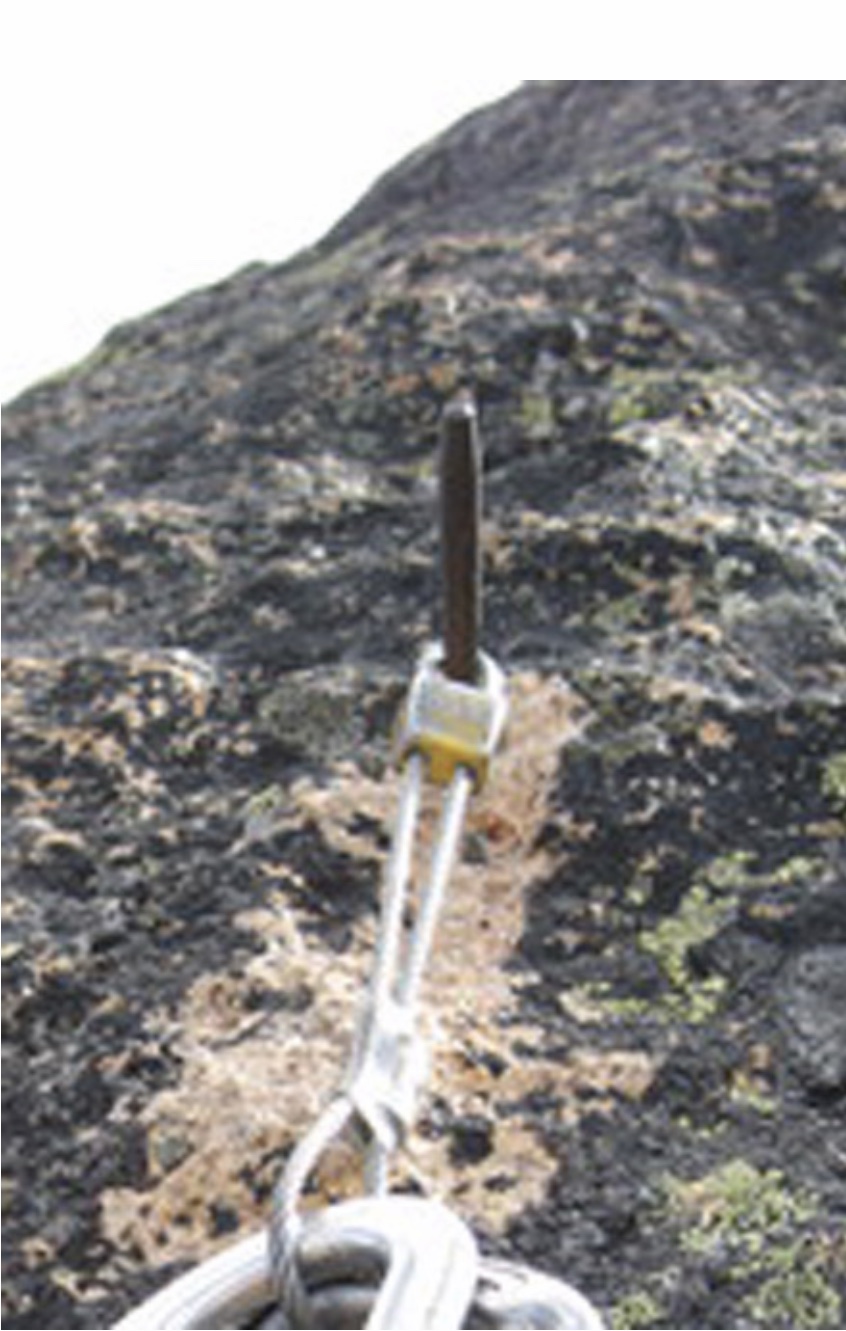
    Fred Becky’s drill-bit/critical aid placement, with a modern wired stopper in place of a bolt hanger. Ray Brooks Photo
    Fred Beckey’s drill bit/critical aid placement, with a modern wired stopper in place of a bolt hanger. Radek Chalupa Photo

    During a rest day back at their Alpine Lake base camp, Fred and Pete made the decision to make the long off-trail hike west into the South Fork Payette drainage to the remote “Red Finger” (i.e., North Raker). Jack would stay at Alpine Lake, and rest his injured leg.

    Besides presenting an enticing profile, when viewed from afar, the attraction of North Raker was that climbing legend Robert Underhill had attempted it during the first of his two Summers of exploration and climbing in the Sawtooth Range in 1934-35. Underhill may have been the best male rock climber in North America at the time and his wife Miriam was certainly the best female climber, but they were not able to climb North Raker. No recorded attempts on its remote summit had been made since 1934. [Miriam Underhill, “Give Me The Hills,” 1956]

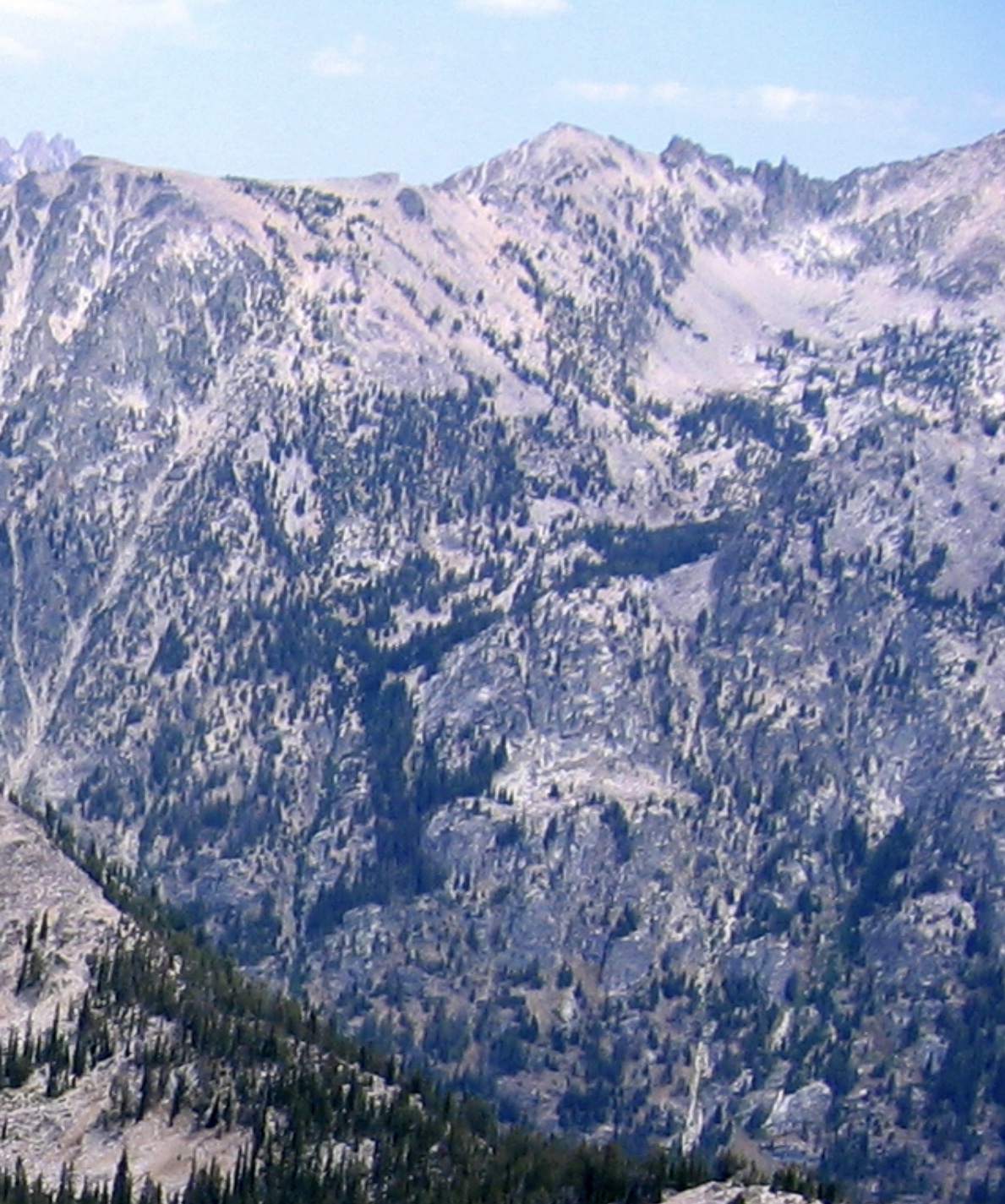
    The North Raker, at top center skyline, from high up in the Baron Creek drainage. Ray Brooks Photo
    North Raker (at top center skyline) as viewed from high up in the Baron Creek drainage. Ray Brooks Photo

    Fred and Pete worked south from Alpine Lake and traversed off-trail into the Upper Redfish Lakes Basin. They ignored nearby attractive summits and slogged up a 10,074-foot pile of rubble called Reward Peak. The summit of Reward, which sits on the divide between the Redfish Lake Creek drainage and the South Fork Payette drainage, gave them a good view of the approach to North Raker. From Reward Peak, they dropped 3,400 vertical feet to the South Fork Payette, forded it in hip-deep water and explored up Fall Creek on the South Side of The Rakers (there is also a South Raker that the Underhills did climb in 1934).

    I hiked with my wife Dorita and 2 fit young friends up the South Fork Payette in late August 2009 and, with some searching, discovered a large log spanning the river just above Elk Lake. Our group found the trail-less terrain leading up Fall Creek to be difficult, wet, loose and brushy. Fred and Pete likely thought it almost pleasant, when compared to their usual cold-jungle bushwhacking in the North Cascade Range.

    After camping a couple of miles up Fall Creek, the next morning Fred and Pete followed grassy open hillsides to a lake basin on the East Side of The Rakers. From there, North Raker looked rather difficult to them.

    The North Raker from the east, with the highest summit at left. Ray Brooks Photo
    North Raker as viewed from the east with the highest summit at left. Ray Brooks Photo

    They hiked up to the saddle to the right/north of North Raker and then discovered that its West Face was more welcoming to climbers. Without roping-up, they were able to scramble to the cairn that marked the high point of Robert Underhill’s 1934 attempt. From this point, it was less than 100 feet to the top of the summit tower, but the route looked hopeless from all sides.

    South Raker at left, North Raker at right. Ray Brooks Photo
    South Raker (left) and North Raker (right). Ray Brooks Photo
    The final summit problem on the North Raker, at top-right. Fred & Pete climbed the overhanging side that faces the camera. Ray Brooks Photo
    The final summit problem on North Raker at top-right. Fred and Pete climbed the overhanging side that faces the camera. Ray Brooks Photo

    “A rope-length traverse was made over considerable exposure to the notch on the North Corner of the peak. Fred anchored to a piton and the climb began.” “Pete traversed right about 15 feet and reached an overhanging crack that appeared to lead somewhere.The crack was composed of a crumbling granitic rubble which took several direct-aid pitons in one place at one time to be even reasonably safe.“

    “Fifteen feet of this, over a space of an hour, convinced Pete that he wanted a rest. Accordingly, he lowered himself back to the notch and Fred took over. He hammered in a giant angle piton behind a loose chockstone, hoping it would act as a wedge and tighten everything up.

    Above this, the crack being absolutely smooth and rather useless for a way, Fred drilled a hole and drove in a solid-sounding bolt. This had a decidedly reassuring effect on his jangled nerves, since the drop was still 500 feet and the quality of the pitons below him was such that any kind of fall would have made them all pop out like buttons from a shirt.”

    Pete took over again and managed to place two pitons and a bolt (their drill was so dull, it was nearly useless) before switching with Fred. Fred placed another piton and another bolt and could see the end of the overhanging section just above. After another trade, Pete was able to climb a 3” wide jam-crack to a ledge. Then with the help of a shoulder stand, Fred jam-cracked another 12 feet to the summit.

    They enjoyed the tiny summit for a few minutes, Pete claimed a lone-eagle feather and then started down. By nightfall, they were back across the South Fork Payette and had climbed to within only 1,100 vertical feet of the pass into Redfish Lake Creek.

    Reward Peak at top center, from near the North Raker.   Fred & Pete went 3,400 vertical feet up and down the appropriately named Drop Creek drainage, below Reward Peak. Ray Brooks Photo
    Reward Peak (at top center) as viewed from near North Raker. Fred and Pete went 3,400 vertical feet up and down the appropriately named Drop Creek drainage below Reward Peak. Ray Brooks Photo

    The next day, they returned to camp at Alpine Lake after making the 3rd ascent of Packrat Peak 10,240 Feet. They loosely followed the route Robert Underhill used to make the 1st ascent of Packrat with his wife Miriam and local packer Dave Williams in 1934. Fred and Pete had a pleasant Class 3-4 scramble on the complex but forgiving East Face.

    Harry Bowron & Dave Thomas, just before we climbed Packrat in 1972.  The East Face route, is to the left in this photo.  We stayed more on the prominent rib at left center. Ray Brooks Photo
    Harry Bowron and Dave Thomas just before we climbed Packrat in 1972. The East Face Route is to the left in this photo. We stayed more on the prominent rib at left center. Ray Brooks Photo

    When they arrived at Alpine Lake in the late afternoon, they found a note from Jack that he had departed for the social life at Redfish Lake. Fred and Pete packed up the remaining gear and trudged back down the trail to the upper end of Redfish Lake and camped, since they planned to climb the nearby Grand Aiguille the next day. Jack picks the story back up at this point.

    “As a gesture of friendship, Fred decided to hike around the lake (5 miles with quite a bit of elevation gain and loss) to the lodge to tell me of their plans in case I could go with them. He arrived just in time to join me at a beach party I was having with a couple of heartening samples of the unattached females who infested the place.  I reluctantly informed him that I would not be able to climb in the morning, but that I would be glad to row him back to save him the 5-mile walk. Thus 4:30AM found us sleepily stroking a rowboat up the lake. Unearthly yodels as we rounded the point informed us that Pete was up and had breakfast ready. An hour later, they started off while I hitched a ride back on the ever-present tourist launch.”

    The Grand Aiguille is a prominent formation above the South End of Redfish Lake. Its first ascent in 1946 is rated Class 5.4 and apparently the rock tower was of interest to Fred and Pete. It is described in Tom Lopez’s fine book “Idaho: A Climbing Guide,” but that area of the Sawtooth Range has a reputation for “ball-bearing” granite and I had never trudged up to the small cirque it is in until early September 2011.

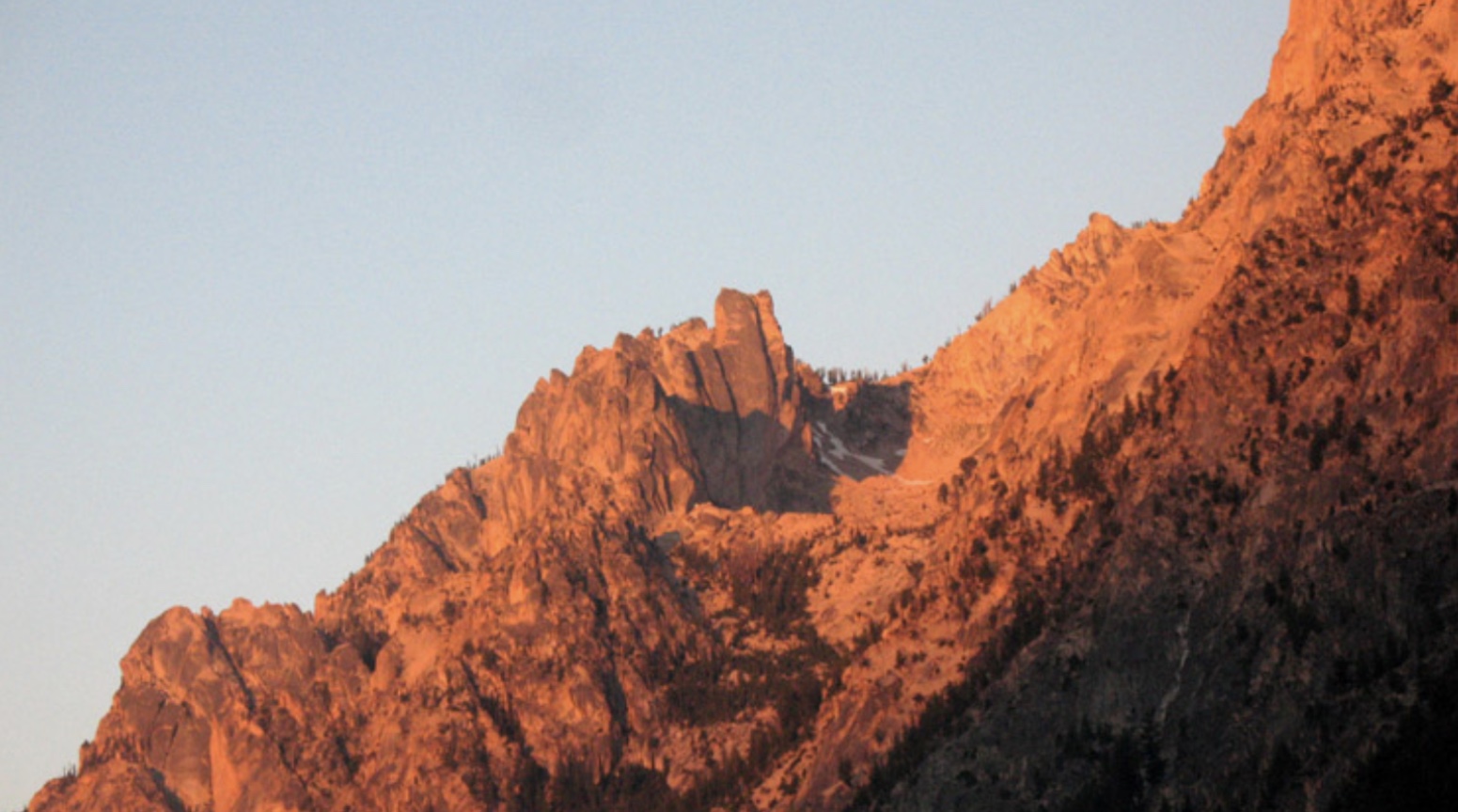
    Early-morning alpenglow on the Grand Aiguille, at center of photo. Ray Brooks Photo
    Early-morning alpenglow on the Grand Aiguille (center). Ray Brooks Photo

    It is several miles and about 3,000 vertical feet from Redfish Lake to the top of the Grand Aiguille. Fred and Pete knocked the 2nd ascent off and were back at Redfish Lake Lodge shortly after noon.

    “They reported a spectacular Class 4 and Class 5 climb on good rock, the crux of which was a vertical crack jammed with overhanging chockstones.”

    After hiking up to the route with Dorita, equipped with a 9mm rope and minimal technical climbing gear, I suffered a reality check when looking for possible easy routes. I can only commend Fred and Pete for their fortitude and speed on the Grand Aiguille. It looked like more of a challenge than I wanted at the time.

    The North-east side of the Grand Aiguille.   The route goes up the snowy gully to the ridge, then apparently follows the ridge, until it goes out of sight to the right. Ray Brooks Photo
    The Northeast Side of the Grand Aiguille. The route goes up the snowy gully to the ridge then apparently follows the ridge until it goes out of sight to the right. Ray Brooks Photo