Category: Joe Fox

  • The Decker Flat Climbing & Frisbee Club By Ray Brooks

    The Decker Flat Climbing & Frisbee Club By Ray Brooks

    I guess we were the Decker Flat Climbing & Frisbee Club (DFC&FC) before anyone, including us, knew. The little guy in the back of my mind liked the way the words fit together. Until the name popped into my head we were simply a group of like-minded climbers who lacked an identifying name. However, on a fateful morning in the mountains of Idaho, adversity transformed us from a nameless, ragged band of climbers into an organization that would accomplish endless deeds of climbing derring-do.

    The fateful day was a hot one in late July 1970. We were hiking into Mount Regan above Sawtooth Lake. Our packs were heavy, each with 60-70 pounds of climbing and camping gear. In addition to the heat, it was a humid and windless morning. We were sweating hard and were being chased mercilessly by a full-strength squadron of horseflies.  

    Flies dive-bombed us incessantly, trying to break through the curtain of insect repellent we had drenched ourselves with. They grew in numbers, until it was difficult to see the sun through the voracious fly swarm above our heads. Frenzied buzzing horseflies became noisily trapped in our long hair and select kamikaze flies would creep between our sweaty fingers to inflict amazingly painful bites.

    It was starting to look like we might become the first known case of climbers eaten by flies when suddenly all the horseflies dipped their wings, did a double roll and turned tail. They flew off down-canyon–a roaring cloud of instant misery. The reason for their retreat stood by the trail snarling evilly, shovel in hand. Even horseflies don’t mess with SMOKEY THE BEAR!!  Of course, a sudden breeze might have helped too.

    We had arrived at the Wilderness Boundary! There beside the plywood Smokey was an 8-foot tall, solid redwood sign proclaiming:

    ENTERING SAWTOOTH WILDERNESS AREA
    CHALLIS NATIONAL FOREST
    PLEASE REGISTER FOR YOUR OWN
    PROTECTION!

    We had some fun filling out the overly-detailed registration form, but then none of us wanted to put our name on it as group leader. In a moment of inspiration, I exclaimed “Let’s call ourselves the Decker Flat Climbing & Frisbee Club” and, since I thought of it, I get to be manager.

    We had elections on the spot and Gordon chose to be Social Chairman, Harry Bowron, Treasurer, and Joe Fox, Member at Large. The next day we climbed Mount Regan (which was somewhat challenging) and had a great time. Our mountain fun was just starting. We never had scheduled meetings or dues but, in order to become a member, you had to go climbing with another member. Of course Gordon took his duties as Social Chairman seriously. He was soon adding females to our club. I must admit to being jealous of Gordon’s social skills in the 1970s and 1980s. His girlfriends were always attractive, assertive and intelligent. Gordon was a “babe-magnet” of the first magnitude. Thus, he was the perfect Social Chairman.

    The rest is history, and we did climb Mount Regan the next day.
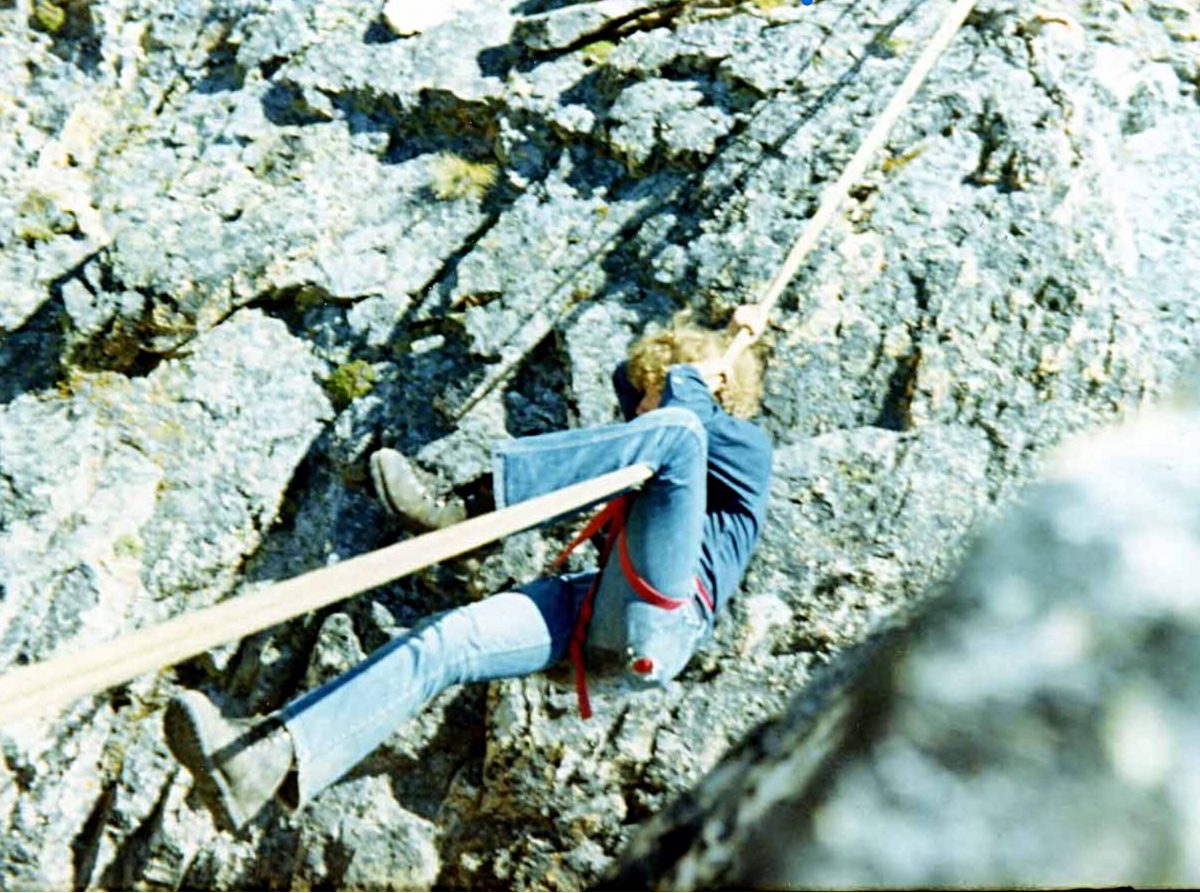
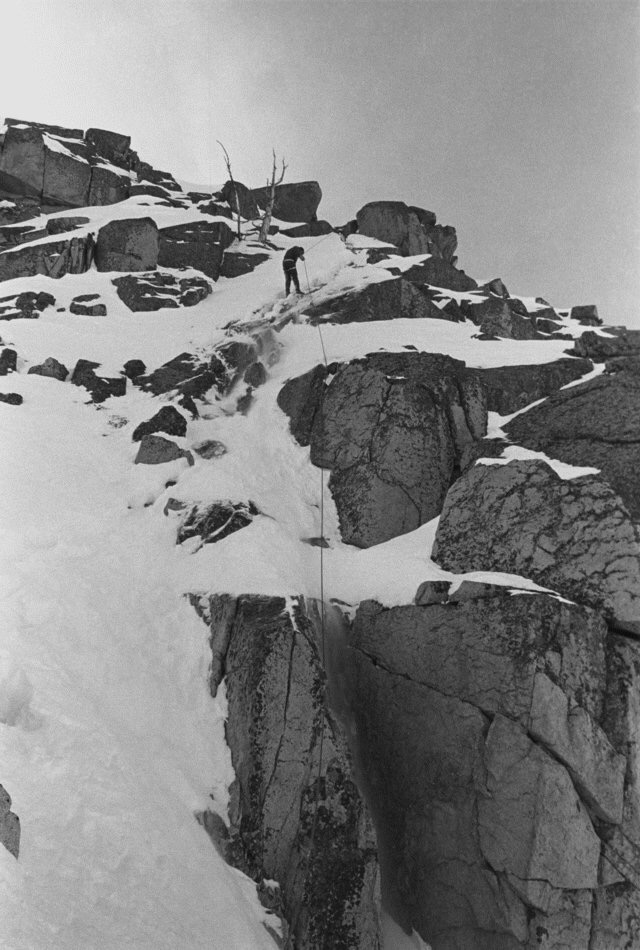
    Gordon Williams on a Tyrolian Traverse near the summit of Mt. Reagan. Note the vintage Goldline rope.
    Gordon Williams on a Tyrolean Traverse near the summit of Mount Regan. Note the vintage Goldline rope.

    After our spur of the moment start in July 1970, we never had regularly scheduled meetings, but we enjoyed a 4th of July group outing in the Pioneer Range and another outing in 1971, with about 20 friends attending. For the most part, DFC&FC members climbed together in small groups.
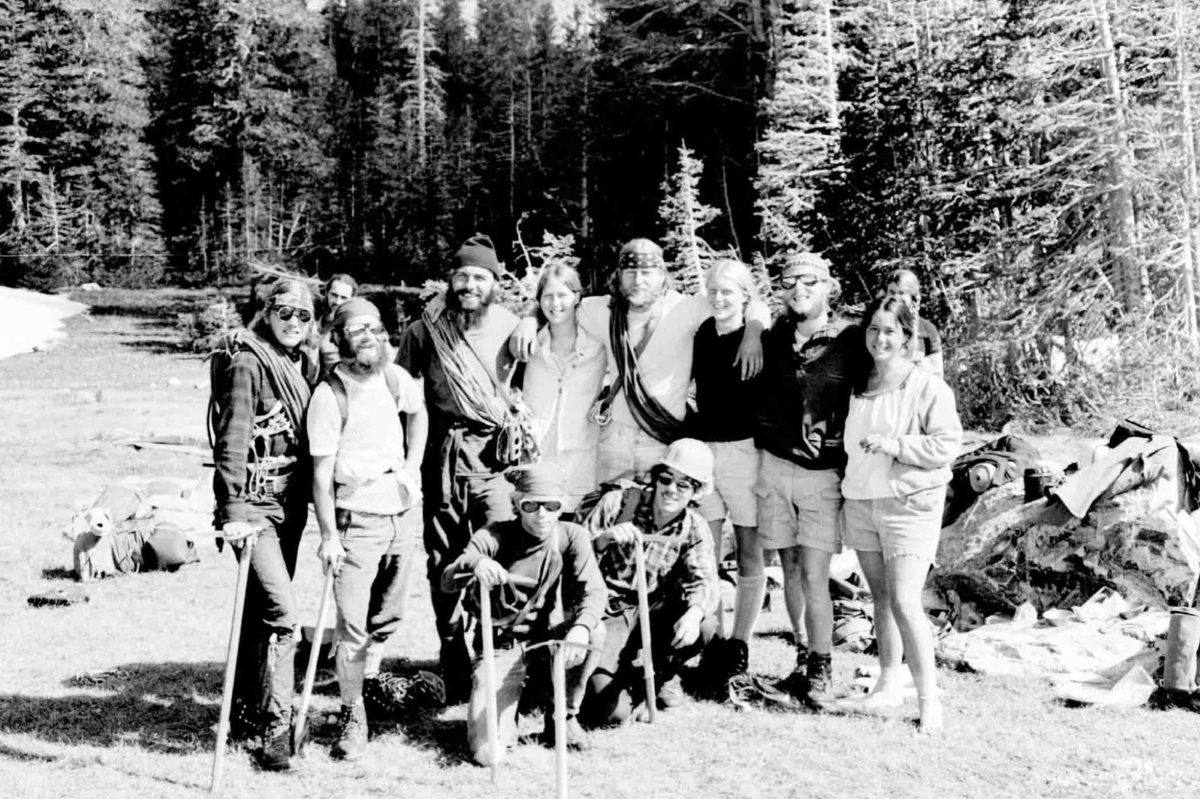
    A Gordon Williams photo of most of the 1970 party group. I’m at the left of the front row.
    A Gordon Williams photo of most of the 1970 party group. I’m at the left in the front row.

    In the early 1970s, Idaho mountaineering was a different world than now. It was a world without good USGS maps, climbing guidebooks, cell phones, GPS devices, an internet to access for climbing information and satellite rescue beacons. Thus, we suffered considerable obstacles to safe and sane mountaineering, but let me assure you, rock climbing and mountaineering in Idaho was a helluva lot more adventurous and a lot more fun then than it is now. Amazingly, although some of our climbing students suffered long scary slides on steep snow slopes, there are no serious climbing injuries or deaths in the history of the DFC&FC.

    In keeping with the local ethics of Sawtooth climbing which sought to keep the Sawtooth Range unpublicized, club members did not (for the most part) publish their climbing exploits. Still, members made some impressive ascents and all of us were actively invested in exploring the nearby mountains.

    In the early 1970s, Gordon Williams was instrumental in leading groups which pushed the limits of Winter climbing in the Sawtooth Range. There were some setbacks, but under Gordon’s leadership, there were successes. The two most notable Winter first ascents were the Finger of Fate and Mount Heyburn.

    Harry Bowron and I completed several notable new routes in 1971 and 1972 in the Sawtooth Mountains, including two new routes to the summit block of Big Baron Spire and a new route on the South Side of Warbonnet. Contrary to local ethics, I did publish an account of a new route I achieved with Mike Paine and Jennifer Jones on Elephant’s Perch in 1967. My ethical breach insured that no other climbers would climb the same route and claim the glory of a first ascent on the biggest wall in the Sawtooths.  

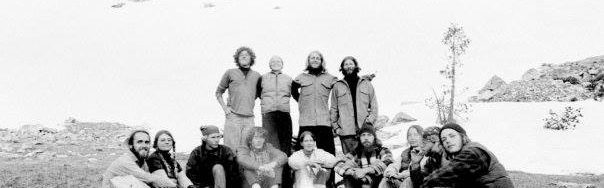
    Here’s a group of us at our 4th of July 1971 gathering. Gordon at left in the back row others pictured include William Michael Bird, Gordon K Williams, Ray Brooks, Danny Bell, Vicki Smith and Randy Felts.
    Here’s a group of us at our 4th of July 1971 gathering. Gordon is at left in the back row. Others pictured include William Michael Bird, Gordon K. Williams, Ray Brooks, Danny Bell, Vicki Smith and Randy Felts.

    The only tangible achievement of the DFC&FC was to restore Pioneer Cabin, which sits on a high ridge east of Sun Valley adjacent to the high peaks of the Pioneer Range, in 1972 and 1973. I was in Moscow, Idaho at the time and had nothing to do with the project. Credit for the rehabilitation goes to Gordon Williams, Robert Ketchum, Chris Puchner and others who donated materials, helicopter time and labor.  

    Gordon Williams was insistent on painting our club slogan: “The higher you get, the higher you get” on the roof. Somehow, that painted slogan survives on the roof of Pioneer Cabin to this day. Here’s a link to an Idaho Public TV article on it: Pioneer Cabin

    Long-term club member John Platt recalls another club slogan he heard while skiing potential avalanche terrain into the Finger of Fate in 1972. “Stay High & Spaced Out.” A high-end outdoor magazine, Adventure Journal, published an article on Pioneer Cabin and the DFC&FC link in their second issue in 2018.

    After a high-point with the Pioneer Cabin restoration, the DFC&FC never managed to hold more scheduled events. Nevertheless, members continued to use the name on wilderness registration forms and an informal competition to achieve the most yearly “back-offs” from major rock climbing routes or mountain peaks, persisted into this century. We of the DFC&FC enjoyed fiascos. In the era before decent USGS maps, climbing guidebooks, cell phones, GPS devices, an internet to access for climbing information and satellite rescue beacons, success on routes was not assured and failures were cherished.

    In 2001, Gordon Williams hosted a 30th Anniversary party for a surprising number of DFC&FC members. I recall around 20 attendees, including one who flew in from Alaska for the occasion.

    In 2012 Matt Leidecker interviewed Gordon Williams, Jacques Bordeleau and me for historical information on notable climbs DFC&FC members had achieved in the Sawtooth Mountains. Leidecker included several paragraphs recounting the club’s history in his fine hiking guide “Exploring The Sawtooths.”

    Matt summed up the DFC&FC club achievements in the Sawtooths with a Gordon Williams quote: “I got to thinking what was the shining achievement of our time in the Sawtooths and I came to the conclusion that it was simply to have a good adventure. Once you learn how to do that, you can keep doing it forever.”
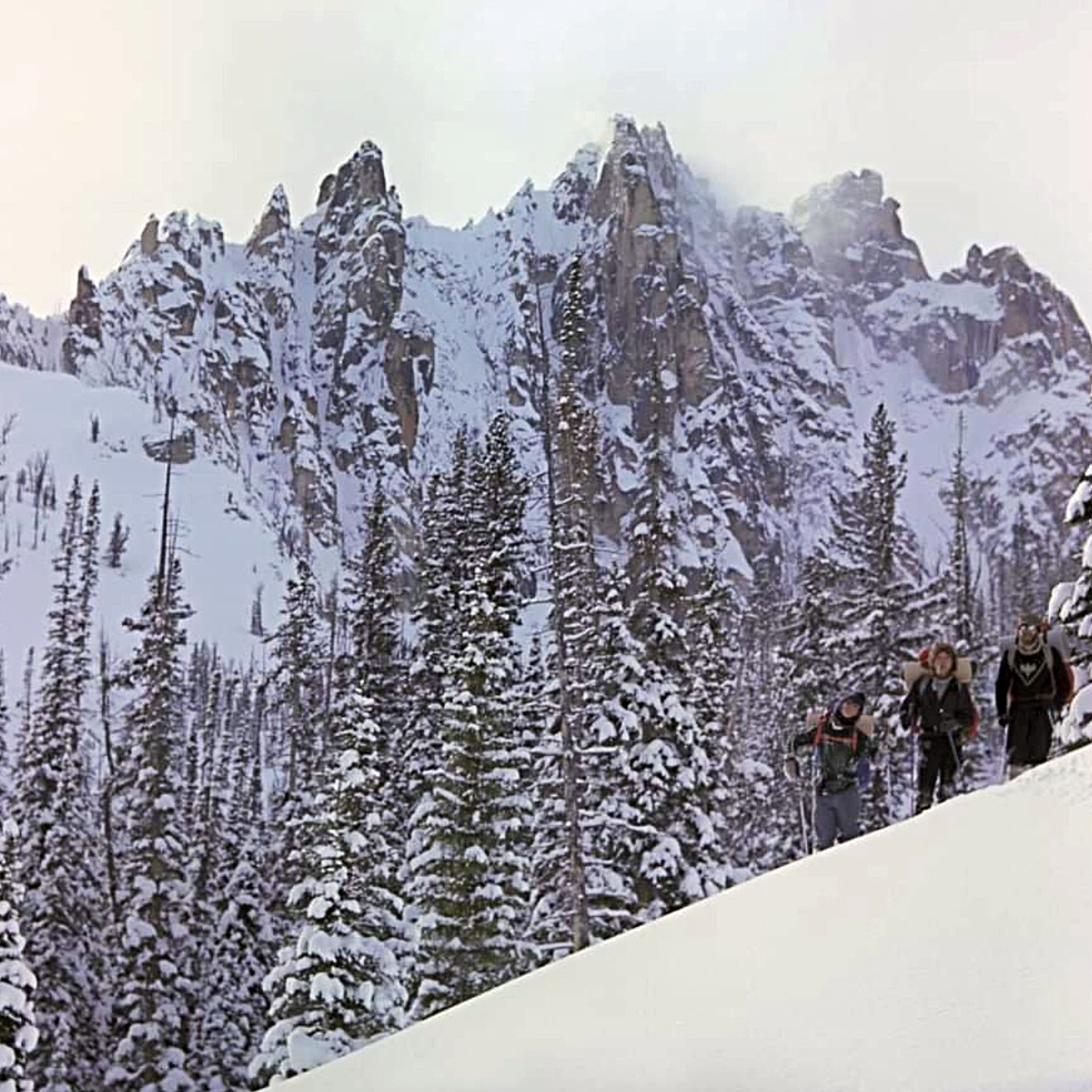

    DFC&FC members Chris Puchner, Gordon Williams and Mark Sheehan retreating from their first winter attempt to climb Mount Heyburn. Jacques Bordeleau Photo
    DFC&FC members Chris Puchner, Gordon Williams and Mark Sheehan retreating from their first Winter attempt to climb Mount Heyburn. Jacques Bordeleau Photo
  • The First Winter Ascent of the Finger of Fate by Jacques Bordeleau

    The First Winter Ascent of the Finger of Fate by Jacques Bordeleau

    The first winter ascent of the Finger of Fate was made on March 19, 1973 by James Christopher Hecht, Harry Bowron, Gordon K. Williams and Joe Fox. I was part of the support team which also included Art Troutner and John Platt. I took the color photos. I developed the black and white photos that were shot by the ascent team.

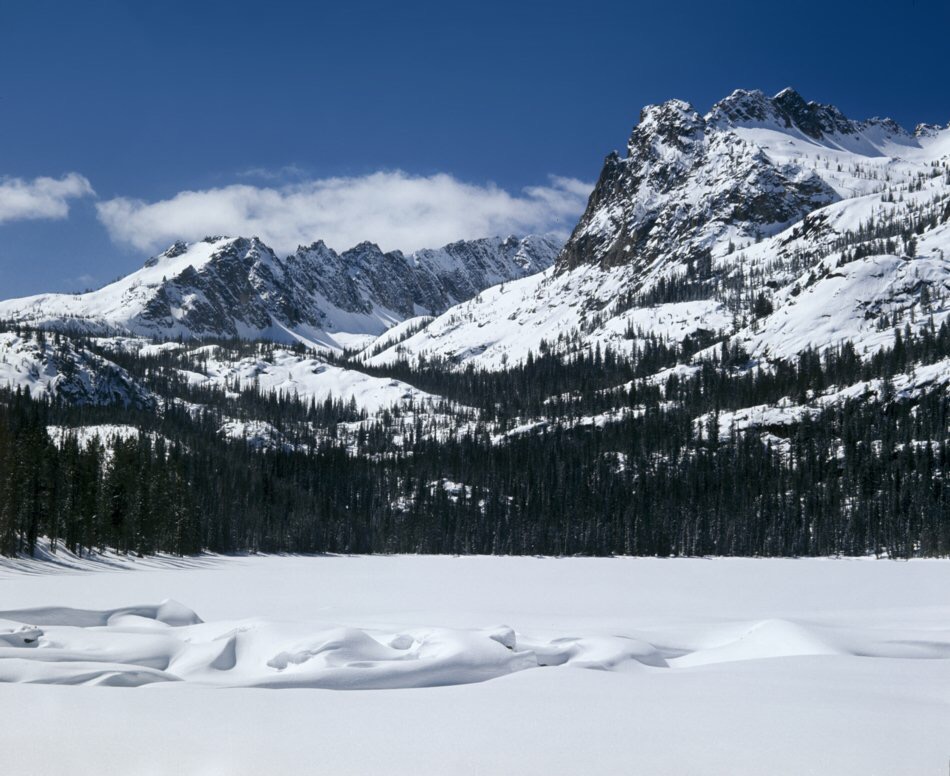
    1. Our first day was spent skiing up Hell Roaring road down in the forest, the end of the road being Camp I. Semi-unplanned as it was we hooked up with a Boise contingent of the DFC&FC* on the ski in, boosting our group to seven adventuresome lads. The second morning we were greeted with scenery. The fickle "Finger of Fate" is seen pointing skyward in this view from the outlet at Hell Roaring lake, flanked by the Arrowhead and the Birthday Cake on the skyline. * Decker Flats Climbing & Frisbee Club
    Our first day was spent skiing up Hell Roaring Road down in the forest, the end of the road being Camp I. Semi-unplanned as it was we hooked up with a Boise contingent of the DFC&FC* on the ski in, boosting our group to seven adventuresome lads. The second morning we were greeted with scenery. The fickle “Finger of Fate” is seen pointing skyward in this view from the outlet at Hell Roaring Lake, flanked by the Arrowhead and the Birthday Cake on the skyline. *Decker Flats Climbing & Frisbee Club
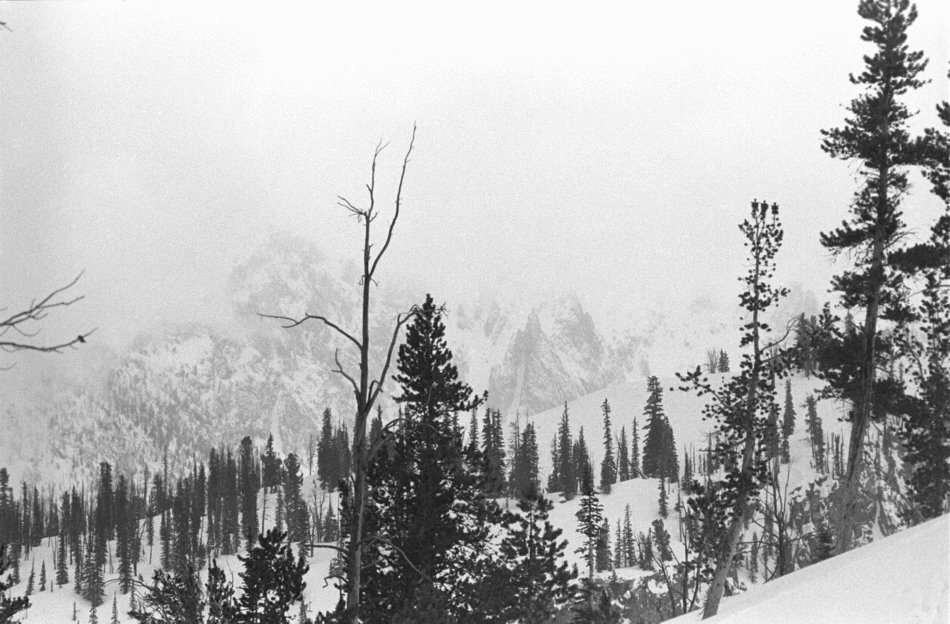
    2. Looking SW from the Hell Roaring Lake outlet, toward Imogene lake, which is up and around the spectacular canyon beyond. This was my first winter expedition and at this point I remember being extremely impressed with the snow forms on the mountains. Everything about the Sawtooths was magnified by being there in winter. I was 22 years old in 1973 and it may as well have been the Himalayas to me.
    Looking southwest from the Hell Roaring Lake outlet toward Imogene lake, which is up and around the spectacular canyon beyond. This was my first Winter expedition and, at this point, I remember being extremely impressed with the snow forms on the mountains. Everything about the Sawtooths was magnified by being there in winter. I was 22 years old in 1973 and it may as well have been the Himalayas to me.
    3. The second day we humped from the road end to Hell Roaring lake, where the climbing began. Carrying heavy packs up to high Camp II was tough. The 3rd morning dawned a little funky but cleared up after a while.
    The 2nd day we humped from the road end to Hell Roaring Lake, where the climbing began. Carrying heavy packs up to High Camp II was tough. The 3rd morning dawned a little funky but cleared up after a while.
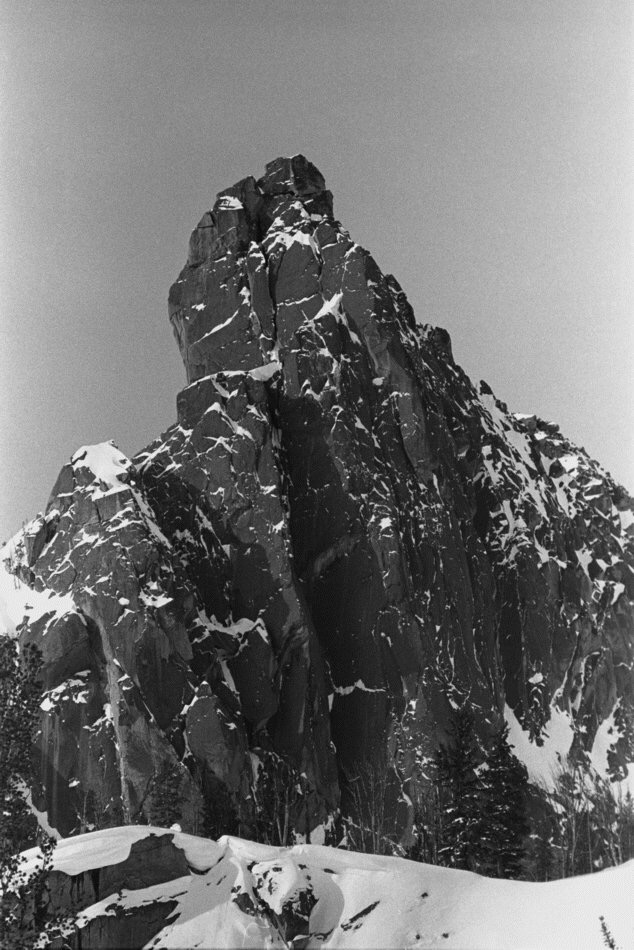
    4. The North Face of the Finger, showing the "Open Book" route in deep shadows, not a nice climb in winter. It was attempted repeatedly before selecting an alternate plan.
    The North Face of the Finger, showing the “Open Book” route in deep shadows, not a nice climb in Winter. It was attempted repeatedly before selecting an alternate plan.
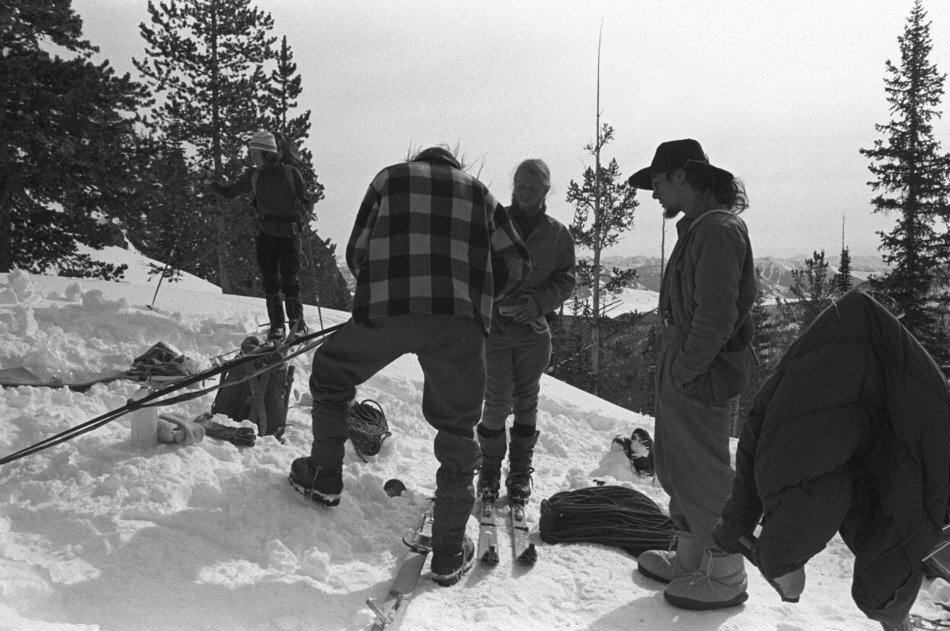
    5. Gearing up in the morning. Nice equipment, huh? I believe those are my hickory 215 cm Sundins Mountain Skis from REI, with screwed in metal edges, and my surplus canvas + aluminum frame pack. I fondly remember treating the ski bases with Pine Tar so wax would adhere properly. I don't miss doing it anymore though. The Silveretta cable bindings were versatile and enabled amazing winter travel, though stylish turns were difficult. Also my classic aluminum cup.
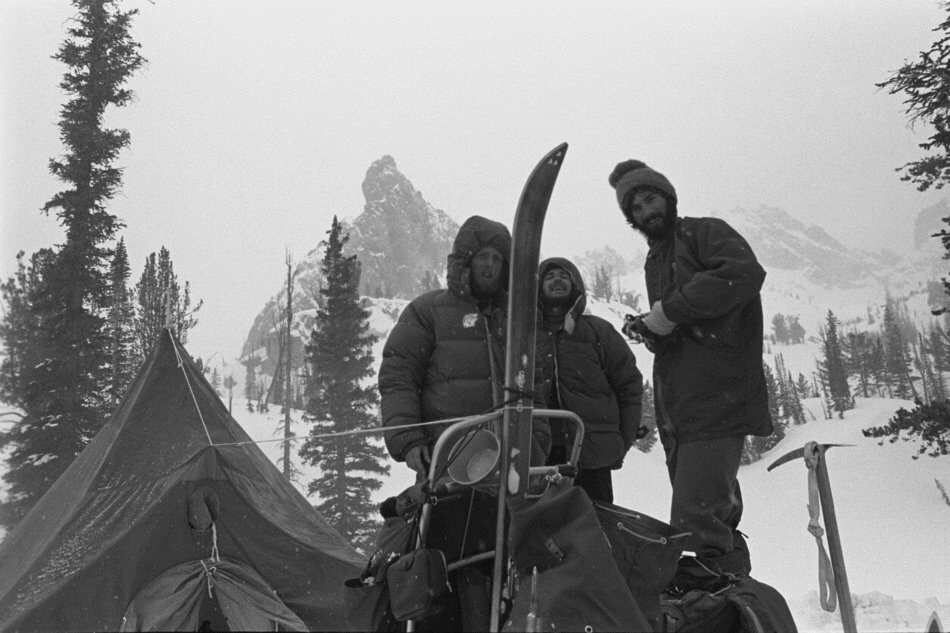
    Gearing up in the morning. Nice equipment, huh? I believe those are my Hickory 215CM Sundins Mountain Skis from REI, with screwed in metal edges and my surplus canvas + aluminum frame pack. I fondly remember treating the ski bases with Pine Tar so wax would adhere properly. I don’t miss doing it anymore though. The Silveretta cable bindings were versatile and enabled amazing Winter travel, though stylish turns were difficult. Also my classic aluminum cup.
    5. Gearing up in the morning. Nice equipment, huh? I believe those are my hickory 215 cm Sundins Mountain Skis from REI, with screwed in metal edges, and my surplus canvas + aluminum frame pack. I fondly remember treating the ski bases with Pine Tar so wax would adhere properly. I don't miss doing it anymore though. The Silveretta cable bindings were versatile and enabled amazing winter travel, though stylish turns were difficult. Also my classic aluminum cup.
    Gearing up in the morning. Nice equipment, huh? I believe those are my hickory 215 cm Sundins Mountain Skis from REI, with screwed in metal edges, and my surplus canvas + aluminum frame pack. I fondly remember treating the ski bases with Pine Tar so wax would adhere properly. I don’t miss doing it anymore though. The Silveretta cable bindings were versatile and enabled amazing winter travel, though stylish turns were difficult. Also my classic aluminum cup.
    7. Soft morning light kisses the powder snow 'Good Morning', as Gordon leads off toward the climb on Day 3.
    Soft morning light kisses the powder snow ‘Good Morning’ as Gordon leads off toward the climb on Day 3.
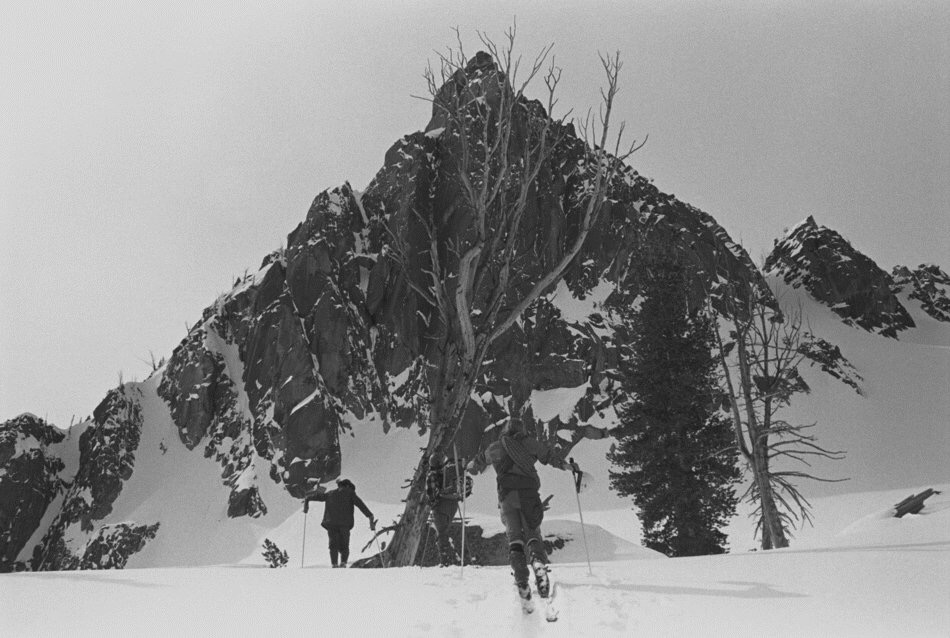
    Skiing up from Camp II the morning of March 19, 1973. A cloudy dawn turned into a fine day.
    Skiing up from Camp II the morning of March 19, 1973. A cloudy dawn turned into a fine day.
    9. A closer look at the Open Book route.
    A closer look at the Open Book Route.
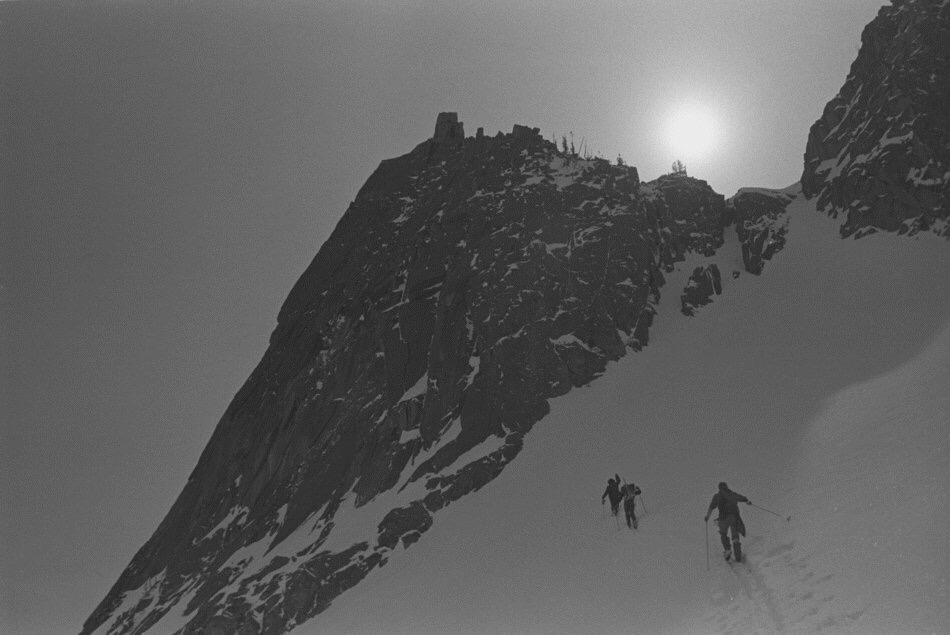
    Ascending the colouir to the West Ridge saddle.
    Ascending the colouir to the West Ridge saddle.
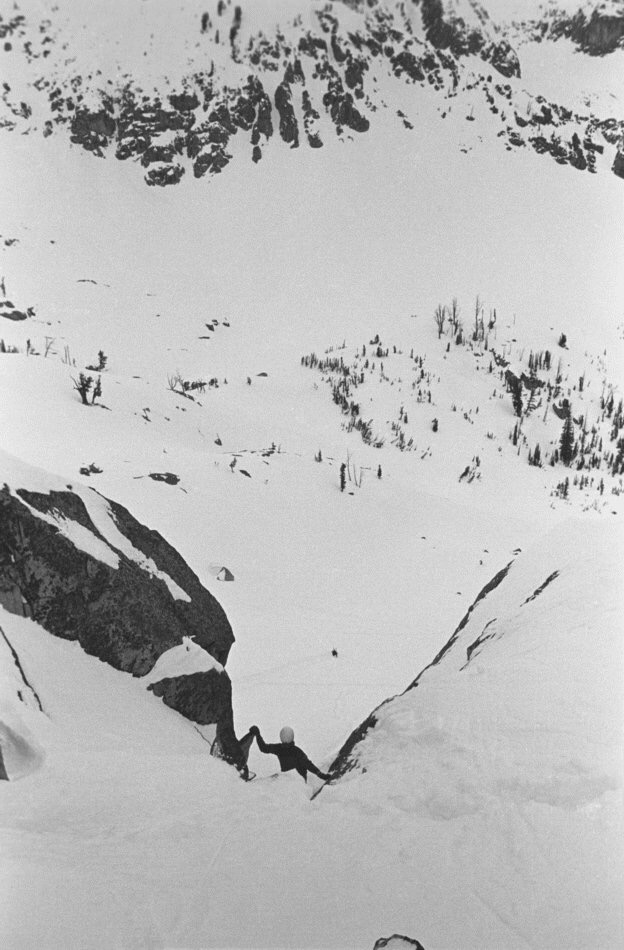
    11. Looking back down the col toward Camp II, with someone working their way up the track way below.
    Looking back down the col toward Camp II, with someone working their way up the track way below.
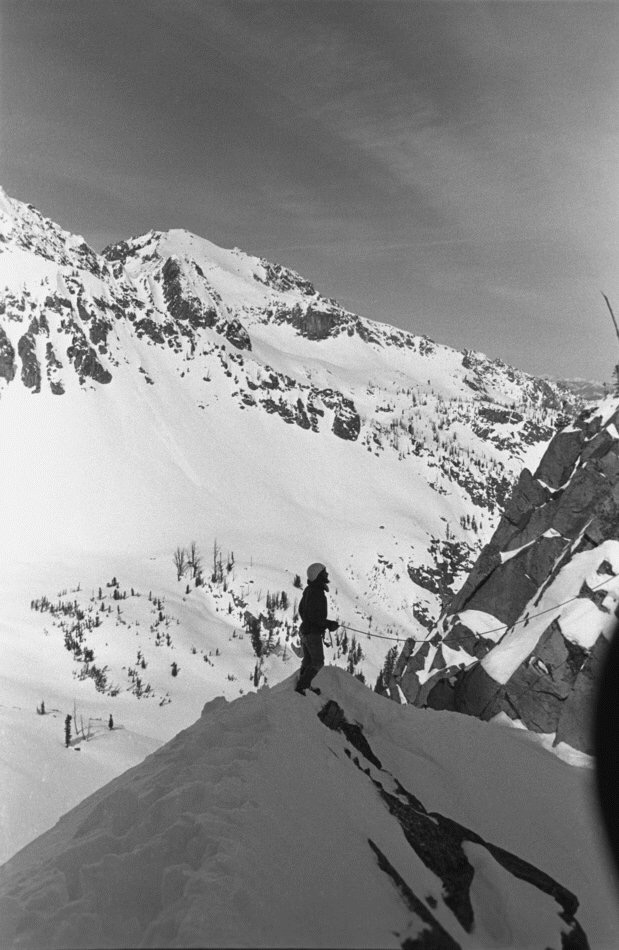
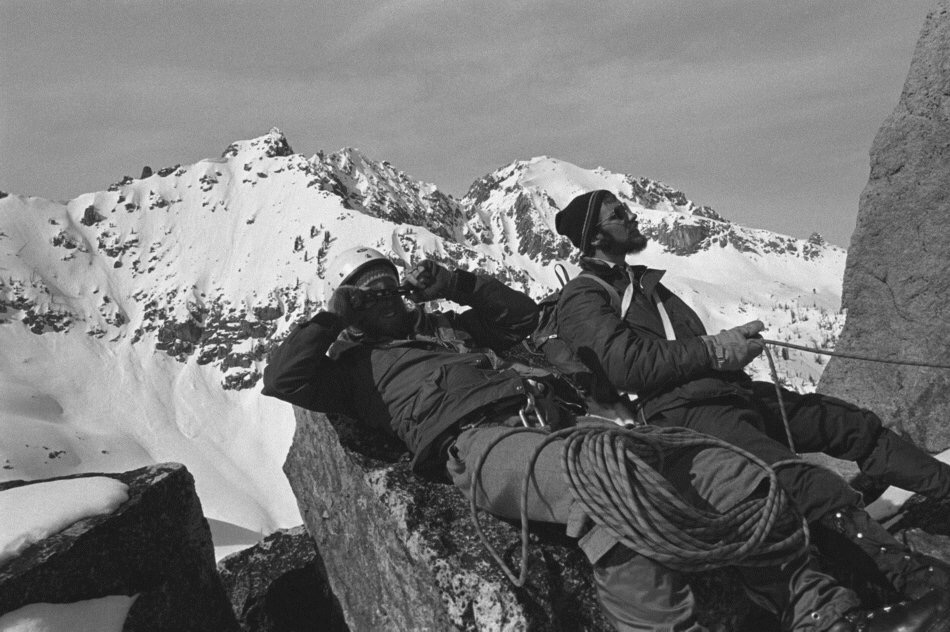
    12. Sitting atop the buttress west of the Finger, making a plan, before the climbers go scramble back down to the saddle and head up the West Ridge route.
    Sitting atop the buttress west of the Finger and making a plan before the climbers scramble back down to the saddle and head up the West Ridge Route.
    16. Rappelling down the Buttress back to the saddle.
    Rappelling down the buttress back to the saddle.
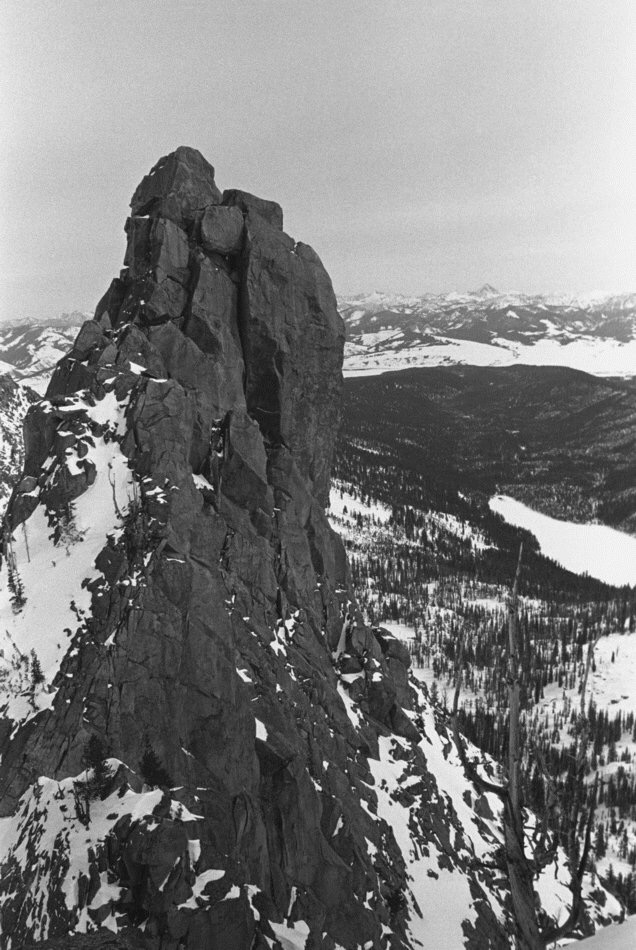
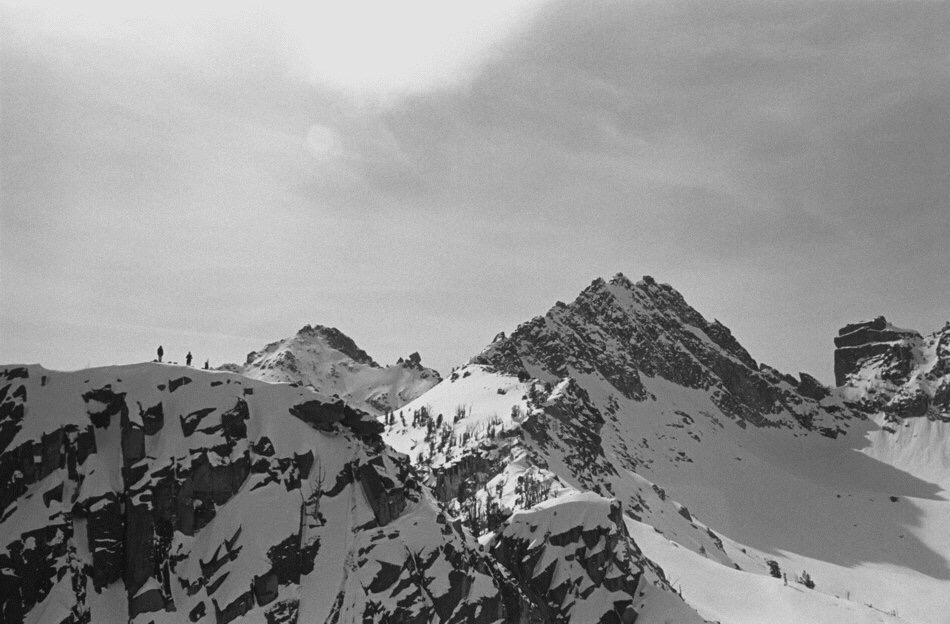
    The Finger of Fate viewed from the buttress, with Hell Roaring Lake snowed over down below, looking east toward the Sawtooth Valley. Our cars are waaaay out there. Big bad Castle Peak on the horizon.
    The Finger of Fate as viewed from the buttress, with Hell Roaring Lake snowed over down below, looking east toward the Sawtooth Valley. Our cars are waaaay out there. Big bad Castle Peak is on the horizon.
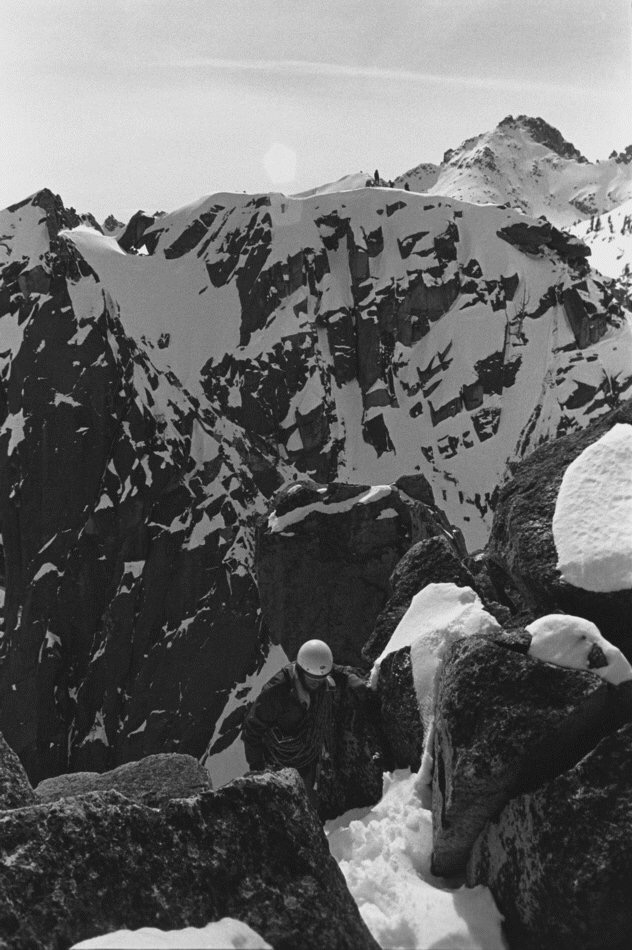
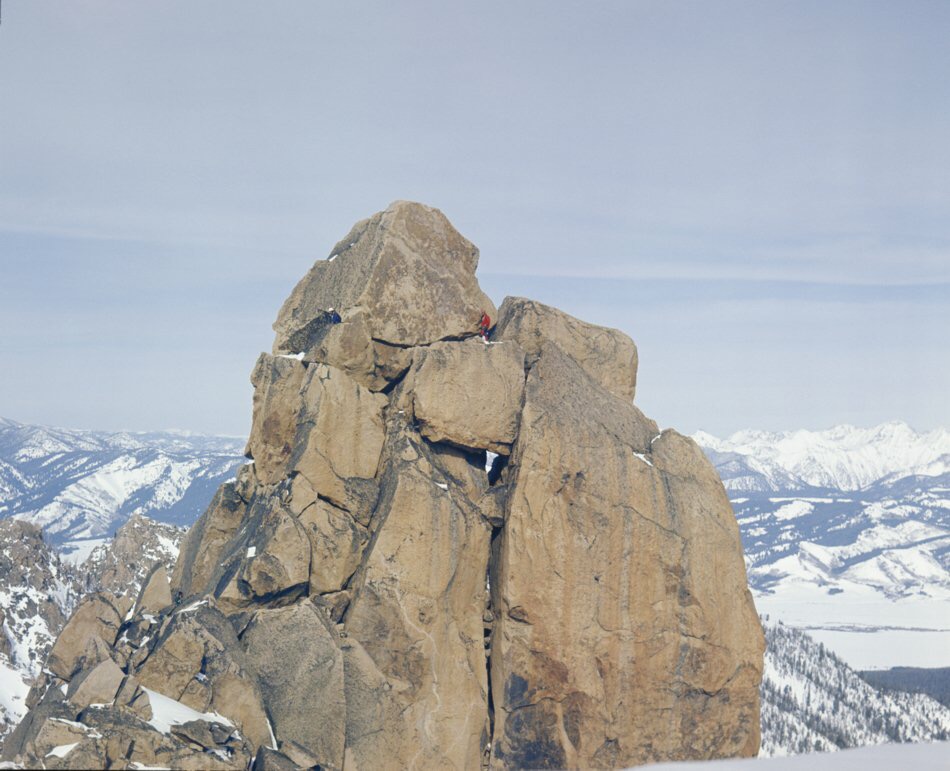
    15. If you see the rope, follow it upward and you'll notice Gordons' head (center) peering out from a belay position above a pitch.
    If you see the rope, follow it upward and you’ll notice Gordon’s head (center) peering out from a belay position above a pitch.
    A casual belay.
    A casual belay.
    Looking down at the saddle.
    Looking down at the saddle.
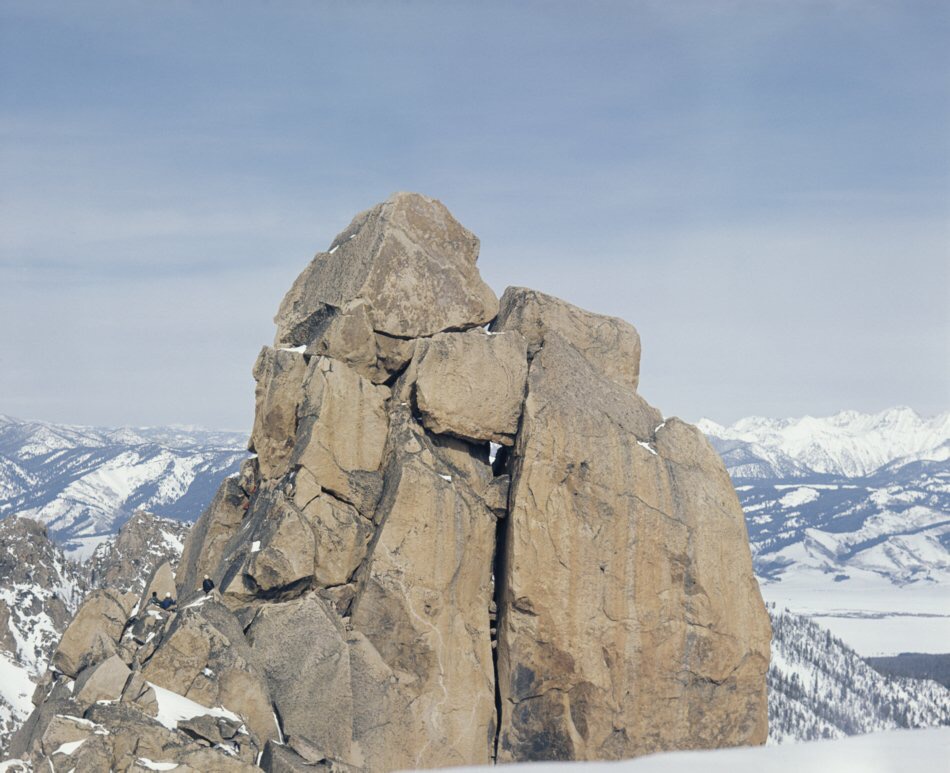
    The Buttress west of the Finger, as seen from the Finger. I took up a position on top of the buttress with my Graflex to shoot pics back toward the Finger, while the rock climbers worked on their goal. You see the route up and down the buttress in the disturbed snow.
    The Buttress west of the Finger as seen from the Finger. I took up a position on top of the buttress with my Graflex to shoot pics back toward the Finger while the rock climbers worked on their goal. You see the route up and down the buttress in the disturbed snow.
    Looking toward the Arrowhead, Sevy Peak and the Birthday Cake displayed prominently on the skyline.
    Looking toward the Arrowhead, Sevy Peak and the Birthday Cake displayed prominently on the skyline.
    West view from the Finger of Fate, Chris coming up.
    The view west from the Finger of Fate. Chris is coming up.
    Belay on! View is to the NNW, with Decker Peak the more distant summit on the right.
    Belay on! View is to the NNW with Decker Peak the more distant summit on the right.
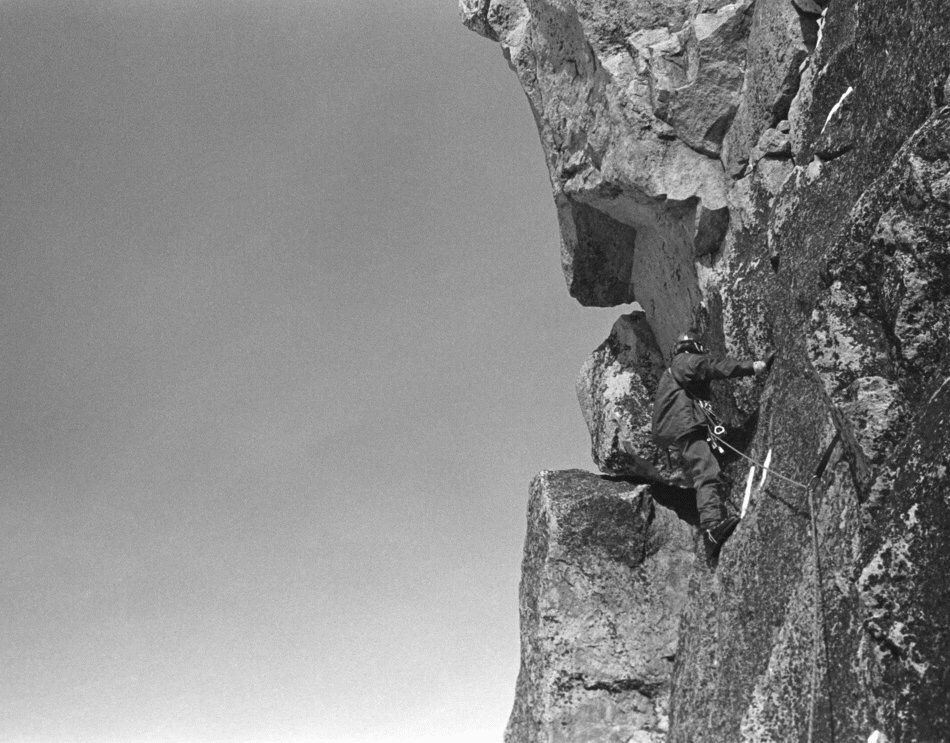
    Harry leads a nice pitch.
    Harry leads a nice pitch.
    The lads are now seen lower left if you look closely, watching as Harry leads a line. These are the pics I shot from over on the buttress.
    The lads are now seen (lower left if you look closely) watching as Harry leads a line. These are the pics I shot from over on the buttress.
    Looks like Gordon belaying the next climber up, while Harry pokes around.
    Looks like Gordon is belaying the next climber up while Harry pokes around.
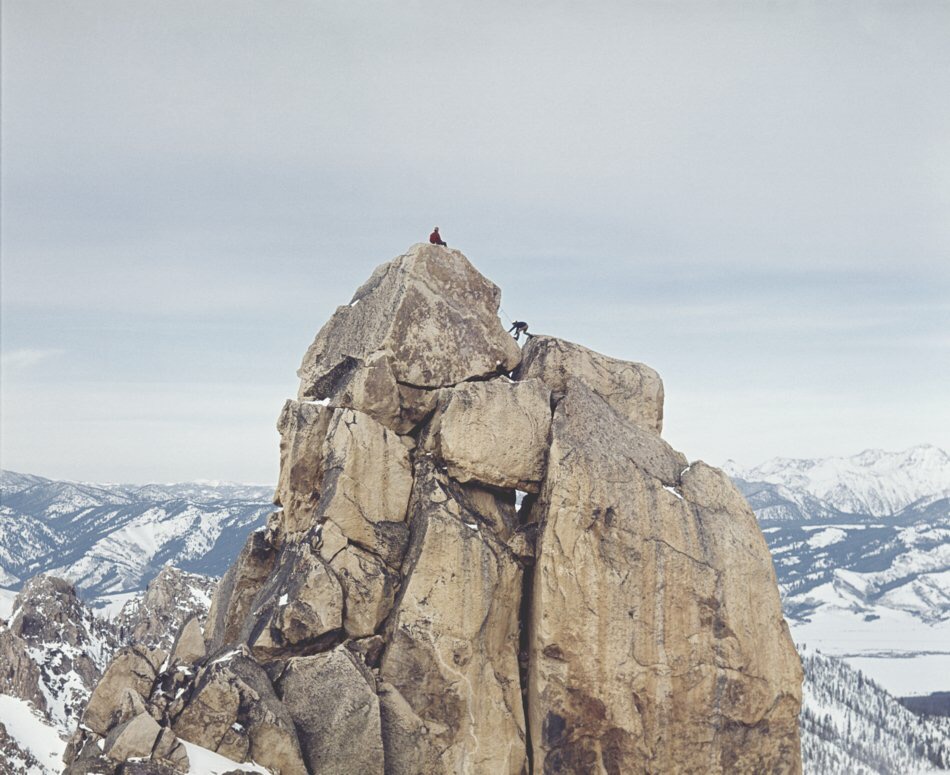
    Making a leap of faith. There is a large gap from one boulder to the next, which takes a measured leap to do properly. Don't come up short, but really don't overshoot the landing.
    Making a leap of faith. There is a large gap from one boulder to the next, which takes a measured leap to do properly. Don’t come up short, but don’t overshoot the landing either.
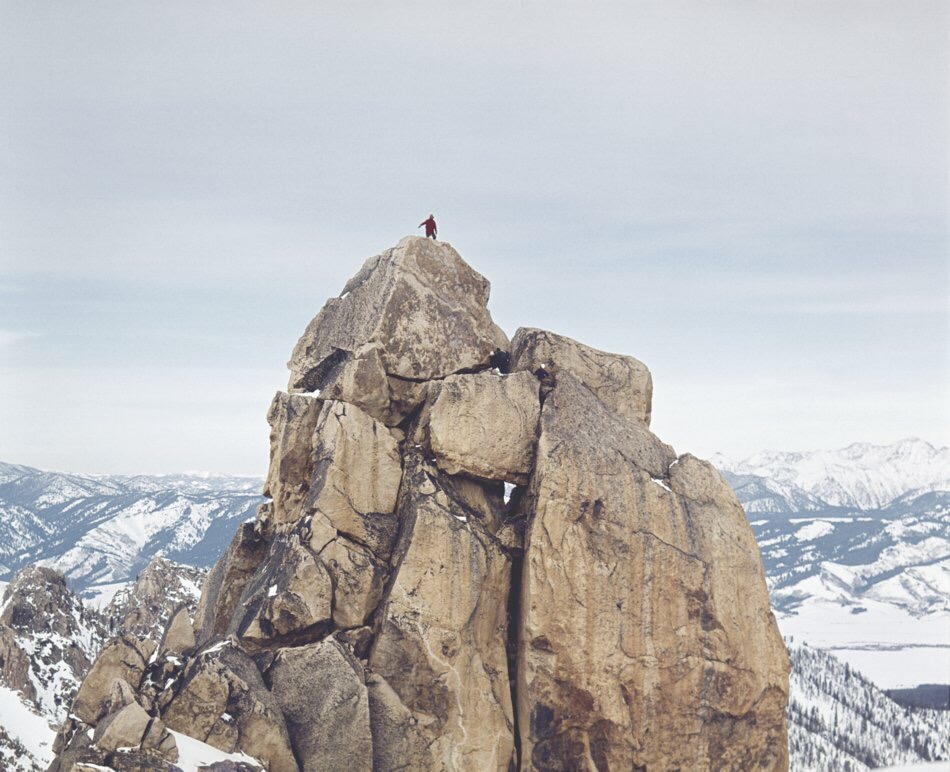
    Harry on the summit block.
    Harry on the summit block.
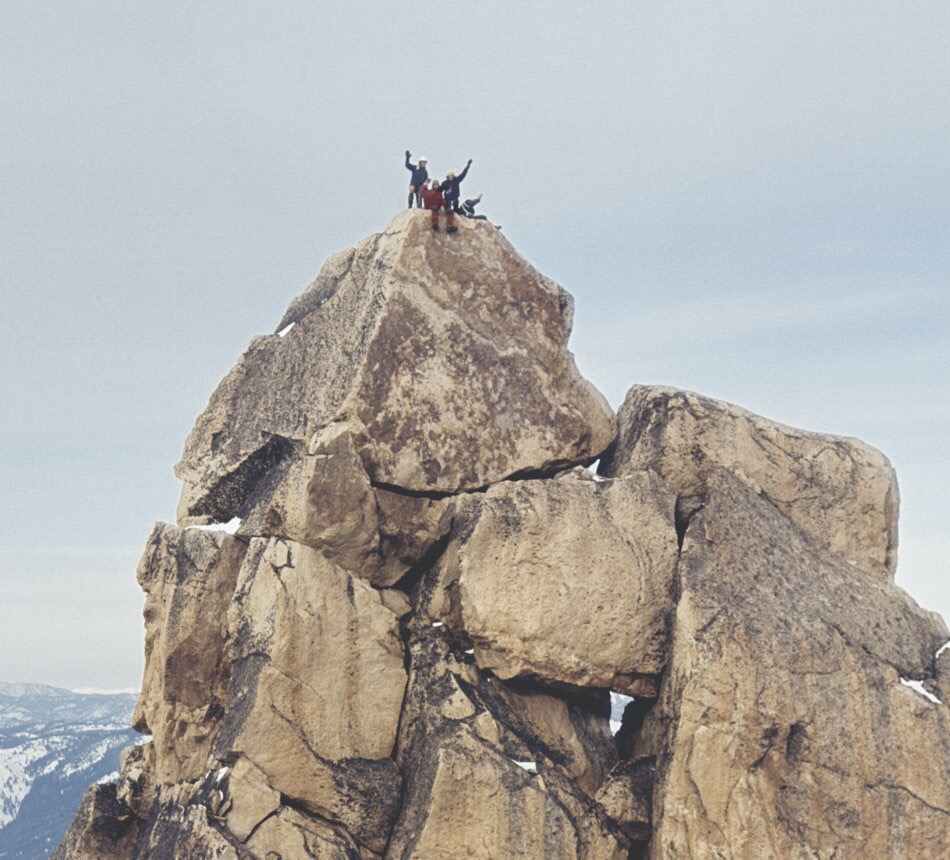
    Detail summit photo, First Winter Ascent, March 19, 1973. L to R > James Christopher Hecht, Harry Bowren, Gordon K. Williams, Joe Fox.
    Detail summit photo of the first Winter ascent (March 19, 1973). Left to right: James Christopher Hecht, Harry Bowren, Gordon K. Williams and Joe Fox.