Category: Lost River Range

  • An 1884 Ascent of Mount McCaleb by J.D. Martin

    An 1884 Ascent of Mount McCaleb by J.D. Martin

    [Editor’s note: J.D. Martin was an early settler of the Lost River Valley. As he was nearing his 90th year, he wrote a memoir covering the early history of the Lost River area which was published in installments in the Arco Advertiser. This portion covers his ascent of Mount McCaleb in 1884. It also references other ascents of mountains in the Lemhi Range near Badger Creek but does not supply names. Badger Creek is located just below Diamond Peak. Martin’s obituary is set out below his trip report.]

    . . . From there we went on to Badger Creek where a number of mining locations had already been made. We climbed several mountains around there but could find nothing which incited us to remain very long. We took another trail, over what was also then called Pass Creek and came onto Birch Creek, a few miles below where the old-time ghost town of Nicholia was at that time quite a bustling and busy little mining town.

    A smelter was in operation and a population of perhaps two hundred people were living there. We then went on over the divide to another old time “ghost town” called Junction which was located on the east site of the Lemhi River about a mile from where the town of Leadore now is. This was also quite a bustling and active little town for that time and place. From there, we went on over the [Beaverhead] Range on the East Side of the Lemhis and prospected along the dividing line of the two territories of Idaho and Montana.

    We found nothing which we deemed worth locating and returned soon to Junction. We then concluded to go up the stream, then and now called Timber Creek, which comes into the Lemhis about a mile or so below Leadore. We endeavored to simply “course our way” without trails or guidance of any kind, relying solely upon our sense of direction. Wild game was so plentiful that we could in a few minutes after pitching camp, easily kill all the wild birds we wanted to eat. An abundance of the three camp essentials (wood, water and grass) were everywhere and we were well inured to outdoor and camp life.

    In passing around the divide between the headwaters of the Little Lost River and the Pahsimeroi, we somehow got onto a blind Indian trail which led us to a point and in a direction somewhat too far north. We came to a place where the higher mountains in front of us seemed to offer an impassible barrier to our further progress in the direction we were going. We found a good camping place for the night and were considering plans for retracing our steps next day. Next morning, Mr. Soloman was not feeling well and proposed that we lay over a day. Williams had seen bear tracks and, taking his gun, started out to add to his hunting laurels by killing a bear. I took a prospector’s pole, pick and started to climb the rough and rugged mountain which stood directly in front of our camp.

    After some hours of arduous and laborious climbing over fallen timber, rocky gorges and deep precipices, I arrived at the top. And behold I stood at the summit of Mount McCaleb. Well, lest this screed should exceed the limits of permissible space, I will here close with the promise that the next installment of this narrative will begin at the summit of Mount McCaleb. (ARCO, June 15, 1941)

    From the summit of Mount McCaleb and the date of about the last of August 1884. I do not deem it necessary to attempt  any kind of a detailed description of the view from the top of Mount McCaleb. I will say that, at that time, nothing contributed by human agency was visible from there. A long, winding fringe of deep green, reflected from the dense growth of trees which marked the course of Lost River (at that time far more abundant and extensive in every way than it is now) was quite visible and marked the course of the valley from the extreme northwest to the southeast. Upon the whole, it was really a sight never to be forgotten and it has always been something of a wonder to me to find so many people who have never been to the top of Mount McCaleb. I returned to the camp and was able to inform my companions—Solomon and Williams—exactly where we were. . . .

    J.D. Martin 1852 to 1942

    “GRAND OLD MAN” OF BIG LOST RIVER VALLEY SUMMONED

    Honorable James D. Martin Closes Career Tuesday Morning After Nearly 90 Years of Active and Honorable Life. [The Arco Advertiser April 17, 1942]

    Judge James D. Martin, known as the “Grand Old Man” of the Lost River Valleys, came to the end of the long, long trail Tuesday morning. His nearly 90 active and honorable years–more than half of them spent in this valley–closed Tuesday morning, and with his death closes the career of a man who was very much a part of the life of our community.

    He had been ill with a cold for several days, but he seemed somewhat improved when he retired Monday night. When he did not appear at his usual hour Tuesday morning, Mr. Daniels (hotel owner) went to the room where the lifeless body was found in bed. Only a short time before, Dr. Egbert said, had his spirit taken flight. Although he was known to be failing in health, the news of his demise spread to the remotest sections of our county and was a shock to all. There was a hushed silence as the death was announced because “Judge” Martin was known intimately by every man, woman and child in the Lost River country and to them he was both friend and counselor.

    Judge Martin wasn’t just an ordinary individual. Although he left his native state of North Carolina when he was a lad of 17 and, as a consequence of which, his education was sadly neglected, he was a man of brilliant intellect–a self-educated man. He continued the quiet dignified bearing of his early youth to the very last. He wrote many interesting pioneer articles for The Advertiser in recent years and always took a leading part in community affairs.

    Martin was born in North Wilkesboro, North Carolina in October 1852. At the age of 17, he and a boyhood chum left to cast their lot in the West. He followed the life of a nomad from then on for 15 years, spending time on the frontier in Colorado, Arizona, and California. In 1883, Martin was attracted to the Wood River country where a mining boom was underway and, naturally, he turned toward the Lost River Valley in 1884 as this valley was then attracting a great deal of attention.

    He filed on a homestead in what is now the Lost River precinct in 1884. He lived there during the required length of time and, between times, worked in the mines on the Wood River. After proving up on his claim, he settled down and became a gentleman farmer in this valley. His education had been improved during his spare time, as he studied hard to increase his many abilities. He taught the second school of record in this valley, and spent a year or more in similar work in Little Lost River Valley. Many of our “old timers” gained the fundamentals of their schooling–their three “R’s”–in the little schools he taught.

    Soon after the Lost River Valley began taking on airs as a “homeland,” he was elected Justice of the Peace. in this position, he served many  years. He became a confident and legal assistant to many of our first families. He performed marriages, spoke at funerals, settled estates and, in scores of ways, endeared himself to the people of the valley.

    He served in other official capacities also. he was County Commissioner during 1919 and for several years thereafter. The first highway construction work in this county—the road to Howe—was built and gravel surfaced during his administration. He was County Commissioner when the Irrigation District was formed. Later he retired as County Commissioner and served several terms as Probate Judge. He was always active in civic and fraternal affairs. He served as Treasurer of the Arco Lions Club during its existence. He “went through the chairs” in the Odd Fellows’ Lodge and for many years continued an active interest in that great fraternal organization. He made frequent trips to his old home in Wikesboro, North Carolina. He also visited a brother in Texas, who served many years as a district judge.

    For quite a number of years, Judge Martin made his home at the Dee Hotel at Arco and, during most of this time, he served as chairman of the Butte County Red Cross, an organization of which he held the highest regard. The successful membership campaigns and other activities engaged in by this humanitarian organization were always a great delight to Judge Martin. He was generous and kind-hearted. He gave generously to charity. He was far from wealthy but, by frugal management and simple wants, he garnered enough of the world’s goods to maintain himself during the years in the sunset of his life.

    Judge Martin seemed to feel that his days were numbered that when he was stricken with a cold about two weeks ago. He confided to friends that in all of his other illnesses he seemed to been able to overcome them, but on this occasion he told one intimate friend: “I feel that it is only a matter of time now, until I shall be called. I do not seem to be able to overcome this cough, but I am ready.” That was like him.

    He united with the Unitarian church in his youth and, although he did not affiliate with any other, he was quite a regular attendant at  services in this community dividing his time between the Baptist and the L.D.S. churches. Funeral services will be conducted this afternoon from the L.D.S. church officiating. Funeral arrangements are in charge of the Marvel Funeral Home and interment will be at Hillcrest. Services will begin at 2:00PM and several of his intimate friends are taking part in these rites. A nephew is expected to arrive from Texas. Thus a highly honored and respected citizen will remain with us in life.

  • 1987 Death on Borah

    1987 Death on Borah

    In 1987, an experienced climber descending Mount Borah fell on the snowpack and lost control of his self-arrest. He landed just above a water chute/water-melt tunnel as the avalanche he triggered pushed him into the chute and buried him.

    Water Chutes/Water-Melt Tunnels

    When temperatures warm, water melts below the snow surface and flows in river-like patterns downhill. As the water flows, a tunnel of air forms and melts the snow from underneath. On steep slopes, and in areas with deep gullies, larger chutes/tunnels may form. Much like a crevasse, these chutes/tunnels may not be evident on the snow surface, though sometimes the snow appears thinner or is of a different color. You may also hear water flowing underneath as you near a chute/tunnel area. Like a crevasse, if the tunnel is large enough, a climber can fall through the weakened snow surface and be buried and/or swept by the water under the snow down the tunnel. A fall into the tunnel on a steep slope can also precipitate backfill of snow from above into the tunnel as the melting, weakened snow surface moves to stabilize itself.

    Water-melt tunnels can be large permanent features below established glaciers and year-round snowfields, or short-lived, more shallow features on seasonal snowfields. Accidents and fatalities from falling into water-melt chutes/tunnels are rare, though these melt features are common. However, risk a chute/tunnel posses to a climber is related to a multitude of factors including: the steepness of the slope, the thickness of the snowpack, the terrain below the snow, the amount of melting occurring, whether a tunnel already exists or is forming, and if a chute/tunnel is large enough and close enough to the surface to collapse and fall into.

    An important lesson from this unfortunate accident is that water-melt chutes/tunnels are features that may exist under the snowpack. Take this possibility into account when choosing a descent path and when searching for a missing team member.

    Here are links to a few photos of chutes/tunnels from places outside of Idaho that gives you an idea of what the feature looks like to help you assess this risk on your climbs.

    The accident report was published by the American Alpine Club (AAC) in Accidents in North American Mountaineering, 1988. Read the full article below, or click on the title to read it on the AAC website.


    FALL ON SNOW, LOSS OF CONTROL—VOLUNTARY GLISSADE, AVALANCHE, INADEQUATE EQUIPMENT, WEATHER

    Idaho, Mount Borah

    On June 13, 1987, David Probst (38), who was a member of the Idaho Mountain Search and Rescue Unit for several years, was descending Mount Borah (3,950 meters) with three friends when he fell 150 meters to his death.

    Accident

    They had started late in the morning, around 0900. Knowing there was very little snow, they carried only one ice ax with them. They reached the summit at 1800. Then they started down and, when they reached the saddle between the summit and false summit, they changed to the Rock Creek descent. The first two, Linda Claiborne (30) and Ben Childlaw (35) with the ice ax, started ahead of Probst and Jennifer Smith (31). Probst used a rock as a dagger for control on the snow while Smith waited in the rocks above. Probst lost control while trying to self-arrest. He disappeared around a bend in the snowfield.

    At this time Claiborne and Childlaw were down at the fourth snowfield. They saw a large mass of snow coming down the chute, but no sign of anyone. They climbed back up to Smith. At this point they searched for Probst and, finding his hat at the second snowfield, they started probing for him. They also probed the first snowfield but stopped when it got too dark to work. They spent ten hours climbing down and hiking out for help.

    The local sheriff’s rescue group from Mackay responded but were initially not able to get to the victim’s location because they had no experience or equipment. The 3-person team arrived wearing tennis shoes and jeans, carrying one rope and a carton of Pepsi-Cola. A deputy accompanied them. Idaho Mountain Rescue personnel were on hand at the staging area. The sheriff indicated that he would have his team go up the mountain and assess the situation first to see what resources were needed. As night neared, the sheriff got a MAST helicopter to drop sleeping bags and food for his team. The helicopter flew to 4700 meters and dropped the supplies. The supplies were well scattered after their 1250 meter descent.

    On June 15, an electrical storm hit, and the sheriff ordered everyone off the mountain, suspending the search until later in the week. The sheriff’s team and Idaho Mountain Rescue returned on June 19. The next day, June 20, rescue teams fine-probed the first snowfield. Course probes and tunnels were dug on the second field. An avalanche dog was used but alerted many times on the snowfields. When teams started searching snowfield three, the body was spotted under the snow above a water chute which Probst had slid into with the loose snow. [Sources: various newspaper reports; Larry Novak and Bob Meridith of Idaho Mountain Search and Rescue; and Merle King]

    Analysis

    The late start, an apparently festive group with an experienced leader, and a clear day that deteriorated late in the afternoon led to the circumstances that turned this situation around. Choosing a technical descent route without having adequate equipment put the group at risk. That Probst used a rock for an ice dagger for self-arrest aid indicates the level of concern he had.

    While it seems likely that Probst died quickly, the rescue response was apparently not handled properly. If the victim had survived the fall, he most likely would have died by the time he was finally reached. Technical rescue resources were available but do not appear to have been used appropriately. [Source: J. Williamson]

  • Death on the Way to Mount Church

    Death on the Way to Mount Church

    Editor’s Note: On August 4, 2006, a fatality occurred on a summit attempt of Mount Church. What follows is the final article, published by the American Alpine Club in Accidents in North American Mountaineering 2006.

    I wrote the article along with Butte County Sheriff Wes Collins, with additional input provided by Portneuf Life Flight Registered Nurse Lance Taysom. Wes, an exceptional climber, led the rescue and recovery activities.

    Accidents In North American Mountaineering started as a report from the Safety Committee of the American Alpine Club. The Safety Committee was established in 1947 in response to “the startling increase in the number of mountaineering accidents which occurred” during that particular Summer. The Safety Committee is charged “to investigate climbing accidents and to formulate a program of prevention for the future.” The Committee gathers data “with no intent to criticize persons involved, but rather to learn why these accidents occurred and to emphasize the lessons to be learned from them.” As such, climbers are referred to by their initials and not their names.

    The full article is a thorough accounting and analysis of the events that lead to this tragic fatality. Consequently, the article also provides valuable route information and lessons learned for this increasingly popular peak. You may also click on the title to read the article directly from the American Alpine Club site.


    Fall on Rock, Off Route, Failure to Turn Back, Party Separated, Inexperience, Inadequate Equipment, Idaho, Lost River Range, Mount Church

    Idaho, Lost River Range, Mount Church

    On August 4, I.C. (41) and B.B. (36) set out to climb the standard route on Mount Church (12,200 feet) in the Lost River Range.

    The approach to Mount Church begins with a strenuous 1.5 miles, 1,000-foot climb through the forested bottom of the Jones Creek Canyon. The route then climbs a side canyon for 1,400 feet to a ridge which divides Jones Creek from an unnamed drainage to the west. The bottom is blocked repeatedly by the meandering Jones Creek, which zigzags back and forth leaving steeply cut banks covered with tangled brush and downed timber. The approach route is so difficult that it takes most climbing groups more than two hours to reach the point where the route leaves the canyon bottom. On the day of the accident, there were no other climbers on the route.

    About halfway through the Jones Creek bottom, the climbers left the route and started to climb a steep side canyon. It appears that at first, they believed they already crossed the entire Jones Creek section of the approach and were on the route. After climbing roughly 800 feet, they realized their mistake and attempted to regain the route by climbing north through a large Class 5 cliff band. I.C. was climbing above B.B. and moving over a rock wall that took her out of his view. I.C. told B.B. “Don’t climb that. That was stupid.” She directed him to climb back to the base of the cliffs while she looked for a route down the other side of the obstacle she just climbed.

    B.B. started down but got stuck on a ledge. As he was looking for a route he heard I.C. call his name. Moments later, he heard rocks falling from I.C.’s direction. He also spotted contents from her pack falling down the face and then saw her falling, ricocheting off a ledge and then continuing to fall out of his view.

    At 11:12AM, B.B. called 911 on his cell phone, reported the accident and advised that he was stuck on a ledge. Custer/Butte County Search and Rescue Team and Portneuf Life Flight responded to the scene. Shortly after 12:00PM, as the rescue team was approaching the mouth of Jones Creek, the rescuers witnessed a violent thunderstorm and saw several bolts of lightning strike the upper slopes of Mount Church and nearby Donaldson Peak. The upper part of the route was covered with a layer of hail. Most of the lightning strikes were above the accident scene. After reaching the scene, the rescuers confirmed I.C. had died in the fall. Her injuries consisted of a broken neck and severe head injuries. The rescue team performed a roped rescue for B.B and then walked him out to his truck.

    About 2:00PM, during the rescue of B.B, the team experienced another series of less-intense thunderstorms. During the rescue and subsequent investigation, rockfall was a continual hazard facing the rescuers. Rain from that system produced slippery conditions in the canyon that ultimately caused two rescuers to slip and sustain injuries as they hauled out I.C.’s body.

    Analysis

    Mount Church is one of nine 12,000-foot summits in Idaho. In recent years, climbing all of these peaks has become a popular pursuit for Idaho climbers. The Lost River Range is rugged, steep and wild. Other than Mount Borah, Idaho’s highest summit, the summits in the range are approached cross-country through difficult, debris-filled, cliff-lined canyons.

    The climbers had a topo map and route description from a hiking guidebook. I.C. was a novice climber who had started sport climbing in the spring of 2006. Two weeks prior to the accident, she successfully climbed the busy standard route (mostly trail) on Mount Borah. Her partner was an avid hiker but did not have any climbing experience.

    This accident occurred due to a combination of the inexperience of both climbers and the difficulty of the terrain. Mount Church is not a peak which can be safely climbed by inexperienced climbers. Jones Creek is extremely wild and unforgiving and the bottom of Jones Creek constantly changes from year to year. Ascending the canyon requires physical conditioning, endurance, prior off-trail hiking experience, mental toughness, and map-reading skills.

    The canyon walls are steep and are crowned by broken cliffs. Experienced climbers who would have known from reviewing the topographic map and scouting the route from the valley floor that there were no non-technical routes up the West Side of the canyon. Despite the technical nature of the canyon walls, the climbers left the canyon at the 8,200-foot contour and climbed up the wall to roughly 8,900 feet. As they ascended the slope, they crossed steep, cliffy terrain and a face that steepened as they continued their ascent. The unsuitability of the canyon wall for inexperienced, unequipped climbers is highlighted by the fact that when I.C. fell, she dropped more than 150 feet, bounced off at least 3 wide ledges, landed on a talus slope, and then rolled to a stop some 80 feet below the bottom of the cliff.

    Inexperience also played into the decision to leave the route. Although B.B. was unsure of why they prematurely left Jones Creek, it was likely due to the difficulty of the terrain, that they believed they had actually reached the correct turning point. In reality, they had traveled less than a mile, underestimating the time it takes to cross such inhospitable country. It is also possible B.B. and I.C. left the route in an attempt to avoid the strain of climbing through the obstacles littering the Jones Creek bottom.

    Inexperience was also demonstrated by their decision to continue onto technical terrain without adequate climbing equipment. While technical climbing equipment was not necessary for the Standard Route, the climbers did not recognize the need for such equipment when they ventured out onto the cliff band.

    The climbers got off to a late (8:00AM) departure on a day when the weather forecast called for thundershowers. The early development of thundershowers made the climb unwise, as the majority of the route crosses exposed ridges and faces. B.B. did not mention that weather concerns factored into their decisions. Finally, their decision-making process was simply to react to obstacles by changing directions. They had several opportunities to retreat but did not consider this option until they were in serious trouble.

  • Lyman Marden

    Lyman Marden

    Lyman Marden was a member of the USGS team that surveyed the Borah Peak quadrangle. He wrote an article entitled Climbing the Slopes of Mount Borah—the Dean of Idaho Peaks about the survey. This article appeared in the Idaho Statesman in 1935. In 1950, he wrote the following report for the Boise Public Library.


    —An account given to the Boise Public Library on April 15, 1950 by Colonel Lyman Marden, a member of the party that surveyed the Borah Peak quadrangle and placed the benchmark on the top (September 13, 1934).

    Located halfway between Mackay and Challis, Idaho. Elevation 12,665 feet above sea level. Highest in the State. Approached via Highway 93 to Challis and Highway 93 toward Mackay or via Highway 20 to Arco, thence to Mackay and toward Challis.  

    The Challis approach is enriched by the Salmon River country through which Highway 93 runs. 

    The Arco-Mackay approach is one of great contrast. The Lost River Range, which culminates in Borah Peak, begins as low hills near Arco on the edge of the Snake River Plain. From there, the Range rises to a long series of peaks over 11,300 feet and several over 12,000 feet. See United States Geological Survey, Topographic Map, Borah Peak Quadrangle 1934-35.  

    A road crosses the mountains just a few miles from Borah Peak through Doublespring Pass and gives access to beautiful country at the headwaters of the Pahsimeroi River, one fork of which rises from the North and East Faces of Borah Peak. These headwaters are scenic with long, grassy slopes called Horse Heaven and at a higher elevation Goat Heaven, and a backdrop of perpendicular mountain faces carved out by glacier action. Small caves may be found at surprising places in the high ridge between the forks of the Pahsimeroi. Good but limited camp spots are available. Obtain Forest Service advice at Challis or Mackay and local ranchers’ advice on springs, streams, wooded areas, etc. 

    Rivers and creeks in the near vicinity of Borah Peak are of the Lost River type and are apt to lose themselves in the gravel of the valleys for many miles only to reappear. Big Lost River and Little Lost River lose themselves in the Snake River Plain.

    The Pahsimeroi River reappears just before emptying into the Salmon River. Fishermen say it is a peculiar shock to run out of water while fishing downstream. There are many interesting phenomena in the general area. Almost certainly some of the peaks have never been climbed. There are castle rocks and pinnacles, hanging lakes, big springs, and distorted and twisted strata. Just north of Borah Peak on the edge of the Pahsimeroi Valley and east of Doublespring is an old volcanic crater containing a crater lake, part of the volcanic action represented by the Craters of the Moon National Monument many miles to the south. It is believed that a large meteor left a wide pockmark in the Pahsimeroi Valley near the upper edge of a distinctive alluvial fan close to the North Face of the Pahsimeroi Mountains. Those who desire to climb Idaho’s highest peak are advised to seek a road to the base of the mountain that leaves the Challis-Mackay Highway 93 quite close to the Dickey Ranch and Post Office. The view of Borah Peak from Dickey will reveal a long, curved ridge ascending to the top. The base of the ridge nearest Dickey is divided by a shallow draw slightly darkened by scrub timber. Ascend the shallow draw and continue along the converged, sharpened ridge to the top.

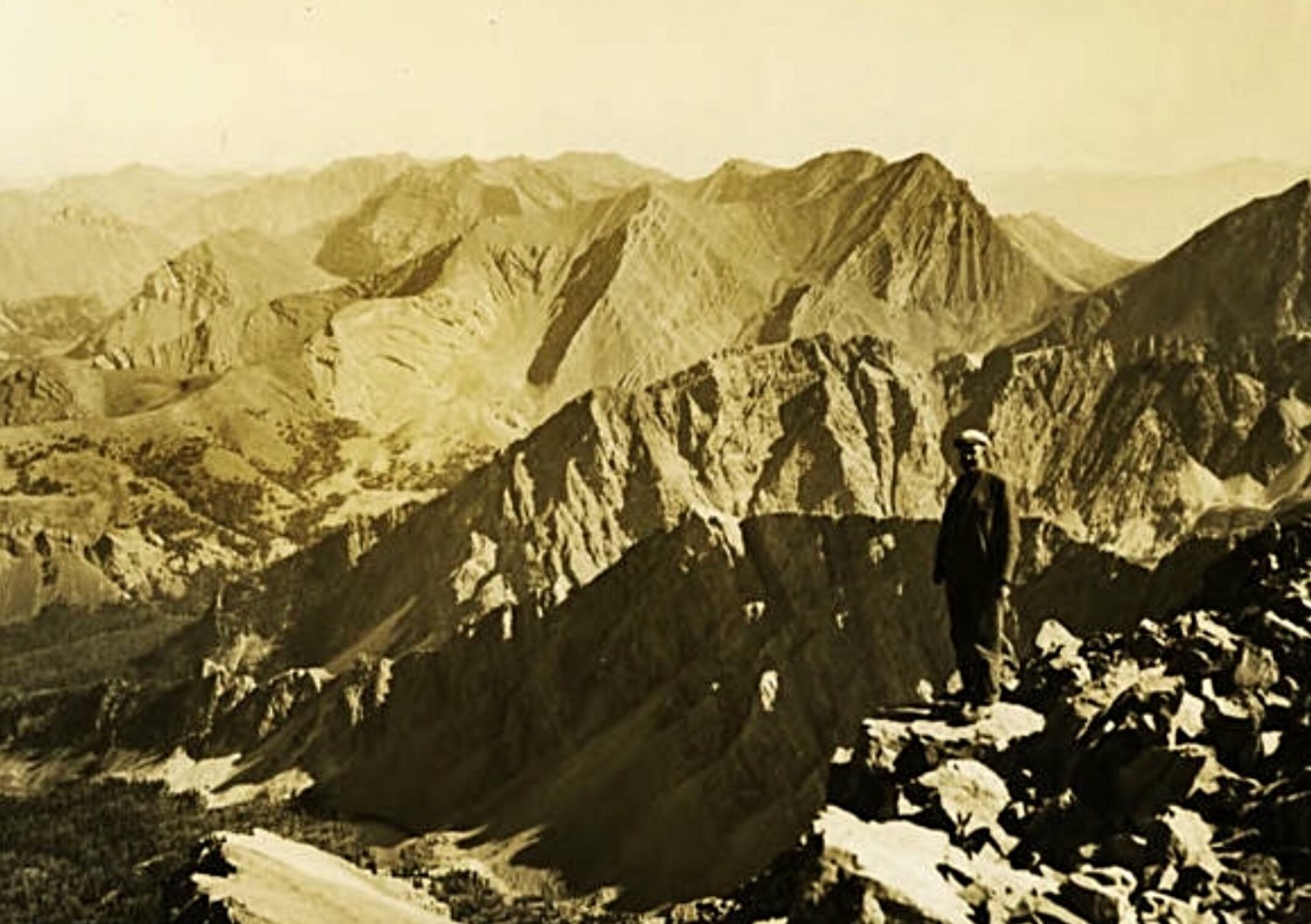
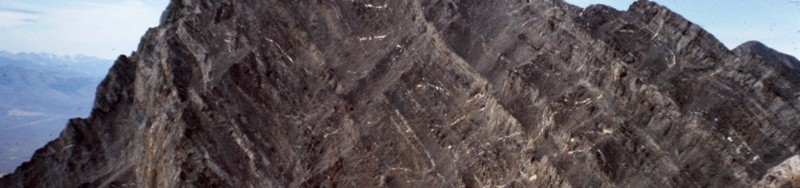
    The Lost River Range viewed from the summit of Mount Borah by Lyman Marden, USGS 1934.
    The Lost River Range as viewed from the summit of Mount Borah by Lyman Marden (USGS 1934).


  • A 1949 Climb Up Borah

    A 1949 Climb Up Borah

    This article was published in the Aberdeen Times on August 18, 1949.Since 1940, only 62 people have climbed Mount Borah, Idaho’s tallest mountain. Among these are 4 amateur mountain climbers from Aberdeen who scaled the 12,655-foot peak last Monday morning. Stanley and Horace Nealey, Howard Morton and Norman Brown put on a good pair of shoes last Saturday afternoon and drove to the base of Mount Borah where they started the climb the next morning.  

    “We stopped at a farmhouse at Dickey and got all the information we could get,” Horace Neeley said, “but we found out that there are no regular trails up the mountain and that climbing it would be up to us.”  

    “We camped that night at the base of the mountain. We had driven as far as possible in our pickup truck, but found that we had about 7,000 more feet to climb on foot the next morning,” Neeley said. He also said that although the mountain is plenty steep, spiked shoes and ropes were not necessary for the climb. ‘‘All you need for Mount Borah is a good sturdy pair of shoes,” he said. “The climb is nearly all rock and it’s easy to wear out a pair of ordinary shoes.” 

    “On the way up, the air kept getting thinner,” Horace said, “and near the top, we had to rest quite frequently.” 

    “The top of the mountain is quite a ways above the timberline. We saw some huge snow drifts and ran into a snowstorm. The snowstorm wasn’t like a regular blizzard because it was caused by a Summer thunderstorm that turned to snow at that high altitude. We had coats with us but it got mighty cold anyway. After about 20 minutes on the summit, we turned back down the mountain. We had left our camp at 7:35 in the morning and got to the top at 12:20PM, approximately five hours of climbing. Although we covered about two miles, it was about a mile from base to summit in a straight line.” 

    “From the top of the mountain, we could see a lake below us with a small iceberg floating around in it. We saw few animals . . . only one herd of about a dozen antelopes. We found a box at the top that had been placed there by the Mazamas Club in 1940. The Mazamas Club is a mountain climbers organization. Only people who have climbed to the top of the mountain where there is perpetual snow qualify for the club. We signed our names to the list. Only 62 people have climbed Mount Borah since 1940. Apparently, the trip back was considerably easier, but it still took the group three hours to go the two miles down.”  

    The boys advise potential mountain climbers to wear a good strong pair of shoes and to take a lunch along on the climb. And, climbers should take a canteen of water, although there will probably be enough snow at the top to take care of thirst. A good truck is needed to get over the rough roads to the base of the mountain because a car won’t clear some of the obstacles.  

    Horace Neeley has been climbing mountains for quite some time and has scaled several in Idaho. He’s climbed Bannock Peak, Mount Sedgwick beyond Lava, and Mount Hyndman near Sun  Valley. The latter is 12,078 feet high. The next mountain on the list to be climbed is Mount Leatherman near Mount Borah. “It’s not quite as high as Borah,” Horace said, “but they say the climb is a lot tougher.”  “I like mountain climbing, but I haven’t reached my ambition yet. Someday, I’m going to climb the Grand Teton, north of the Jackson Hole country.”  Want to keep cool this summer? Go find a nice, tall mountain and sit on top of it.

  • 1929 Borah Declared Idaho’s Highest Peak

    1929 Borah Declared Idaho’s Highest Peak

    The book discusses the discovery of Borah Peak as the highest point in Idaho on Pages 16 and 17. This entry expands on that discussion and adds source documents relating to the issue as well as documentation for T.M. Bannon’s first ascent in 1912.


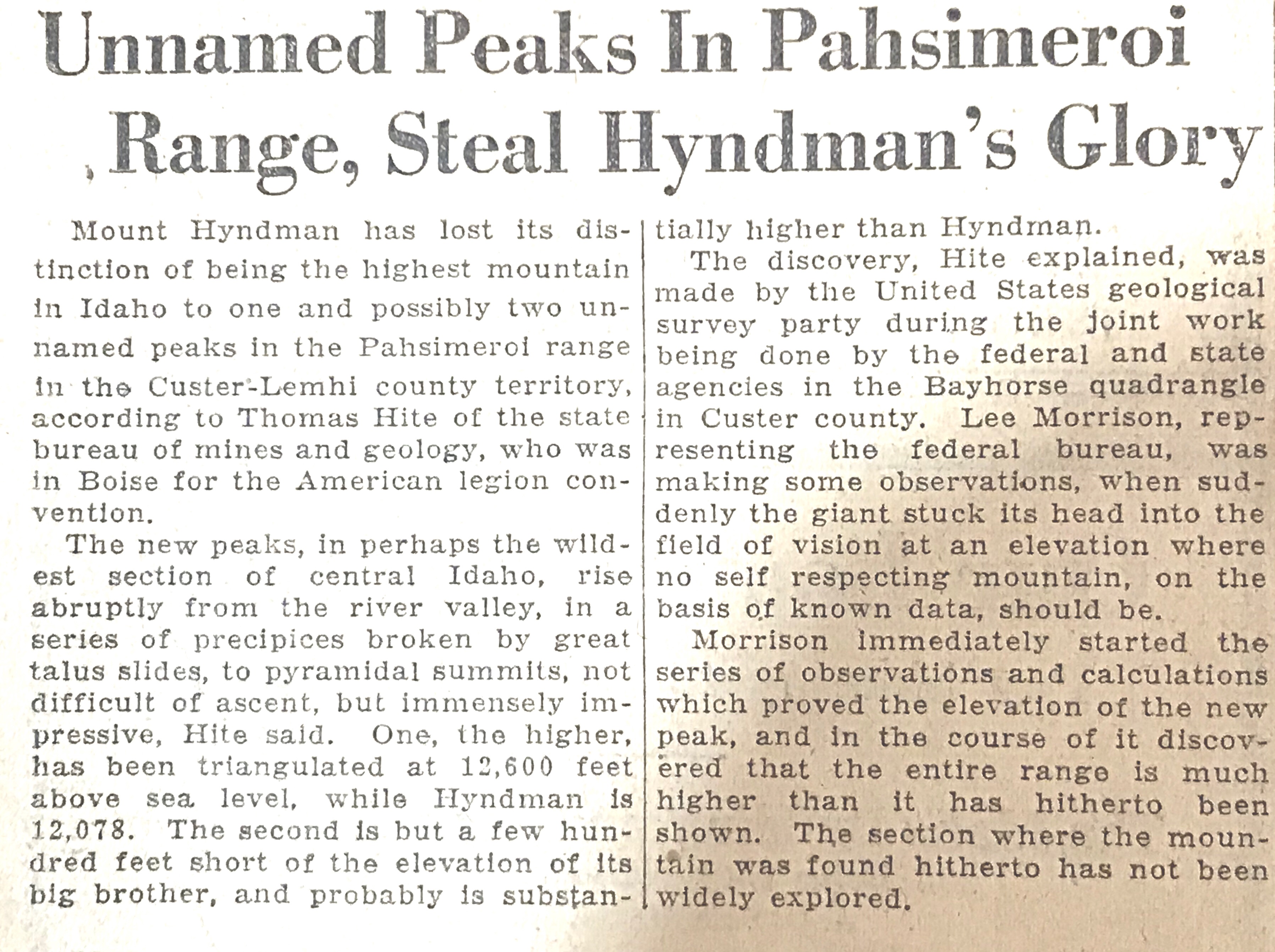
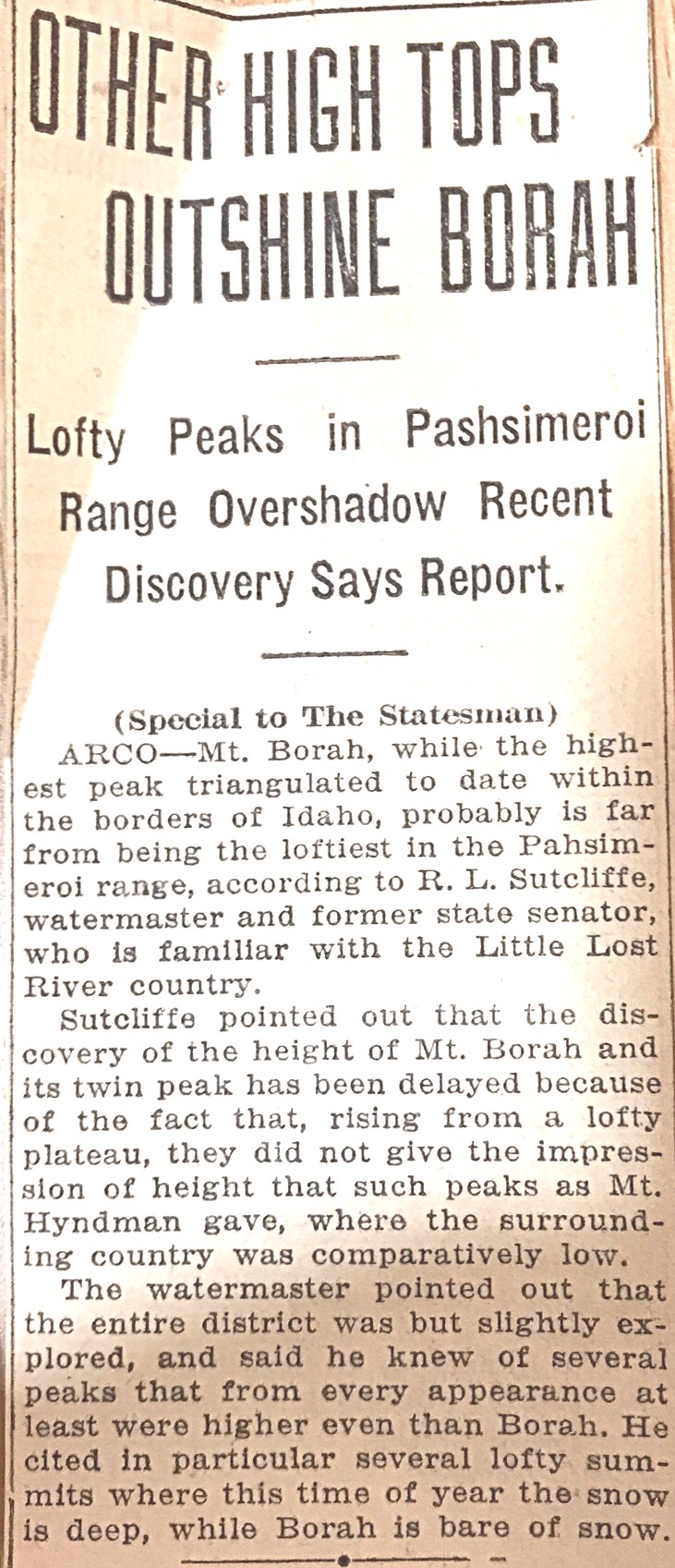
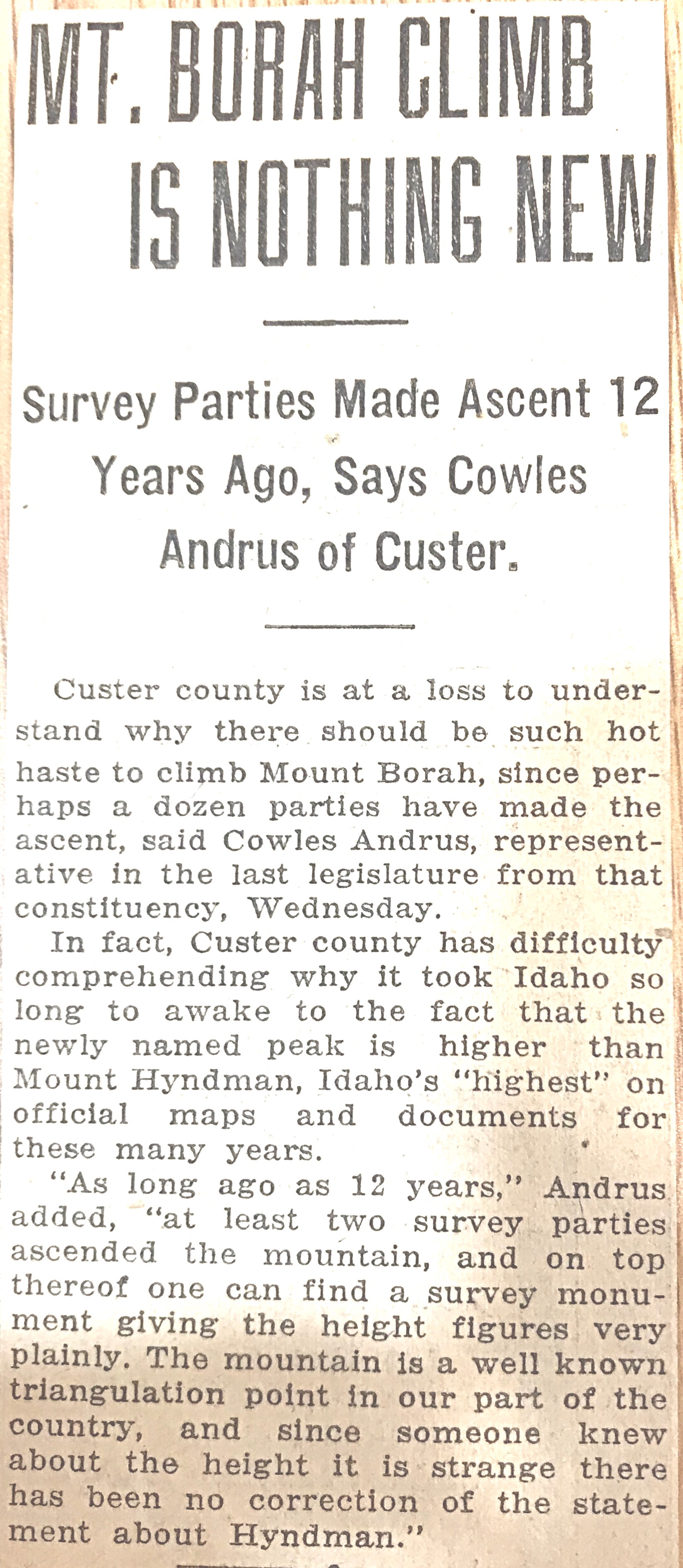
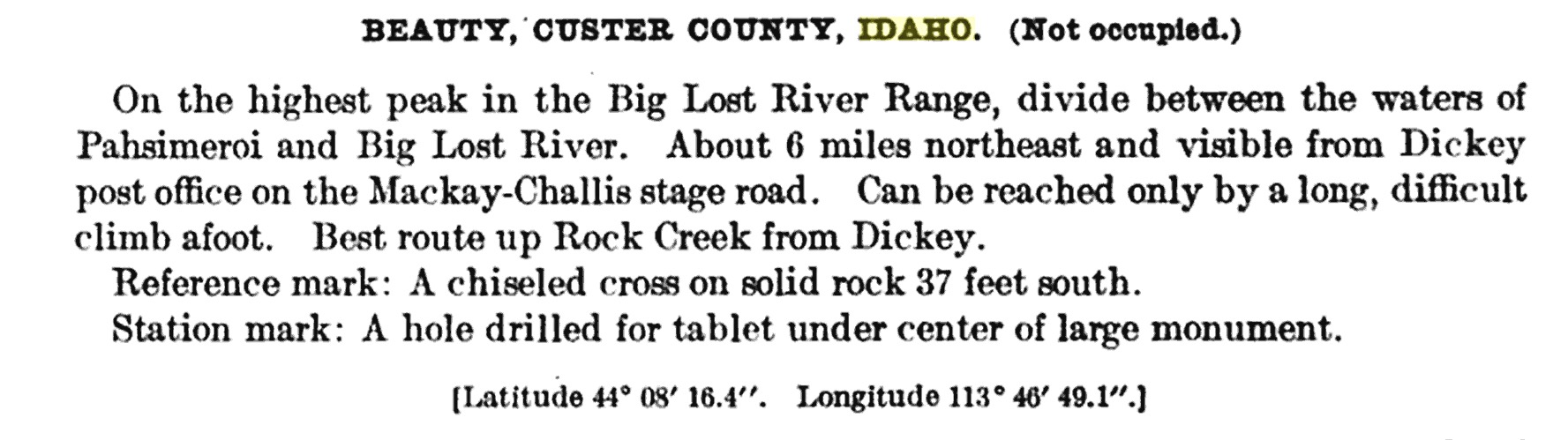
    The following 1929 article from Idaho Statesman declared to the world that Borah Peak, also known as Mount Borah, was Idaho’s highest peak. However, the second article on this page demonstrates that not everyone was willing to accept that Borah was the highest peak. The third Idaho Statesman article on this page disputes the fact that many knew before 1929 that Mount Borah was taller than Hyndman. Interestingly, there is support for this proposition (see below) as T.M. Bannon, a government surveyor, placed the Beauty Benchmark on the summit in 1912, although it does not appear he mapped an elevation at the time. Click on the articles to expand and enjoy.

    Idaho Statesman, November 29, 1929.
    Idaho Statesman December 19, 1929.Except from the Thirty-Third Annual Report of the Director of the United States Geological Survey, 1912.

    This 1912 entry is one of many by T.M. Bannon and covers his work on Mount Borah and briefly describes his first ascent route.
    This 1912 entry is one of many by T.M. Bannon and covers his work on Mount Borah. It briefly describes his first ascent route.