Category: Mountain Names

  • Kong and Us by Bob Boyles

    Kong and Us by Bob Boyles

    [This article was first published in Idaho Magazine, July 2022.]

    The Peak That Got Away

    Lady and I gotten along just fine for about half of the five-day horseback trip up the South Fork of the Payette River, until she bolted off the trail into Lodgepole pines. She was at full gallop and I had to lie flat on the saddle to keep from getting knocked off by low-lying tree limbs. After I finally managed to stop her and we trotted back up to the trail, the outfitters quickly found the cause of her behavior. A yellow jacket had burrowed under her saddle blanket and she was getting stung repeatedly. Other than this incident, Lady and I became good friends, and she impressed me with her calm demeanor and backcountry skills. I had ridden a few times in my youth but had never spent a full eight hours on the back of a horse, so I was in for a surprise after dismounting at the end of a long day. It took me a full day to walk normally again and by then, I had nothing but respect for those who make a living on horseback.

    This was September 1973, and I had been invited on the trip by the Carson family. When the outfitter assigned the horses that we would ride based on our experience and the personalities of the animals, he told me, “You’ll ride Lady. She’s a little feisty but she’s a good, sure-footed horse.” We started from the stables at Grandjean, from where we would ride a loop around Virginia, Edna, and Vernon Lakes in the Tenlake Basin before reaching base camp at Ardeth Lake.

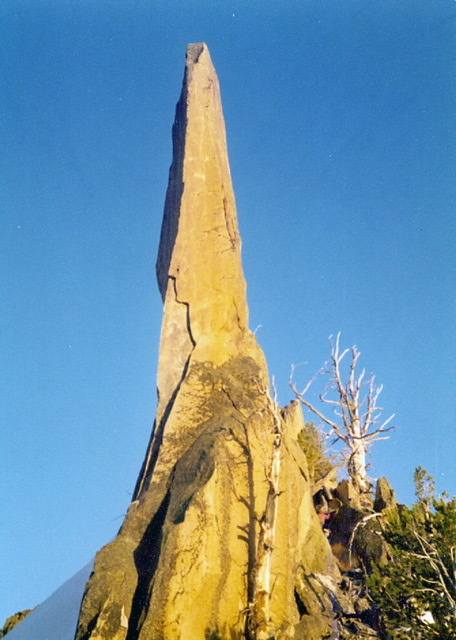
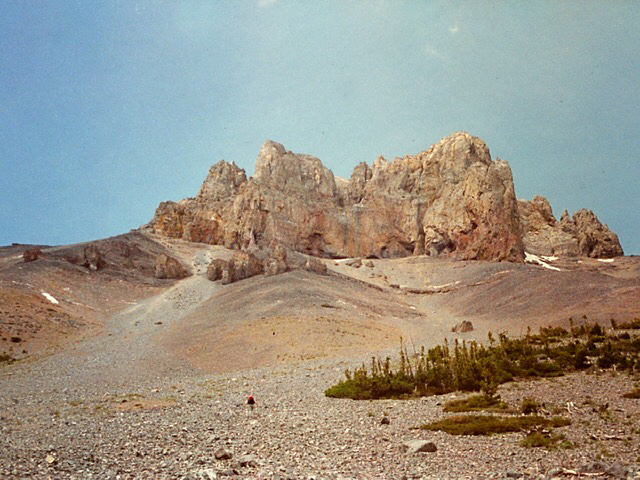
    Our trip was one year after I had started rock climbing, and because we had pack mules to haul our loads on this trip, I had decided to take my rock gear along. I also kept an eye out for opportunities for future trips and wasn’t disappointed once we passed Fern Falls on the South Fork of the Payette River. As we rode farther up the trail, I gawked at the granite formations on the east side of the valley and thought, “Wow.” One formation in particular stood out. I shot photos and vowed to come back to it with my rock-climbing buddies. The first name for it that occurred to me was King Kong, which stuck, although we later shortened it to Kong.
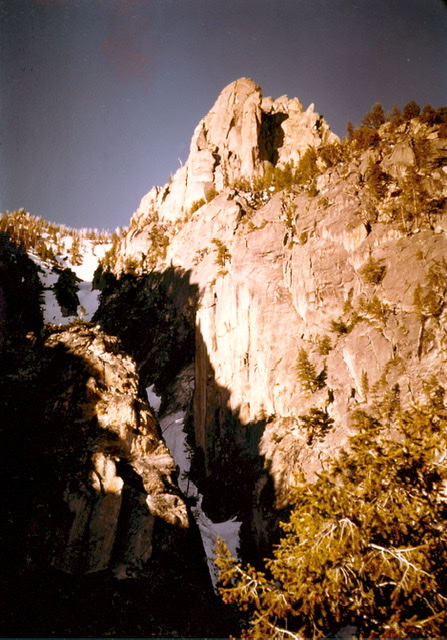
    The Kong

    After a long day in the saddle, we arrived at Ardeth Lake. Our outfitters had previously set up wall tents, so it was kind of like arriving at a motel in the wilderness. The pack mules had ensured there was just about nothing that didn’t get packed, including a couple of coolers full of drinks and comfort food like steaks and burgers. I wasn’t used to this kind of backcountry camping but quickly adapted after being offered an ice-cold beer. The early fall weather had been perfect for the ride up to camp but the next morning we woke to the surprise that it had snowed a couple of inches overnight.
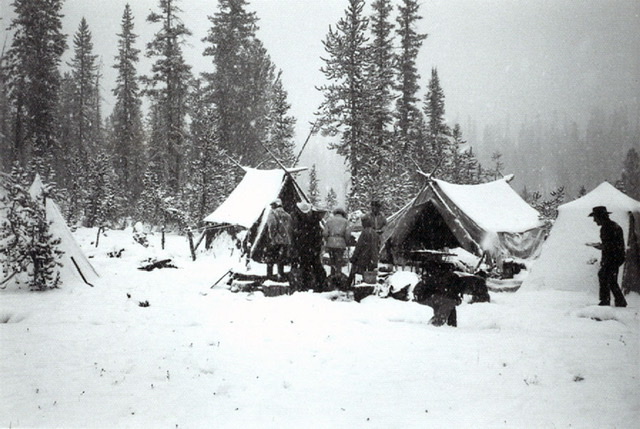
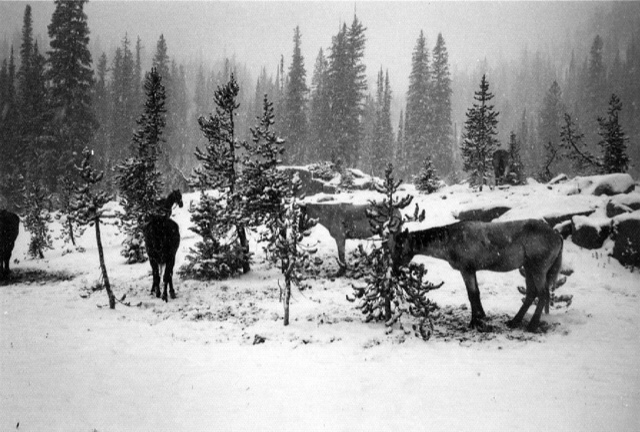
    Lady (foreground) with the other packhorses.

    Typically for fall, the weather improved by evening and the next day promised to be much better. The morning was clear and cold but by afternoon it had warmed into the lows seventies , and the dusting of snow had all but melted. The Carson kids, Bruce, Jackie, and Guy, headed up Tenlake Trail with me, and after about a half-mile we spotted a worthy climbing objective: the eastern face of Point 8590.
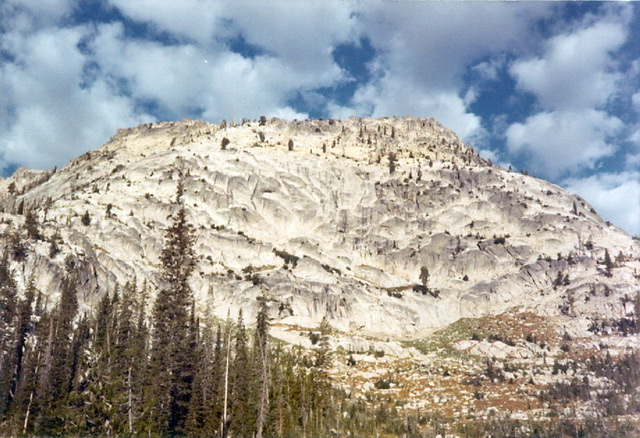
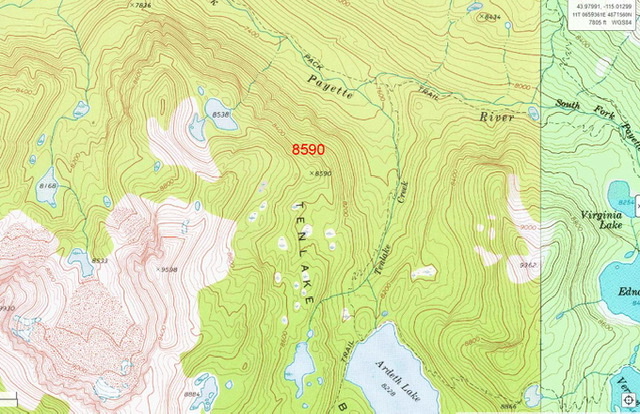
    Point 8590.
    Point 8590.

    It was getting late in the afternoon so we went back to camp, our plans for the next day now set. After a big breakfast along with real cowboy coffee, in which the grounds are dumped right into the water and boiled over an open campfire, the four of us headed back up Tenlake Trail, this time loaded with rock-climbing gear and a rope. We found a series of ledges that started out as second class but turned to fourth class higher up the face. At that point, Jackie decided she had had enough rock-climbing and went back down. Bruce, Guy, and I continued up until we finally reached a point where a rope and belay were in order. I led the first pitch, a delightful 5.4 (of a maximum 5.15 class rating) on near-perfect granite. After I brought Bruce and Guy up, we stayed roped and finished with another pitch of fun climbing. Below the top it turned to easier ground where we could scramble to the high point on the ridge and soak in views of the central Sawtooth Range.

    As soon as I got home from our pack trip, I started talking up with my climbing friends what I had seen on the Payette River. It didn’t take long to generate interest in Kong, and we made the trip in early October. This time we didn’t have horses, which meant our backs and legs took the load on the grueling hike above Fern Falls. After a hard day on the trail, we found a nice camping spot below our objective and spent the night. The next day we started looking for a way to get up the rock to the bottom of a massive slab that marked the beginning of final peak. There was an obvious gulley along the left of the climb but it was very steep, loose, and it looked like a death trap loaded with boulders that could tumble in a heartbeat. We found a fourth-class zigzagging rock route that led to a nice ledge (for camping or bivouacking) close to the base of the slab, but it also was out of the question, because we’d be carrying full climbing packs. It was getting late and we knew we’d have to do more exploring to figure out this challenge. We descended and decided to come back early the next summer, when the gulley would most likely be filled with snow.

    Not wanting to leave without some kind of summit, we decided to explore the top of the ridge and try to find the finish of our future climb. We were carrying only day packs, so we climbed up the gulley and along the ridge, where we spotted some interesting formations. There was a beautiful tower at the top of the gulley and we gave it a try. Mike made it all the way up to the last thirty feet, where the rock went blank. Lacking bolts or any way to protect ourselves, we called this one a near miss. Following the ridge that separates the Payette River and the Goat Creek drainages, we spotted a summit that looked reasonable and got to the top of it.
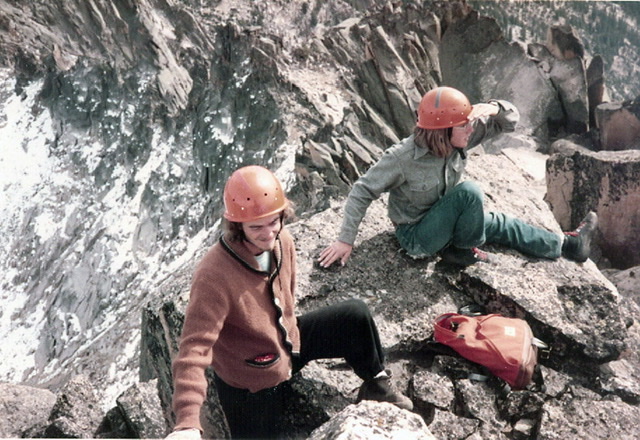
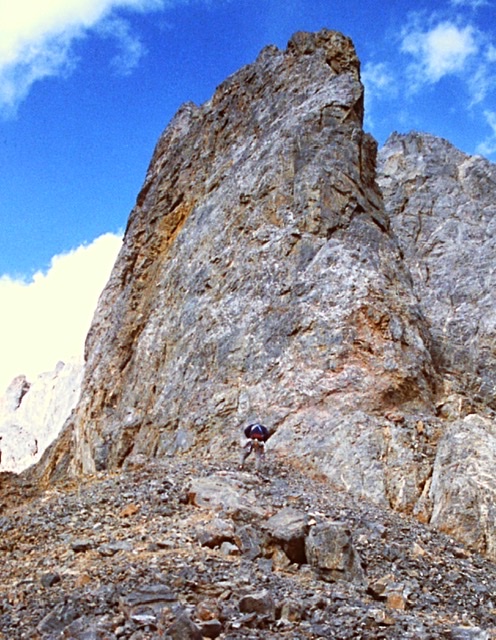
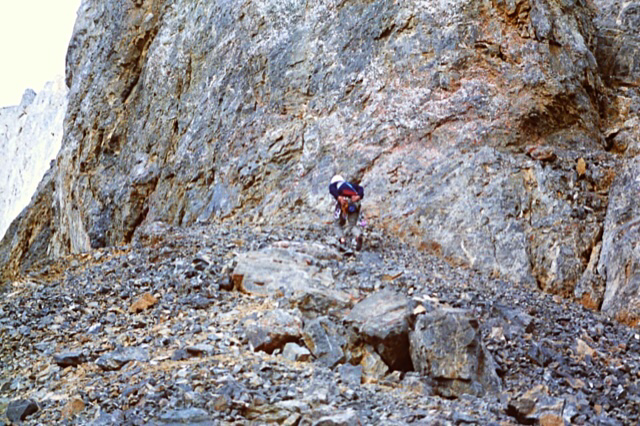
    Carl and the author on a ledge below the summit of The Kong.
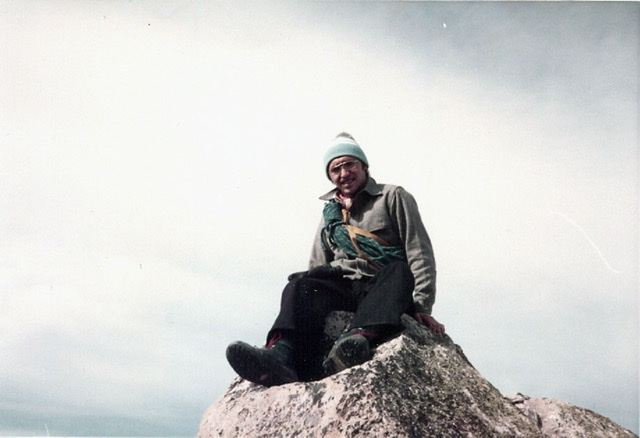
    Guy Carson on the summit of the unnamed point above the Kong.
    Mike climbed up to the last 30 feet on this pinnacle next to The Kong. The last 30 feet was without holds.

    When the time came in June 1974, we decided to do things a little differently. Instead of hiking up the South Fork of the Payette River and arriving in the heat of the afternoon, we would spent a night at the Grandjean campground and depart at 1:00 a.m., which should put us at our base camp early in the morning. Everything went as expected and we arrived in time for breakfast and a good rest. We lounged around for most of the day, enjoying the scenery and exploring the Elk Lake area.
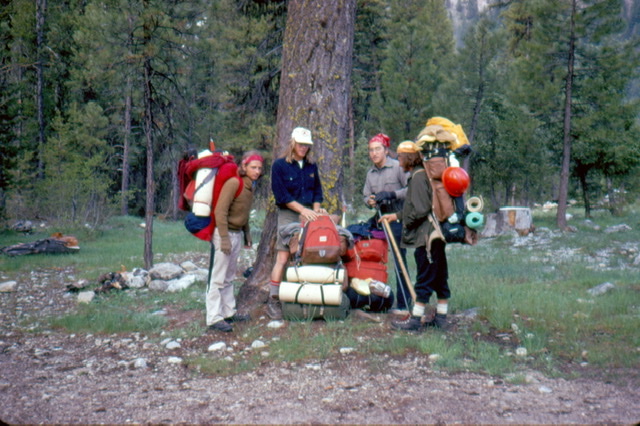
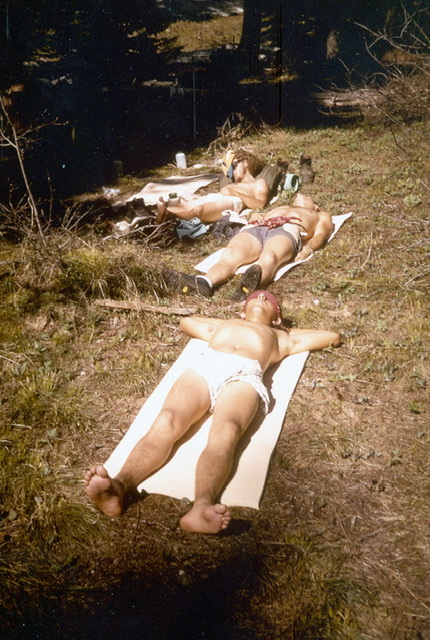
    (From left to right) Mike, Bob, Guy and Carl ready to roll at the Grandjean trailhead.
    Mike, Guy and Carl rest a few hours after the group’s all-night assault on The Kong.

    The weather was perfect and mosquitoes were non-existent, so we camped without bothering to put up a tent. Early the next morning, I awoke to the sound of something shuffling around our camp. I raised my head to the sight of a medium-sized black bear sniffing the foot of our sleeping bags. I sat up in and yelled to the guys, who woke all at once. My thought was that once the bear saw us, he’d bolt into the woods. Instead he slowly walked past us and stood on his hind legs to show us how big he was. A few minutes later, he took off into the brush and we didn’t see him again for the rest of the morning. We weren’t too worried about him, because we had plans to head up to our bivalve  ledge for the day so we loaded up our climbing packs and headed up the gulley. We had brought ice axes but no crampons, figuring the snow would soften up a bit by the time we got up the gulley. We were wrong.

    The gully was reasonably accessible, but we could see that a short climb up an incline of fifty-five-to-sixty degrees on hard snow to the biv site would require step-cutting and a lot of “pucker factor.” After reaching the bivy ledge we scrambled up to the start of the climb where Guy and Carl watched while Mike and I racked up and tried to find a continuous crack system up the face. We finally spotted a good-looking line and I led the first pitch. I led up maybe ninety feet to the bottom of an overhanging, left-leaning fist crack that flared into an arm-and-knee crack. I didn’t think I could free-climb it so I slapped in a couple of hexes (hexagonal nuts that can be placed without a hammer) and pulled out my aiders (short ladder slings). Once I rounded the lip, I went free, but it was still very awkward and hard. I made it over the edge and decided to set a belay (a pulley-like device to control the rope)so I could talk to Mike when he came up. He ascended to the start of the overhang and then decided to try free-climbing the rest of the way up. After a fair amount of swearing, grunting and sweating, he made it over the lip. We really didn’t know grading very well but we both thought that it was maybe a 5.10. It later proved to be the crux pitch of the climb. We went up another pitch to a ledge system along the crack, and the climbing was still fairly stiff. We had burned up quite a bit of time getting to the base and working out the first two pitches so we knew we had to make a decision. It was getting late in the afternoon and we still had to descend the gully to get back to our base camp so we rappelled off and decided to come back the next summer to try it again.

    After descending the gulley we hiked back to where our packs were stashed and discovered that our bear friend had made another visit. All our packs were untouched except for Guy’s. It was missing two of the outside pockets that had had food in them and his foam pad had a large bite taken out of it. It was rolled up and when he unrolled it, it reminded me of how we used to make paper dolls. He accused the bear of being out to get him and no-one else. We picked up our packs and headed back to our base camp. As we ate the last of our food and listened to Guy grumble about the bear, Carl came up with an idea for revenge. He had part of a loaf of bread, some honey and a tin of cayenne pepper, so he and I went into the brush to fix the bear a snack.

    We found a stump and Carl stacked bread as if they were pancakes. In between each layer of bread he dumped a couple of tablespoons of cayenne pepper and then topped it off with a generous helping of honey. Chuckling, we headed back to camp. Figuring the bear wouldn’t find the bread for a while, we sat around talking about our adventure. We were wrong again. It took the bear only about thirty minutes to discover his snack, and he was very annoyed. As he came out of the brush above our camp, he was ripping leaves off the bushes.  We could see he had a mouthful of leaves and the hair on his back stood up. He snorted around and wouldn’t leave, which made us nervous, so we decided to use the African bush-beating method we’d seen on TV to chase him off. We all picked up our ice axes and at the word “go,” we charged toward him. We got about halfway to where he was sitting when he reared up on his hind legs and charged us. We turned and ran as fast as we could back to our camp. Luckily, his charge was a bluff, but he would not let us out of his sight. We agreed that maybe it wasn’t a good idea to stay there for the night. Under the watchful glare of the bear, we packed and hiked back to Grandjean.
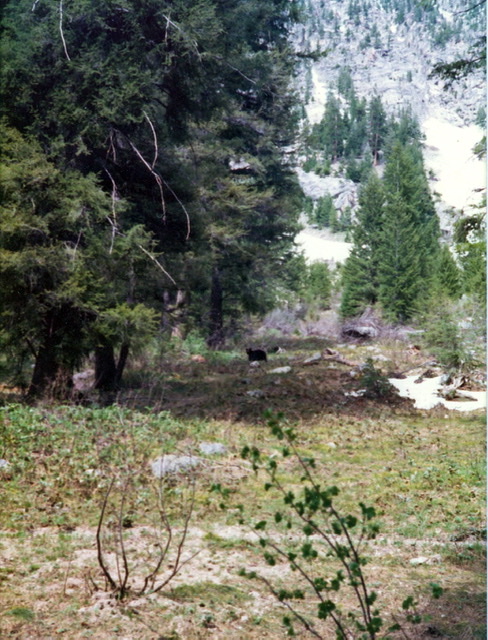
    Only hungry visitor casing our campsite.

    On our third trip at the beginning of July, 1975 we altered our plans once again. Instead of camping at the base and climbing the gully, we decided to haul all of our gear up to the bivy ledge both saving us time and avoiding any more encounters with our buddy, the bear. We couldn’t convince Guy to go back again so we recruited Mike’s cousin Sam to join us on our adventure. Carl was still interested so as a foursome we headed back up to Grandjean for the long grind up the Payette River. After a long day on the trail and a hard climb up the gully, we made it to our bivy spot below our climb.
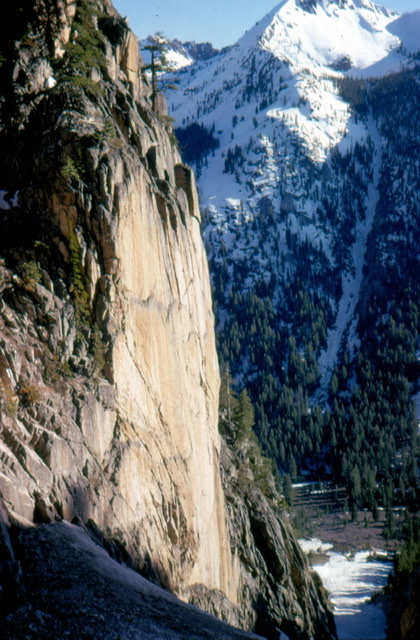
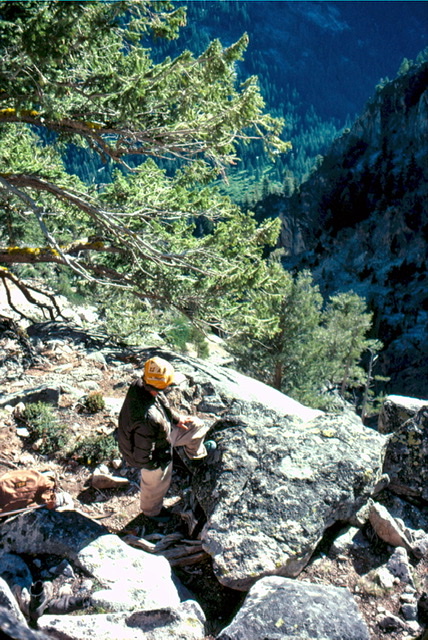
    The author and his friends bivouacked next to the tree at the top of this photo during the lightning storm.
    Carl on the bivy ledge.

    Early the next morning, Mike took the first lead up to the crux overhang. I had set a directional belay about twenty feet from the start in order to be able to watch him climb. Just as he was grunting his way over the bulge, he suddenly flew out of the crack and I heard him yell “falling.” As I was pulling in slack, his top piece of protection popped out and then my directional anchor gave way, leaving maybe thirty feet of slack in the rope. I watched him free-fall around forty feet until he came to a stop about thirty feet off the deck. As I lowered him, he cursed about having almost made it. I thought he’d pass me the lead after recovering but that’s not how Mike works. He quickly gathered himself and went right back up, more determined than ever. On this second try, he cracked the code of the crux and continued up to a nice belay ledge.
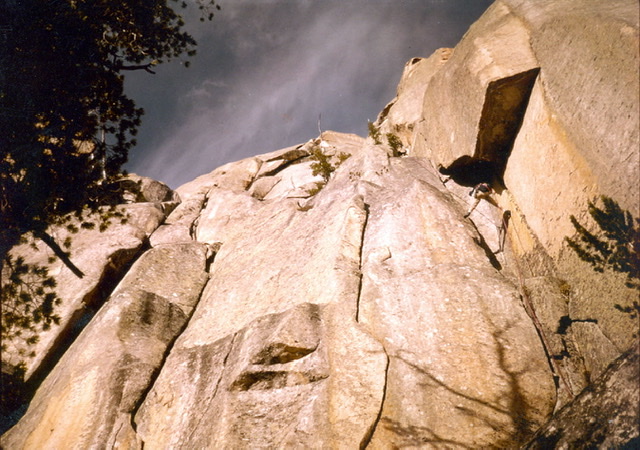
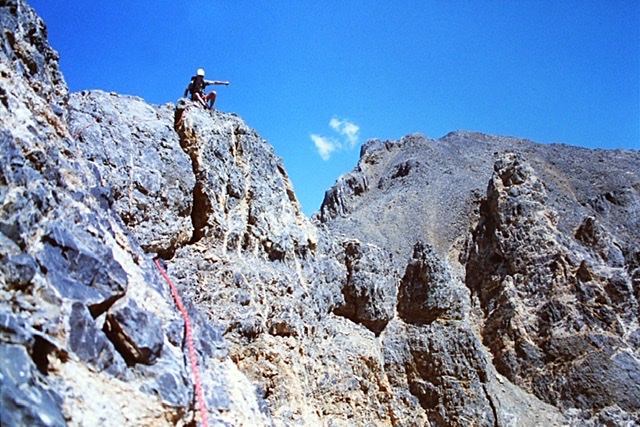
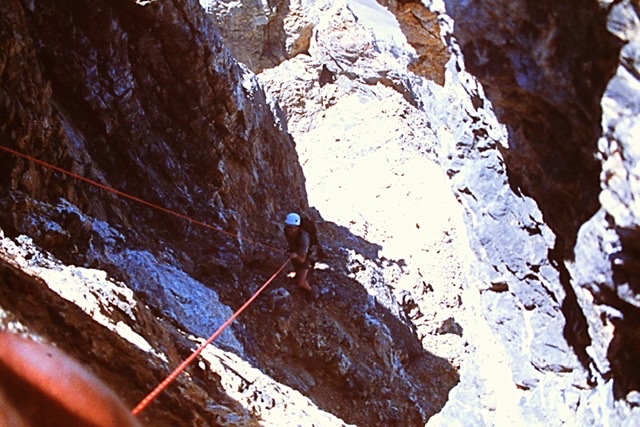
    Bob can be spotted on the right rappelling from the top of the first pitch.

    The next pitch led up to a dihedral (two planes of intersecting rock face). The climbing was on near-perfect granite that varied from hand-width to arm-width cracks. I led pitch three, which ended on a nice flat ledge midway up the dihedral. Mike took the fourth pitch, to the top of the dihedral, where we stopped to inspect the final short pitch to the top. There was no defined summit and from our ledge, we saw only two options for what we called the “H” pitch. To our left was a thirty-foot horizontal knife-blade crack that would require aid and led to places unknown. To our right was a large overhanging flared crack that would require very large pieces of gear to protect us. We didn’t have the right equipment for either approach, so we were stuck concerning how to finish the last fifty feet of rock. Bolts would have worked but we were devoted to the clean-climbing ethics of the time and neither of us owned that kind of hardware. We talked about cutting tree limbs for chocks and slinging them with webbing but it was too late in the day for that, so we called our high point good and began to rappel back down to our start.
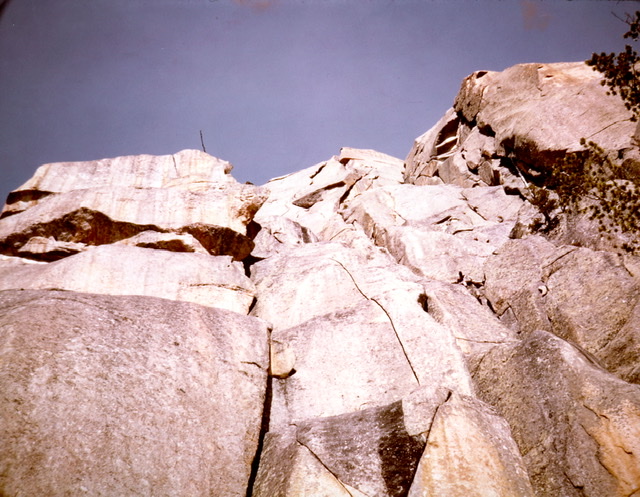
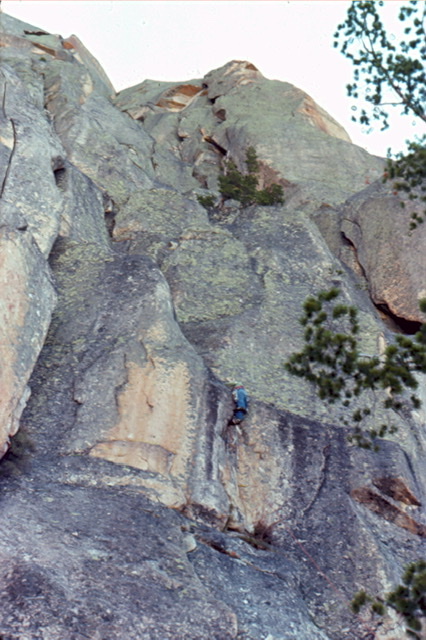
    The author cleaning P2.
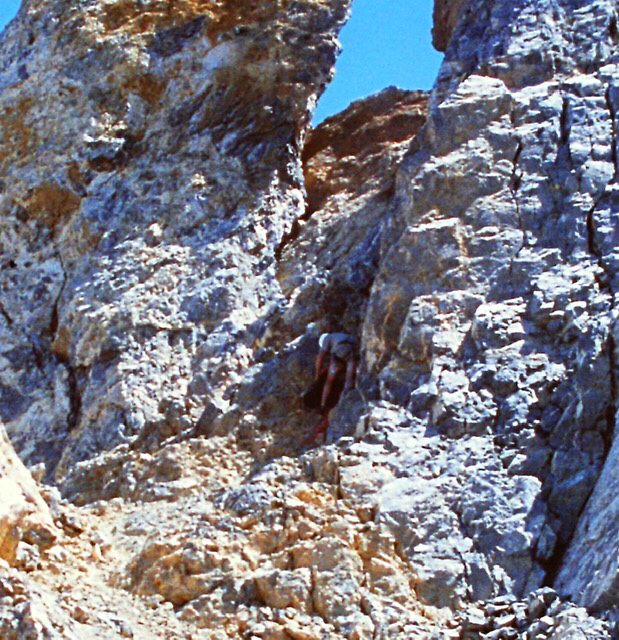
    Mike is the tiny figure contorted on the crux pitch.

    The first rappel went a without hitch and we had only to leave a single sling behind on our way down. On the third rappel, things were looking good until I pulled the rope down. Just after the free end started to fall, it stopped. We pulled as hard as we could and realized it was jammed hard and would not budge. It was late in the day and clouds were building rapidly in the west. Ascending a stuck rope was completely out of the question and neither one of us wanted to lead that pitch again. We had two ropes with us, so along with the shortened end of the stuck rope, we still had enough rope to get down.  I free-climbed up as high as I could without aids and cut the rope, after which we descended to our bivy ledge for another night but soon discovered our adventure wasn’t over yet.
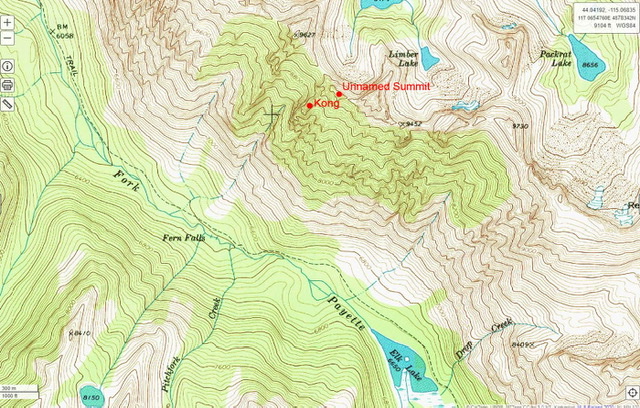
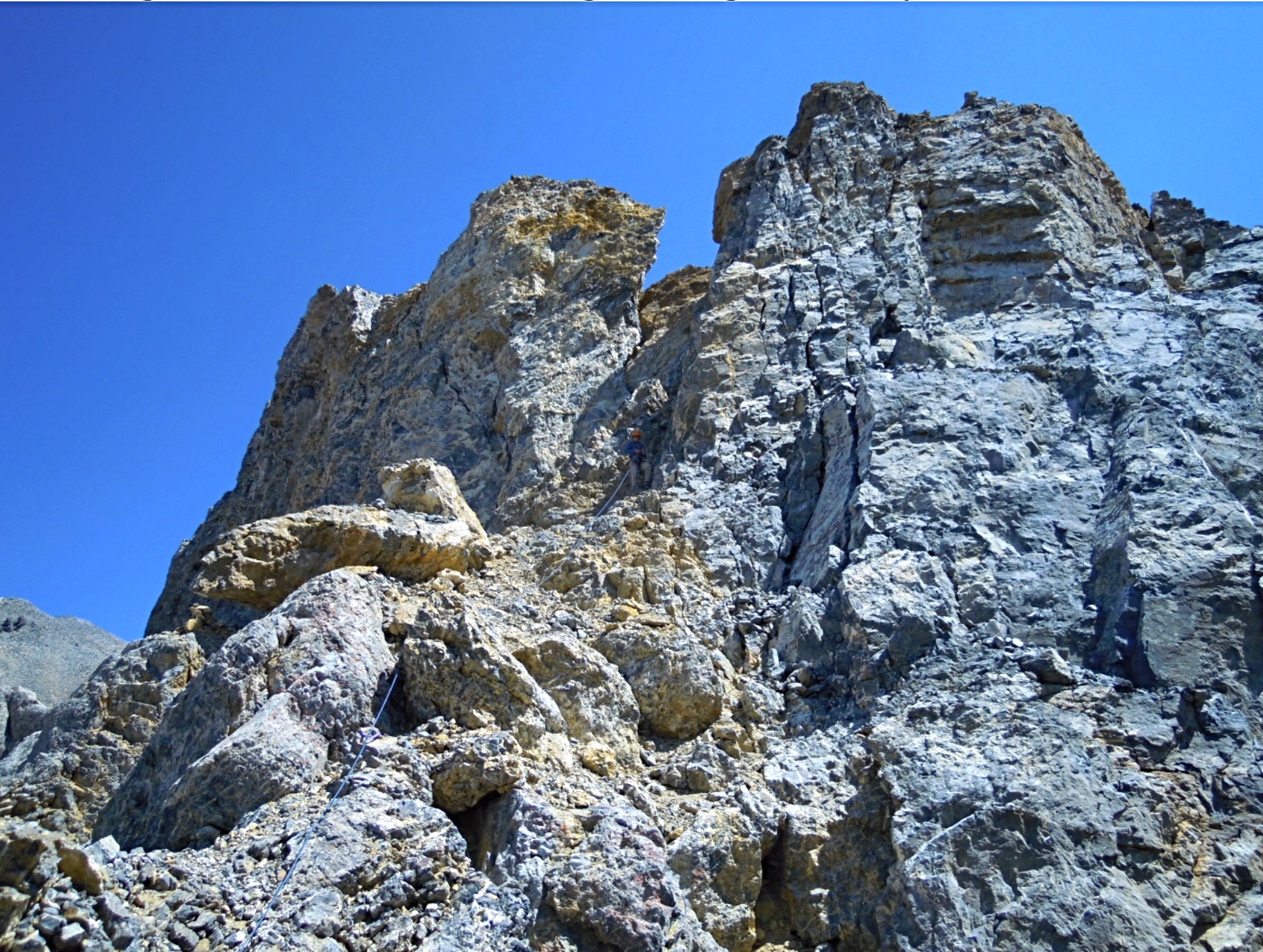
    The Kong.

    By the time the four of us down-climbed to our bivy ledge the sun was starting to set. We ate and settled into our respective spots. Soon it got dark and the wind began to blow in earnest. We saw the first of many flashes as a thunderstorm rolled in from the west. Rain poured down and the wind whipped up to about 50 m.p.h. We huddled in our spots and, in case we took a hit, we said goodbye to each other over the howling wind. Lightning struck below and above us. Rain hit the rocks in sheets and for maybe ten minutes it went up the mountain instead of down it. It then changed direction and poured downward for at least another half-hour. Lightning flashes that illuminated the entire mountainside left us temporarily blinded. There was no pause between the lightning and thunder, only loud explosions and an acrid smell in the air. Finally, the storm passed, and we were all okay. I later realized we had gone through a vertical wind shear, where the wind blows up one side of a thundercloud and down the other. We had experienced both sides of the storm.

    As chance would have it, it was the evening of July 4. In the morning, we not only were a little shaken from the excitement of the night before but realized we needed to rethink our hardware. We down-climbed and went back to Boise, where we read that a hiker had been killed by the same storm on the eastern side of the range.

    We always intended to go back and finish that last little bit of climbing to the top of Kong and retrieve the piece of stuck rope we had left hanging, but we were distracted by other Sawtooth climbs, such as the Finger of Fate and Elephant’s Perch. Around that time, we also started making regular trips to the Tetons and North Cascades. For us, Kong turned out to be the summit that got away.
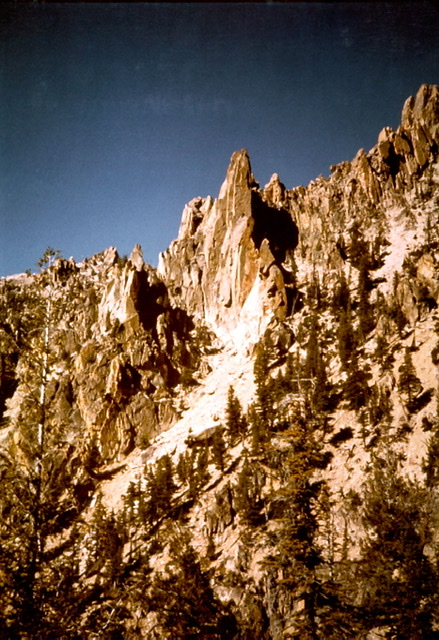

    An an unnamed tower that sits across the gully from the Kong.


  • T.M. Bannon by Rick Baugher

    T.M. Bannon by Rick Baugher

    Thomas M. Bannon was also a self-taught mountaineer. Although his name is not widely known in mountaineering circles, during his surveying career from 1889 to 1917 he climbed nearly one thousand summits in the American West. More than two hundred of these summits were in Idaho. Bannon’s cryptic reports, supplemented by the rock Cairns, Wooden triangulation signals, chiseled cross-reference marks; and brass benchmarks that he left behind tell his fascinating story. More than one hundred of his Idaho ascents were probably first ascents. These climbs included many of Idaho’s highest and most famous peaks, including Mount Borah (which he called Beauty), Leatherman Peak, and Invisible Mountain in the Lost River Range; Diamond Peak (which he called Thumb), Bell Mountain (Bannon’s Finger), Lem Peak, and May Mountain (Bannon’s Hi Peak) in the Lemhi Range; Standhope Peak and Smiley Mountain in the Pioneers; Castle Peak in the White Clouds); and Mount McGuire in the Salmon River Mountains. Bannon’s death at 48 cut short an extremely active life.

    I spent a good part of the 1990’s investigating pioneer government surveyors in the Idaho and western US mountains. This involved recovering some 100 mountain top triangulation stations placed by Bannon & party in Idaho from 1911-1915. In his career as USGS Topographical Engineer 1894-1917 T.M. Bannon had a hand in making ~50 topographic maps.

    Having grown up myself in Maryland, a highpoint was a July 1995 pilgrimage to the Bannon burial plot at St Lawrence Martyr R.C. Church in Jessup. Bannon family monument (like T.M.’s triangulation monuments) occupies a prominent position in the church graveyard.

    Photo on right is T.M.B. gravestone. Rick Baugher Photo

    Obituary notice from Washington Evening Star, Feb 6, 1917:

    THOMAS M. BANNON DIES AFTER A BRIEF ILLNESS

     Was Engineer of Topographic Branch Geological Survey- Funeral Thursday at Jessups, Md.

    Thomas M. Bannon, engineer of the Topographic Branch of the geological survey and a prominent resident of Anne Arundel county, Md, died Sunday evening at Maryland University Hospital in Baltimore. Mr Bannon had been ill only a short time. [Author’s Note: USGS said field worker deaths at that time often attributed to typhoid fever].

    Mr. Bannon had been connected with the geological survey since 1888, the greater portion of his service having been given to topographic and geodetic surveys in different western states.

    Prior to the organization of the United States reclamation service, Mr Bannon was detailed to collect the data which that organization used in connection with the development of its projects in Idaho and Utah [Author’s Note: chiefly Bear River drainage].

    In 1908 he was detailed to the Porto Rican government and placed in charge of surveys in developing irrigation of the semi-arid portion of the island.

    During the last few years Mr Bannon’s efforts had been directed to the extension of geodetic work in western Montana and eastern Idaho and in mapping portions of the national forests in Idaho.

    In addition to his official duties with the government Mr Bannon served seven years as a member of the board of governors of the Maryland board of correction and was active in many local and charitable organizations of Anne Arundel county.

    Mr Bannon was unmarried, is survived by two sisters, Mary and Francis Key Bannon, and three brothers, James T., Phillip M., and Joseph Bannon.

    Final notes: It is believed Bannon thru his mother Evaline was related to Francis Scott Key. Bannon’s federal appointment as an 18 year old was thru Rep. Barnes Compton, also an F.S. Key relative. Survey director John Wesley Powell was chided for hiring “Congressmen’s nephews”. Bannon estate in Jessup was demolished in 1950 to make way for Baltimore Washington Expressway.

    See also: Appendicitis Hill and T.M. Bannon and 1929 Borah Declared Idaho’s Highest Peak

  • The First Ascent of Triple Peak

    The First Ascent of Triple Peak

    ARTICLE INDEX


    The second edition of the book discussed the then unnamed Triple Peak as follows:

    Peak 11280+                                                               11,280+ feet (Rating unknown) 

    This complicated tower, the southernmost summit on the Corruption/Breitenbach divide, is probably unclimbed. It is located 1.5 miles northeast of Mount Breitenbach. It is the steepest, most rotten looking summit in the entire range. Access the base of the peak from Breitenbach Pass [(A)(6.1)(a) or (C)(3.2)(a)]. USGS Leatherman Peak

    It was the only peak that I put in the book that I was sure had never been climbed. I thought I would give others a chance to make the first ascent but I had every intention of   being the first to reach its summit.

    Triple Peak in all its majesty viewed from the north. George a Reinier Photo
    Triple Peak in all its majesty viewed from the north. George a Reinier Photo

    The peak first caught my attention when I reached the top of Mount Breitenbach in 1991. The peak’s multiple towers dominated the view to the northeast. It looked like a difficult climbing problem. Triple Peak is a complicated summit located on the treacherous Mount Corruption/Breitenbach Divide. Triple Peak is composed primarily of Challis Volcanic rock which was deposited on top of the Lost River Range’s limestone base. The rock is as rotten you can find in Idaho. It was clear that the peak’s poor rock quality would be the biggest obstacle facing climbers.

    I mentally added the peak to my exceedingly long climbing todo list. At this time I was working on the second edition of the guidebook and many other peaks across the state had a higher priority than that rotten towers I observed from Breitenbach’s summit.

    Eight years later the second edition of my book was scheduled to hit the books stores in late Summer 2000. I decided I should make an attempt before the book was sent to the printer or someone else got ahold of the new edition and beat me to it. Little did I know that it would take me four tries over four years to discover the secrets of the towers that make up the peak.

    Triple Peak, 11,280, from Brietenbach. Beyond is Bell Mountain.

    The first attempt took place in late June of 1996 with Scott Mcleasch.  We were surprised to find that unusually high water would keep us from driving across either Dry Creek or the upper Pahsimeroi. We turned to plan B which was to begin from West Fork Burnt Creek, climb Cleft Peak and then traverse the connecting ridge to Triple Peak. This was a long approach and I was not having a great day. When we reached the summit of Cleft Peak, the view of the connecting ridge and Triple Peak’s east tower  was not encouraging. We decided to call it a day. Cleft was a nice consolation prize and at least I learned that the traverse, while it might be work, was not an efficient route to make the summit.
    The second attempt took place in 2000 with Brian and Karen Wright. This time we were able to ford Dry Creek and reach the trailhead. At one time a good trail climbed up Dry Creek, crossed Breitenbach Pass and descended down the Pahsimeroi River. In 2000 the trail had not been maintained in many years. We hiked up the poorly maintained trail toward Breitenbach Pass. At 8,600 feet we decided to leave the trail and climb the talus directly to the base of the east face of the summit block aiming for its southwest corner. It was a long, loose and tiring trudge. The higher we got, the looser the talus got. We finally reached the summit block and began looking for a line we could climb. The block’s face was mostly vertical. We tried a crack and a gully without finding a suitable route. We then climbed around to the peak’s south ridge and spotted a suitable line. However, it was now late in the day and, as working stiffs, we had to call it a day.

    Karen Wright leading us up the peak’s east face across endless scree.
    Looking for a line up the east face.
    Exploring a dead end.
    The rock face had potential difficult lines on hard rock. Since we were not sure if these lines would lead to the true summit we were not enthusiastic about trying them.

    On the third try in 2001 Brian and I backpacked up the Pahsimeroi River and set up a camp at 8,800 feet. The next day we hiked to Breitenbach Pass utilizing the trail where it existed and the mostly open slopes where the trail disappeared. From the pass we had a good view up the peak’s southwest ridge. The tower that loomed above us looked imposing but there was a split in the vertical wall that looked like a potential line to start our ascent. We hiked up to the base of the tower and roped up.

    Looking at the summit towers from Breitenbach Pass.
    Time to harness up at the base of the west tower.

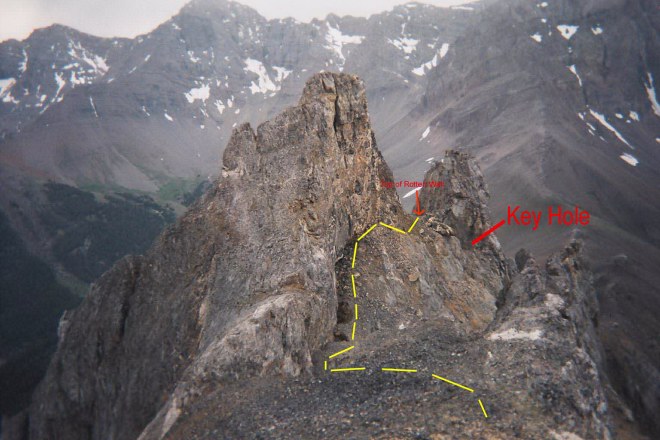
    I started up the steep gully that cut the tower’s face cognizant that the rotten rock was not conducive to roped climbing. First, I traversed to the right off the ridge top climbing over boulders and talus for about 150 feet to the base of the steep, slippery, debris-filled gully that split the face. I carefully climbed up the gully crossing loose talus in places and a series of hard ledges covered with loose rock. At the top of the gully, I was in an alcove capped by a 12-foot-high Class 3-4 wall. At the top of the wall I found a narrow hole or keyhole that exited out of the alcove to the northeast. I set an anchor and looked through the keyhole and discovered we had options to continue the ascent. I put Brian on belay and brought him up.

    Looking down the dirty gully from the Keyhole. Judi Steciak and Carl Hamke Photo

    We climbed through the keyhole and continued to climb up, unroped, across Class 2-3 debris until we found ourselves at the base of the southwestern most tower’s highest point. Above us was a vertical 75-foot wall shaped like an open book. The wall’s was composed of hard or at least harder rock than we had already crossed. It appeared this feature would lead to the top of the tower without too much difficulty. To the left, we could see a ledge system that appeared to traverse the base of tower’s north face. Access to this ledge would involve crossing a steep rotten gully and climbing a 25-foot-high nearly vertical wall of dirt and debris. From our perch any further the view northeast along the summit ridge was blocked.

    Looking back at Carl Hamke on a later ascent climbing through the keyhole. Judi Steciak and Carl Hamke Photo
    The view from the keyhole looking toward the base of the open book. Judi Steciak and Carl Hamke Photo

    Since we had no confirmation of which of the peak’s three towers was actually the highest (we did suspect the middle tower was the highest) we debated our two options. First, we could climb the tower we were on which would at least help clarify the highest point issue. Second we could descend down the very steep, loose debris filled gully and see if we could locate a route out of the gully at some point which would allow us to traverse northeast toward the notch between the West Tower on and the middle tower. In sum we had to choose between a descent of unknown length into the unknown on loose and unconsolidated crud or a climb to the top of the tower we were on relatively hard rock. It really was not a choice that was hard to make. We did not consider attempting to climb out of the gully via the 25-foot dirt wall.

    We set an anchor. I put Brian on belay and he made short work of the climb. We rated this short 75-foot section at 5.7. He belayed me up. As I reached the top I detected disappointment on Brian’s face. He didn’t say anything. He just point to the next tower which was undoubtedly higher. Although it was higher it was obviously a Class 2 scramble from the intervening notch. Between us and the notch was a hundred foot vertical drop, a drop that didn’t look conducive to down climbing. “Okay,” I said, we need to rappel down the 100 foot drop into the notch.

    Brian on top of the tower.

    We spent the next thirty minutes trying figure out a safe way to set up a bomb proof rappel anchor cognizant that we would also have to use the anchor to safely protect ourselves when we had to climb back up wall on our return. There was horn we could safely use to rappel down our line of ascent but it’s shape would not work for a rappel down into the notch. The rope would slide off it. Our effort to set an anchor proved futile. It was impossible for us to set an anchor to rappel into the notch between the two towers with the equipment we brought.

    While the route from the notch to the summit looked an easy walk, it was late on Sunday afternoon, we still had to backpack out to the truck, make the six hour drive back to Boise and we both had to work the next day. We gave up and vowed to return. The Summer passed by without an opportunity or the desire to return.

    Brian rappelling off the tower.

    In 2002, I broke my leg sliding into second base in a softball tournament in early June. (I was safe by the way). After surgery, recuperating and physical therapy it was late September and my leg was too weak for serious climbing. I settled for easier climbing until the snow flew.

    Finally, on July 19, 2003 Brian and I found ourselves once again at the base of the southwestern most tower. Based on our prior adventures, we decided that the best route was to climb the southwestern tower again, set up some south of Rube Goldberg rappel anchor and rappel into the intervening gap and finish the climb. We took an extra rope, a bolt kit and 100 feet of sling, ascenders in hopes that we could fashion a safe rappel anchor someplace on the tower’s rotten summit.

    Once again we packed up the Pahsimeroi River and set up camp. In the morning we hiked up to Breitenbach Pass and then hiked northeast up the ridge to the base of the wowed. This time we climbed the dirty gully to the keyhole without roping up. We climbed through the keyhole and up to the base of the open book.

    While Brian was setting up an anchor to begin the climb up the open book, I stared at the ledge to the rotten 25-foot wall blocking the way and the view. After wondering for two years what was on the other side of the wall and whether it connected with the ledge I made up my mind. I decided to take a look. Brian put me on belay and I edged across to the gully to the base of the wall and started up. It was like climbing an overhanging road cut. Dirt and rocks streamed down around me but it was not as bad as I had imagined two years earlier. When I reached the top and looked over the top, I found a rather wide ledge that traversed the remaining section of the Towers north face which lead into the notch. From that point on, the climb was a walk across talus and boulders.

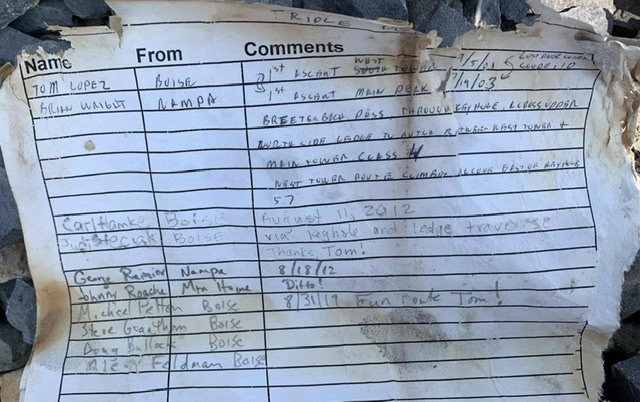
    As we reached the summit, the East Tower came into view. We could not say with certainty that we were on the highest point. We had to check with a spirit level to be certain that we had the first ascent.

    Looking from the summit down the upper route. The West Tower is roughly 25 feet
    lower than the summit.
    The register that Brian and I left on the summit. Haylee Stocking Photo
    Brian on the summit with East Tower
    in the background.

    Next: Sierra Nevada Day Hiking


    ARTICLE INDEX

  • Appendicitis Hill and T.M. Bannon

    Appendicitis Hill and T.M. Bannon

    On February 26th, 1926, the Sunday Idaho Statesman published the following report by E.S. Crawford describing the origin of the name Appendicitis Mountain, now Appendicitis Hill. Bannon’s extensive surveying contributions to Idaho Surveying are discussed on Pages 14 and 15 of the book.


    Appendicitis Case – Responsible for Mountain’s Name

    Answering a query of The Statesman several weeks ago as to how “Appendicitis Mountain” acquired its name, E.S. Crawford of Antelope Valley sends the Arco Advertiser the following story which adds a bit to Idaho history:

    “What is now known as Appendicitis Mountain forms part of the East Canyon Wall of Antelope Valley, and is one or Antelope’s beauty spots. It is steep and rugged and rises almost from the creek bed. From the top of this mountain looking eastward, Moore and Arco can be seen.”

    “In the Spring of 1915, the Hanson brothers (from Lewiston, Idaho) came through this section of the country, building monuments on the highest peaks of the mountain ranges. Among these peaks are Old Smiley, Mount Shelley, what is now known as Appendicitis Mountain and Mount McCaleb.

    “During the Summer and Fall of the same year, T. M. Bannon (a geographic surveyor from Washington, D.C.) and his helper, Mr. Tucker (from New Jersey), George Adams (of Challis, Idaho) and another man from Colorado (who acted as cook for the party), came through, making maps and prints of the airline distances between these mountains.

    “In the early part of September 1915, they camped at the foot of this mountain, in the grove of trees which is on the Crawford Ranch. On the second day of their stay, a trip was made to the mountain top. But as the fog and haze were so thick, they were unable to make the survey and planned on making another trip the following day. This trip, though they did not know it at the time, was never to be made by Mr. Bannon, for that very night he became suddenly ill and passed a night in pain from which morning brought no relief.

    Stricken With Appendicitis

    “About 8:00AM the next morning, they asked for the best doctor in Mackay and Dr. N. H. Farrell was called. Doctor Farrell pronounced the trouble as appendicitis and advised the removal of Mr. Bannon to the Mackay Hospital. As cars were few in the Antelope Valley, a bed was made in the back of a white-topped buggy and a trip of 20 miles, over not any too smooth roads, was made. This was Doctor Farrell’s first operation case after coming to Mackay, which proved to be a serious as well as a successful operation and Mr. Bannon (in writing to Mr. Crawford after he had recovered returned to his home in Washington, D.C.) wrote very highly of Doctor Farrell and the nurse, Miss  Hendickerson.”   

    “Although lung trouble set in after the operation and Mr. Bannon had to spend a great deal of time in Ashville, North Carolina, he finally recovered from that and died from some minor ailment in either 1918 or 1919. In one of his letters to Mr. Crawford, he told of naming this mountain and having it put on record in Washington, D.C. as Appendicitis Mountain.”

  • Where Do Mountain Names Come From?

    Where Do Mountain Names Come From?

    The history, evolution and process of naming mountains is discussed on Pages 32-33 of the book. However, the specific origin of official (and unofficial) mountain names is often not documented. The public can submit proposed names for peaks via the U.S. Geological Survey’s U.S. Board on Geographic Names website. But often, and especially before the Internet, names that were not officially designated through the Board tended to come and go with time. Now unofficial peak names are showing up on Google Maps and other websites, giving unofficial names some semblance of approval and permanence.

    This page contains historical information (in alphabetical order) on the origins of Idaho peak names. Do you have an article or another document about the naming of an Idaho mountain? Share it with us through our update form and we will feature it here!  


    Appendicitis Hill (Pioneer Mountains)

    See this link: Appendicitis Hill


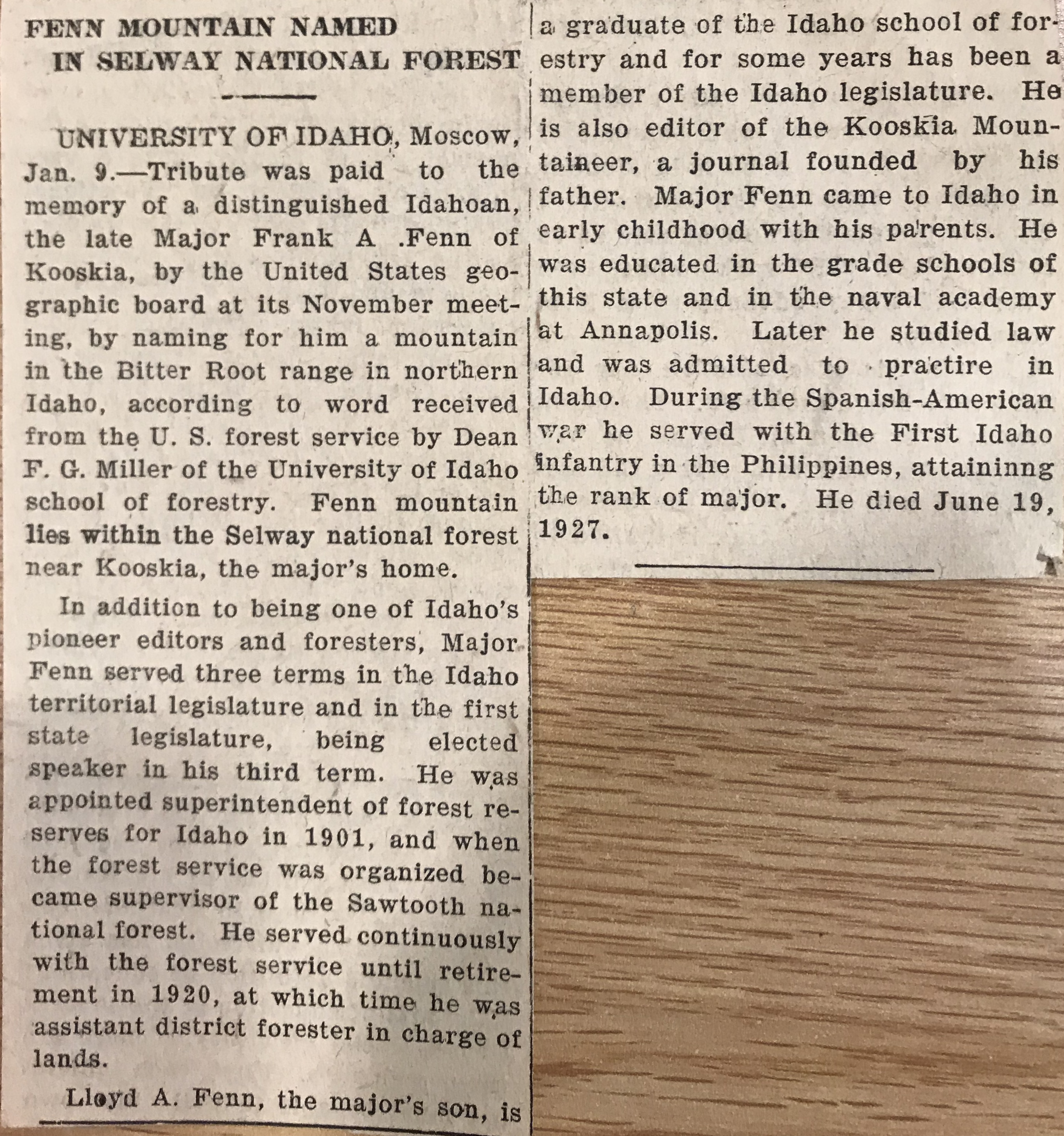
    Fenn Mountain (Selway Crags)

    Fenn Mountain is one of the most impressive summits in the Clearwater Mountains and is one the peaks identified as the Selway Crags.

    January 13, 1928. I believe this article is from the Idaho Statesman.
    January 13, 1928. I believe this article is from the Idaho Statesman.

    Frank Fenn was the first supervisor of the Clearwater National Forest headquartered in Kooskia that included all of the Lochsa-Selway country.  Fenn had an illustrious career before taking up public forest management in 1901: he was a student at the first public school in Idaho, at Florence; was a cadet at the U.S. Naval Academy; was a participant in the Nez Perce Indian War of 1877; was Speaker of the House in the first Idaho Legislature; and was a major in the U.S. Army during the Spanish-American War.  He retired from the Forest Service Regional Office in 1920 and moved back to Kooskia, where he died in 1927.

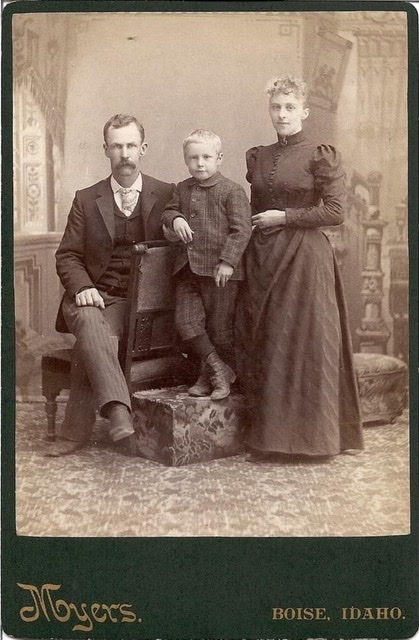
    Major Frank Fenn with his wife Florence and son Lloyd. Date unknown. Penny Bennett Casey Collection, Nez Perce-Clearwater National Forests archives

    Gospel Peak (Gospel Hump Wilderness)

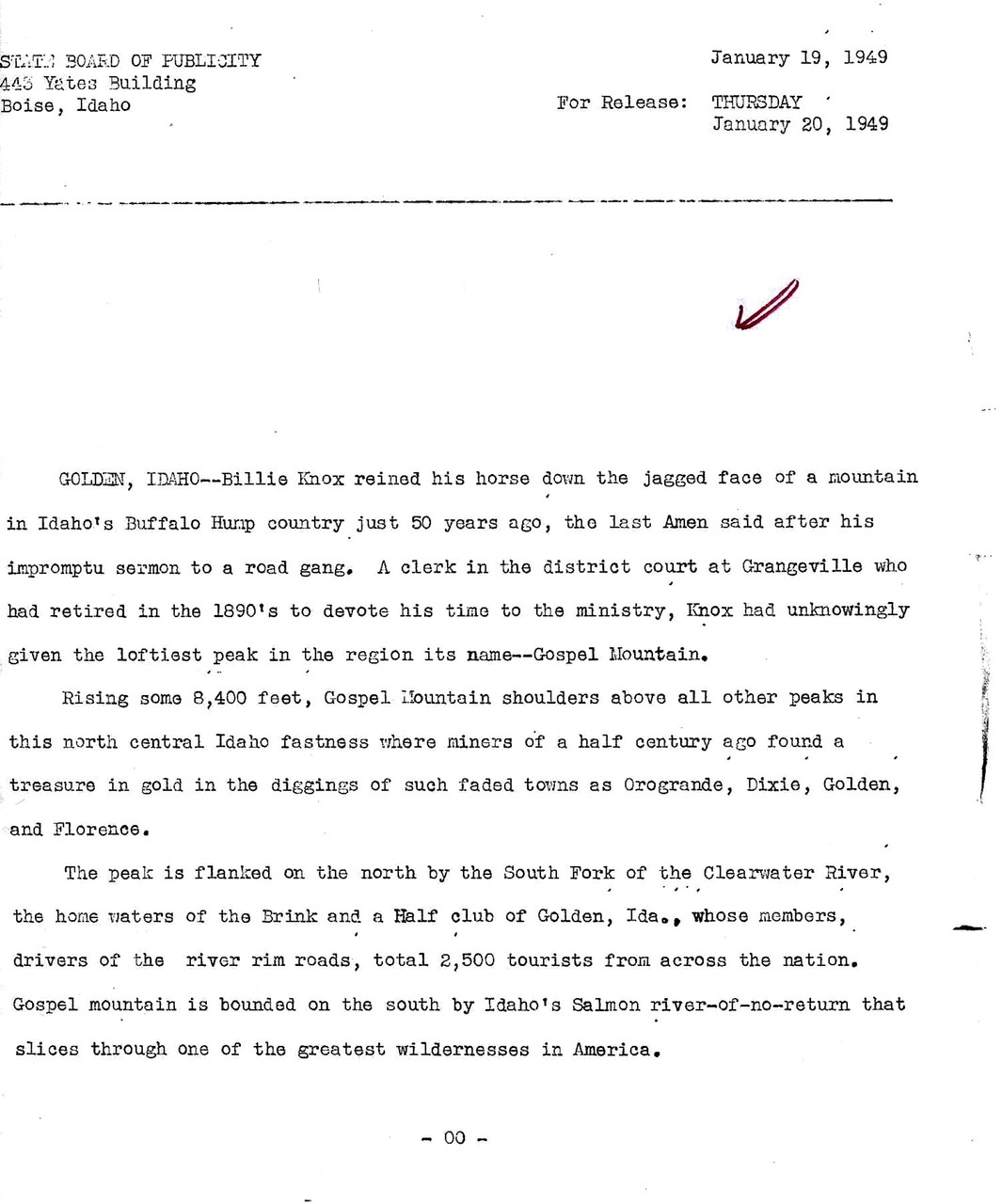
    As explained in this 1949 press release Billie Knox is responsible for the use of the name “Gospel” for north Idaho two peaks, Gospel Peak and Gospel Hill as well as the Gospel Hump Wilderness.


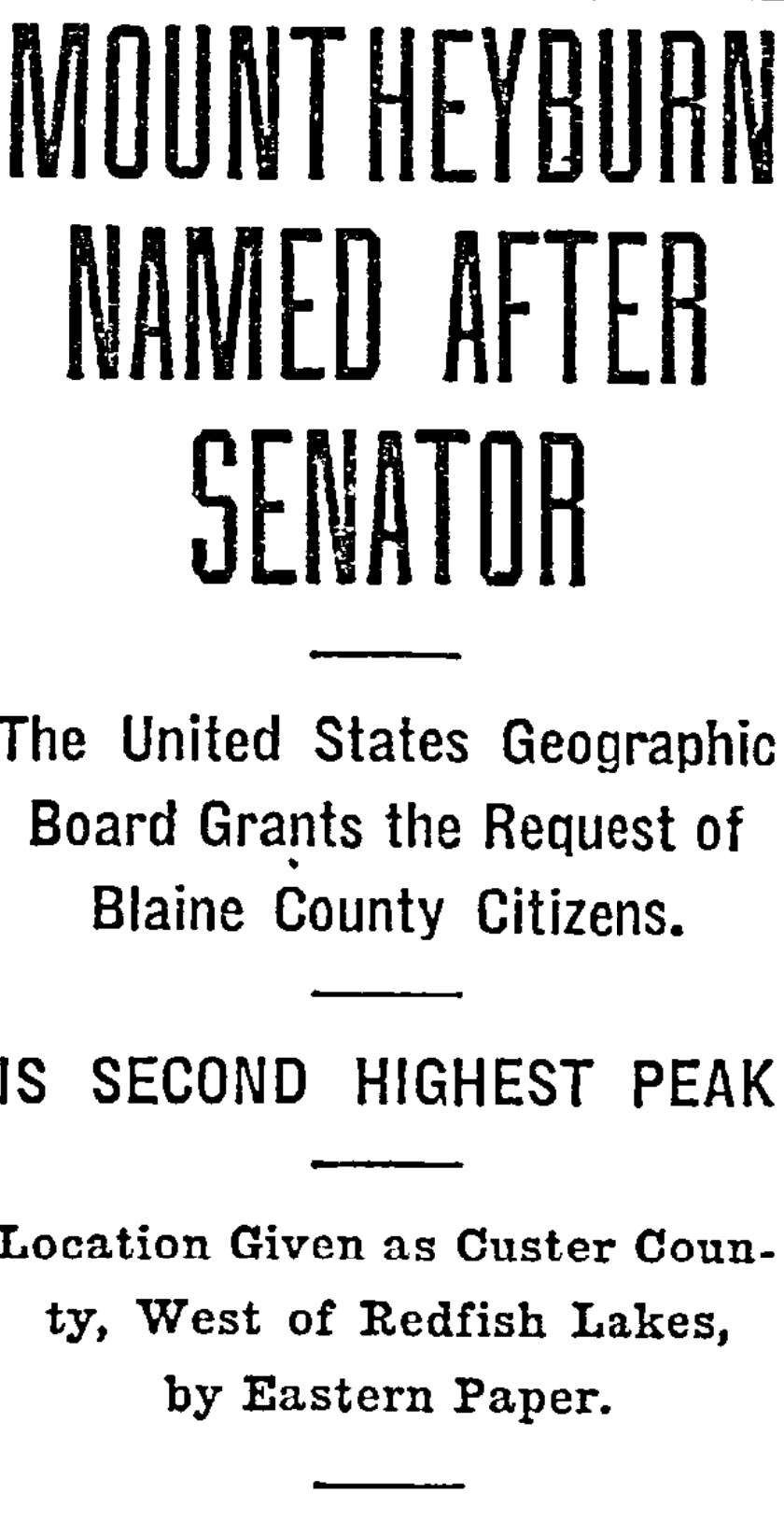
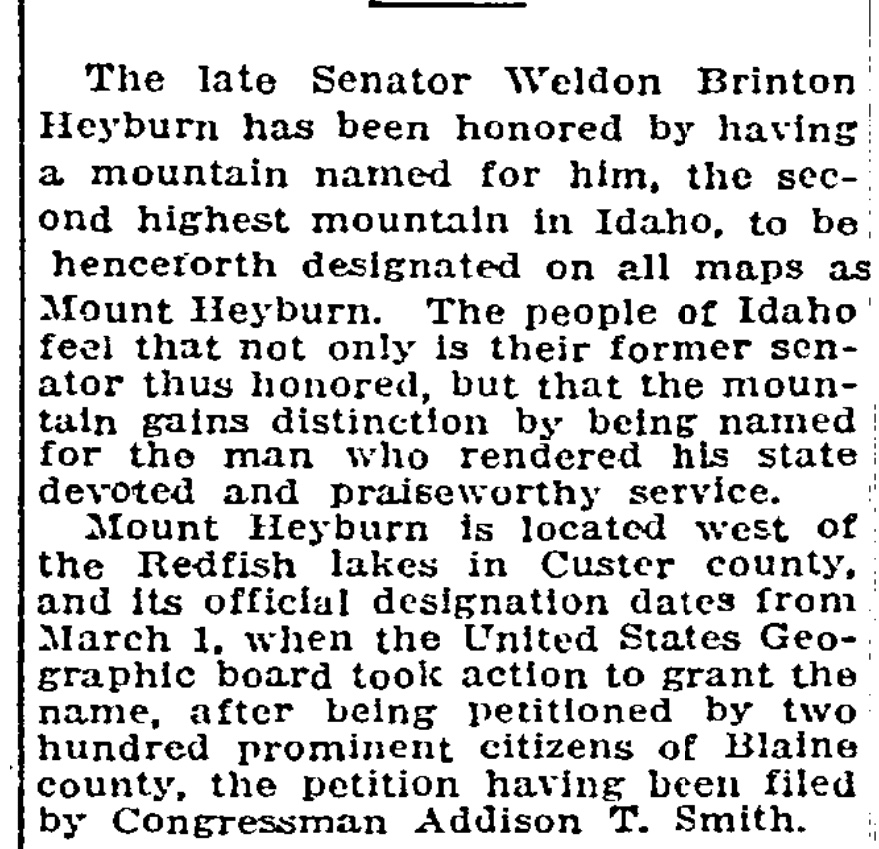
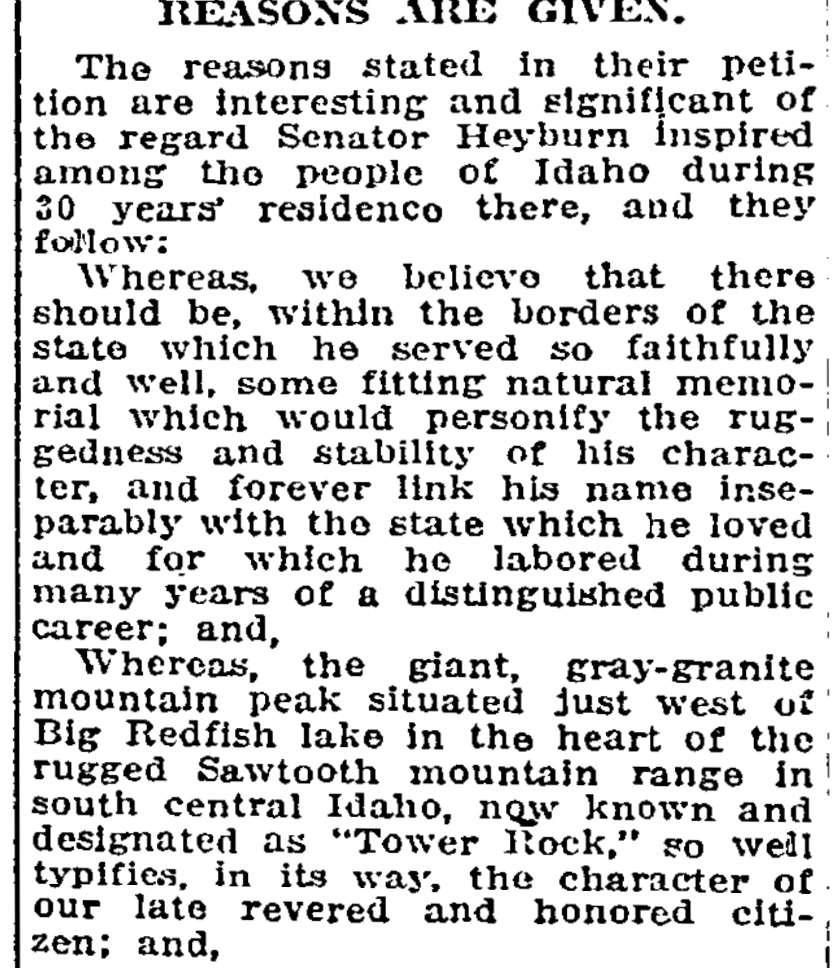
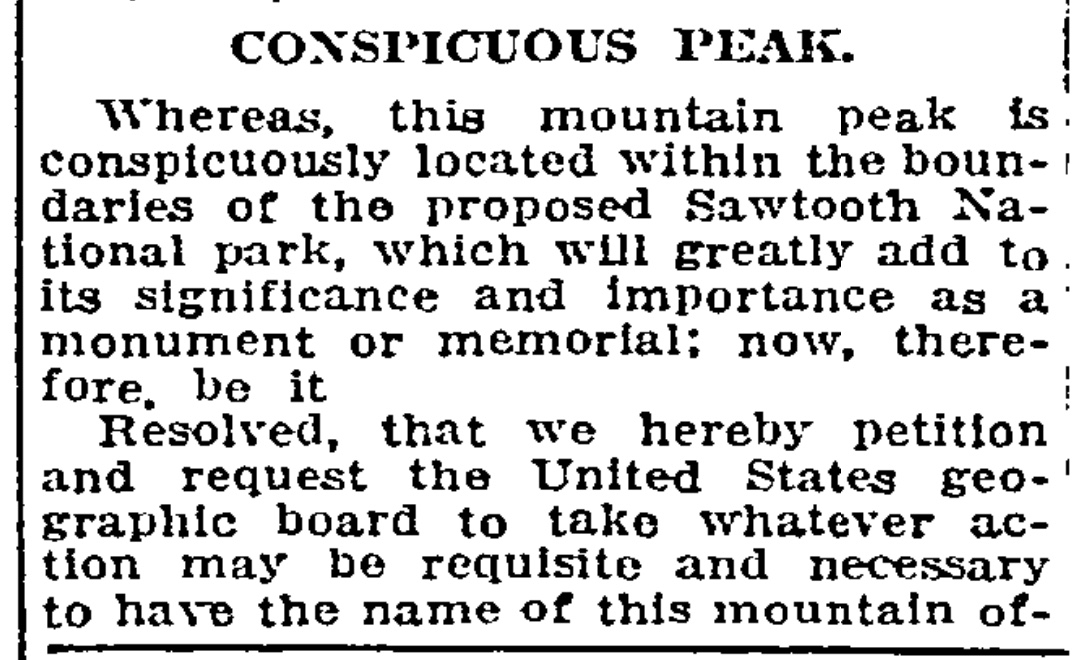
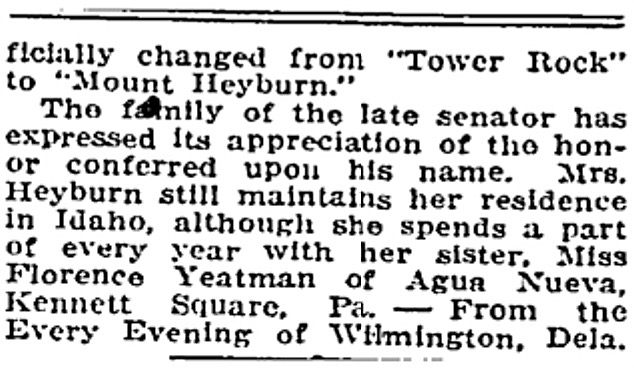
    Mount Heyburn (Sawtooth Range)

    –Idaho Daily Statesman, April 10, 1916


    Kinport Peak (Bannock Range)

    The dispute referenced in the caption found below was eventually resolved in Gideon’s favor.

    An article from the Idaho State Journal. Date unknown.
    An article from the Idaho State Journal. Date unknown.


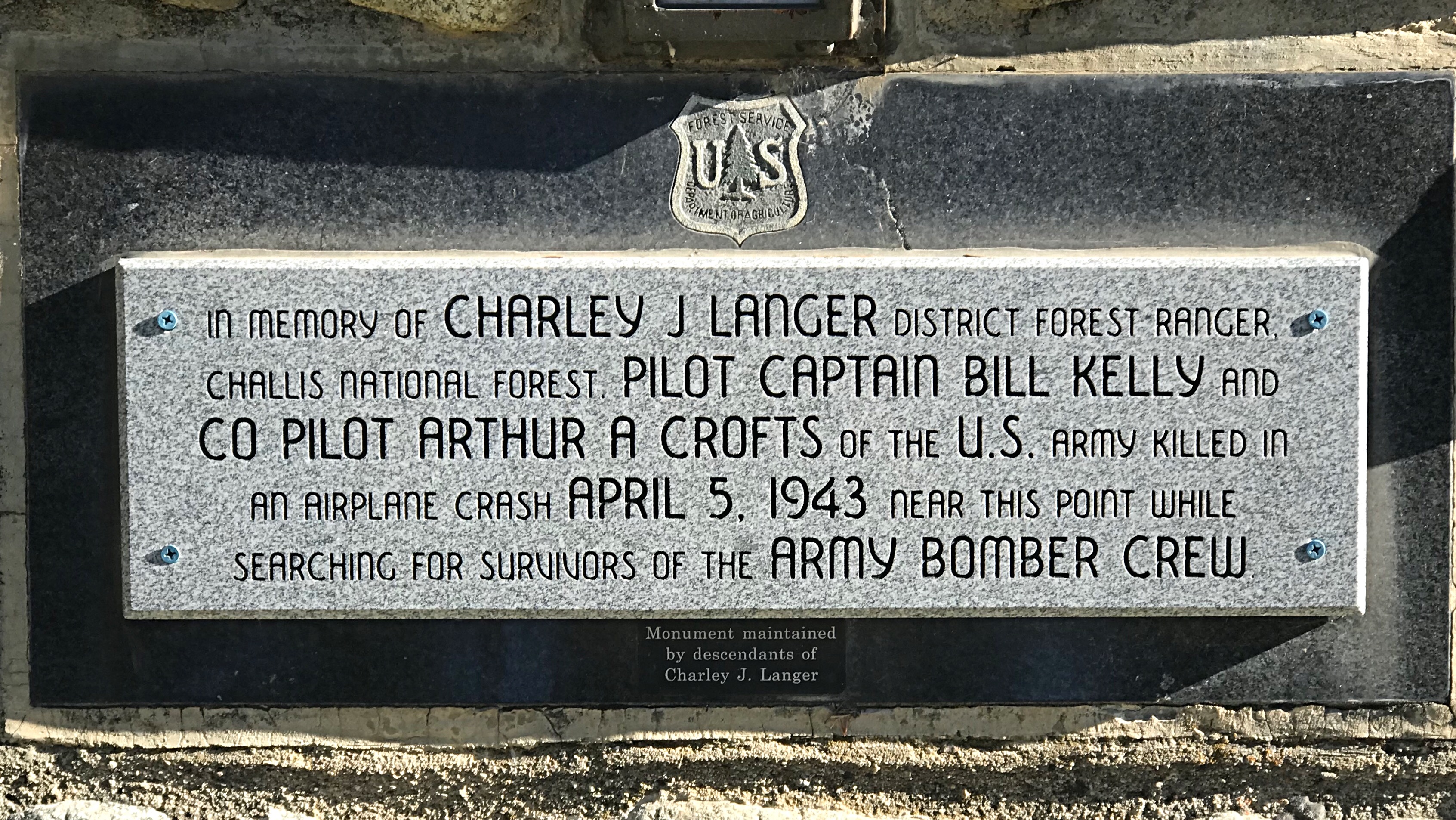
    Langer Peak (Salmon River Mountains)

    Langer Peak and Lake.

    This memorial at the Langer Lake Trailhead provides the history behind the Langer name.
    This memorial at the Langer Lake trailhead provides the history behind the Langer name.

    Saviers Peak (Smoky Mountains)

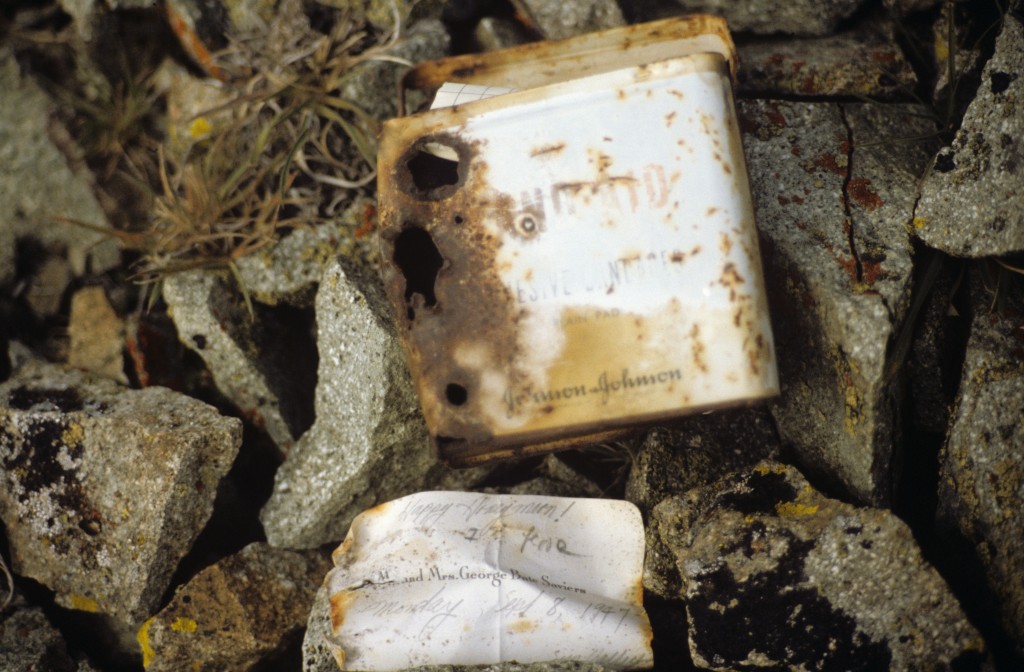
    This is the register left by Mr. and Mrs. George Saviers who climbed the peak while on their honeymoon in 1947. Later climbers adopted the Saviers name for the peak.

    Saviers Peak Register
    The summit register found in 1987 and left by Mr. and Mrs. George Saviers who climbed the peak on their honeymoon.

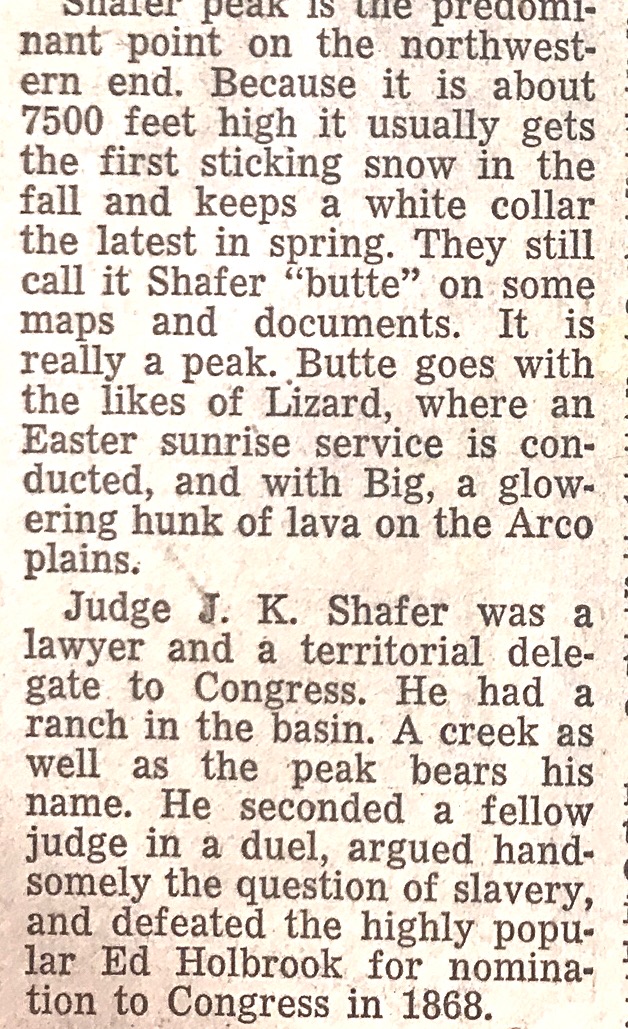
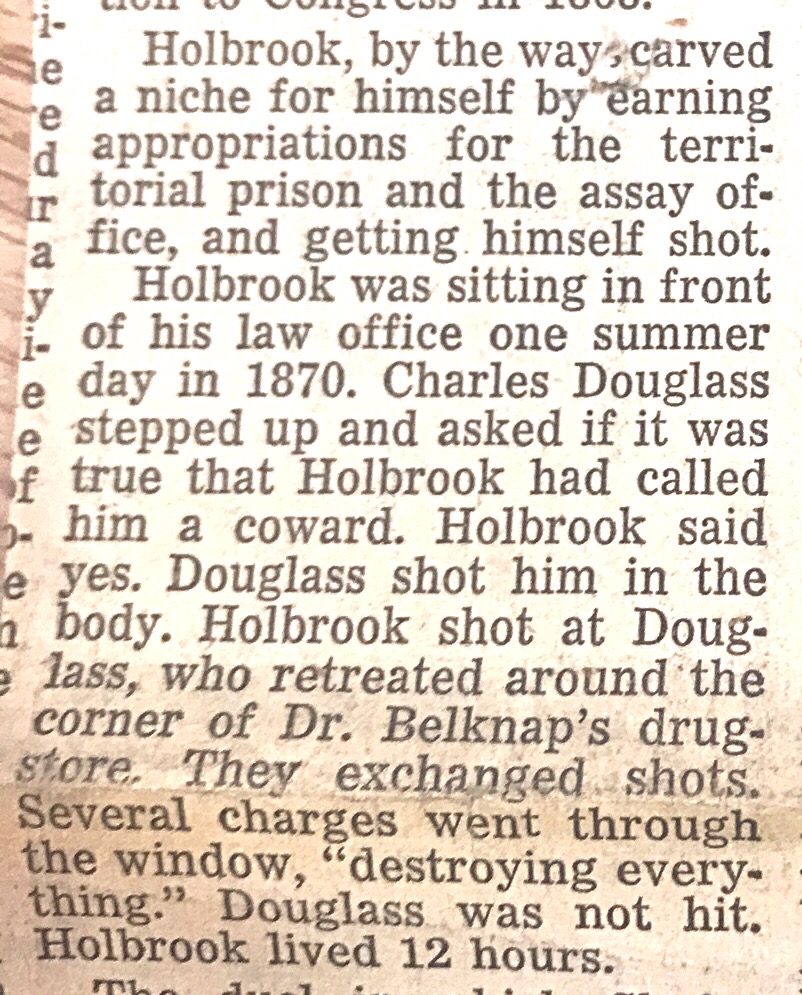
    Shafer Butte (Boise Mountains)

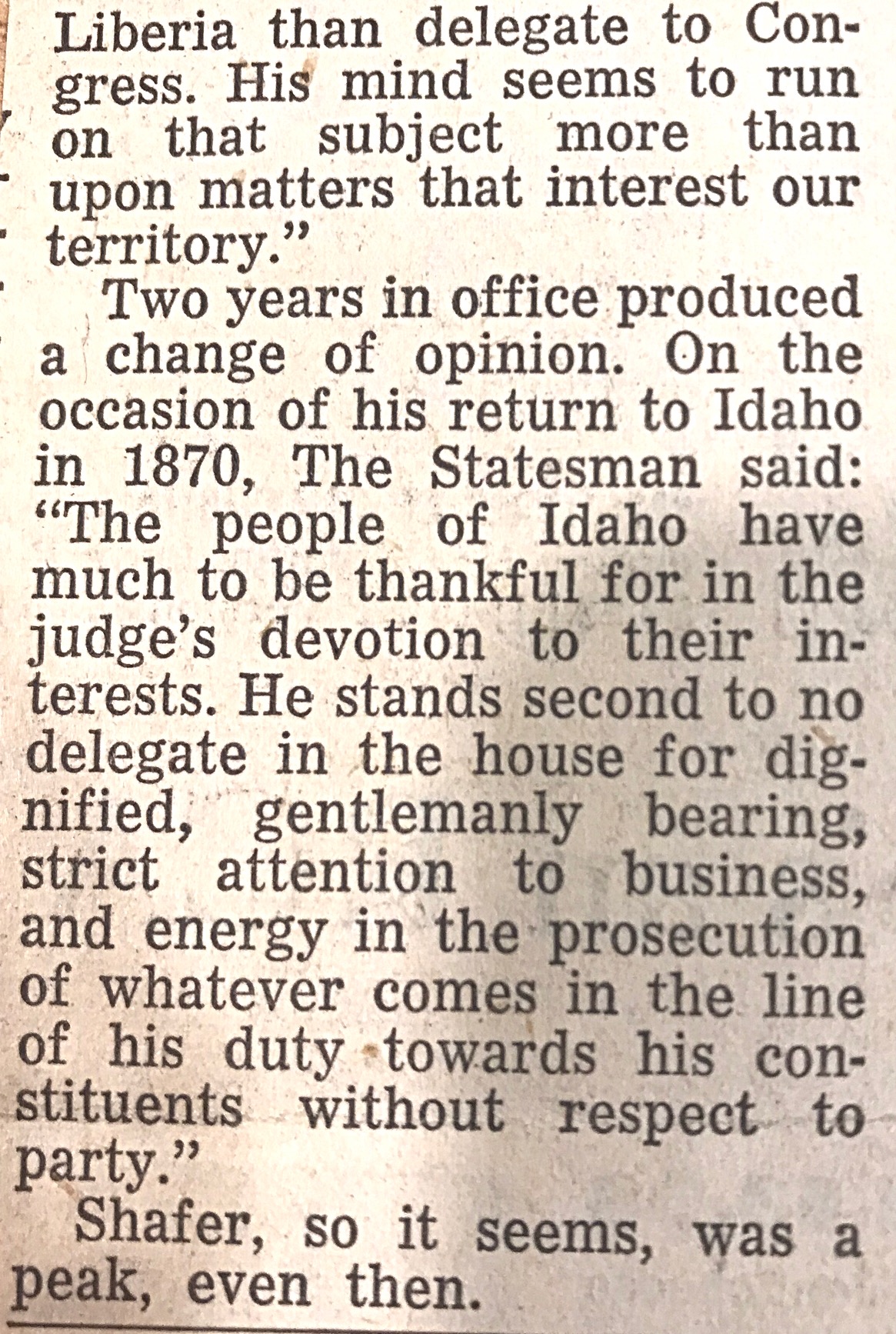
    This excerpt is from an Idaho Statesman Column by Dick d’Easum entitled “The Hills of Home.” The article shows an interesting side of the peak’s namesake.