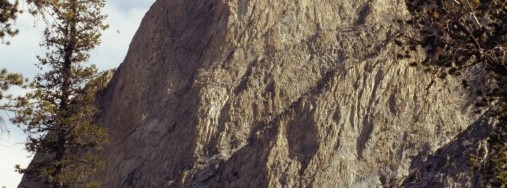
[Editor’s note: J.D. Martin was an early settler of the Lost River Valley. As he was nearing his 90th year, he wrote a memoir covering the early history of the Lost River area which was published in installments in the Arco Advertiser. This portion covers his ascent of Mount McCaleb in 1884. It also references other ascents of mountains in the Lemhi Range near Badger Creek but does not supply names. Badger Creek is located just below Diamond Peak. Martin’s obituary is set out below his trip report.]
. . . From there we went on to Badger Creek where a number of mining locations had already been made. We climbed several mountains around there but could find nothing which incited us to remain very long. We took another trail, over what was also then called Pass Creek and came onto Birch Creek, a few miles below where the old-time ghost town of Nicholia was at that time quite a bustling and busy little mining town.
A smelter was in operation and a population of perhaps two hundred people were living there. We then went on over the divide to another old time “ghost town” called Junction which was located on the east site of the Lemhi River about a mile from where the town of Leadore now is. This was also quite a bustling and active little town for that time and place. From there, we went on over the [Beaverhead] Range on the East Side of the Lemhis and prospected along the dividing line of the two territories of Idaho and Montana.
We found nothing which we deemed worth locating and returned soon to Junction. We then concluded to go up the stream, then and now called Timber Creek, which comes into the Lemhis about a mile or so below Leadore. We endeavored to simply “course our way” without trails or guidance of any kind, relying solely upon our sense of direction. Wild game was so plentiful that we could in a few minutes after pitching camp, easily kill all the wild birds we wanted to eat. An abundance of the three camp essentials (wood, water and grass) were everywhere and we were well inured to outdoor and camp life.
In passing around the divide between the headwaters of the Little Lost River and the Pahsimeroi, we somehow got onto a blind Indian trail which led us to a point and in a direction somewhat too far north. We came to a place where the higher mountains in front of us seemed to offer an impassible barrier to our further progress in the direction we were going. We found a good camping place for the night and were considering plans for retracing our steps next day. Next morning, Mr. Soloman was not feeling well and proposed that we lay over a day. Williams had seen bear tracks and, taking his gun, started out to add to his hunting laurels by killing a bear. I took a prospector’s pole, pick and started to climb the rough and rugged mountain which stood directly in front of our camp.
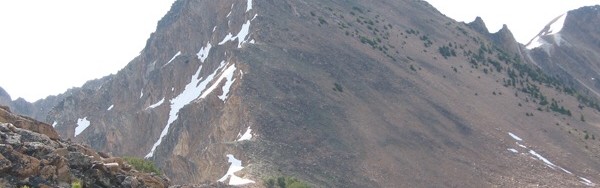
After some hours of arduous and laborious climbing over fallen timber, rocky gorges and deep precipices, I arrived at the top. And behold I stood at the summit of Mount McCaleb. Well, lest this screed should exceed the limits of permissible space, I will here close with the promise that the next installment of this narrative will begin at the summit of Mount McCaleb. (ARCO, June 15, 1941)
From the summit of Mount McCaleb and the date of about the last of August 1884. I do not deem it necessary to attempt any kind of a detailed description of the view from the top of Mount McCaleb. I will say that, at that time, nothing contributed by human agency was visible from there. A long, winding fringe of deep green, reflected from the dense growth of trees which marked the course of Lost River (at that time far more abundant and extensive in every way than it is now) was quite visible and marked the course of the valley from the extreme northwest to the southeast. Upon the whole, it was really a sight never to be forgotten and it has always been something of a wonder to me to find so many people who have never been to the top of Mount McCaleb. I returned to the camp and was able to inform my companions—Solomon and Williams—exactly where we were. . . .
J.D. Martin 1852 to 1942
“GRAND OLD MAN” OF BIG LOST RIVER VALLEY SUMMONED
Honorable James D. Martin Closes Career Tuesday Morning After Nearly 90 Years of Active and Honorable Life. [The Arco Advertiser April 17, 1942]
Judge James D. Martin, known as the “Grand Old Man” of the Lost River Valleys, came to the end of the long, long trail Tuesday morning. His nearly 90 active and honorable years–more than half of them spent in this valley–closed Tuesday morning, and with his death closes the career of a man who was very much a part of the life of our community.
He had been ill with a cold for several days, but he seemed somewhat improved when he retired Monday night. When he did not appear at his usual hour Tuesday morning, Mr. Daniels (hotel owner) went to the room where the lifeless body was found in bed. Only a short time before, Dr. Egbert said, had his spirit taken flight. Although he was known to be failing in health, the news of his demise spread to the remotest sections of our county and was a shock to all. There was a hushed silence as the death was announced because “Judge” Martin was known intimately by every man, woman and child in the Lost River country and to them he was both friend and counselor.
Judge Martin wasn’t just an ordinary individual. Although he left his native state of North Carolina when he was a lad of 17 and, as a consequence of which, his education was sadly neglected, he was a man of brilliant intellect–a self-educated man. He continued the quiet dignified bearing of his early youth to the very last. He wrote many interesting pioneer articles for The Advertiser in recent years and always took a leading part in community affairs.
Martin was born in North Wilkesboro, North Carolina in October 1852. At the age of 17, he and a boyhood chum left to cast their lot in the West. He followed the life of a nomad from then on for 15 years, spending time on the frontier in Colorado, Arizona, and California. In 1883, Martin was attracted to the Wood River country where a mining boom was underway and, naturally, he turned toward the Lost River Valley in 1884 as this valley was then attracting a great deal of attention.
He filed on a homestead in what is now the Lost River precinct in 1884. He lived there during the required length of time and, between times, worked in the mines on the Wood River. After proving up on his claim, he settled down and became a gentleman farmer in this valley. His education had been improved during his spare time, as he studied hard to increase his many abilities. He taught the second school of record in this valley, and spent a year or more in similar work in Little Lost River Valley. Many of our “old timers” gained the fundamentals of their schooling–their three “R’s”–in the little schools he taught.
Soon after the Lost River Valley began taking on airs as a “homeland,” he was elected Justice of the Peace. in this position, he served many years. He became a confident and legal assistant to many of our first families. He performed marriages, spoke at funerals, settled estates and, in scores of ways, endeared himself to the people of the valley.
He served in other official capacities also. he was County Commissioner during 1919 and for several years thereafter. The first highway construction work in this county—the road to Howe—was built and gravel surfaced during his administration. He was County Commissioner when the Irrigation District was formed. Later he retired as County Commissioner and served several terms as Probate Judge. He was always active in civic and fraternal affairs. He served as Treasurer of the Arco Lions Club during its existence. He “went through the chairs” in the Odd Fellows’ Lodge and for many years continued an active interest in that great fraternal organization. He made frequent trips to his old home in Wikesboro, North Carolina. He also visited a brother in Texas, who served many years as a district judge.
For quite a number of years, Judge Martin made his home at the Dee Hotel at Arco and, during most of this time, he served as chairman of the Butte County Red Cross, an organization of which he held the highest regard. The successful membership campaigns and other activities engaged in by this humanitarian organization were always a great delight to Judge Martin. He was generous and kind-hearted. He gave generously to charity. He was far from wealthy but, by frugal management and simple wants, he garnered enough of the world’s goods to maintain himself during the years in the sunset of his life.
Judge Martin seemed to feel that his days were numbered that when he was stricken with a cold about two weeks ago. He confided to friends that in all of his other illnesses he seemed to been able to overcome them, but on this occasion he told one intimate friend: “I feel that it is only a matter of time now, until I shall be called. I do not seem to be able to overcome this cough, but I am ready.” That was like him.
He united with the Unitarian church in his youth and, although he did not affiliate with any other, he was quite a regular attendant at services in this community dividing his time between the Baptist and the L.D.S. churches. Funeral services will be conducted this afternoon from the L.D.S. church officiating. Funeral arrangements are in charge of the Marvel Funeral Home and interment will be at Hillcrest. Services will begin at 2:00PM and several of his intimate friends are taking part in these rites. A nephew is expected to arrive from Texas. Thus a highly honored and respected citizen will remain with us in life.