Editor’s Note: Carl Hamke and Judi Steciak recently became the third and fourth climbers to summit all of Idaho’s peaks exceeding 11,000 feet. George Reinier and Johnny Roache were the first climbers to summit all of these peaks, while Judi is the first woman to accomplish this exceedingly difficult task. The short article below summarizes their quest and lists the 11,000-foot peaks that are not set forth in the book. The peaks identified below and the routes climbed by Judi and Carl were added to this site courtesy of Carl and Judi. Enjoy!
Tom Lopez’s guidebook for exploring Idaho mountains hits a good balance between detailed directions to trailheads and route descriptions that allow you to enjoy the thrill of discovery. Although many hundreds of mountains are included, peakbaggers wanting to summit Idaho’s highest mountains might be interested in learning more about the 17 ranked summits between 11,000-11,999 feet that are missing from the 2nd edition, plus a few easier routes on the Eleveners that are in the book.
It only fair to give a hint of the effort involved in summitting all 114 Eleveners. The peaks are spread out over 4 counties (Beaverhead, Blaine, Custer and Lemhi) and 7 different mountain ranges [Lost River (41), Pioneer (30), Boulder (17), Lemhi (9), White Cloud (8), White Knob (5) and Beaverhead (4)]. Most of the peaks are hikes or scrambles, but 10 have Class 4 routes and one has no other option than a Class 5 route.
In the process of reaching all those summits, we accumulated approximately 374,000 feet of elevation gain. This includes the 11,000 vertical feet we gained in one 2-day weekend (we were younger then). Note that the route from the Khumba base camp to the summit of Mount Everest shares the same elevation gain, albeit with higher starting and ending elevations. We covered at least 820 miles on the ground and spent at least 800 hours walking. You do the arithmetic: that’s only about a 1 mile/hour average. We found 23 peaks and/or routes for which we had no hard-copy information.
It took us 16 years from start to finish (along with many other higher and lower summits as well as ski trips, white water rafting…). We climbed as many as 3 Eleveners in one day. We needed 3 tries to summit some of the peaks, due to thunderstorms, wildfire smoke and not having the right gear in one case. We had to climb one Twelver twice in one day to reach an Elevener. We found no peaks with maintained trails to their summits. Trailheads were lonely places. We never met anyone on a summit and rarely met anyone in the valleys. We became addicted to the joy of exploration and discovery, and enchanted by the solitude, wildlife, wildflowers, pristine wilderness, and achingly beautiful vistas. Beware!
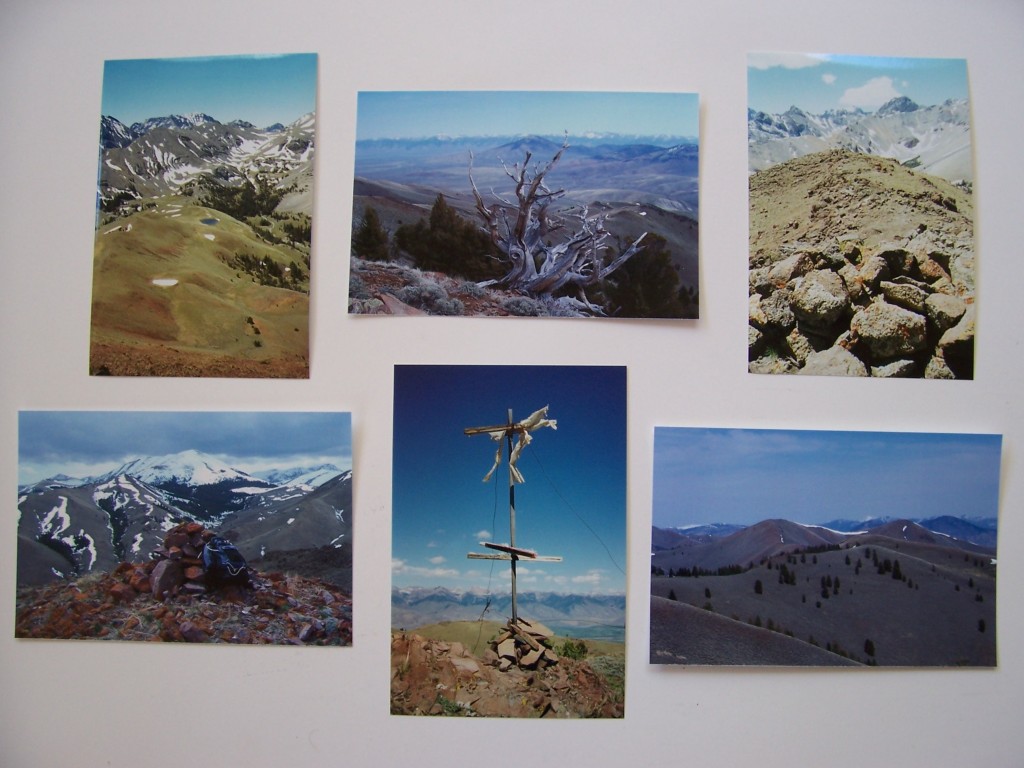
They say that one person’s junk is another’s treasure. Archeologists of future millennia should have a field day sifting through the midden of our modern society. Humans seem to leave calling cards wherever they go. Here are some Idaho mountain summit artifacts left by those of two or three generations back.
Left to Right (pictured):
WHISKEY PEAK (11,154 feet, Boulder Mountains). This pre-Prohibition whiskey bottle was left by some reveler high on this mountain. The summit view is north to Castle Peak (September 1993).
LEATHERMAN PEAK (12,228 feet, Lost River Range). The coffee can worked well to house a summit register until it rusted out. This one may have been placed by William McIntyre of Twin Falls in the mid 1950s….and look at that wooden ice axe! View north to Borah Peak (September 1984).
HOODOO PEAK/WCP-3 (10,588 feet, White Cloud Peaks). This summit sardine can dates from the early 1960s (October 2004).
Since the beer can’s introduction in 1935, mountains have provided an
artistic theme. The draw seemed to be recreation and pure water. Here
are some brands from the 1930s to the 1950s featuring Western U.S.
mountains.
Cone tops (shown on the top row) are sought-after items by collectors. Bohemian Club, brewed in Boise, was a favorite of WWII era beer drinkers. Tons of these could once be found in the Mount McCaleb dump (Mackay). The Sun Valley can (brewed in Pocatello) is rare. But keep exploring. You never know what’s over the next hill.
All material courtesy of Rick Baugher (April 23, 2007).
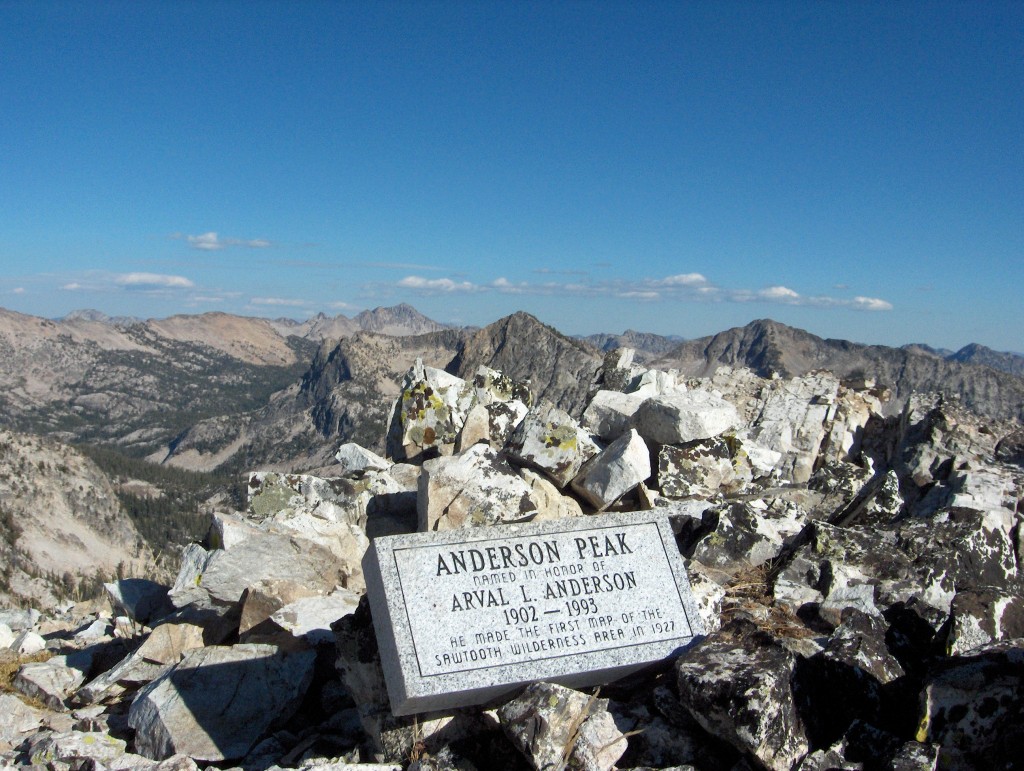
Arval Anderson, a civil engineer, was an early USFS Surveyor who was stationed in the Boise Mountains and Sawtooth Range in 1927. He is responsible for naming Tohobit, Reward and Bugle peaks among others. This entry covers a bit of Arval’s history which is quintessential Sawtooth History. There are three entries below: (1) a portion of a 1983 USFS interview, (2)”What we did on our summer vacation” by Arval Anderson, (3) an excerpt from a 1967 Summit Magazine article and (4) correspondence between Idaho climber Dave Pahlas and Arval’s family. The family has tried to have Peak 9704 in the Sawtooth Range backcountry named after Arval since 1976. This website unofficially uses the name “Anderson Peak” as Mr Anderson undoubtedly is worthy of the honor. The family has climbed the peak on numerous occasions and left a monument on the summit. The naming effort began in 1966 long before it’s location was in a designated wilderness.
(1) 1983 Forest Service Interview.
My first work that summer of 1926 was in surveys and maps and on my first field assignment I left Ogden about July 10th and traveled by train and bus to Robinson Bar which is near Stanley, Idaho. That’s where I first met Henry Shank who was Chief of the Surveys and Maps section of Engineer- ing, and my first boss in the Forest Service. I was to help him on a triangulation job in which we were to locate the geodetic positions of all the lookouts on the Boise National Forest, plus a few other peaks for mapping control. We actually started working on the Challis Forest. The Sawtooth range of mountains is located west of Stanley and marks the dividing line between the Boise and the Challis National Forests. The Sawtooth Forest lies to the south.
Shank and I started on this triangulation job and then about the latter part of July, while we were on a pack trip into the area west of Stanley, on the head of the Boise River, Henry came down with a severe cold and headache. he apparently had sinus trouble, so we returned to Stanley. Henry decided he must return to Ogden and turned the job and his car over to me. I took him the sixty miles to Ketchum (today’s Sun Valley) where he caught a train to Ogden.
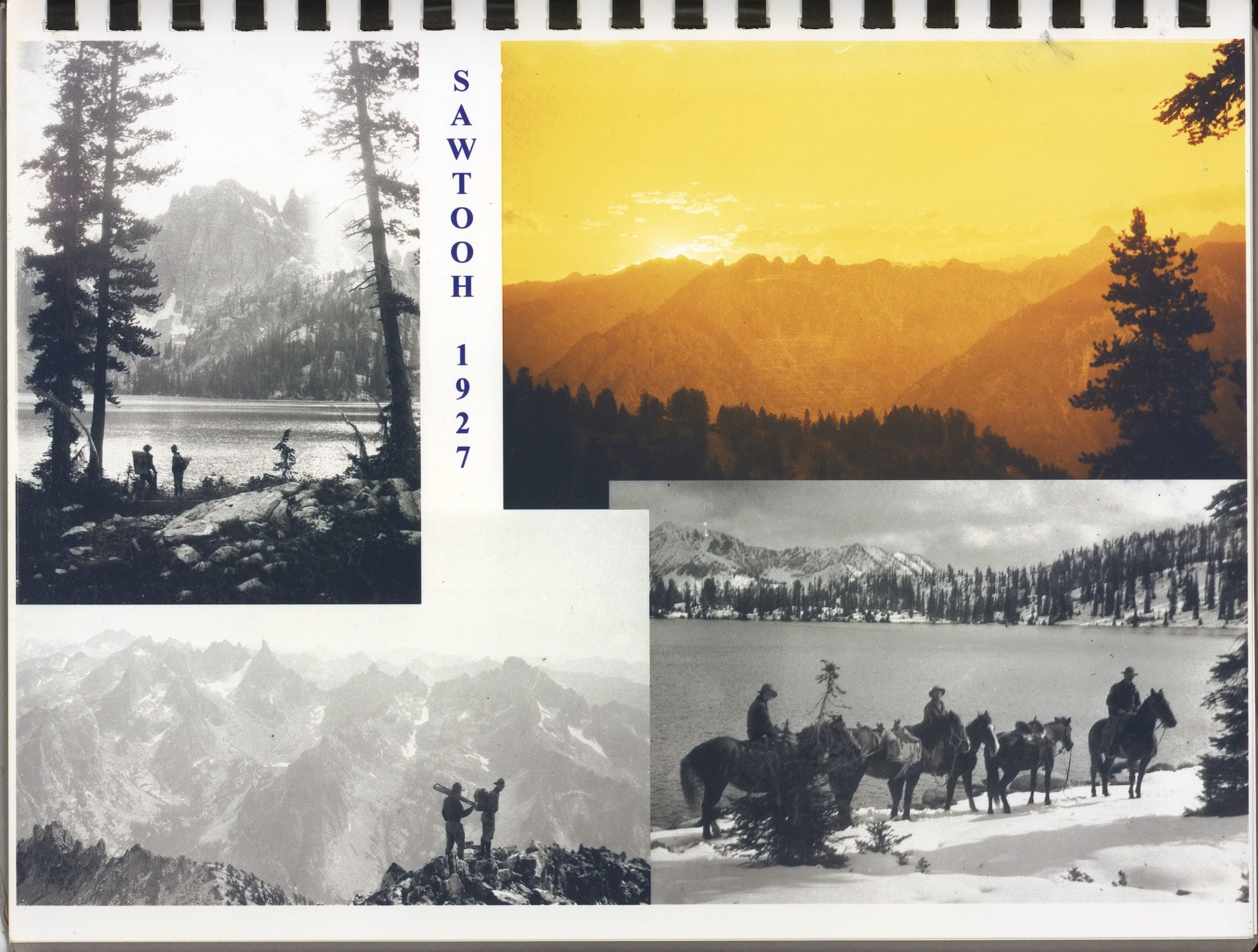
Henry had hired a young fellow, named Bobby Allen, probably 17 years old, to be my assistant. He was the son of Ed Allen who was the Forest Ranger at Stanley at that time. Bobby Allen and I took Henry Shank’s Model T Ford Coupe and started out to complete the triangulation work on the Boise Forest. We occupied about ten peaks, most of them were actually lookouts, on the Boise Forest. However, Henry and I had already occupied a couple of the rugged peaks in the Sawtooth Range: Snowyside and Thompson. We also had occupied Wolf and Swanholm on the pack trip when he got sick.
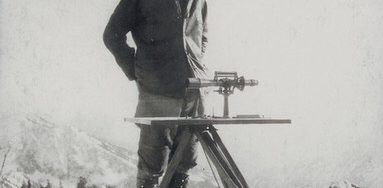
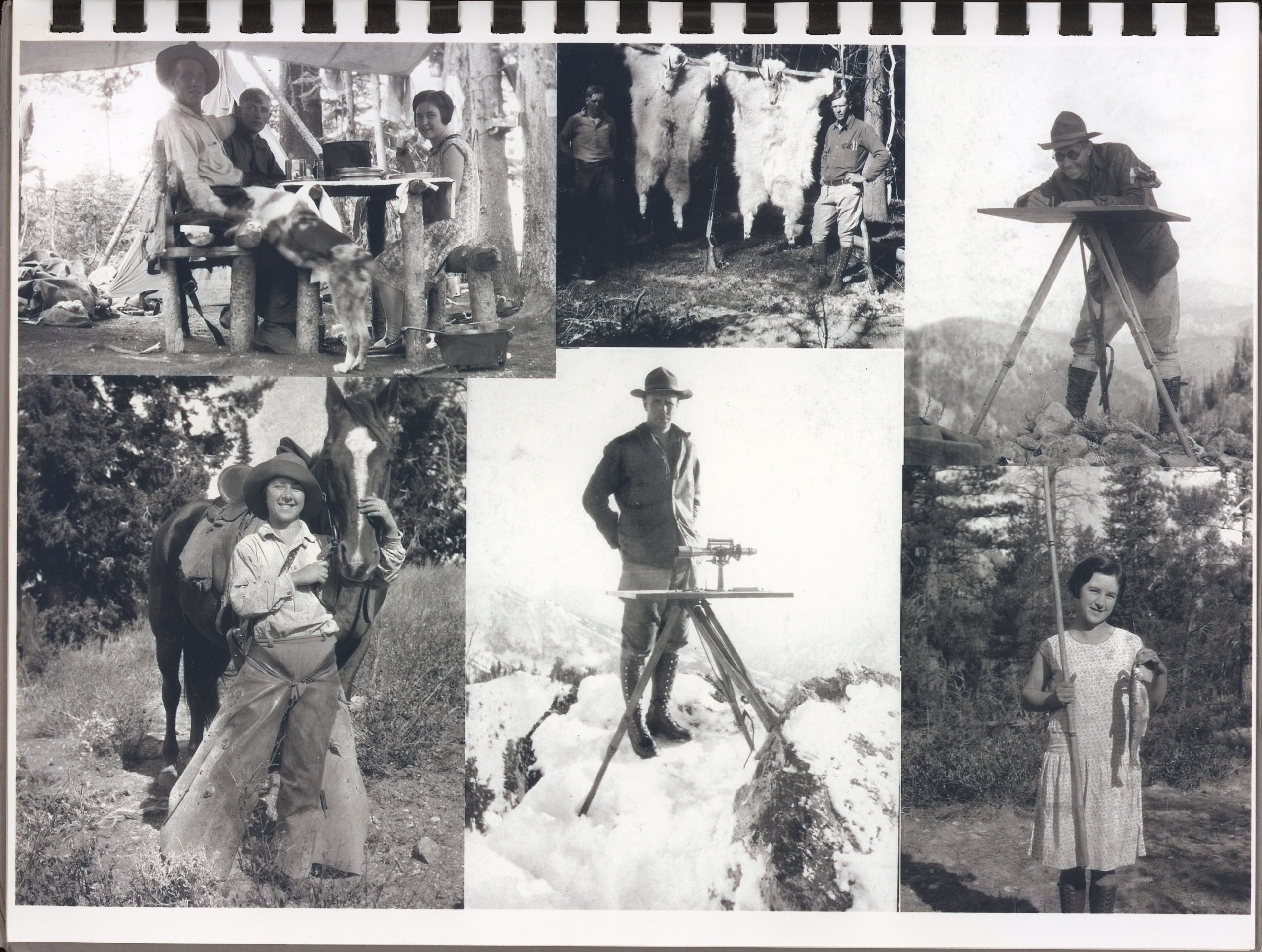
The first is a photo taken during the 1927 mapping project which shows Arval Anderson on the summit of a peak in the southern Sawtooth Mountains with his plane table and alidade. Arval Anderson Family Collection
The triangulation work required setting up a transit on each peak and reading and recording the horizontal angles between all the other desired peaks that could be seen. During the following winter in the Regional Office, I did the geodetic computations to determine the latitude, longitude, and elevation of each peak or lookout. The triangulation job included tying the network in to two Coast and Geodetic Survey second order stations. They were, Squaw Butte, north of Emett and Shafer Butte, north of Boise.
Besides locating the lookouts, the primary purpose of the triangulation was to establish control for a mapping project to be done in 1927. The area to be mapped included a total of about 600 square miles on the eastern side of the Boise National Forest. I was to map, by plane table method, 310 square miles on the northern part of this area, and another man. Major Simons, was to map the southern portion. Therefore, in addition to the goedetic computations. I prepared the plane table sheet on which I was to do the mapping in the field the following summer. About two-thirds of my area included the most rugged part of the Sawtooth Mountains. which are the most rugged in the state of Idaho.
FS: On the triangulation job. did you travel entirely by car?
AA: When Bobby Allen and I did the triangulation work. we would drive as close as we could get the car to where we were to occupy a point. If it was too far to hike and carry our instruments, we would rent horses from some local rancher. Most of the time we could make the trips within a day from where the car would be and I don’t recall that we camped out on that particular part of the work. On the actual mapping work in the summer of 1927 we had two parties on the Boise Forest. I had the northern part (310 square miles) which included the rugged country of the Sawtooth Mountains which I have described.
Arval Anderson Family Collection
The summer of 1927, I made the map by using the plane table and alidade method. The 24″ x 31″ plane table was mounted on a tripod. The alidade, an instrument with an eight-power telescope with cross hairs and a level for reading vertical angles and a straight edge base for marking directions, was used on the plane table. I sketched the topography and drainage directly on the sheet I had prepared during the previous winter. I maintained control by sighting in on control points by means of the alidade.
During the mapping operation we set bronze tablets on fifteen of the control peaks in the area. This required carrying a four pound hammer and a star drill to drill holes in the rock and a pound can of cement plus water for mixing, in order_to fasten the tablet. Our method of transporta- tion was horseback and on foot. We used pack-horses to carry our camp equipment and supplies. My party consisted of a field assistant, a combined cook and packer, and my wife, Maysel. We had many interesting experiences on that job so I will highlight a few.
Arval Anderson Family Collection
First, to look at the background of my party: As previously men- tioned. I had grown up in a logging town in northern Idaho and my field assistant was my younger brother, Joel. We were both woodsman and lumberjacks, so “roughing it” was nothing new to us. In our home town it was normal to have three to four feet of snow and thirty degrees below zero weather in the winter, with no indoor plumbing. My wife, Maysel. had grown up on a large wheat ranch near Moscow, Idaho, where her father also raised many horses. She. therefore, was an experienced hand with horses. I should also add that I grew up with horses, and in the summer of 1922 I worked as a packer for the Clearwater Timber Protective Association. using horses and mules to carry supplies to forest fire fighting crews.
Our packer, Hank Holverson, with three saddle horses and seven pack horses, from Challis, met us at Stanley about June 22, 1927. We packed up our surveying equipment. camp gear, and grub supply (from the Gillespie store in Stanley) and started over the mountains to the South Fork of the Payette River to begin our mapping job. Among our ten head of horses, three were half broke broncs. To get into the South Fork of the Fayette we were required to make a big detour to the north, as there was too much snow on Trail Creek Summit. As it was, we were delayed by rains, high water, and unruly pack horses. We took our horses over some patches of well packed snow, several feet deep and hard enough to support the horses. Altogether, it took six days to get to our first camp site on the mapping job. It was on the South Fork of the Fayette River near Baron Creek.
The 310 square miles I had been assigned to map contained about 200 square miles of country that was too rugged to traverse with horses. The result was that Joel and I were required to do much of our travel on foot. The average closest distance we could get a horse to the peaks we occupied for map sketching was about two miles. On a few occasions we would carry our surveying equipment, food, and bedding on our backs and stay out over night. On those “back-packing” trips we each carried about forty pounds while traveling and climbing over terrain too rugged for horses. It was literally “mountain goat” country and we saw many of them on this job.
Arval Anderson Family Collection
Because of the extremely rugged terrain, my progress on mapping was much slower than it would have been in average mountain terrain. It, therefore, took until November 19th before we were able to get out of the mountains. We had much rain, snow, and cold weather during September, October, and November. Our living conditions could be considered quite rigorous. We slept in 7′ x 7′ tepee tents with a canvas floor. We had no air mattresses or sleeping bags. We used evergreen boughs to make our beds less hard, and World War I Army blankets for bedding. Many nights in the fall it was cold enough to freeze our eggs into solid chunks of ice and our canned food was often frozen solid. Many a morning our wet boots were frozen stiff, so that we could not put them on until we had built a fire and thawed them out.
We had no camp stove and no tent to live in. although we did have a small wall tent to keep supplies in. All of our cooking was done on an open fire at the edge of a canvas “fly” which we had stretched overhead to cover the table on which we ate. It provided us with shelter from rain or snow and also shade from sunshine. Maysel became quite adept at keeping our sour—dough pot going for hot cakes and bread.
Another unique feature of this job was the fact that many of the mountain peaks, streams, and lakes in our area were not named. I was, therefore, instructed to name those that I believed warranted naming. I was not allowed to name them after any of our party or other people unless there was a bona fide reason. I was provided with a dictionary of American Indian words to apply in order to help perpetuate such words. We first adopted names that had local usage. This meant little. as nobody lived in the area I mapped. Much of it is now in the Sawtooth wilderness area. We named many of the peaks. streams. and a few lakes. There were more than a hundred lakes, but most of them were too small to warrant a name at that time.
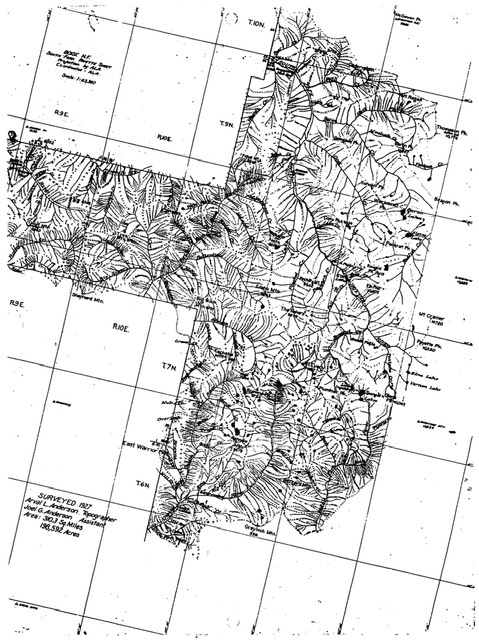
One of Arval’s maps. Arval Anderson Family Collection
At the conclusion of the mapping work I submitted a list of proposed names for topographic features. Those names were eventually approved by the National Board of Geographic Names in Washington, D.C. For examples of names: I occupied a peak in early November wading snow about two feet deep. While there, a snowstorm with gusty winds set in. I was forced to abandon efforts to sketch topography. I named the peak “Blizzard Mountain.” On another occasion Maysel and I were on top of a peak in the late afternoon and we heard a bull elk bugling in a cove below the peak. Maysel suggested the name “Bugle Mountain” which we adopted. Examples of Indian words are: “Nahneke” which means “goat,” and “Tyee” which means “chief.”
We completed the actual mapping job on November 12, from our last camp at the mouth of Mattingly Creek on the Middle Fork of the Boise River; about seven miles east of the small village of Atlanta. By that time, the snow on Mattingly Creek Summit had gotten so deep we could not get through it with our 17 horses.
The reason for the 17 horses is another unusual incident. I pre- viously mentioned Major Simons’ mapping party on an area adjoining mine to the south. The pack strings and saddle horses for the Simons mapping party and for mine were provided by the same man, Sam Hessen, in Challis. Be. as owner of the horses, hired both packers, who were then put on the Forest Service payroll at $100 per month each. However, Sam required my packer, Hank Eolverson, to furnish three horses, for which Sam would receive the pay from the Forest Service. Sam would actually furnish only seven horses in my string and get paid for ten at $10.00 per month per horse.
In early September Hank said he needed to go out to pack hunters before October 1st, when the deer and elk season would open. He told me that Sam had arranged to send in a replacement packer and three extra horses. With that assurance Hank took off with his three horses to ride the 100 miles to Challis. The replacement packet and horses were to meet him at Atlanta. No replacement packer or horses showed up and we operated for one month, until mid—October, with no packet and seven horses instead of ten. I should mention that we used hobbies and a bell to keep our horses near camp. In the meantime, the Simons party completed its work and released its packer and pack string which then appeared in my camp about October 15th with no prior notice. I then had a new packer and 17 horses. The name of the new packer was Heinie Blume. He remained with us to the end of the job.
Now to get back to our efforts to leave the area: After a second futile attempt to get the horses over Mattingly Creek Summit. we pulled in to Atlanta where I shipped out all of our surveying equipment. camp gear, etc. by parcel post. This meant it went from Atlanta by a horse drawn bobsled 16 miles over Bald Mountain Sumit to the little village of Rocky Bar. From Rock Bar it was carried by truck to Mountain Home and from there by train to Ogden. Maysel traveled the same route as a fare paying passenger on the horse drawn stage which carried the mail to Rocky Bar. then on a truck stage to Mountain Home. Idaho. From there. she took a train north to visit her folks in Pullman, Washington. The packer leading all his horses took the same route to Rocky Bar, but then went through Fairfield and Bailey to Challis; a trip of about 200 miles.
Joel and I used my Forest Service key to enter the Atlanta Ranger Station (the ranger had already gone out for the winter) and borrow two pairs of web snow shoes. We then set out to walk the fifty miles to Stanley, where my car awaited us. The snow on Mattingly Creek Summit was six feet deep as we crossed on our snow shoes a short time before dark. As we got down to lower altitudes and the snow only a foot deep we discovered tracks of a man. We followed the tracks (aided by a lantern we had made from a candle and a tin can) for a short distance, perhaps a mile, and they led to a small log cabin near the shore of Alturas Lake.
We entered the cabin and were very glad to find a bedroll hanging from the roof logs and a small cook stove in one corner of the cabin, there was also a table. It was obviously a line cabin for a trapper. We spent the night in relative comfort compared to sitting or lying by a fire all night which we had planned to do. The next morning after breakfast, and we had rehung the bed roll to the roof log, a model T Ford car came clattering up to the cabin door. At the cabin the snow was only two or three inches deep. The man in the car identified himself as “Trapper Green” the owner of the cabin. He was very friendly and I paid him $12.00 to take us the 35 miles to Stanley where my car was stored. This saved us a hard and long day’s hike on the slushy road to Stanley. By now it was November 19th, 1927.
(2) “What we did on our summer vacation” by Arval Anderson
–Amazing Sawtooth History
(3) Summit Magazine
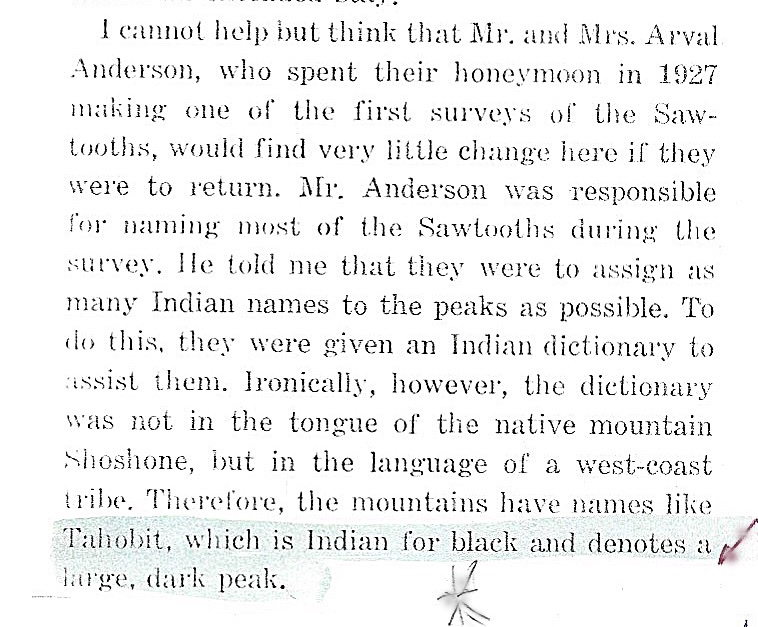
The following is an excerpt from an April 1967 article by Gary M. Smith in Summit Magazine entitle The Sawtooth Country of Idaho
(4) Dave Pahlas Materials
Dave Pahlas provided the following historical information about Arval Anderson, who was an early surveyor and mountaineer in the Sawtooths. Anderson is credited with naming several Sawtooth peaks.
Dave reports: “On the summit of Peak 9704, I found a large stone marker proposing that the peak be named after Arval L. Anderson. This led to some Internet searching and researching, which has been rewarded with the email chain below. It was pure luck that I happened upon Mr. Anderson’s family and now I feel like I’m getting an insider view on some neat history. Anyway, I was hoping to get your thoughts on whether you think they have any chance at all of getting the peak officially named after Arval Anderson? I’ve heard that it is next to impossible to get a name changed within a Wilderness Area, but I was hoping if there was ever an exception to that rule, this one might have at least a slim chance.”
His discovery led him to Mr. Anderson’s relatives and the following email exchange which provides valuable history and demonstrates the difficulty of getting peaks officially named.
Peak 9704 (Anderson Peak) as viewed from Plummer Peak.
Dave Pahlas wrote:
Hello, I found your email address from a photo on flickr.com and I’m hoping you might be able to help me find some information about Arval L. Anderson. This weekend, I climbed a remote mountain in the Sawtooth Mountains of Central Idaho and was surprised to find a block engraved with:
“Anderson Peak”
Named in honor of Arval L. Anderson 1902-1993
He made the first map of the Sawtooth Wilderness Area in 1927.
If you know of him, I would be very interested to hear more about him and his time spent in the Sawtooths.
Regards,
Dave Pahlas
Dave Pahlas Photo
Roger Anderson wrote:
Hi Dave,
My father and I first climbed that mountain in 1952 when I was 12 years old. He told me that it was one of his favorite spots for triangulation (to locate other peaks) because you can see a large part of the Sawtooths from there. The attached, more recent, picture shows the beautiful view toward the southeast. The person enjoying the view from the top is my grandson Brandon. To the northeast (not in this picture), the Rakers are clearly visible. When dad did his survey in 1927, he did not give this peak a name because it is a few feet lower than Mount Everly to the southeast which already had its name. He used “Arval’s Peak” for triangulation because it is more accessible and has a great view of much of the Sawtooth Wilderness Area.
The other group of pictures show Arval on one of the peaks (possibly Arval’s Peak) with his plane table and alidade, and another of my mother Maysel with her horse. These were taken in 1927 while they were doing the mapping. I have other pictures from a number of trips there. I also have a copy of the autobiography done for the Forest Service that covers his entire career.
I have been to that mountain 5 times (in 1952, 1967, 1995, 1997 and 2002). I was on the top every time except 1995 which was a backpacking trip from the North End of the Sawtooths. We brought the marker to the summit where you can see “Arval’s Peak” but did not have enough time to take it closer. We took it halfway up the South Face in 1997 and my daughter Sherille’s husband Mike took it the rest of the way in 2002. The rest of us were challenged to climb the peak without carrying something as heavy as the marker. My son Keith was there every time except 1952 and in addition he was there along with his sisters in 2007. The Bells have been there in 1967, 1997 and 2002.
Keith, my daughter Kristen and I have been involved with trying to get this peak to be named “Arval’s Peak”. This is a long process and is even more difficult for a Wilderness Area. The Naming Board meets once a year and needs to have justification and signatures from other people in addition to the details on the naming petition. Keith and Kristen have gotten signatures from some of the local residents, but we have not put together a complete package. One of the rules is that we need to use first names, not last names, hence “Arval’s Peak”. We did not know that when we had the marker made. Also, his map was not the first, but was an improvement. The existing map in 1926 was not very accurate.
Regards,
Roger Anderson
—– Original Message —-
From: Donna B Sanders
To: Dave Pahlas <dpahlas@hotmail.com>Sent: Monday, August 4, 2008 4:07:32 PM
Subject: Re: Looking for information about Arval L. Anderson
Dear Dave:
That’s great!! Arval L. Anderson is my grandfather and he made the first maps of the Sawtooth Wilderness area for the Forestry Service back in 1927. He and his new bride Maysel, his brother Joel Anderson, and another fella were part of the surveying party. It was quite an amazing trip, which he documented in reports to the Forestry Service and in an autobiographical account. My cousin, Keith Anderson, has collected much of the historical information about that trip and my mother, Berniece Anderson Bell also has typed up their personal recollections of that trip. We’ve also transcribed many of the conversations we’ve had about how they named various things on their trip.
Here are some notes that I took when I visited Grandma and Grandpa in 1988 when they were still living in their house in Ogden. I found them in an old journal I kept. He explained that there were certain guidelines for naming things–i.e., you couldn’t name anything after a living person [unless that was the already established landmark] and that, wherever possible, they were to choose names that the Native Americans had used or that were Native American words.
Names and Derivations of Grandpa’s Sawtooth Survey
Wolf Mountain — Where Grandpa and Uncle Joel saw some wolves
Tyee — Indian word for Big and Fat. Named because it was a big, fat mountain
McPhearson Creek, McLeod Creek and McKay Creek — were already named after sheepherders in the area.
Big Buck Mountain — was named after the Big Buck Grandpa killed which is hanging in the basement.
Edaho Mountain — is named after the Indian word for “Light on the Mountain”
The Rakers are named for how they look: the raker blade of a logger’s saw.
Reward Peak was so named because on the top they found a pile of stones with a paper under it. The paper said “There is a $25 reward for whoever returns this paper to: ” Then there was an address. Grandpa wrote to them, but they never wrote back.
They saw a packrat at Packrat Peak.
Bugle Mountain was named after the elk bugling in the valley below.
Warbonnet Peak looked like an Indian warbonnet.
Blizzard Mountain was so named because they had a terrific snowstorm while they were there.
In 1967, Grandma and Grandpa took all their kids and grandkids [including me] on a backpacking trip to celebrated the 40th anniversary of their surveying trip. It was an amazing adventure and we have many photographs of that trip. My mom and likely Keith have many of the photographs of Grandma and Grandpa’s 1927 original trip as well. My nephew Bryan Wesley Bell may have digitized some of these photos as well.
Attached are a few photos from our 1967 trip. I’ve also attached a picture of Grandma and Grandpa with us kids so you’d know what he looked like. He was wonderful person, very even-tempered, kind-hearted, wise and extremely capable. After he retired from the U.S. Forest Service, he was hired by the Taiwanese Government to be the civil engineer to build their country’s first highway.
After our Grandfather died, some of us climbed up Anderson Peak to place the marker you found. His son, Roger [my uncle] worked with the authorities to officially name that peak after my Grandpa. You can talk to him or Keith about that process. Several of us make the trek up there every year or two to spend time in the beautiful Sawtooths. I’m also cc’ing this email to my cousin Keith, my uncle Roger, my Mom and my brothers [Bruce Wesley Bell, Bryan Arval Bell] who may have other things to add.
With warm regards,
Donna Bell Sanders
Date: Sat, 13 Sep 2008 14:14:18 -0700
Subject: Fw: Information on Arval Anderson
Hi Dave,
I just realized that I do have a copy of the letter that I sent to Vaughn Stokes in 1996. It has a summary about my father. It is attached. While I was working with the Forest Service/U.S.Geological Survey, they suggested that a different peak might be easier, one outside the Wilderness Area or one not so close to another peak (Everly) that already had a name. I said no; it had to be this one.
I did not tell them of the experience that I had had with my father when we were there in the 1950s. He took me to this peak and told me that it was one of his favorite triangulation points because the view is so vast. You know that Dave because you have been there. He picked up a rusty tin can, pulled out a small slip of paper and wrote on it “Roger’s Peak” and said, “I am going to name this peak for you” and explained that he couldn’t really do that, but it was just between him and me. He put the paper in the rusty can and placed it under a rock on top of the peak. What a great dad. There could be no other peak to honor him. For a little more information–within our family, we call the small lake at the base of the peak “Bell Lake.”
Regards,
Roger Anderson
—– Forwarded Message —-
From: Roger Anderson
To: Dave Pahlas
Cc: Keith
Sent: Saturday, September 13, 2008 11:47:47 AM
Subject: Information on Arval Anderson
Hi Dave,
I was just looking through the information that I have on my dad and the Sawtooths. I have the following items:
1) Pages 4 thru 9 of the “Forest Service History Series, Arval L Anderson, Interviewed by Al Brady, May 1983”. This covers in great detail the Summer of 1927 that my dad and others spent mapping the Sawtooth Wilderness Area.
2) A copy of the map that my dad had made in 1927. My sister Berniece (Donna’s Mother) may have the original.
3) Pictures that include: Arval, me and my ex-wife sitting on top of “Arval’s Peak” in 1967. A beautiful picture of “Arval’s Peak” taken from Mount Everly. It was taken from high enough that you can see the lake just below the peak. And other pictures.
4) A copy of the first request to name this peak that I had sent in 1996 to Vaugh Stokes, the Forest Service Regional Engineer for Region 4 and his response.
The problem is I need to wait until Wednesday of next week to scan these documents. My wife is away and she is the scanner expert. Did you get my last e-mail that had pictures attached? I got at least one date wrong. We were there in 2003 not 2002. Were you able to open the pictures?
Regards,
Roger Anderson
Vaughn Stokes May 19, 1996
Regional Engineer
U.S. Forest Service
324 25th Street
Ogden, Utah 84401
Dear Sir,
This letter is written to request that one of the peaks in the Sawtooth Wilderness Area be named for Arval L. Anderson.
Arval was born in 1902 in Northern Idaho and died in 1993 in Colorado Springs, Colorado. During his life, he worked for the Forest Service, was an Officer in the Military and together with his wife Maysel, produced three children and adopted a fourth. He was my dad and a wonderful father to all four of us.
Arval graduated from the University of Idaho in June of 1926 with a degree in Civil Engineering. He joined the Forest Service and was given an assignment to make the first U.S. Forest Service map of the Sawtooth Wilderness Area northeast of Boise, Idaho.
During 1927 Arval, Maysel and Arval’s brother Joel lived and worked in the Sawtooth Wilderness creating a map. A copy of that map is enclosed. He occupied most of the major peaks and named many of the peaks, streams and rivers.
When I was in my teen years in the 1950s, I visited the Sawtooth Wilderness for the first time with my dad. He took me to a peak which is located in the center of the wilderness area. This peak is a location used by my father as a triangulation point for creating the map. From that point, you can see many of the other peaks including The Rakers, Mount Everly, Brown’s Peak and others as far away as Glens Peak and Mount Cramer.
Again, in 1967, my father and I climbed the peak. This was during a family vacation when Arval and Maysel took their children and grandchildren for a 5-day camp-out at the head of the Queen’s River. Our campsite had a beautiful view of the peak as the sun arose in the morning.
The peak is not accessible by trail and can only be climbed from the Southeast Face. My dad loved this peak because of its central location and beautiful 360-degree view of the Wilderness Area. The height of this peak is 9,704 feet, which is comparable to other peaks in the Sawtooths. It is located one-half mile south of Arrowhead Lake.
In 1995 my son Keith, my daughter Sherille and I, along with their spouses and other friends took a 6-day backpacking trip into the Sawtooths. We attempted to climb the peak on a one-day side trip from Benedict Lake. We did not all make it to the top, but two of our party did and took panoramic pictures from the top. I have enclosed one of the pictures which shows the view eastward looking back toward Mount Everly and extending northward to Blacknose Mountain. The other picture is a view of the peak taken from the ridge north of Mount Everly which divides the Queens River drainage from the Benedict Creek drainage. This peak does not have a name. I am requesting that it be given the name of “Anderson Peak” in honor of my father.
Arval worked for the Forest Service from 1926 until he retired. His jobs included Regional Engineer for Region 4 (Ogden) from 1938 until 1959 and Regional Engineer for Region 1 (Missoula) until he retired in 1962. His work for the Forest Service was noted in a “Forest Service History Series” publication made from an interview by Al Brady in 1983. A copy of the portion of that interview relating to his Sawtooth experience is enclosed. He was a retired Colonel in the U.S. Army and served active duty during the 2nd World War.
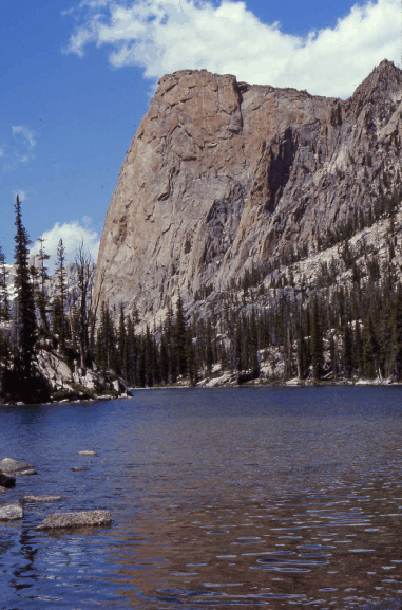
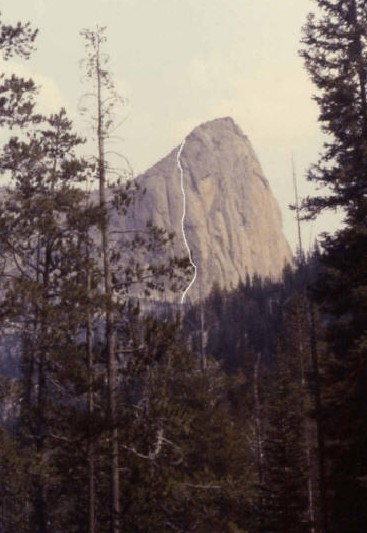
My photographic explanation of why this mountain is called Elephants Perch.
It was love at first sight with me and Idaho’s Sawtooth Range. Rotten rock, mosquito bogs and the annual July plague of biting flies: all failed to dampen my ardor. In 1971, I discovered Elephants Perch. It is a massive dome of beautiful pink granite (Leucocratic quartz monzonite). Its very clean and solid 1,200-foot high West Face is the best big wall in Idaho.
I started technical climbing in the Sawtooth Range in 1970. I was a Ketchum native and my Summer job on a Forest Service fire crew in the area gave me weekends off. Unfortunately, 2 years after a high point in 1971 of 28 days in the Sawtooths, I found gainful employment running an outdoor store in Moscow, Idaho. After that, my time in the Sawtooths became the typical “long-distance” love affair, with short visits throughout the 1970s and early 1980s.
In 1971, I learned that Fred Beckey (renowned Seattle Mountaineer) had done a Grade V route on Elephants Perch. Rumor had it that a convenient belay ledge capped each 150-foot lead. While climbing in the area in 1973, I spotted a line of weakness on Elephants Perch that I assumed was “The Beckey Route.” It took me 2 years to find the right partner for the route. Before the mid-1970s, there was no Sawtooth Range guidebook. Other than an occasional note in climbing journals, climbing history in the Sawtooth Range was all word of mouth.
The West Face of Elephants Perch as viewed from Goat Perch. The Pacydermial Pleasantries Route is in white.Ray Brooks and Chris Puchner on Goat Perch (1975).Elephants Perch as viewed from Redfish Lake Creek. The Pacydermial Pleasantries Route is in white.
In the Summer of 1975, Chris Puchner and I decided to climb Fred Beckey’s route on Elephants Perch. Day One: we lugged large packs full of big wall climbing gear into the lakes at the base of the wall. To carry both climbing and camping gear, each of us carried two packs lashed together. These masochistic bundles of equipment exceeded 70 pounds each and had been dubbed “Sawtooth Overloads.”
At that point in my life (age 25), I had climbed one Grade V direct aid route: Leaning Tower in Yosemite. My chief background in direct aid was occasional use of it on an otherwise free climb. Chris Puchner had done a small amount of aid climbing, but he was a natural athlete and always game for anything that entailed suffering.
Following what we thought was Fred Beckey’s classic line, we proceeded for 7 slow leads up a suspiciously easy route, just north of the center of Elephants Perch’s massive face. In current terms, we were in the first major-crack system to the north of “The Mountaineer’s Route.” We mostly free climbed but, on our last pitch, Chris ended up doing some direct aid as well. At the end of Lead #7 was a nice, flat 10 x 10 ledge waiting below a slightly overhanging, very thin crack. Since we had brought bivouac gear, Chris and I decided to wait for morning before attacking the wall above.
During the short night, a cloud of mosquitoes raised unseen from the lakes below and, in our sleep, we were both savagely attacked. I remember Chris mocking my puffy face the next morning. However bug bites on a bivy were much better than a thunderstorm–always our major fear in the Sawtooths.
The next morning we discussed our growing certainty that we were on unclimbed terrain. We felt excitement about pioneering a new route, rather than depression at not being on “The Beckey Route.” We always enjoyed doing something different. Thus inspired, but stiff and bug bitten, Chris attacked the aid crack above our ledge. The crack ran vertical about 20 feet to a small overhang, then continued thin, vertical, and unrelenting for a full 150 feet to where the crack finally widened. Chris went up a ways, bitched about not having enough thin pitons and retreated. I accepted his judgment and we rappelled off the route.
In the Summer of 1977, I was back with a secret weapon and a fantasy. The secret weapon was Mike Paine, a very good climber who I suspected would be of great help in climbing Elephants Perch. I had also found more information on Elephants Perch and was certain that instead of repeating the Beckey route, Chris Puchner and I had stumbled upon an actual new route.
The plan was to do the route with Mike and my girlfriend Jennifer Jones, just before my 10th high school reunion in nearby Hailey. Ray Brooks (high school social retard and non-athlete, voted most likely to be a nuclear physicist) would show up for the class reunion having just knocked off a prestigious first ascent in the Sawtooth Range. I would, of course, have my tanned and muscular woman on my tanned, muscular, and hopefully slightly scarred-up arm.
Once again we had to haul a huge load of climbing gear to the base of Elephants Perch. However, we had stashed 3 climbing packs full of food and climbing gear at the entrance to the canyon that goes up steeply to Elephants Perch on another climbing trip into the Sawtooths a few days before.
Unfortunately, when we arrived at the place where I had hidden the packs under bark and vegetation, they were no longer there. Some searching revealed fresh bear scat with aluminum foil in it. A wider search revealed 2 destroyed packs, no food and some climbing gear scattered around. Finally we found the 3rd missing pack over 200 yards away. It had been full of only climbing gear, weighed about 30 pounds and was intact but covered with tooth marks. United with our gear, we were short of food and low on water containers, but had enough equipment to proceed.
Mike Paine and I had been climbing together a lot that Summer. But Jennifer had not climbed at all since she had been off on an archaeological dig in Washington. We humped our “Sawtooth Overloads” up the steep climbers trail from Redfish Lake Creek into Elephants Perch Valley. Then Jennifer and I spent the late afternoon on a short warm-up climb for her.
Jennifer Jones and Mike Paine on Elephants Perch with Mike Paine leading.
Early the next morning we were off and up, burdened with bivouac gear and water for a 2-day climb. Mike and I swapped leads, making rapid progress up the first pitches, which had taken Chris Puchner and me a whole day 2 years before. Early in the day, we unexpectedly found ourselves back on the fine flat bivouac ledge, just below Chris and Ray’s high point of 1975. We had turned the 7 leads into 5 leads with my knowledge of the route and Mike’s willingness to run out the rope. Mike had also free climbed through an area where Chris had resorted to much slower aid climbing. Directly above us in a right facing corner stretched the thin aid crack.
As the direct aid expert or, more correctly, as the only person with much direct aid climbing experience, I got to lead the long, thin, aid crack. I had brought every thin piton and nut available for the aid crack and I used them all. The small overhang was not difficult to aid over but above that the crack stayed unrelentingly thin, accepting only Knife Blades and thin Lost Arrow pitons. It finally started to widen just as I was running out of thin pitons. I must confess that my lack of aid climbing experience and the vertical wall kept me placing aid pitons more closely together than good style dictates. The “clean climbing-throw away your pitons and use nuts for protection” revolution had occurred in the early 1970s. We were fervent users of nuts, when possible. In this crack, however, it was mostly not possible.
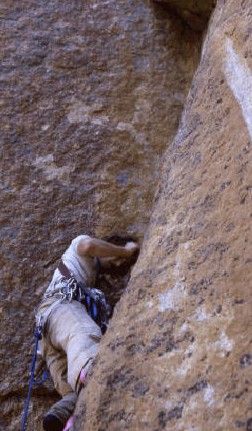
Ray on the aid crack, Pitch 6 of the Pacydermial Pleasantries Route.
Somewhere well up the aid crack, I ran so low on thin pitons I was forced to resort to very small wired-nuts (Copperheads) for aid placements. Some of these did not exactly fit well into the skinny crack so I resorted to bashing them into place while nervously humming that old British ditty: “When is a chock a peg?”
One well known fear of aid climbers is the dreaded “zipper” fall: where an aid placement you are standing on fails, then a number of placements below fail when your accelerating falling mass “zips” them out of the crack. I was aware that below me were a bunch of fairly insubstantial nuts and pitons. Of course, one of the nuts I had hammered on popped out of the crack just after I fully committed my weight to it. Thankfully, my “zipper” fall only pulled 2 more pieces of aid out of the crack before the rope stopped me.
I was used to taking lead falls but generally there was nut protection I trusted in cracks below me. Here the little demons inside my head were chuckling loudly about my good chance of taking a huge fall when every thin piton below me zippered. I pushed my fear into action and renewed a controlled struggle back up the crack. At almost the end of the 150-foot rope the crack widened slightly and accepted several large nuts. I felt relatively safe.
WOOHOO! I had a decent semi-hanging belay with even a slight footrest. I had vanquished the thin, vertical aid crack. Mike Paine jumared up the rope to me, shared some water that I was very grateful for and attacked the next lead. Above my belay, the crack was wider and in a much larger right-facing corner. Mike was forced to aid climb up the crack, and suffered considerably. There were 2 problems. First, although Mike was a great free climber, he had done very little direct aid climbing. Second, the suddenly wide crack demanded large nuts which we did not have a copious supply of.
I had convinced myself the worst was over after my lead but Mike’s thrashing and muttering above me indicated otherwise. However, I knew that even if Mike ran out of nuts for the crack, we had brought along “the bolt kit.” This consisted of a ¼-inch drill in a steel holder and a small supply of bolts. When a climber could not find anywhere to place a nut or piton, he could always spend 20 laborious minutes hand-drilling a 1½-inch deep hole by hammering on the drill then pound a special “Rawl” drive-in bolt into place. Although this was accepted technology for rock climbing, it was considered to be “bad form.” In theory and practice, climbers could climb almost anything by “bolting their way up.”
A possible slide into the low morals of using bolts for upward progress was taken out of our hands. During Mike’s struggles, the drill and holder (which had been in his pant’s pocket) worked loose. I heard a melodic “ding, ding, ding” and muttered “oh shit.” The bolt kit came flashing by me. We were now limited to cracks for placing our protection.
After more struggles, Mike finally called down to me that he was giving up on the crack he was in. He wanted me to lower him from a secure nut he had placed at his high point and he would pendulum to another crack about 20 feet to our right. This was a fairly normal maneuver in big-wall climbing. I started lowering Mike back down to my belay point to make the pendulum. However, when he was about 15 feet above me he started rolling his eyes and groaning.
Mike Paine had a mild form of epilepsy from a high school football injury. I had seen him have seizures twice before and the symptoms he was exhibiting now were identical to those starting a seizure. I knew he would instantly be fine if he could take his medication pill, which he always kept handy. I feared he might not be able to access those pills without my help. The consequences could be horrible.
I dropped Mike to my belay quite quickly. At that point, he looked at me with alarm (as he was bouncing up and down) and exclaimed: “Christ, Brooks, what are you doing? The nut I’m dangling from isn’t that solid.” I quietly asked, “You’re not having a seizure?” “No way man,” Mike replied, “The climbing harness was just killing my kidneys.” So with that crises over, Mike was able to run back and forth on vertical rock, supported by the rope, and grab onto the crack 20 or so feet to our right. He scrambled up some lower-angled rock a few feet, put some nuts in for a belay and I thought we were all set to go higher.
The maneuvers I would have to perform to follow Mike’s pendulum were a little complicated and put me at risk of a considerable fall onto Mike’s belay. For that reason, I asked Mike to reassure me that he had a good belay just in case something went wrong. He wouldn’t give me any mental comfort. I just wanted him to tell me it was okay. We proceeded to have a fairly loud discussion on the subject that ended with him shouting: “Christ, Brooks!” “When is a belay ever really good!” At this point, we decided to call it a day and retreat to our bivouac ledge 150 or so feet below.
By this point, Jennifer had been waiting patiently on the bivy ledge for about 6 hours. She had been alarmed by increasingly urgent yells between Mike and me and had, early on, noted the passing of our bolt kit. Somewhere in that long stressful afternoon, she decided it looked a lot like Ray and Mike might well go ding, ding, dinging, down the wall just like the bolt kit. After that epiphany, she prudently untied from the potential mutual suicide pact that she suspected the climb had become. Securely tied to her ledge, but not to us, Jennifer had somewhat tearfully waited for the drama to play out.
I should mention that in a 30-year climbing history, I have only witnessed one other incident where a climbing party member had decided to unrope before a possibly deadly group fall could occur. I was climbing in the Canadian Bugaboos in the mid-1970s with Chris Puchner. We impressed a couple of very competent female climbers with our ice climbing abilities. They subsequently dumped the English lads they were climbing with and went off to the Canadian Rockies to climb with us. Climbing conditions were horrible due to recent heavy snow. In desperation, we ended up doing the tourist route on 11,100-foot Mount Victoria, which had enough fresh snow to make it “very interesting.”
On the descent from the summit of Mount Victoria, I belayed my female climbing companion down a steep, but very snowy, chimney. She exited onto a ledge and vanished from my sight. After a few minutes, she called “On Belay.” I climbed and skidded down the mixture of loose rock and snow in the chimney without ever finding a substantial hold. Several times I believed I was about to fall, but knew the rope to my partner would catch me. After a while, I reached the ledge and walked around a corner to see her tying back into the climbing rope. She looked up and saw me, then quite calmly said: “I couldn’t find any anchors to protect a belay with. Didn’t see any reason to die with you if you fell.” Women are so practical!
Once Mike and Ray rejoined Jennifer safely on the bivouac ledge, all was soon better. A little food and water led to a good night’s sleep. No mosquitoes or thunderstorms arrived during the night and the next morning we woke ready to continue the climb. Mike and I jumared back up to my high point. Mike cleaned the nuts from his pendulum lead, protected by my good belay anchors and then jumared up to his doubtful belay. With more nuts, he was able to improve the anchors and pronounced it “pretty good.” Of course, if we hadn’t dropped the bolt kit, we could have set “bomb-proof” belay anchors with it. I then jumared up to Mike’s belay while Jennifer took up my old belay station as a safety backup.
At that point, Mike took off on the most difficult free-climbing lead of the route. It involved a delicate balance of friction and crack climbing on a very steep slab. Mike thought it was 5.9 and after following the lead with jumars, I was willing to agree. My next lead took me into a huge lower-angled chimney. When I reached the end of the rope, I propped myself into the chimney, placed anchors very carefully and then belayed up my partners. The problem was that the back of the chimney (about 5 feet below my belay) was piled with loose rock. If our climbing ropes disturbed any loose rock, those below me would not have enjoyed the subsequent projectile shower.
As I belayed up Mike and Jennifer, I coiled the rope over my legs to avoid disturbing rocks. Mike led on up, Jennifer went next and, about 1-½ hours after propping myself across the chimney, I could finally move. I immediately discovered a problem. My left leg had gone to sleep. It was numb from the knee down.
After doing all the standard things you do to wake up a numb limb, I gradually accepted I had a problem. The leg worked; I just couldn’t feel anything with it. I climbed up to Mike and Jennifer and informed them I had a slight incapacity. Mike led the final 3 easier leads and we were on top of Elephants Perch at about 1:00PM. We loitered around the summit for a while then decided that, if we were going to make my class reunion party, we had better start down.
The Pacydermial Pleasantries Route is in white. The arrow shows the bivouac ledge. The job to the right with white line indicates the pendulum.
Since my leg still had not awakened, Mike and Jennifer took most of the weight for the climb down. The easiest routes off of Elephants Perch are mostly walking down talus. I soon discovered I had to pay very careful attention to foot placement with my left leg, otherwise it would buckle under my weight. Despite my care, I took a couple of minor falls.
After reaching our camp, we jumped in the lake for a much-needed bath. Cleaner and much revitalized, we set off down the steep trail to Redfish Lake Creek. We had also picked up our backpacks and camping gear and now had more weight. Mike had martyred himself carrying a huge amount of weight, but I had about 50-60 pounds of gear in my Kelty frame backpack. Of course, my leg was still numb. The mile or so down to Redfish Lake Creek is very steep and I had to be very careful. I took more minor falls along the way.
Finally, we hit the creek bottom and some smooth granite slabs for walking surface. In the dim forest light of early evening, I failed to see a small stick that rolled under my right foot. I lost my balance and quickly threw my left foot out to catch myself. My left leg collapsed (it was numb, you remember) and I found myself stumbling faster down an inclined slab with the heavy backpack and gravity forcing my upper body head-first toward the granite.
About 2 inches before I slammed head-first into the granite, the frame extension on my pack hit the slab first. I somersaulted over into a sitting position and screamed: “That’s it!!” I think my bulging eyes nearly touched the rock just before the frame extension hit! I had been acutely aware my skull was about to be shattered like a ripe kumquat!! It was not in my stock of outdoor trivia that a pack frame extension could also function as a “roll bar.”
The pack with “roll bar” that saved my head. The red item is a fishing rod.
There was still a delicate log to walk over Redfish Lake Creek then 2 downhill trail miles to the lake and hopefully a waiting motorboat. After we reached the far end of the lake, we would have had a 65-mile drive to Hailey and the party. We camped right where I had fallen instead. Yes, I gave up on making the class reunion party. They probably would not have been impressed with our smelly bodies and matted hair. I didn’t have any good scars on my arms either.
The next morning, we cleaned up the remains of the picnic the bear had made of the two stashed climbing packs a few days before and had a mellow walk out. My leg recovered in about 6 months. I made it to my 20th class reunion. One disappointment was that we only took one picture the 2nd day of our climb. I have discovered that the number of pictures taken is inversely proportional to the difficulty of the route. Somehow the camera never got much use when I was suffering through an epic. I think it all has to do with priorities. For us, staying alive was more important than taking pictures.
I wrote up the route as “Pacydermial Pleasantries” for the American Alpine Journal. They published the description, but not my cool route name. I indignantly protested: since I had achieved a pinnacle of status in the climbing community with a free charter membership in the DFC&FC as well as a paid membership in the American Alpine Club. My protest was ignored. The rumor mill told me the stuffy AAJ editor only allowed route names that were in Webster’s Dictionary or were proper nouns. “Pacydermial” was not in Webster’s and did not make the cut.
Ray Brooks
Copyright 2003
Below is my heavily edited (by AAJ staff) route description. They even changed my first name from Ray to Raymond.
The 1979 American Alpine Journal route description under “Climbs & Expeditions: Idaho”:
Elephants Perch, Northwest Face, Sawtooth Range. Chris Puchner and I attempted a new route on the Northwest Face of Elephants Perch in 1975 but ran out of thin-crack aid gear. In 1977, Mike Paine, Jennifer Jones and I completed the 11-lead route in 2 days. The route is 150 to 200 feet south of the route Bill March did (A.A.J., 1976, Page 455). Our route went up the right side of a huge flake while he went up the left side of it. Raymond Brooks
Volcanoes and related igneous flows are a staple of the Pacific Northwest landscape, so it is interesting to observe that Idaho’s highest mountain range presents a 60-mile front of sedimentary limestone. How did these Lost River Mountains align the way they did and how did they reach their current height? Much can be explained by the movements of the North American tectonic plate over the last 11 million years, when compression and extension forces initially faulted the surface crust. Also, 2 glaciations over the past 100,000 years left their mark. But a far more powerful source, arising from deep within the earth, are the volcanoes.
Their presence can be seen along much of the back side of the Lost River Range. The largest igneous flow begins at the mouth of Pass Creek, continues north then northwest, to form a large apron around the range. The keen observer, with a little imagination, can trace the roots of long-gone Mesozoic stratovolcanoes on the order of Rainier and Orizaba. The limestone which piled up against their eruptive flanks gave the birth to our Lost River Mountains. Three stratovolcano locations tentatively identified are: Arco Valley (between King Mountain and Arco Hills), Wet Creek Basin and Upper Pahsimeroi.
Here’s a look at some remnant Lost River volcanic peaks. Clockwise from top left.
VULCAN PEAK (10,297 feet): The highest volcanic summit in the Lost River Range. View S to USGS Peak (1999). APRON MOUNTAIN (9,382 feet): View NE to Hawley Mountain and the Lemhi Range, showing the Wet Creek stratovolcano caldera (2007). EAST BURNT PEAK (10,149 feet): A prehistoric cairn? View SW to Cleft Peak (1999). THE CAPE (8,387 feet): Iron-rich andesite of Eocene Challis Volcanics. View S to Massacre Mountain (2007). GROUSE PEAK (8,464 feet): The northernmost Pahsimeroi/Lost River Range summit overlooks the Round Valley caldera. A T. M. Bannon 1914 triangulation station (1994). VICTORIAS SECRET (8,860 feet): Beauty is in the eye of the beholder (2007).SQUAWTIP (9,046 feet): The most prominent topographic feature in the Burnt Creek area. A conical peak of rugged andesite breccia. There is no easy line to the summit. First ascent by Lee Morrison and Lester Walker, USGS (1934-1935). The easiest way up Squawtip is a zig-zag climb on its East Face and gully system. The average slope angle is 65 degrees (2007). CAMPION PEAK (9,597 feet): A 2005 cairn and view SW to Borah Peak. Campion is a pink alpine flower. SPRING HILL MOUNTAIN (9,449 feet): A 1932 benchmark placed by E. M. Buckingham. View to Doublespring Peak (1996). DRABA HILL (9,315 feet): Above Horseheaven Pass. Draba is a bright yellow circumpolar flower abundant in this area (2005). BABY PEAK (9,191 feet): Heads Baby Creek in lonely cowboy country (2005). Any errors of opinion or observation in this article are mine alone. Rick Baugher (May 2007)
By the 1930s, the Forest Service had a goal to “put a firewatch on every mountaintop.” Idaho ended up with 989 fire lookout structures, more than any other state in the Pacific Northwest. Of Southern Idaho’s 128 lookouts, 36 were above 9,000 feet. Red Wings (10,910 feet) was the highest. Twin Peaks (10,340 feet) is the highest fire station in America today. By the 1960s, many of the old lookouts were destroyed in the name of progress but, fortunately, a representative sampling remain today at least until the elements ultimately win.
Everything you’d ever want to know about lookouts is contained in the book “Fire Lookouts of the Northwest” by Ray Kresek. You can reach Ray through his Historic Lookouts Project in Spokane, Washington. In doing his research, Ray has climbed over 1,000 mountains. He knows what he’s talking about. As mountain users, sooner rather than later, we have an encounter with lightning. In his book, Ray describes one of those terrible nights in a shack on a summit, something like this:
As the lightning approached, the firewatcher would pull the “go to hell rope” to disconnect all appliances. The copper wire grounding system would begin to hum and glow with dancing Saint Elmo Fire. At this time, as your hair began standing on end, you’d hop on a glass-legged insulated stool. For the grand finale, the blinding white light would cause anything metal to sizzle. The cabin reeked of foul ozone. After several minutes your sight and senses return….and leave you something not to forget in a lifetime.
Left to right from top: WILDHORSE PEAK (9,546 feet): White Knob Mountains. This fire lookout is preserved as a national historic monument. TWIN PEAKS (10,340 feet): Idaho’s highest outhouse provides a contemplative view to 10,442-foot White Mountain, high point of the Salmon River Mountains SLEEPING DEER (9,881 feet): In the heart of the Frank Church Wilderness. Built in 1935. Still active. SAL MOUNTAIN (9,593 feet): Lemhi Range. This 10’x10′ lookout was built in 1926. The USGS triangulation signal is from 1945. These are the first Idaho mountains to be seen and described by a white man. Cresting Lemhi Pass on August 12, 1805, Meriwether Lewis records: “I discovered immense ranges of high mountains still to the west of us with their tops partially covered with snow.” BLUE NOSE (8,677 feet): ID/MT border. An oddity: this lookout was split down the middle by 2 States, Counties, National Forest Ranger Districts and Regions. The lower floor accommodated livestock. The brass benchmark in the foreground was set by USGS’ T. M. Bannon in 1912. MOUNT GREYLOCK (9,857 feet): Left to the elements. By Rick Baugher (April 24, 2007)