Category: Sawtooths

  • Fred, Pete and Jack’s Big Sawtooth Adventure by Ray Brooks

    Fred, Pete and Jack’s Big Sawtooth Adventure by Ray Brooks

    The Summer of 1949: Fred Beckey, Pete Schoening and Jack Schwabland went into Idaho’s Sawtooth Range to finish “some business” with two peaks that had repulsed their climbing attempts the previous Summer. They also had a shopping list of other unclimbed peaks in the Sawtooths. Their “Idaho adventure” may well be the most exciting epic in Idaho’s climbing history.

    Fred Beckey passed away at age 94 in 2017, after becoming a “living legend” in climbing circles as the man who had done the most first ascents and new routes in North America. Pete Schoening is most famous for saving 5 of his team-mates when they fell on K-2 during a 1953 expedition. Pete was also part of the group that made the first ascent of Gasherbrum I in 1958, the only 8,000 meter peak first climbed by Americans. Jack Schwabland was a highly respected climber who took part in many first ascents in the Northwest.

    The only write-up I have been able to find of their Sawtooth adventures is an photo-less article by Jack Schwabland in the 1950 American Alpine Journal: “Sixth-Class Climbing in the Sawtooth Range.” To chronicle their “Big Sawtooth Adventure,” I will include extracts from that article along with my own photos and experiences on these peaks.

    Their “shopping list” for the trip included: Fishhook Spire (i.e., El Pima) and Big Baron Spire (i.e., Old Smoothy) in the Baron Creek drainage, Red Finger (i.e., North Raker) in the South Fork Payette drainage and The Grand Aiguille in the Redfish Lake drainage.

    Fred, Pete, and Jack entered the Sawtooths by boating across Redfish Lake, then hiking 5 steep miles to Alpine Lake, where they left their “base camp” with a reserve cache of food and equipment. Then, with somewhat less-heavy packs, they hiked north over a pass to Baron Lakes and their first objectives. This was the era of heavy war-surplus gear and canned food for climbing trips, so their original packs likely each weighed in the 70 pound range. In 1948, Fred and Jack had been part of a group that failed in attempts on both Fishhook Spire and Big Baron Spire. On this trip, they had bolt equipment and more gear. They planned on achieving first ascents of each.
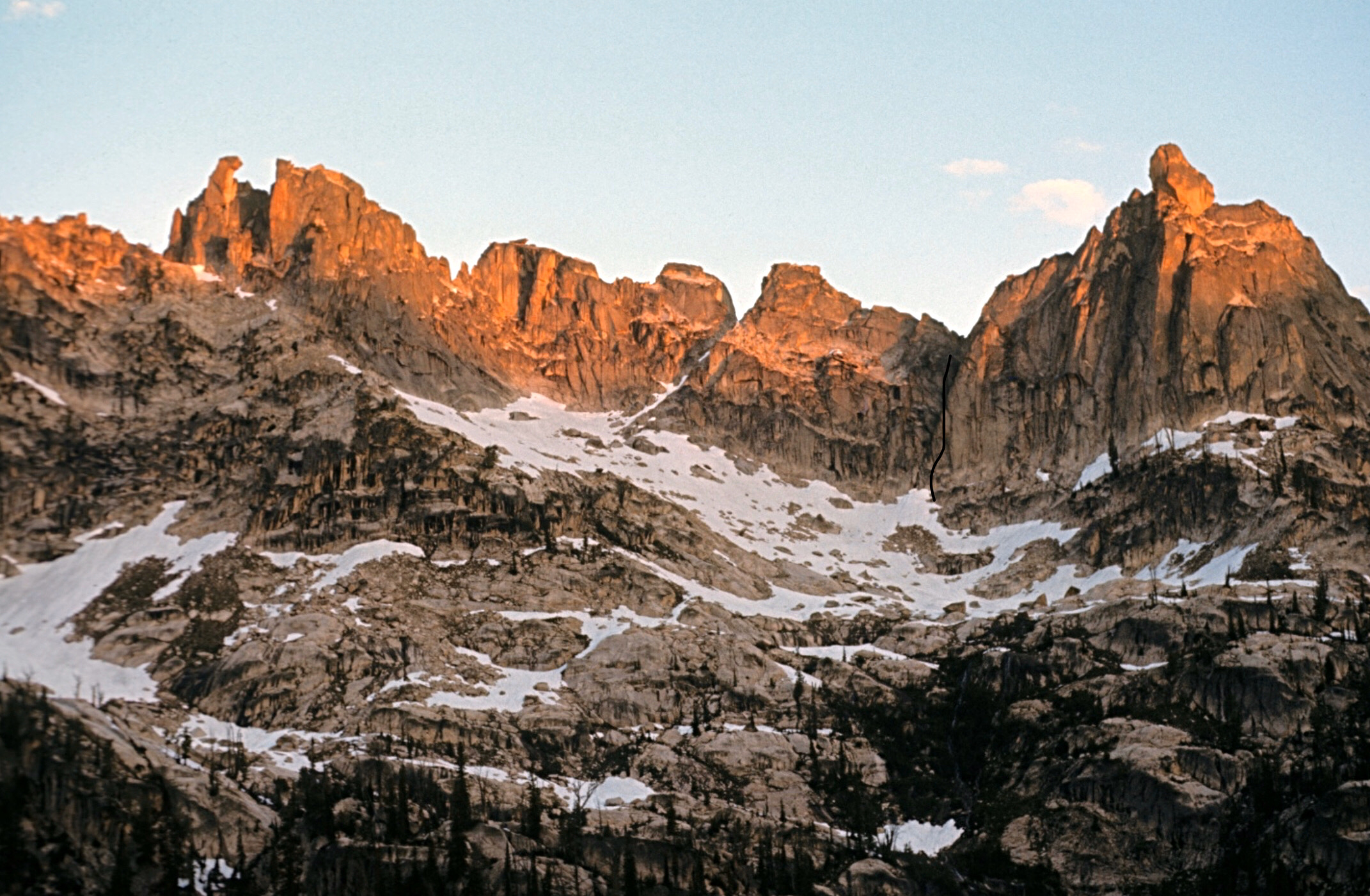
    View north from the Redfish Cr./Baron Creek divide of some of the many rock towers above Baron Lakes.   Fishhook Spire (now El Pima) at top left.  Big Baron Spire is on the far right. The 1949 route up Big Baron Spire starts below the V notch with snow, well left of Big Baron Spire, then traverses horizontally across the light colored area to the closer notch, and up the ridgeline. Ray Brooks Photo
    View north from the Redfish Creek/Baron Creek Divide of some of the many rock towers above Baron Lakes. Fishhook Spire (El Pima) is at top left. Big Baron Spire is on the far right. The 1949 route up Big Baron Spire starts below the V notch with snow, well left of Big Baron Spire. It then traverses horizontally across the light-colored area to the closer notch and up the ridgeline. Ray Brooks Photo
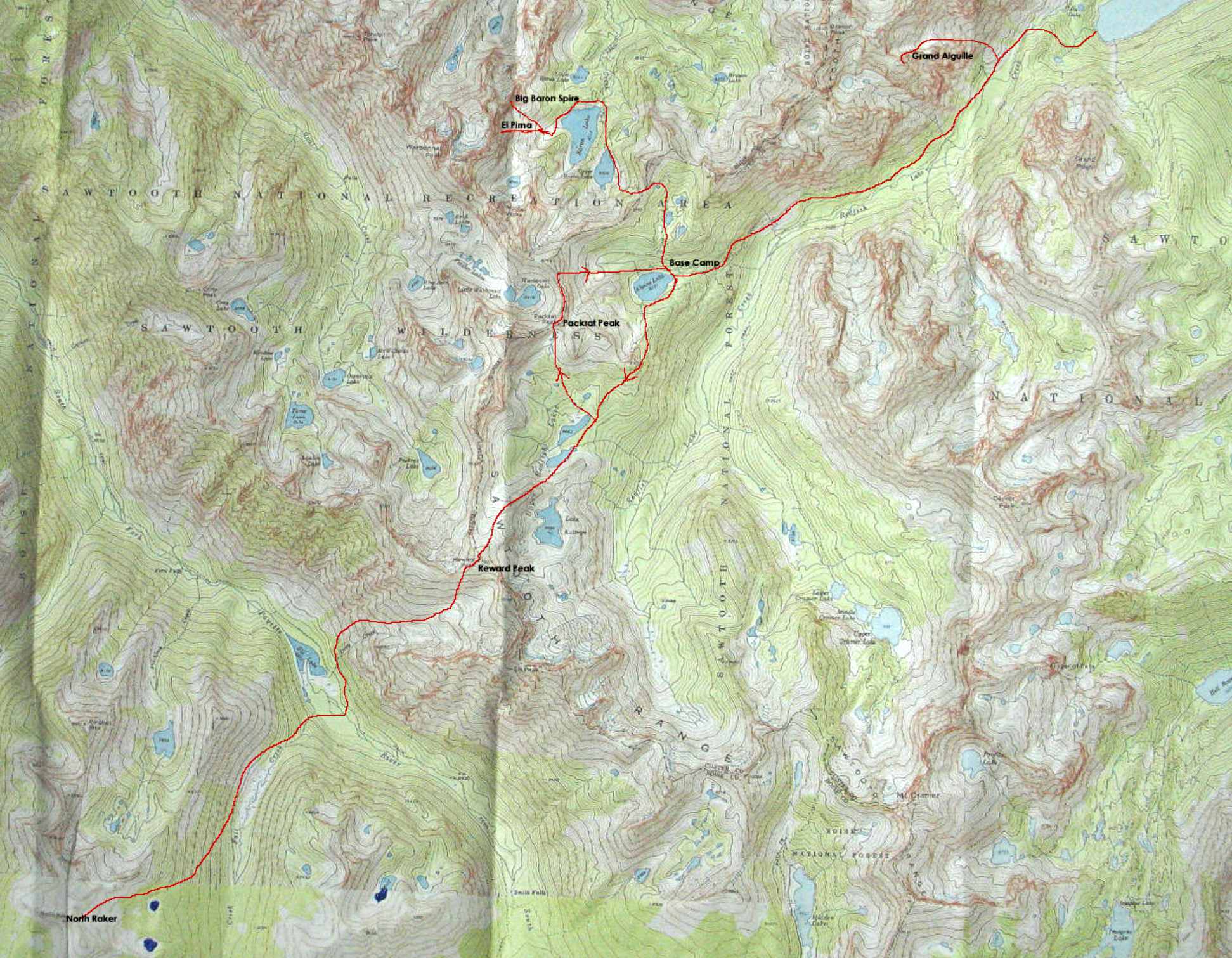
    Map of the Sawtooth adventure area with routes taken marked in red.  
    Map of the Sawtooth Adventure area with the routes marked in red.

    On the first day at Baron Lakes, they hiked up to Fishhook Spire’s East Face, donned tennis shoes and “wiggled up a series of steep dirt-filled chimneys to a tilted rock pile some hundred feet directly below the great overhang on the summit block.”
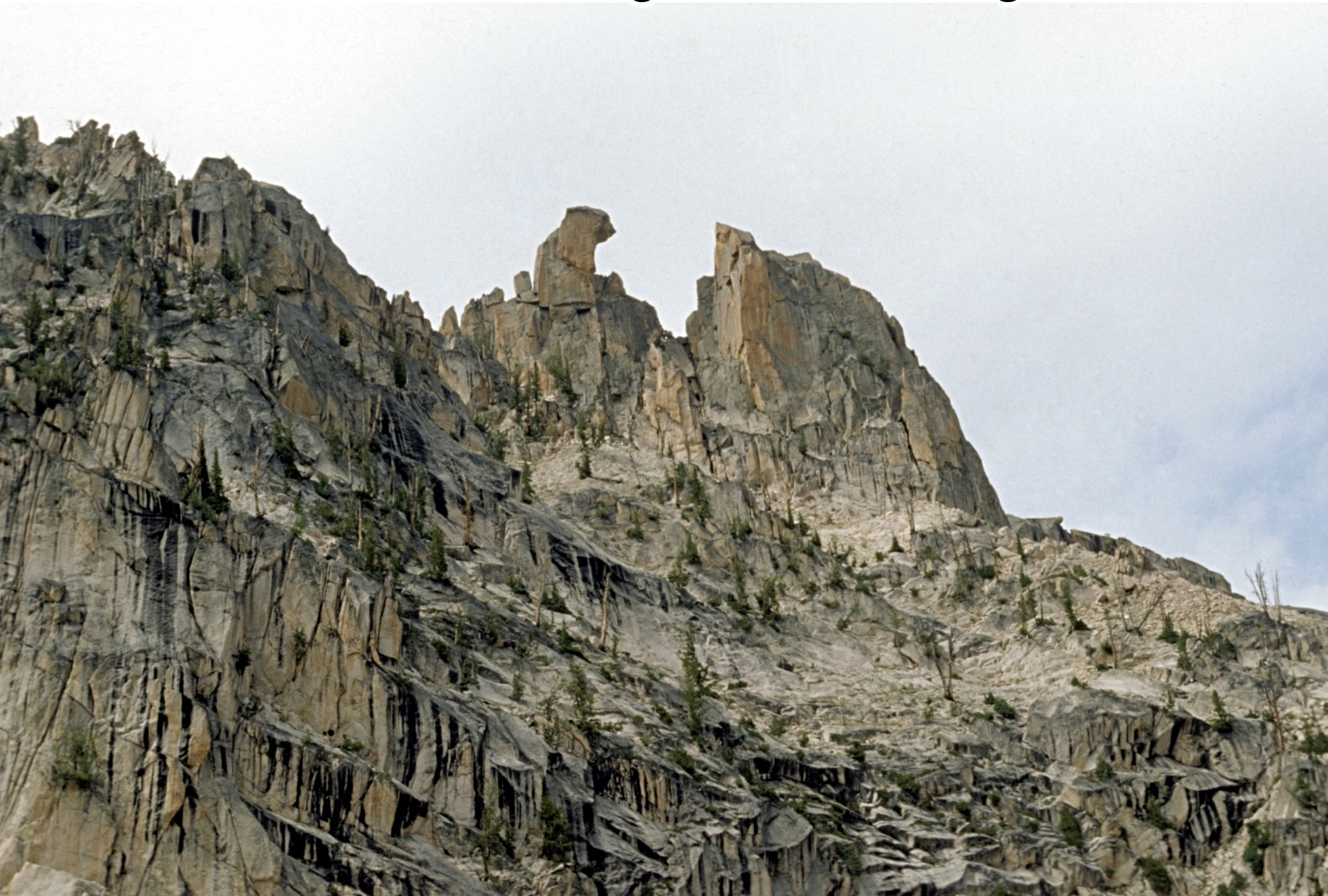
    The South-East-face of Fishhook Spire, at top center.  Becky route follows line of weakness to notch, at right of hook, then goes behind the spire. Ray Brooks Photo
    The Southeast Face of Fishhook Spire (El Pima) at top center. The Beckey Route follows the line of weakness to a notch at right of hook, then goes behind the spire. Ray Brooks Photo

    From there, they climbed a short jam crack and moved around to the North Side.

    “Pete gave Fred a shoulder stand from the chockstone. Fred appeared to be stymied for a moment. It was the sort of pitch you almost wanted to try to climb free, but didn’t quite think you’d make. We decide to give the pitch the benefit of the doubt and resort to direct aid. Fred gingerly stepped on top of Pete’s outstretched hands and managed to drive a spoon piton at the limit of his reach. It was only partially in, but seemed solid enough for tension, so Fred went up on it until he could reach another crack. Two more very insecure pitons and he was able to hunch himself around onto a sloping ledge at the right from where the route became easy. Pete and I swung rapidly up on the rope to find Fred reclining on a large slab. A quick shoulder stand put us on the exposed summit.”

    I climbed Fishhook Spire in 1971 with Harry Bowron by about the same route, although we knew nothing about the previous ascents. Toward the top,  I gave Harry a shoulder stand, and later he made one aid move using a postage stamp sized piton called a RURP (realized ultimate reality piton). Our ascent was only the 3rd one since 1949.
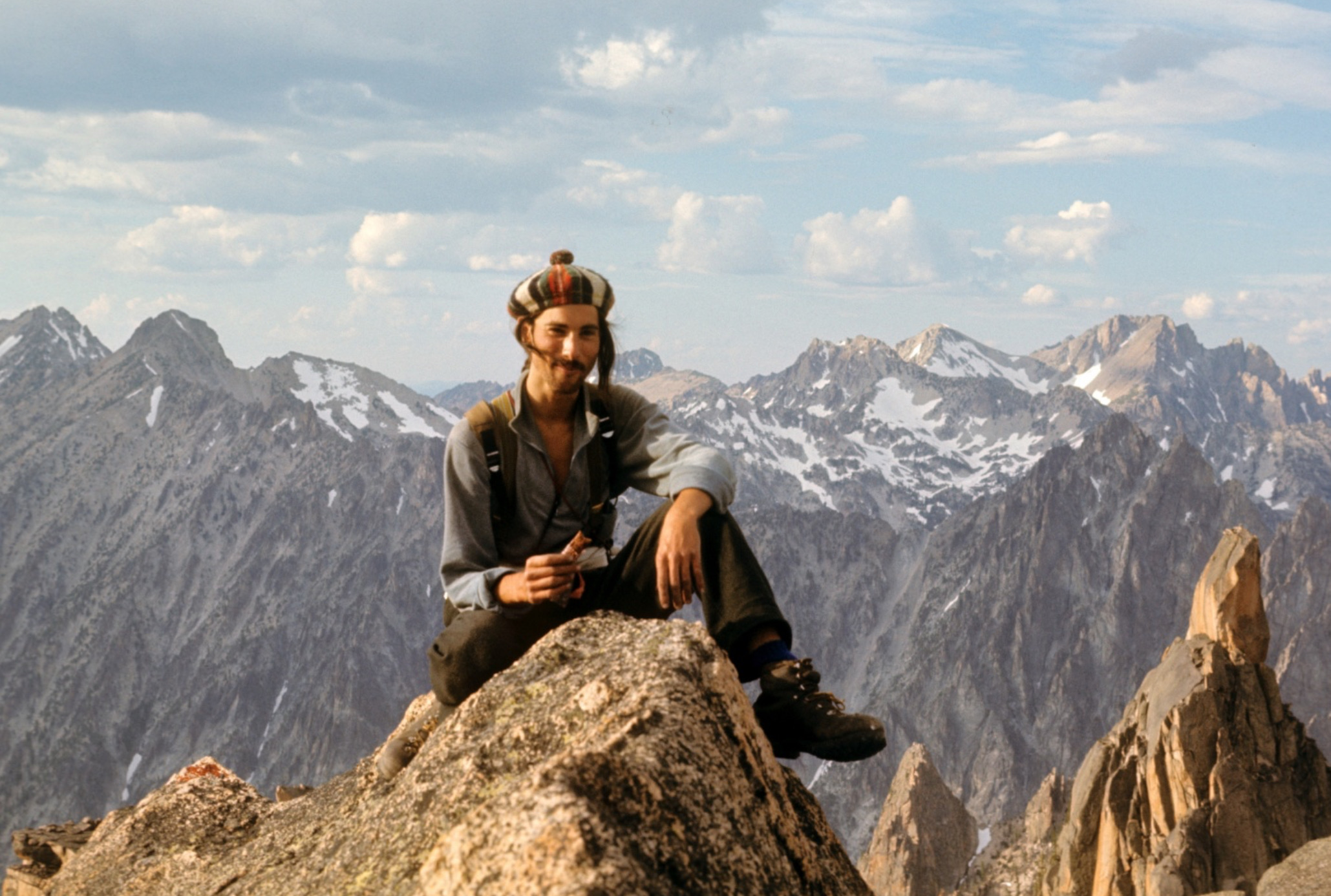
    Harry Bowron on top of Fishhook Spire, (now El Pima) 3rd ascent 1971.    Lower right side of picture shows the summit block of Big Barron Spire. Ray Brooks Photo
    Harry Bowron on top of Fishhook Spire (El Pima) on the 3rd ascent (1971). The lower right side of the photo shows the summit block of Big Baron Spire. Ray Brooks Photo

    Fred, Pete and Jack still had lots of time left in the day and decided to reconnoiter a route on Big Baron Spire. “We had no illusions about climbing it that day, but wanted to go as high as possible and find out what to expect.”
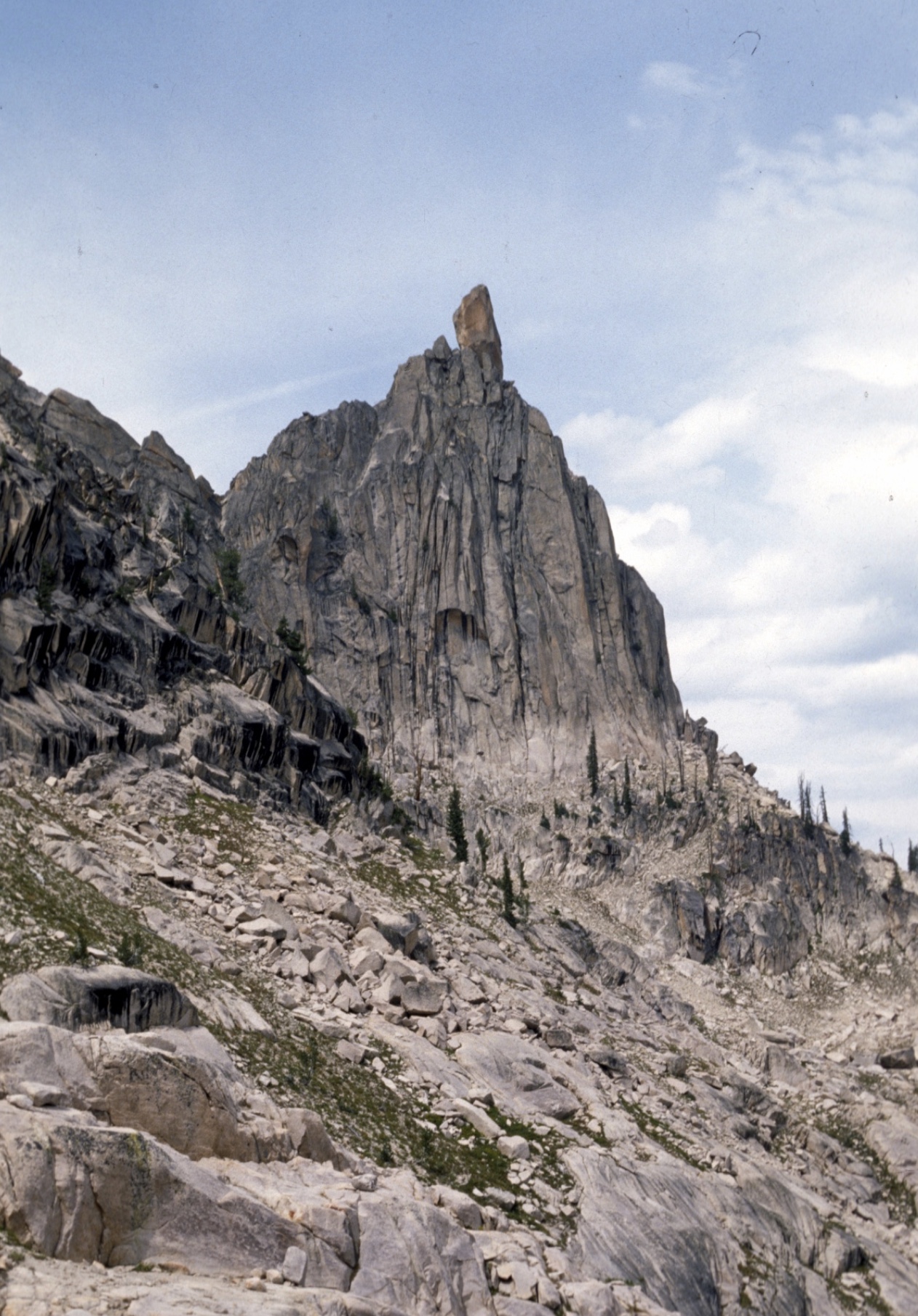
    Southeast side of Big Baron Spire. Becky route traverses to just below the notch from cliffs on left of photo, then stays near ridgeline to the summit block. Ray Brooks Photo
    The Southeast Side of Big Baron Spire. The Beckey Route traverses to just below the notch from cliffs on the left of the photo, then stays near the ridgeline to the summit block. Ray Brooks Photo

    Every approach looked difficult, but they found some surprising lines of weakness that took them to the notch below the final ridge without roping up. Even above the notch, out on the West Face, they were able to scramble still higher before finally wanting ropes for safety. They then had some difficult climbing to the bottom of the 110 feet-high summit monolith.

    “We found ourselves perched on the North Shoulder of the peak with smooth walls plunging away beneath us on 3 sides and the summit soaring directly above, some 110 feet away. As we looked up at the great block, we could understand why the Iowa Mountaineers had dubbed it ‘Old Smoothy.’  It was a magnificent piece of rock, resembling nothing so much as a monster egg standing on its end atop the rest of the mountain. It overhung all the way around and, search as we might, we could not find a single crack or hold anywhere. Reluctantly, we hauled out our drills and bolts and prepared to do battle.”

    The crack-less 110 Ft. high summit block of Big Baron Spire. The 1949 bolt ladder goes up it, near the left skyline. Ray Brooks Photo
    The crackless 110-foot summit block of Big Baron Spire. The 1949 bolt ladder goes up it, near the left skyline. Ray Brooks Photo

    “We decided to climb alongside the Northwest Corner, since that offered only 25 feet of overhang, followed by 35 feet of 75-degree slab, to a ridge where we hoped to find a hold or two. Pete mounted our shoulders to drill the first hole—-hurrying, because black clouds were rolling in from the southwest. Taking turns at drilling, we managed to place 7 bolts up the overhang and just get over onto the great slab before the rocks started buzzing with static electricity and an ominous rumbling informed us the storm was at hand.”

    “We huddled under an overhang for more than an hour while lighting crackled about us and hail danced off the rocks.  By the time the rock had dried enough to let us climb safely again, it was nearly dark. Leaving the hardware and one rope in place, we descended to camp, resolved to start early in the morning.”

    Day Two of the climb on Big Baron Spire was long and exciting, and nearly resulted in the deaths of the climbers.

    “As soon as it was light enough to see, we were pushing up the lower slopes again. The preliminary Class 3 and Class 4 rock climbing went rapidly and we found ourselves huddled on the shoulder once again while the sun was still near the horizon. Although it was bitterly cold, the weather was beautiful and we had high hopes of standing on the summit before sunset.”

    “The drilling took much longer now, as the drills were getting duller and duller with each hole.  We took turns at this unpleasant chore. Each man would place 2-3 bolts while the second man belayed and the third sharpened the extra drills.  Late in the morning, I placed the 14th bolt just under the crest of the ridge, then dropped on tension to the shoulder. Fred replaced me on the rope and was hauled up to the highest bolt. By working up the sling and using his hands for balance, he succeeded in standing on the bolt and hauling himself astride the steeply-pitched ridge. Fifteen feet away was a tilted depression where, it seemed, a man might stand. This ‘bowl’ was the closest thing to a belay point on the whole summit block. Fred wormed over to it and put in a bolt for an anchor. He peered upward and saw that the arête above steepened again almost to the vertical. There appeared to be an occasional hold, but it still looked like a bolt job all the way.“

    With the summit only 40 feet away, Fred had to rappel off the summit block when a new storm appeared.

    “We held a council of war and determined to wait and try to finish the climb when the storm blew over. Hours passed by, while hail and freezing rain soaked us to the skin and lightning flashed in the murky sky. Finally we could see that it was getting dark and we decided to make a run for camp while we still could.  We skidded around the slabby corner and raced down the ledge toward the wall above the finger traverse.”

    “The rock was running with water, and every hold was packed with hail as we climbed down the wall. Pete started across the traverse just as the storm picked up in intensity. Lightning struck within 200 feet of us 3 times in quick succession. Pete reared back, blinded by the flashes, and it was several minutes before he could go on.”

    “As the storm increased in fury, we all wondered whether we were to get down alive. The ’V’ crack was a terrible thing with water sluicing down its twisting length and lightning knifing all around. Fred and I took tension from the rope, while Pete half climbed, half fell as best he could. The remaining pitches were easier, but the lightning was still striking terrifyingly close.”

    Back in camp, the beat-up climbers watched the storm clear and wondered if they were ever going to climb Big Baron Spire. The next morning, Pete had a wrenched shoulder and Dick a very sore ankle. Of course, they went back up on the mountain. This time both Fred and Pete climbed up to the top of the bolt ladder and Pete started to the top.
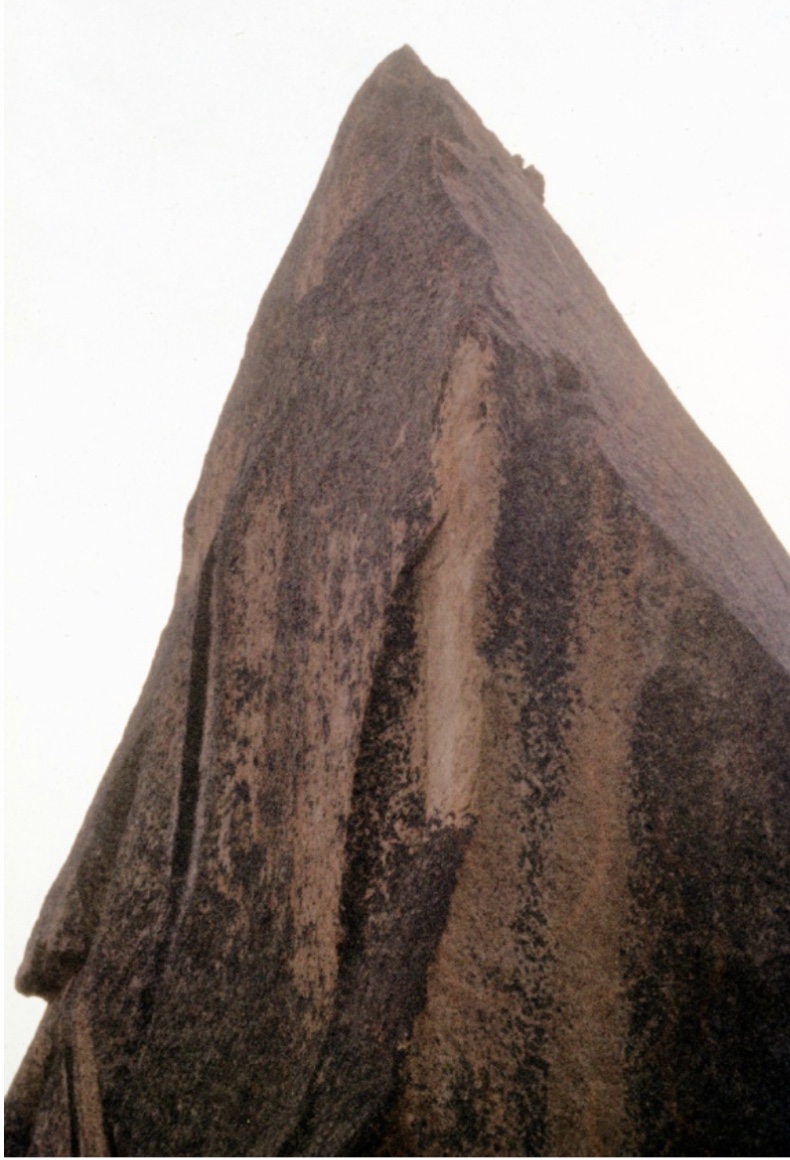
    The top of the summit block. The bolt route goes up the right skyline. Ray Brooks Photo
    The top of the summit block. The bolt route goes up the right skyline. Ray Brooks Photo

    After a shoulder stand and four more bolts: “Pete was clinging to a tiny projection only 15 feet from the top. Things were looking up.”

    Pete climbed free to the summit and clasped his hands in the victory sign. A total of 20 bolts had been placed. The climbers were so wary of another approaching lightning storm, that Jack didn’t follow Pete and Fred to the summit. However, they had no more storms that day and were able to go back over to their base camp at Alpine Lake.

    In the 1970s, I climbed Big Baron Spire 3 times by two different routes that Harry Bowron and I pioneered. When we first arrived at the bottom of the bolt ladder in 1971: what we saw was a long line of rusted and bent ¼” diameter bolts without hangers. The bolts looked horrible, some appeared to be missing, and we did not have the gear to climb the dilapidated bolt ladder. On a 1977 ascent, we brought bolt hangers and bolting gear, but were thwarted by a thunderstorm that forced us back off the mountain.

    Since I was last at the summit block in 1977, some Good Samaritan had put hangers on the old ¼” bolts and replace those that were missing when we were there. In 2009, I shared emails with Radek Chalupa, who climbed the bolt ladder in late Summer 2009. From his account, it appears that at least some of the missing or unusable bolts have been replaced, but the classic Fred Beckey drill bit remains.
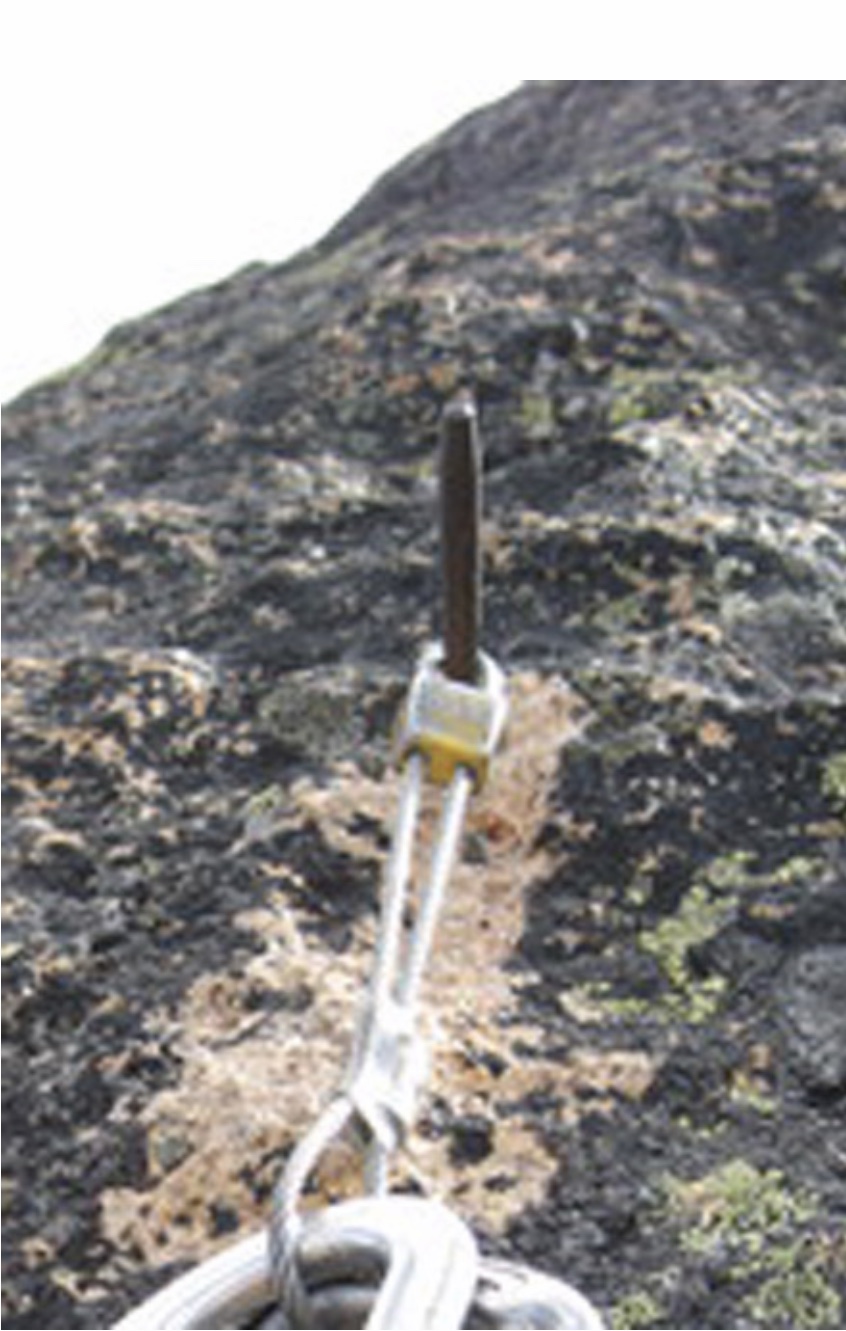
    Fred Becky’s drill-bit/critical aid placement, with a modern wired stopper in place of a bolt hanger. Ray Brooks Photo
    Fred Beckey’s drill bit/critical aid placement, with a modern wired stopper in place of a bolt hanger. Radek Chalupa Photo

    During a rest day back at their Alpine Lake base camp, Fred and Pete made the decision to make the long off-trail hike west into the South Fork Payette drainage to the remote “Red Finger” (i.e., North Raker). Jack would stay at Alpine Lake, and rest his injured leg.

    Besides presenting an enticing profile, when viewed from afar, the attraction of North Raker was that climbing legend Robert Underhill had attempted it during the first of his two Summers of exploration and climbing in the Sawtooth Range in 1934-35. Underhill may have been the best male rock climber in North America at the time and his wife Miriam was certainly the best female climber, but they were not able to climb North Raker. No recorded attempts on its remote summit had been made since 1934. [Miriam Underhill, “Give Me The Hills,” 1956]
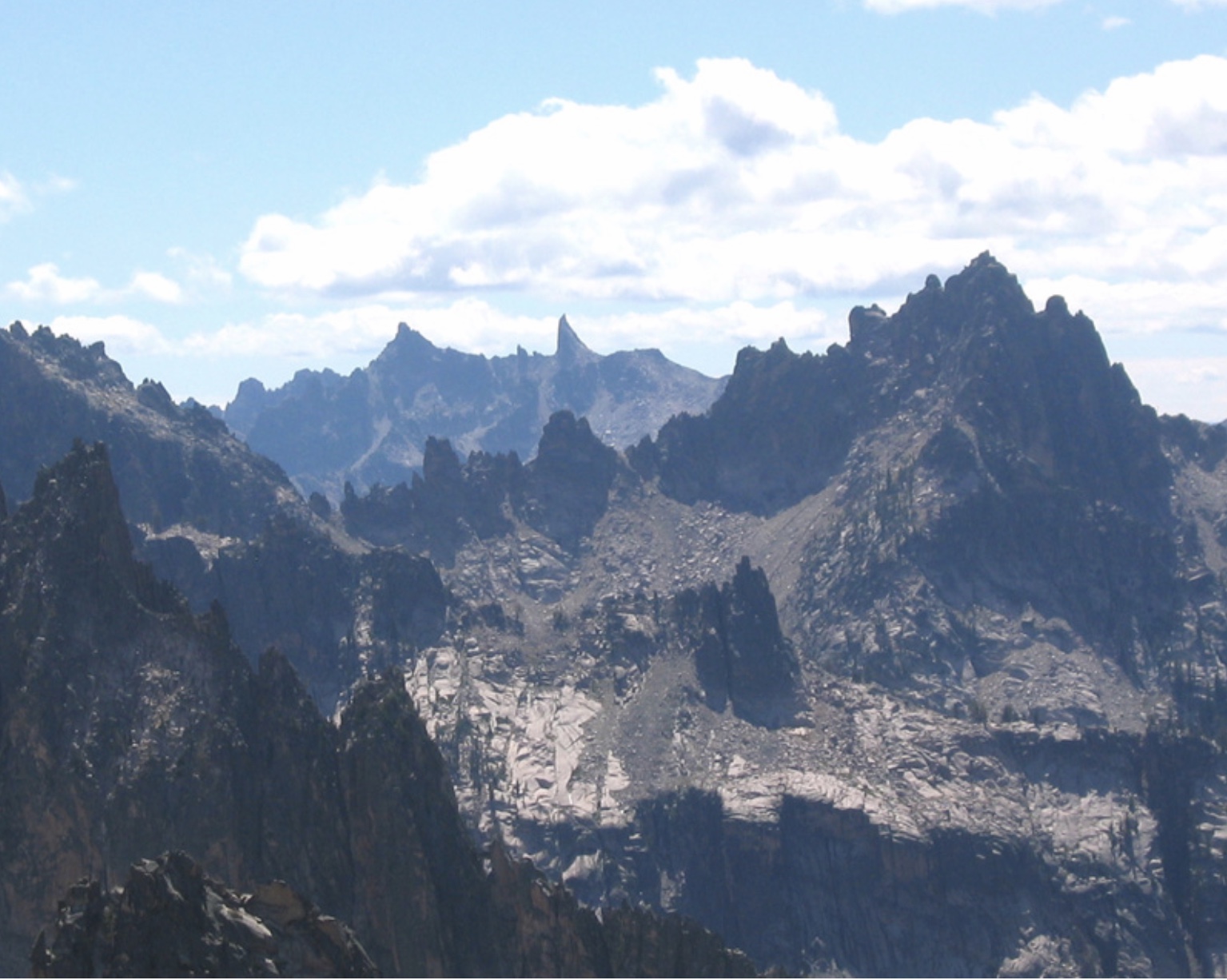
    The North Raker, at top center skyline, from high up in the Baron Creek drainage. Ray Brooks Photo
    North Raker (at top center skyline) as viewed from high up in the Baron Creek drainage. Ray Brooks Photo

    Fred and Pete worked south from Alpine Lake and traversed off-trail into the Upper Redfish Lakes Basin. They ignored nearby attractive summits and slogged up a 10,074-foot pile of rubble called Reward Peak. The summit of Reward, which sits on the divide between the Redfish Lake Creek drainage and the South Fork Payette drainage, gave them a good view of the approach to North Raker. From Reward Peak, they dropped 3,400 vertical feet to the South Fork Payette, forded it in hip-deep water and explored up Fall Creek on the South Side of The Rakers (there is also a South Raker that the Underhills did climb in 1934).

    I hiked with my wife Dorita and 2 fit young friends up the South Fork Payette in late August 2009 and, with some searching, discovered a large log spanning the river just above Elk Lake. Our group found the trail-less terrain leading up Fall Creek to be difficult, wet, loose and brushy. Fred and Pete likely thought it almost pleasant, when compared to their usual cold-jungle bushwhacking in the North Cascade Range.

    After camping a couple of miles up Fall Creek, the next morning Fred and Pete followed grassy open hillsides to a lake basin on the East Side of The Rakers. From there, North Raker looked rather difficult to them.
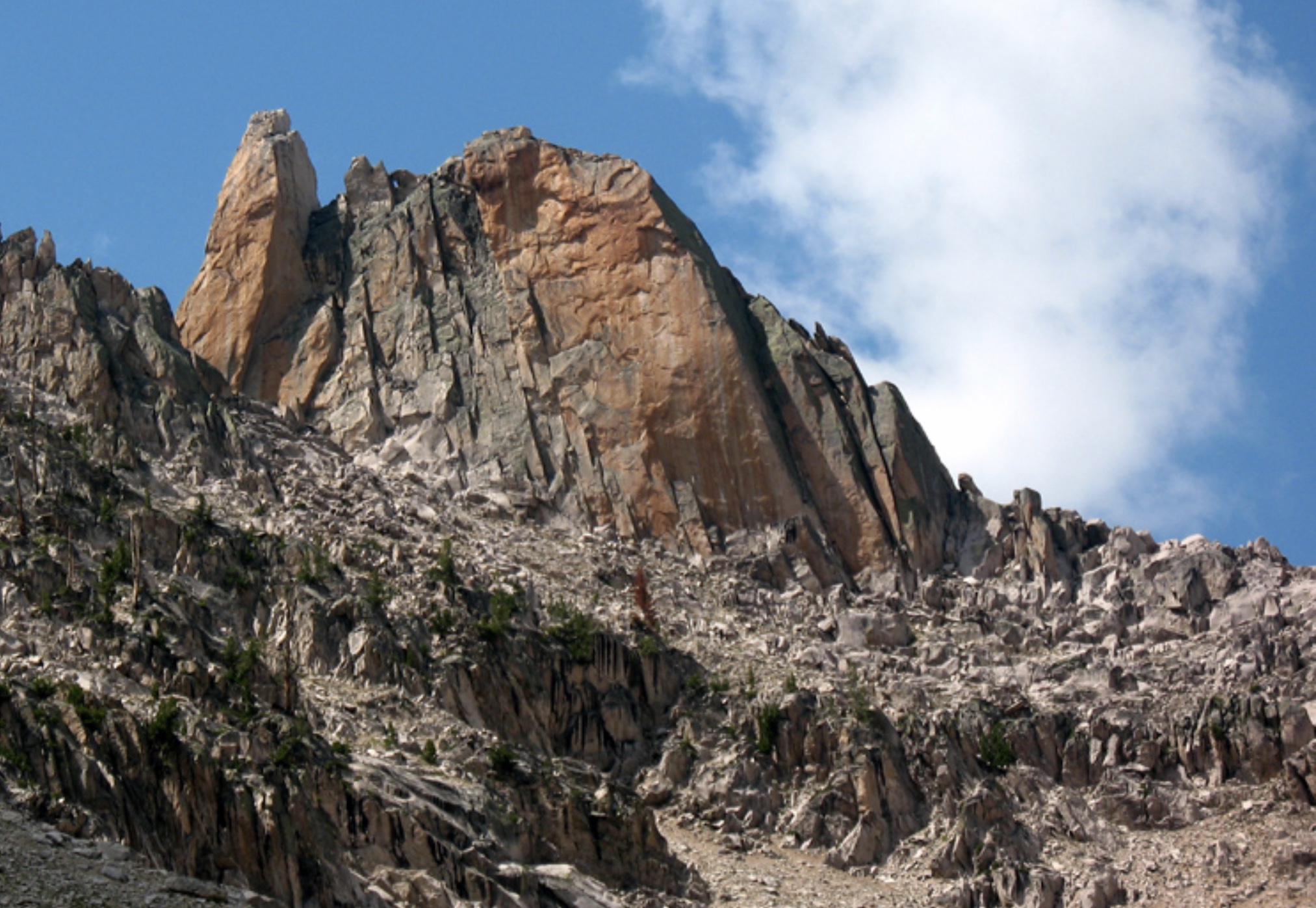
    The North Raker from the east, with the highest summit at left. Ray Brooks Photo
    North Raker as viewed from the east with the highest summit at left. Ray Brooks Photo

    They hiked up to the saddle to the right/north of North Raker and then discovered that its West Face was more welcoming to climbers. Without roping-up, they were able to scramble to the cairn that marked the high point of Robert Underhill’s 1934 attempt. From this point, it was less than 100 feet to the top of the summit tower, but the route looked hopeless from all sides.
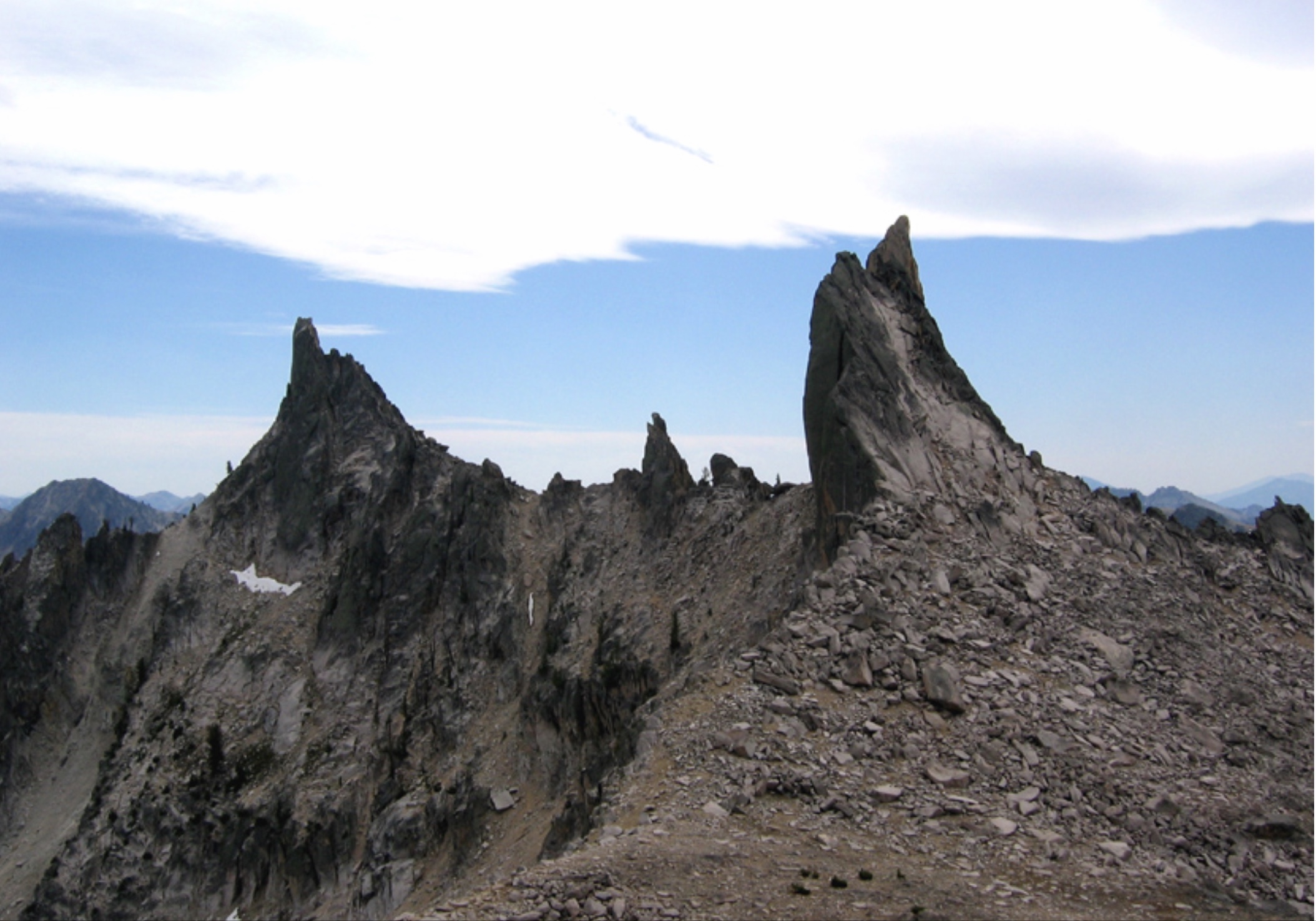
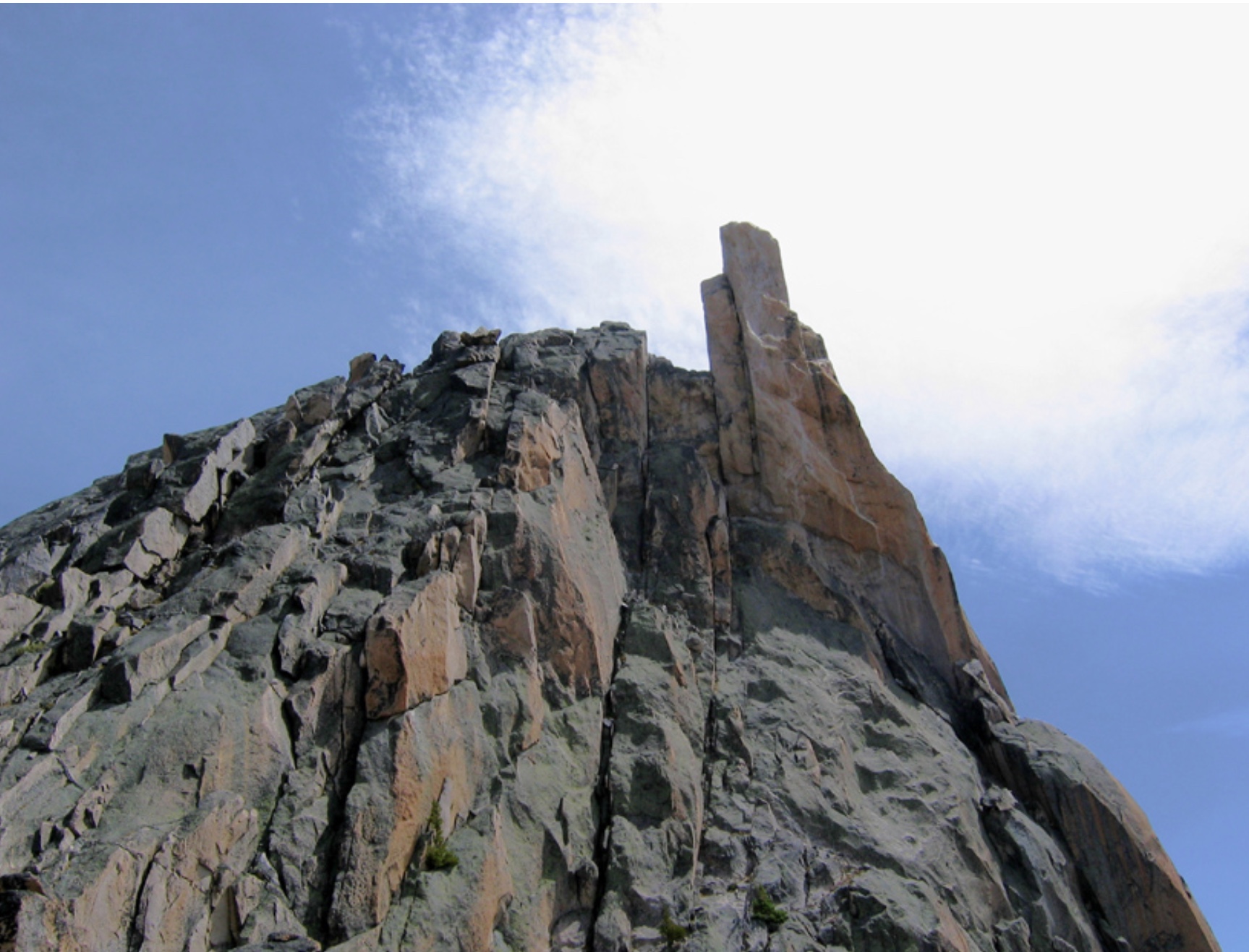
    South Raker at left, North Raker at right. Ray Brooks Photo
    South Raker (left) and North Raker (right). Ray Brooks Photo
    The final summit problem on the North Raker, at top-right. Fred & Pete climbed the overhanging side that faces the camera. Ray Brooks Photo
    The final summit problem on North Raker at top-right. Fred and Pete climbed the overhanging side that faces the camera. Ray Brooks Photo

    “A rope-length traverse was made over considerable exposure to the notch on the North Corner of the peak. Fred anchored to a piton and the climb began.” “Pete traversed right about 15 feet and reached an overhanging crack that appeared to lead somewhere.The crack was composed of a crumbling granitic rubble which took several direct-aid pitons in one place at one time to be even reasonably safe.“

    “Fifteen feet of this, over a space of an hour, convinced Pete that he wanted a rest. Accordingly, he lowered himself back to the notch and Fred took over. He hammered in a giant angle piton behind a loose chockstone, hoping it would act as a wedge and tighten everything up.

    Above this, the crack being absolutely smooth and rather useless for a way, Fred drilled a hole and drove in a solid-sounding bolt. This had a decidedly reassuring effect on his jangled nerves, since the drop was still 500 feet and the quality of the pitons below him was such that any kind of fall would have made them all pop out like buttons from a shirt.”

    Pete took over again and managed to place two pitons and a bolt (their drill was so dull, it was nearly useless) before switching with Fred. Fred placed another piton and another bolt and could see the end of the overhanging section just above. After another trade, Pete was able to climb a 3” wide jam-crack to a ledge. Then with the help of a shoulder stand, Fred jam-cracked another 12 feet to the summit.

    They enjoyed the tiny summit for a few minutes, Pete claimed a lone-eagle feather and then started down. By nightfall, they were back across the South Fork Payette and had climbed to within only 1,100 vertical feet of the pass into Redfish Lake Creek.
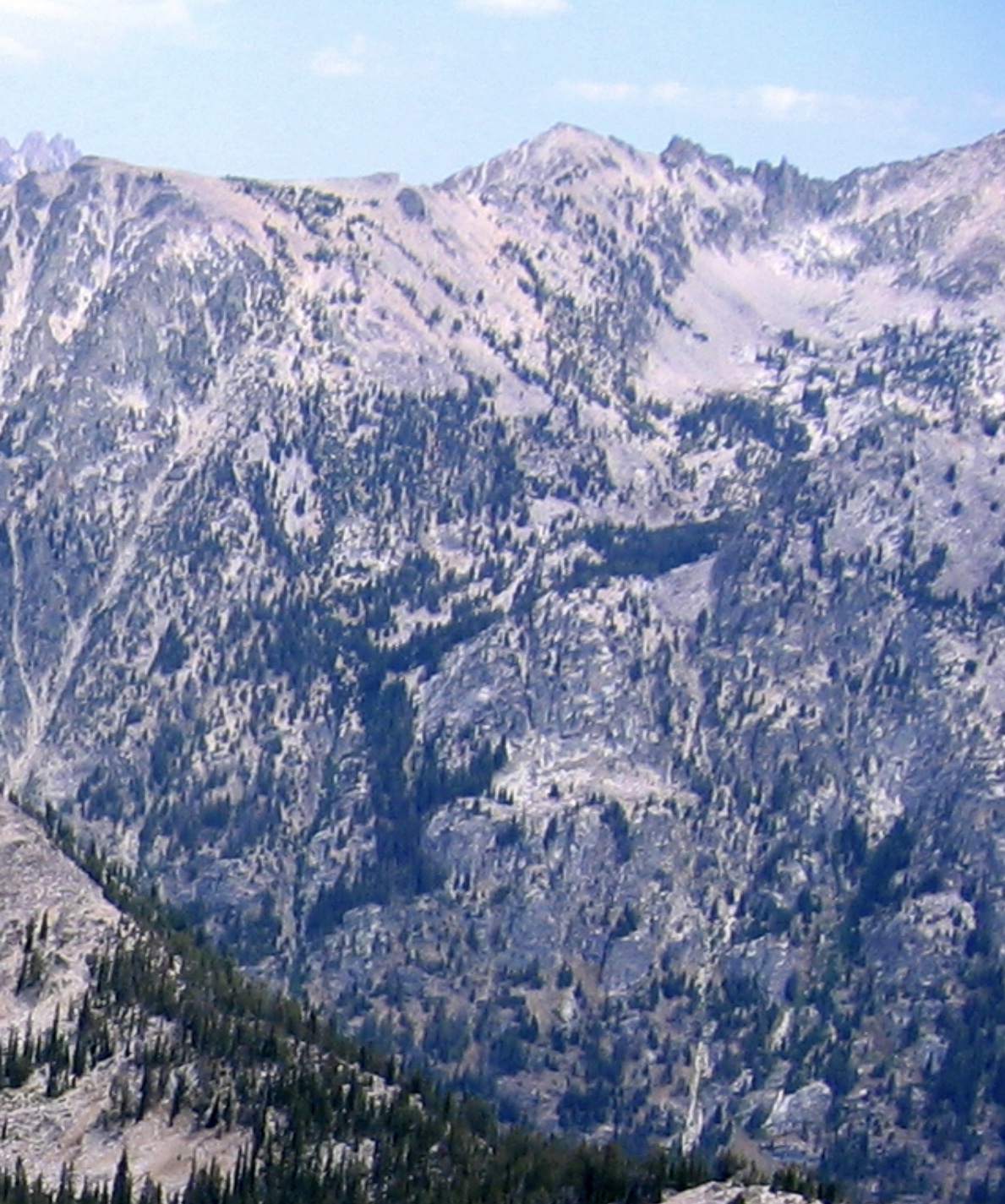
    Reward Peak at top center, from near the North Raker.   Fred & Pete went 3,400 vertical feet up and down the appropriately named Drop Creek drainage, below Reward Peak. Ray Brooks Photo
    Reward Peak (at top center) as viewed from near North Raker. Fred and Pete went 3,400 vertical feet up and down the appropriately named Drop Creek drainage below Reward Peak. Ray Brooks Photo

    The next day, they returned to camp at Alpine Lake after making the 3rd ascent of Packrat Peak 10,240 Feet. They loosely followed the route Robert Underhill used to make the 1st ascent of Packrat with his wife Miriam and local packer Dave Williams in 1934. Fred and Pete had a pleasant Class 3-4 scramble on the complex but forgiving East Face.

    Harry Bowron & Dave Thomas, just before we climbed Packrat in 1972.  The East Face route, is to the left in this photo.  We stayed more on the prominent rib at left center. Ray Brooks Photo
    Harry Bowron and Dave Thomas just before we climbed Packrat in 1972. The East Face Route is to the left in this photo. We stayed more on the prominent rib at left center. Ray Brooks Photo

    When they arrived at Alpine Lake in the late afternoon, they found a note from Jack that he had departed for the social life at Redfish Lake. Fred and Pete packed up the remaining gear and trudged back down the trail to the upper end of Redfish Lake and camped, since they planned to climb the nearby Grand Aiguille the next day. Jack picks the story back up at this point.

    “As a gesture of friendship, Fred decided to hike around the lake (5 miles with quite a bit of elevation gain and loss) to the lodge to tell me of their plans in case I could go with them. He arrived just in time to join me at a beach party I was having with a couple of heartening samples of the unattached females who infested the place.  I reluctantly informed him that I would not be able to climb in the morning, but that I would be glad to row him back to save him the 5-mile walk. Thus 4:30AM found us sleepily stroking a rowboat up the lake. Unearthly yodels as we rounded the point informed us that Pete was up and had breakfast ready. An hour later, they started off while I hitched a ride back on the ever-present tourist launch.”

    The Grand Aiguille is a prominent formation above the South End of Redfish Lake. Its first ascent in 1946 is rated Class 5.4 and apparently the rock tower was of interest to Fred and Pete. It is described in Tom Lopez’s fine book “Idaho: A Climbing Guide,” but that area of the Sawtooth Range has a reputation for “ball-bearing” granite and I had never trudged up to the small cirque it is in until early September 2011.
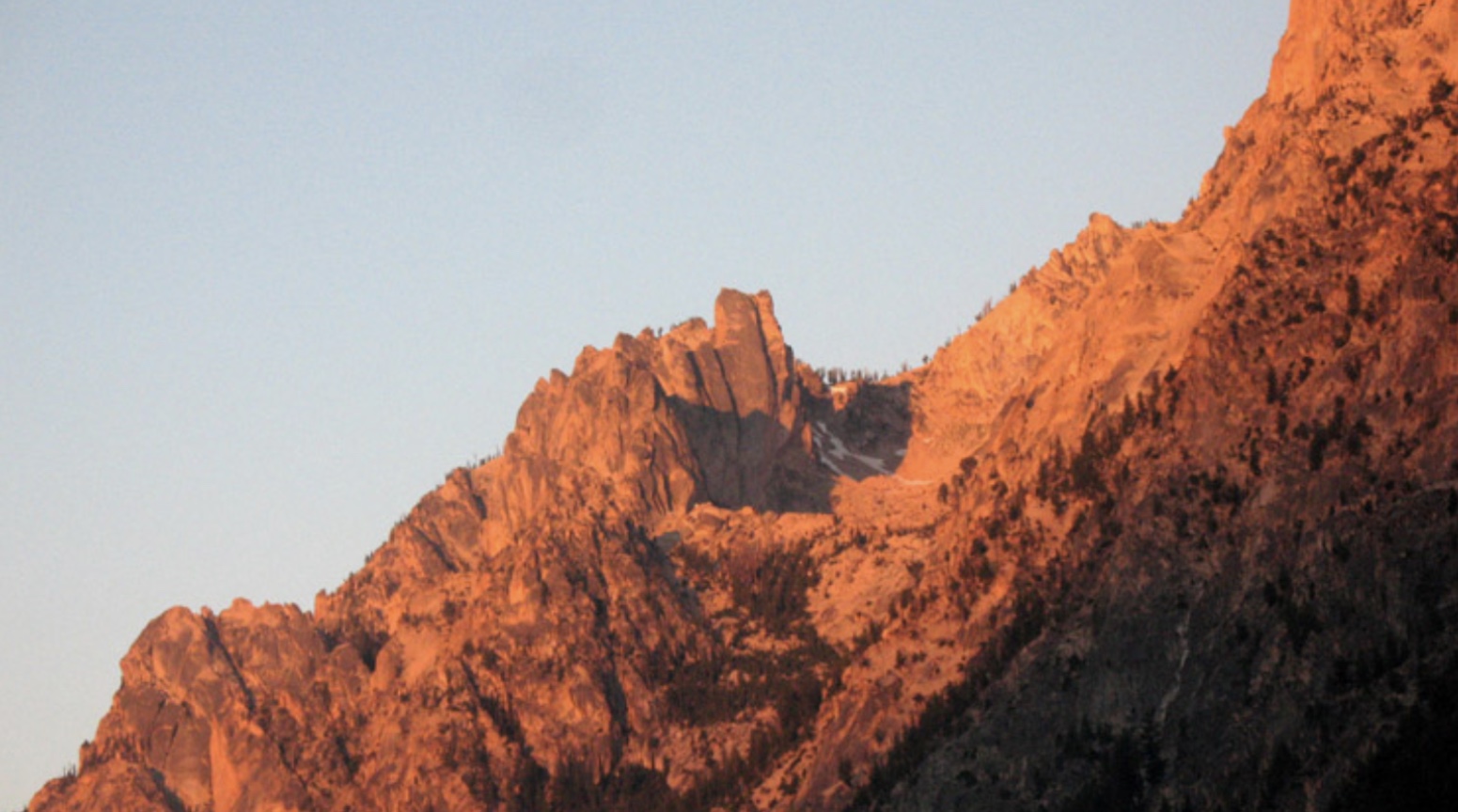
    Early-morning alpenglow on the Grand Aiguille, at center of photo. Ray Brooks Photo
    Early-morning alpenglow on the Grand Aiguille (center). Ray Brooks Photo

    It is several miles and about 3,000 vertical feet from Redfish Lake to the top of the Grand Aiguille. Fred and Pete knocked the 2nd ascent off and were back at Redfish Lake Lodge shortly after noon.

    “They reported a spectacular Class 4 and Class 5 climb on good rock, the crux of which was a vertical crack jammed with overhanging chockstones.”

    After hiking up to the route with Dorita, equipped with a 9mm rope and minimal technical climbing gear, I suffered a reality check when looking for possible easy routes. I can only commend Fred and Pete for their fortitude and speed on the Grand Aiguille. It looked like more of a challenge than I wanted at the time.

    The North-east side of the Grand Aiguille.   The route goes up the snowy gully to the ridge, then apparently follows the ridge, until it goes out of sight to the right. Ray Brooks Photo
    The Northeast Side of the Grand Aiguille. The route goes up the snowy gully to the ridge then apparently follows the ridge until it goes out of sight to the right. Ray Brooks Photo
  • Idaho Mountaineering 1939

    Idaho Mountaineering 1939

    This July 23, 1939 article briefly surveys Idaho Mountaineering at the time. Unfortunately, the climbers shown in the photographs are not identified. Nevertheless, the article demonstrates that Idaho climbers were actively “getting after it” 80 years ago.
  • The Missing Link: Norman Clyde in Idaho

    The Missing Link: Norman Clyde in Idaho

    Idaho is a virtual sea of mountains. While there is no doubt that Native Americans rambled across the state’s mountain summits and that explorers, trappers, miners, ranchers, surveyors and locals were climbing Idaho’s mountains from the time Lewis and Clark first passed through the state, there are few recorded accounts of these early ascents.

    When I wrote Idaho: A Climbing Guide, I noted at the time the second edition was published that “The following [Climbing History] is a thumbnail sketch of Idaho’s mountaineering history, filled with unfortunate, but unavoidable gaps.” In the intervening years, I have searched for additional accounts of Idaho climbers to fill in the gaps. I recently came across a couple of 92-year-old Idaho Statesman articles that answered one of my unanswered questions about the Sawtooth Range.

    The birth of modern Idaho Sawtooth mountaineering has historically been credited to Robert and Miriam Underhill. Robert, a Harvard philosophy professor and an Appalachian Mountain Club member, was a cutting edge American mountaineer in the 1920s and 1930s. Miriam was the top American female climber of her time. They climbed in the Sawtooths in 1934 and 1935 and then published articles in the Appalachian Mountain Club’s journal, Appalachia, in 1934 and 1935. No doubt, these articles awakened the wider climbing community to the Sawtooth’s impressive granite peaks but who told the Underhills about the Sawtooths?

    The Idaho Department of Commerce publicized the scenic beauty of the Sawtooths as early as 1910. However, it is unlikely that the Underhills read about Sawtooth climbing opportunities in an Idaho Department of Commerce brochure or in Idaho Statesman articles, like the the 1927 article “Crown of the Sawtooths” by Bob “Two Gun” Limbert.

    It turns out that the link between the Underhills and Idaho was Norman Clyde. Norman Clyde (1885-1972) was unquestionably one of the most prolific Sierra Nevada explorers and climbers. He is credited with more than 130 first ascents in the Sierra, has a peak, a minaret and many routes named after him. Less well known are Clyde’s climbing adventures in Montana, Wyoming and Idaho. Yes, Idaho. Although a very obscure fact, in 1927, Clyde climbed in both the Sawtooth Range and the White Clouds.

    Clyde was also a prolific writer. The Bancroft Library at the University of California maintains Clyde’s papers which includes an archive of 1,467 articles. Three of these articles cover Clyde’s visit to Idaho in 1927: An Ascent of Castle Peak; Up and Down Castle Peak; and A Glimpse of the Sawtooth Mountains of Central Idaho. Two of these articles, An Ascent of Castle Peak and A Glimpse of the Sawtooth Mountains of Central Idaho (albeit with a slightly altered form) were published in the Idaho Statesman in 1929.

    Clyde’s visit to Idaho was first noted in a September 10, 1927 news clip in the Idaho Statesman:

    CLIMBS SAWTOOTH PEAKS

    HAILEY — Norman Clyde, who makes a specialty of guiding parties on mountain climbs, is in the Sawtooth country looking for new territory and has finished climbing a number of the major Sawtooth peaks, including some of the White Cloud peaks and Castle Peak. He reports that Castle Peak is not so hard to climb as the Grand Teton, where he conducted a party last year, but is a mountain that will appeal to mountain climbers. Mr. Clyde’s home is at Independence, California.”

    The first Clyde article published by the Statesman was a shortened version of his  longer, unpublished  article, A Glimpse of the Sawtooth Mountains of Central Idaho. The Statesman article was entitled A Southerner’s Glimpse of the Sawtooth Mountains. It appeared on June 2, 1929. This article recounted his ascent of Decker Peak and described the rugged crest.

    Arriving at the crest of the ridge, I came upon a trail leading toward the summit of the range. This I followed until it terminated near timber line. To the southwest, beyond rocky cirques, the summit of Mount Decker came into view. Here it was necessary to drop down several hundred feet in order to avoid an impassable crag.”

    Despite suffering from a violent toothache, Clyde pressed on. He recounted:

    As I advanced, more and more of the rugged crest of the range came into view. After surmounting several craggy and glaciated pitches, I reached a talus slope just below the summit. Seized with the elan that fills me when nearing the summit of a mountain, I soon traversed this and scrambled up to the crest of a narrow arete which I followed to the highest point of the peak.”

    Clyde then described the view in terms that make climbers grab their packs and head for the mountains:

    The panorama that lay outspread around me was thrilling. For a score of miles in either direction extended the crest of the Sawtooths—a maze of craggy peaks, deep cirques, narrow ridges and pinnacled knife-edges. Azure lakes lay ensconced in verdant timbered bowls of the lower basins while others lurked in rocky cirques, tinged with a shade of turquoise; one with an indescribable amethystine hue. Masses of snow clung here and there to precipitous slopes, while several remnants of almost vanished glaciers appeared in sheltered depressions. Fleecy clouds floated slowly past, crossed the Sawtooth Valley and gathered about Castle peak and the White Cloud peaks. In every direction, range after range extended to the horizon. To the north, the broken crest of the Sawtooths continued for a considerable distance. To the southeast, undulating lines varied by several precipitous mountains faded away in the distance. To the east, beyond the Sawtooths were the high masses of the Boulder and Hyndman groups .”

    The second of Clyde’s three Idaho articles, An Ascent of Castle Peak, was published in the Idaho Statesman on June 9, 1929. His article doesn’t mention if he found evidence of a previous ascent but does constitute the earliest description of a climb of the White Cloud Peaks giant.

    Clyde made his base camp for his Idaho explorations at the F.W Shaw Ranch near Obsidian. He undoubtedly learned about the lay of the land from his hosts. Following, this advice, he approached Castle Peak via Fourth of July Creek. He climbed an unnamed peak along the way, probably the still unnamed Peak 10405, and then made his way of into Chamberlain Basin and the lake below Castle Peak’s South Face. The next day he climbed up the face, writing:

    Leaving camp early on the following morning, I was soon trudging up the steep slope that rises to the east of the lake to an elevation of about 1,500 feet above it. As I surmounted it, I came into full view of Castle Peak, towering above a lake-studded basin a few hundred feet below me. A number of steep chutes seemed to rise almost vertically toward its summit, which appeared to consist of a series of pinnacles of almost equal height. One chimney, just to the left of the summit almost reached it but, as the apparently perpendicular wall above it appeared to possess few holds, I decided to go to the east and ascend its Southwest Shoulder or attempt to find a way up–another.”

    His account into the unknown continued:

    “. . . Crossing above one of them, I made my way up a a broad stretch of talus and then up a chute, broad and gently sloping at first, but soon narrow and steep. After reaching its head by a somewhat difficult scramble, I crossed one narrow arete to another and went toward what appeared to be the summit, but upon reaching it I found it to be only a point on a jagged knife-edge, with another higher one to the east, beyond a deep gash in the arete. Dropping down several hundred feet, I quickly climbed to the top of it. Probably the highest point on the mountain, but several pinnacles of almost equal or possibly greater height were seen to the east. . . .”

    Thus, Clyde was confronted with the same question that still confounds climbers 92 years later: which point on Castle Peak’s ragged summit ridge is the true summit? He continued:

    To make certain of not missing the highest point of the mountain, I proceeded to climb the other pinnacles. As I worked my way along the cliff, surmounting one after another of them, I found interesting but not very hazardous climbing, except possibly in one instance where I carelessly stepped on a loose mass of rock that suddenly gave way. Fortunately I had a good handhold, and after hanging in partial suspension for a few moments I was able to proceed along a narrow shelf. Eventually I came to the last of the higher pinnacles.”

    No doubt the Idaho Statesman’s publishing of Clyde’s articles and similar articles gave local climbers further reason to explore the Idaho mountains.  How did Clyde inspire the Underhills to travel form their home at Harvard to Idaho?

    Clyde was a member of the Sierra Club. In 1931, Sierra Club officer Francis Farquhar invited Robert Underhill to the Sierra Nevada to teach the latest techniques of roped climbing to Sierra Club members. Clyde was part of this group. Given Underhill’s drive to explore mountains world wide, there can be no doubt that he and Clyde exchanged climbing stories over a campfire.

    The link between Clyde and the Underhills led to the opening of the Sawtooth Range to a cosmopolitan, out of state, array of climbers including Fred Beckey, Luis Stur, Gordon Webster, Steve Roper, Bill March, Jeff Lowe and the Iowa Mountaineers. Idaho climbers followed these climbers and established themselves in the Pantheon of Sawtooth Climbers. Lyman Dye started the first Sawtooth climbing guide service and he was later followed by Kirk Bachman who established Sawtooth Mountain Guides. Reid Dawdle, Ray Brooks, Dave Bingham, Kevin Swigert, Jeff and Kelly Rhoads and many others redefined and refined the Sawtooth climbing ethic which started with Norman Clyde’s 1927 visit.


    Read more about Norman Clyde in Wikipedia and in the Adventure Journal.

  • The First Winter Ascent of Mount Heyburn

    The First Winter Ascent of Mount Heyburn

    The first Winter ascent of Mount Heyburn was made by Gordon Williams, Mark Sheehan, Jacques Bordeleau, Chris Puchner and Joe Saviers on December 30, 1974. They climbed the peak from the fifth Bench Lake via the Northwest Ridge. Mark Sheehan recalls: “It was a real slog, breaking trail though waist deep powder on a 45 degree slope. Once we got onto the rock it was one pitch of 5.5 climbing.” [Use this link to see Jacques’ photos from the groups first Winter attempt: Mount Heyburn Attempt]

    The ascent crew after the first ascent. Left to right: Mark Sheehan, Joe Saviers, Gordon Williams and Chris Puchner. Photo Courtesy of Jacques Bordeleau
    The ascent crew after the first ascent. Left to right: Mark Sheehan, Joe Saviers, Gordon Williams and Chris Puchner. Photo courtesy of Jacques Bordeleau.

    John Miller was the sixth member of the expedition but he did not summit. Jacques Bordeleau remembered “All but one guy summitted in 1975. Milner sat in his tent whining about his cold toes all day and I haven’t seen him since. It was 2 degrees on the summit but the sun felt good once we had climbed up into it.”

    This is the Wilderness Permit issued to the climbers. Note the signature is David O. Lee, the long time backcountry ranger for the Sawtooths. A White Cloud Peak is named after him.
    This is the Wilderness Permit issued to the climbers. Note the signature is David O. Lee, the long time backcountry ranger for the Sawtooths. A White Cloud peak is named after him.
    Mount Heyburn covered in deep snow at the time of the climb. Mark Sheehan Photo
    Mount Heyburn covered in deep snow at the time of the climb. Mark Sheehan Photo


  • The Decker Flat Climbing & Frisbee Club By Ray Brooks

    The Decker Flat Climbing & Frisbee Club By Ray Brooks

    I guess we were the Decker Flat Climbing & Frisbee Club (DFC&FC) before anyone, including us, knew. The little guy in the back of my mind liked the way the words fit together. Until the name popped into my head we were simply a group of like-minded climbers who lacked an identifying name. However, on a fateful morning in the mountains of Idaho, adversity transformed us from a nameless, ragged band of climbers into an organization that would accomplish endless deeds of climbing derring-do.

    The fateful day was a hot one in late July 1970. We were hiking into Mount Regan above Sawtooth Lake. Our packs were heavy, each with 60-70 pounds of climbing and camping gear. In addition to the heat, it was a humid and windless morning. We were sweating hard and were being chased mercilessly by a full-strength squadron of horseflies.  

    Flies dive-bombed us incessantly, trying to break through the curtain of insect repellent we had drenched ourselves with. They grew in numbers, until it was difficult to see the sun through the voracious fly swarm above our heads. Frenzied buzzing horseflies became noisily trapped in our long hair and select kamikaze flies would creep between our sweaty fingers to inflict amazingly painful bites.

    It was starting to look like we might become the first known case of climbers eaten by flies when suddenly all the horseflies dipped their wings, did a double roll and turned tail. They flew off down-canyon–a roaring cloud of instant misery. The reason for their retreat stood by the trail snarling evilly, shovel in hand. Even horseflies don’t mess with SMOKEY THE BEAR!!  Of course, a sudden breeze might have helped too.

    We had arrived at the Wilderness Boundary! There beside the plywood Smokey was an 8-foot tall, solid redwood sign proclaiming:

    ENTERING SAWTOOTH WILDERNESS AREA
    CHALLIS NATIONAL FOREST
    PLEASE REGISTER FOR YOUR OWN
    PROTECTION!

    We had some fun filling out the overly-detailed registration form, but then none of us wanted to put our name on it as group leader. In a moment of inspiration, I exclaimed “Let’s call ourselves the Decker Flat Climbing & Frisbee Club” and, since I thought of it, I get to be manager.

    We had elections on the spot and Gordon chose to be Social Chairman, Harry Bowron, Treasurer, and Joe Fox, Member at Large. The next day we climbed Mount Regan (which was somewhat challenging) and had a great time. Our mountain fun was just starting. We never had scheduled meetings or dues but, in order to become a member, you had to go climbing with another member. Of course Gordon took his duties as Social Chairman seriously. He was soon adding females to our club. I must admit to being jealous of Gordon’s social skills in the 1970s and 1980s. His girlfriends were always attractive, assertive and intelligent. Gordon was a “babe-magnet” of the first magnitude. Thus, he was the perfect Social Chairman.

    The rest is history, and we did climb Mount Regan the next day.

    Gordon Williams on a Tyrolian Traverse near the summit of Mt. Reagan. Note the vintage Goldline rope.
    Gordon Williams on a Tyrolean Traverse near the summit of Mount Regan. Note the vintage Goldline rope.

    After our spur of the moment start in July 1970, we never had regularly scheduled meetings, but we enjoyed a 4th of July group outing in the Pioneer Range and another outing in 1971, with about 20 friends attending. For the most part, DFC&FC members climbed together in small groups.

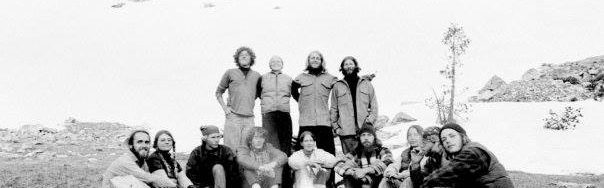
    A Gordon Williams photo of most of the 1970 party group. I’m at the left of the front row.
    A Gordon Williams photo of most of the 1970 party group. I’m at the left in the front row.

    In the early 1970s, Idaho mountaineering was a different world than now. It was a world without good USGS maps, climbing guidebooks, cell phones, GPS devices, an internet to access for climbing information and satellite rescue beacons. Thus, we suffered considerable obstacles to safe and sane mountaineering, but let me assure you, rock climbing and mountaineering in Idaho was a helluva lot more adventurous and a lot more fun then than it is now. Amazingly, although some of our climbing students suffered long scary slides on steep snow slopes, there are no serious climbing injuries or deaths in the history of the DFC&FC.

    In keeping with the local ethics of Sawtooth climbing which sought to keep the Sawtooth Range unpublicized, club members did not (for the most part) publish their climbing exploits. Still, members made some impressive ascents and all of us were actively invested in exploring the nearby mountains.

    In the early 1970s, Gordon Williams was instrumental in leading groups which pushed the limits of Winter climbing in the Sawtooth Range. There were some setbacks, but under Gordon’s leadership, there were successes. The two most notable Winter first ascents were the Finger of Fate and Mount Heyburn.

    Harry Bowron and I completed several notable new routes in 1971 and 1972 in the Sawtooth Mountains, including two new routes to the summit block of Big Baron Spire and a new route on the South Side of Warbonnet. Contrary to local ethics, I did publish an account of a new route I achieved with Mike Paine and Jennifer Jones on Elephant’s Perch in 1967. My ethical breach insured that no other climbers would climb the same route and claim the glory of a first ascent on the biggest wall in the Sawtooths.  

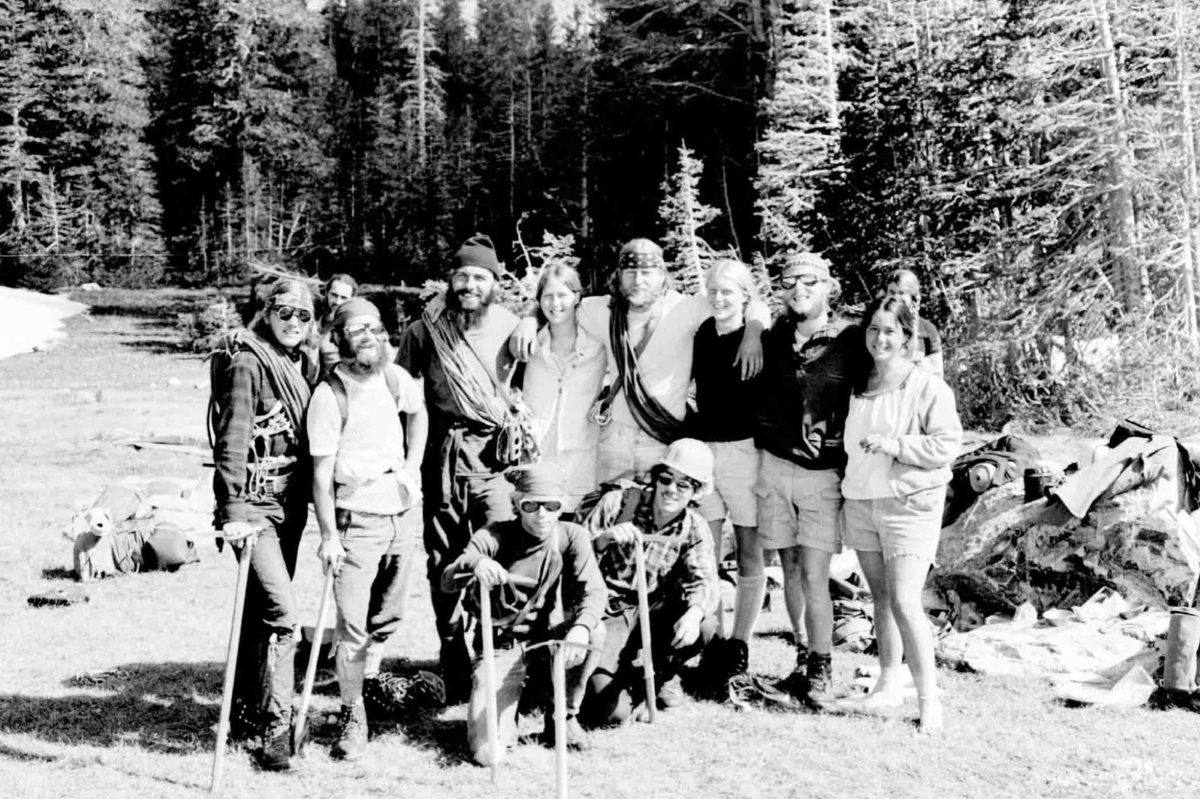
    Here’s a group of us at our 4th of July 1971 gathering. Gordon at left in the back row others pictured include William Michael Bird, Gordon K Williams, Ray Brooks, Danny Bell, Vicki Smith and Randy Felts.
    Here’s a group of us at our 4th of July 1971 gathering. Gordon is at left in the back row. Others pictured include William Michael Bird, Gordon K. Williams, Ray Brooks, Danny Bell, Vicki Smith and Randy Felts.

    The only tangible achievement of the DFC&FC was to restore Pioneer Cabin, which sits on a high ridge east of Sun Valley adjacent to the high peaks of the Pioneer Range, in 1972 and 1973. I was in Moscow, Idaho at the time and had nothing to do with the project. Credit for the rehabilitation goes to Gordon Williams, Robert Ketchum, Chris Puchner and others who donated materials, helicopter time and labor.  

    Gordon Williams was insistent on painting our club slogan: “The higher you get, the higher you get” on the roof. Somehow, that painted slogan survives on the roof of Pioneer Cabin to this day. Here’s a link to an Idaho Public TV article on it: Pioneer Cabin

    Long-term club member John Platt recalls another club slogan he heard while skiing potential avalanche terrain into the Finger of Fate in 1972. “Stay High & Spaced Out.” A high-end outdoor magazine, Adventure Journal, published an article on Pioneer Cabin and the DFC&FC link in their second issue in 2018.

    After a high-point with the Pioneer Cabin restoration, the DFC&FC never managed to hold more scheduled events. Nevertheless, members continued to use the name on wilderness registration forms and an informal competition to achieve the most yearly “back-offs” from major rock climbing routes or mountain peaks, persisted into this century. We of the DFC&FC enjoyed fiascos. In the era before decent USGS maps, climbing guidebooks, cell phones, GPS devices, an internet to access for climbing information and satellite rescue beacons, success on routes was not assured and failures were cherished.

    In 2001, Gordon Williams hosted a 30th Anniversary party for a surprising number of DFC&FC members. I recall around 20 attendees, including one who flew in from Alaska for the occasion.

    In 2012 Matt Leidecker interviewed Gordon Williams, Jacques Bordeleau and me for historical information on notable climbs DFC&FC members had achieved in the Sawtooth Mountains. Leidecker included several paragraphs recounting the club’s history in his fine hiking guide “Exploring The Sawtooths.”

    Matt summed up the DFC&FC club achievements in the Sawtooths with a Gordon Williams quote: “I got to thinking what was the shining achievement of our time in the Sawtooths and I came to the conclusion that it was simply to have a good adventure. Once you learn how to do that, you can keep doing it forever.”

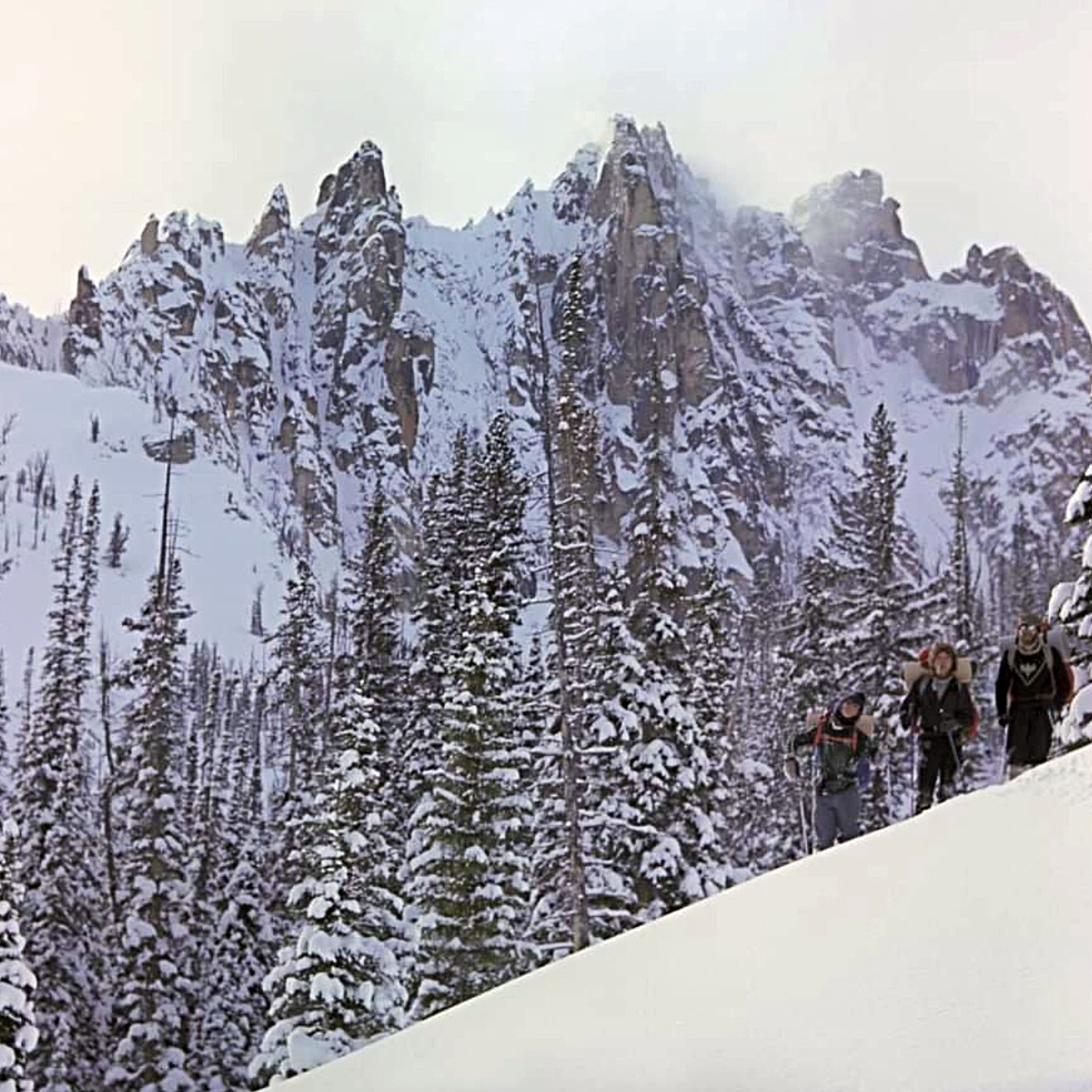
    DFC&FC members Chris Puchner, Gordon Williams and Mark Sheehan retreating from their first winter attempt to climb Mount Heyburn. Jacques Bordeleau Photo
    DFC&FC members Chris Puchner, Gordon Williams and Mark Sheehan retreating from their first Winter attempt to climb Mount Heyburn. Jacques Bordeleau Photo
  • Gordon K. Williams by Ray Brooks

    Gordon K. Williams by Ray Brooks

    Editor’s Note: see additional photos assembled by Jacques Bordeleau at the following link: Gordon K. Williams Photos


    My friend, high school classmate, climbing and adventure buddy Gordon Williams (aka Stein Sitzmark and, on occasion, “Imstein”) passed away on Tuesday July 23rd at age 69 and 3/4. He leaves a lot of good friends and his loving family behind.

    Gordon was trained to be a registered surveyor but was also an artist by choice and inclination. Many folks enjoyed his keen wit and loquacious manner. He was interested in many, many things, but his photography has been a major achievement since the late 1960s.

    I met Gordon soon after his family moved to Ketchum in the mid-1960s.  Although I was a year ahead of him in high school, we were almost the same age. Like many have since, I found him interesting and likable, but we were not close friends in high school. However, I must confess to being the person who introduced him to roped rock climbing.

    The Early Days

    In the Summer of 1969, Jim Cockey took an afternoon to teach his younger half-brother Art Troutner and me some key elements of roped rock climbing near McCall. We learned how to belay climbers with a rope, hammer in pitons to anchor belays and rappel off a rock cliff, in a few short hours of instruction. I went home to Ketchum and ordered a climbing rope, some soft-iron pitons and aluminum carabiners from REI. I then proceeded to share my inadequate and dangerous knowledge of the rudiments of roped technical climbing with Gordon and his high school classmate, Chris Hecht. They were instant converts and soon Chris thereafter ordered better climbing gear. That Winter, we read up on climbing techniques and practiced climbing knots until we could tie them while stoned.  

    By the Summer of 1970, we were ready for real mountains. Gordon, Chris and I started with a bang by climbing 10,981-foot Boulder Peak near Ketchum in early June. Next, we convinced a number of friends to hike into Wildhorse Canyon in the Pioneers for the 4th of July weekend. But during that weekend, Chris, Gordon and I encountered steep and difficult rock on the North Face of 11,771-foot Old Hyndman Peak and an oncoming thunderstorm convinced us to retreat.

    The Decker Flat Climbing & Frisbee Club

    For our next trip into the Pioneers, we were mentored by my “somewhat” experienced climber-friend Harry Bowron, who summered in Stanley. Harry had been exposed to roped climbing on various Sierra Club trips and had recently survived a long National Outdoor Leadership School (NOLS) outdoor skills course in the Wind River Range. His knowledge and abilities helped our climbing skills considerably.

    It was a hot day in late July 1970, during our hike into Mount Regan above Sawtooth Lake. Pursued by evil, we hurried up the dusty trail. Our packs were heavy, each with 60-70 pounds of climbing and camping gear. It was a hot, humid and windless morning. We were sweating hard and were being chased mercilessly by a full-strength squadron of horseflies.  

    Flies dive-bombed us incessantly, trying to break through the curtain of insect repellent we had drenched ourselves with. They grew in numbers until it was difficult to see the sun through the voracious fly swarm above our heads. Frenzied buzzing horseflies became noisily trapped in our long hair and select kamikaze flies would creep between our sweaty fingers to inflict amazingly painful bites.

    It was starting to look like we might become the first known case of climbers eaten by flies when suddenly all the horseflies dipped their wings, did a double roll and turned tail. They flew off down-canyon–a roaring cloud of instant misery. The reason for their retreat stood by the trail: snarling evilly, shovel in hand. Even horseflies don’t mess with SMOKEY THE BEAR!!  Of course, a sudden breeze might have helped too.

    We had arrived at the Wilderness Boundary!! There beside the plywood Smokey was an 8-foot tall, solid redwood sign proclaiming:

    ENTERING SAWTOOTH WILDERNESS AREA
    CHALLIS NATIONAL FOREST
    PLEASE REGISTER FOR YOUR OWN
    PROTECTION!

    We had some fun filling out the overly-detailed registration form, but then none of us wanted to put our name on it as group leader. In a moment of inspiration, I exclaimed “Let’s call ourselves the Decker Flat Climbing & Frisbee Club” and, since I thought of it, I get to be manager.

    We had elections on the spot and Gordon chose to be Social Chairman, Harry Bowron, Treasurer and Joe Fox, Member at Large. The next day we climbed Mount Regan (which was somewhat challenging) and had a great time. Our mountain fun was just starting. We never had scheduled meetings or dues but, in order to become a member, you had to go climbing with another member. Of course, Gordon took his duties as Social Chairman seriously. He was soon adding females to our club. I must admit to being jealous of Gordon’s social skills in the 1970s and 1980s. His girlfriends were always attractive, assertive and intelligent. Gordon was a “babe-magnet” of the first magnitude. Thus he was the perfect Social Chairman.

    In the early 1970s, Idaho mountaineering was a different world than now. It was a world without good USGS maps, climbing guidebooks, cell phones, GPS devices, an internet to access for climbing information and satellite rescue beacons. Thus, we suffered considerable obstacles to safe and sane mountaineering but, let me assure you, rock climbing and mountaineering in Idaho was a helluva lot more adventurous and a lot more fun then than it is now. Amazingly, although some of our climbing students suffered long scary slides on steep snow slopes, there are no serious climbing injuries or deaths in the history of the Decker Flat Climbing & Frisbee Club.

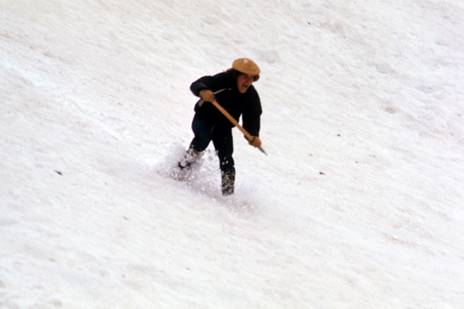
    June 1971, my photo of Gordon glissading “way too fast” on our way down from climbing the highest peak in the Sawtooths.
    Gordon glissading “way too fast” on our way down from climbing the highest peak in the Sawtooths (June 1971).

    Gordon As A Climbing Pioneer 

    In the early 1970s, Gordon was active in attempting the first Winter ascents of some Sawtooth Range peaks which even difficult to climb in Summer. There were some setbacks, but he was integral in the first Winter ascent of the difficult pinnacle, The Finger of Fate, and a large peak with no easy way to the summit, Mount Heyburn.

    In mid-March 1971, Gordon, his Seattle friend Roxanna Trott and I enjoyed a somewhat unconventional moonlight Winter ascent of Boulder Peak. We knew the snow was very firm with near zero avalanche danger (despite our lack of avalanche awareness training). Gordon and I departed Whiskey Jacques at 1:00AM with a drink, picked up Roxanna at her place, drove to Boulder Flat and skied into the Southwest Side of Boulder Peak on Styrofoam-hard snow under a full moon. We arrived on the summit at dawn and were back in Ketchum for a late lunch.

    Here’s my photo of Gordon & a friend Roxanna Trot, on a winter moonlight ascent of 10,891’ Boulder Peak near Sun Valley.
    Here’s my photo of Gordon & a friend Roxanna Trot, on a winter moonlight ascent of 10,891’ Boulder Peak near Sun Valley.

    Pioneer Cabin

    In 1972-1973, Gordon, Chris Puchner, Robert Ketchum and others worked on the now locally-famous restoration of Pioneer Cabin above Sun Valley. Pioneer Cabin (a 1937 Sun Valley Company high mountain ski hut) sits on a scenic ridge at the edge of the Pioneer Mountains. Here’s a link to an Idaho Public TV article on the cabin which mentions the history: Outdoor Idaho. Gordon’s hard work on Pioneer Cabin and his insistence on painting the DFC&FC slogan “The Higher You Get, The Higher You Get” on the newly-repaired roof of Pioneer Cabin made both him and our club famous in western mountain lore. The story has appeared in several outdoor magazines.

    Gordon and the Finger of Fate

    Gordon was active at rock-climbing and mountaineering through the 1970s. Gordon really enjoyed climbing the challenging Open Book Route on the Finger of Fate in the Sawtooths. By 1978, it was a routine climb for him and Mark Sheehan. On one of these outings in 1978, they were hit by a severe thunderstorm just below the top of the Finger. Suddenly lightning was hitting nearby peaks and it was raining hard. They could not climb the final difficult summit pitch in the rain and with their single rope, descending the Open Book Route was unthinkable. Getting off the rock was essential and they started to down climb on what seemed to be a safer alternative. As Gordon rappelled, the rope slipped . . . but I will let Gordon tell the story.

    Gordon’s Close Call by Gordon K. Williams

    In late July 1978, I hiked into Idaho’s Sawtooth Mountains with my friends Mark and Gail Sheehan. We were off to do our favorite rock climb, the Open Book Route on The Finger of Fate. By 1978, I had climbed the classic Class 5.8 route a number of times and it had become normal for us to hike in, climb the route and return back to Ketchum on the same day.

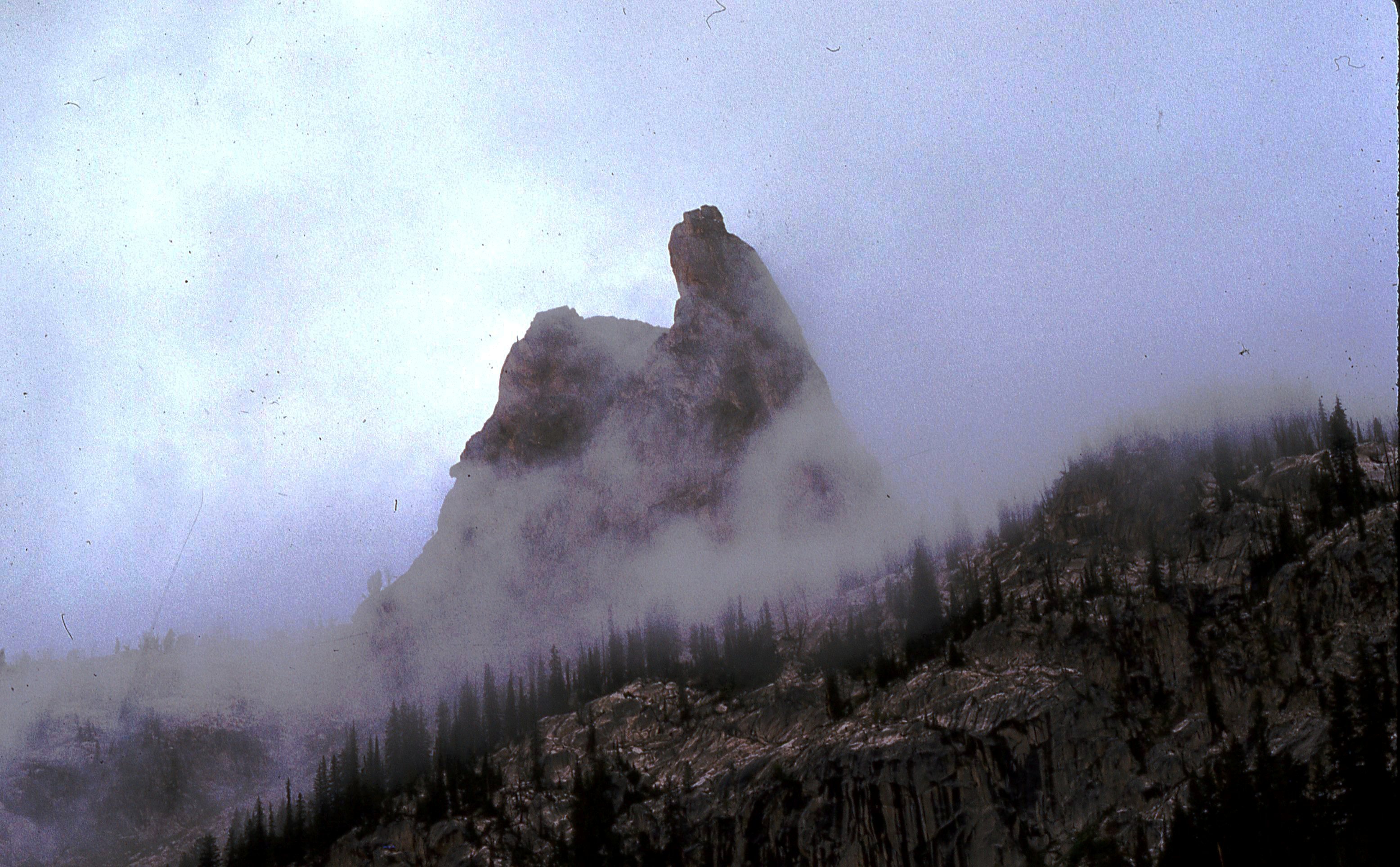
    The Finger of Fate from the Southeast.
    The Finger of Fate as viewed from the Southeast.

    Perhaps we made a bad choice. The weather was deteriorating and we put on the climb anyway. That is how we first met Brent Bernard. When Brent and several of his friends had arrived at the base of the Open Book, we hadn’t yet finished the first pitch. They sat down to wait for us. While waiting, they looked at the sky. The sky told them to back off. They walked away. That was a good choice.

    Twenty feet of steep snow guards the bottom of the climb. In early July, it is cold on the North Side. First thing in the morning, that snow is hard. We chopped steps, kicked the snow off and gingerly stepped onto the rock. You must immediately swarm up a blank section with wet boots. This may be the crux. There is no warm up. There is not much to work with. Go up or go home.

    From the belay ledge, I watched Mark Sheehan levitate up the first pitch. It is the only place big enough for two and a welcome refuge after working around the foreboding overhang. Looming at the top of a perpetually cold jam crack, the clean overhang extinguishes hope. There appears to be no way around it. One must push up under that overhang then exchange heel for toe in the crack. Turning around to face out puts your head where the next move becomes visible. Exit right onto the face for a “Thank God” handhold that is nearly beyond your reach. Swinging across on one hand brings you to where it is possible to work up the face and mantel on the ledge. Some consider this the crux problem. On arrival, Mark expressed pleasure. We were having fun.

    Gordon at the top of the jam-crack lead on the second pitch of the Open Book. The crack ends under the overhang and climbers are forced out right onto thin holds. Mark Sheehan Photo
    Gordon at the top of the jam-crack lead on the second pitch of the Open Book. The crack ends under the overhang and climbers are forced out right onto thin holds. Mark Sheehan Photo

    Our plan had been to travel light and fast. One rope, three slings and about a dozen chocks would be enough. We had everything necessary and nothing more. Heavier clouds were beginning to build. They told us to pick up the pace. Two more pitches would bring us to the top of the Book. Then send a short pitch up the ski tracks, crawl under the summit block, jump the gap and bag the summit. We would rappel from an old bolt and down climb to another short rap above the saddle. Our plans began to change half way through the third pitch.  

    Lichens cover most of the rock on the Finger. Lichens are composite organisms consisting of a symbiotic relationship between an alga and a fungus. The fungus surrounds the algal cells, enclosing them with complex fungal tissues unique to lichen. Lichens are capable of surviving extremely low levels of water content. When fully hydrated, the complex fungal tissues become slippery. Rehydration requires several minutes. We were still adapting to light rain and slippery rock when thunder started echoing off nearby mountains.

    Suddenly our location near the top of a prominent pinnacle seemed imprudent. We were climbing a lightning rod. Mark and I are both afraid of lightening. We wanted to get down fast. From the ridge above the Book we had two choices. Knowing the South Side to be much shorter, we decided to rappel that way. Mark split the coil while I threw a sling over a horn on the ridge. No time to tie knots at the ends – throw the rope. More thunder and louder now we were in a panic to get off. Assemble four carabiners as a brake, clip into the line and ease gingerly to the edge. Wind was whipping rain from every direction. I would be careful not to slip on the wet rock or rap off the end of the rope.

    Starting down with feet spread wide I was leaning back perpendicular to the wall so my boots wouldn’t slip. Descending slowly and looking down for more foot placements, I felt the line above release. Turning my head to look up, I saw the rope and anchor sling whipping against the sky above. My rappel anchor had slipped off the rock horn and I was accelerating in free-fall with hundreds of feet to the floor… a dead man falling.

    Instantly I understood this to be the end. There was no hope of surviving such a fall. Anxiety and fear disappeared. Perhaps I stopped thinking. Time did not compress or elongate. There was certainly no flipping through old photos or videos of past events no life flashing by. This was the end of the film, the part where the screen goes blank.

    I have no recollection of hitting the wall. It knocked the wind out of me. I came to my senses gasping for air, unable to get the first bite. It was a raw shock, being jerked from some quiet place back into my body. Everything was confusing. I was hanging upside down pressing lightly against the rock wall. Nothing made sense. How could Mark have caught me? My hands found the rope and I struggled to get back upright. Stepping onto a toehold produced sharp flashes of pain in my left ankle. It was broken.

    Mark was peering down from the ridge. Raindrops were hitting my face. The situation was coming into focus. He hadn’t caught the rope. Instead, it had snagged on the rock face. My rappel brake was jammed. This had prevented my sliding off the end of the rope after slamming into the wall. I used one hand to loosen the brake while holding onto the wall. Easing weight onto the rope again, I rappelled to a ledge fifteen feet below. Off rappel, a flick on the rope set it free from the snag… first try.

    Mark was stranded on the ridge and the threat of lightening was not yet past. He had to get down. We were too far apart to throw the rope back up so Mark rummaged into his pack for cord. He lowered it… too short. Next he pulls out his boot laces and tied them onto the cord. Altogether it reached and I sent the rope up. Mark set a new anchor and rappelled to my level. We followed the ledge system around the East Side back onto the North Face trying to find the top of the PT Boat Chock Stone. We had enough gear to set two more rappel anchors and it would take five to get off the pinnacle. Several years earlier, we had left slings retreating down the Chock Stone route. In spite of their age, we hoped they might still hold our weight. They did.

    Gail Sheehan was waiting at the bottom, wet and worried by our extended absence. We were greatly relieved to be off the rock. Climbing with a broken ankle was difficult, but hiking was out of the question. We had several miles of rough terrain to negotiate before getting to the lower end of Hell Roaring Lake. From there, another two miles of easy trail ran back to the car. Again Mark rummaged into his pack pulling out a Swiss army knife with a saw. He cut free some planks about an inch thick from the shell of a rotting hollow log. He then fashioned a splint that allowed me to walk by transferring some of my weight past the ankle and onto my left hand. It worked pretty well. Gail had taken all of the weight out of my pack and we three set off down the mountain. It was torture. By the time we reached the lake, I was exhausted and ready to confess. Mark offered to carry me. I said yes.

    We rearranged the rope into a long mountaineer’s coil, split the coil into halves from the knot and draped it over Mark’s shoulders with the knot behind his neck. My legs ran through the coils transferring my weight onto his shoulders in a piggyback carry. Mark didn’t have to hold my weight with his arms. Gail carried our three packs. We set off down the trail. It was torture. After a few hours, Mark was exhausted and ready to confess. Gail was pretty much used up too. It was raining and the three of us were sitting on a log in the dark. We were too tired to start again. It was a low point. That is when Brent arrived.

    They had waited at the cars. They knew something was wrong and were just about ready to drive out to call for help. Brent decided to walk up the trail a short way and see if he might find us. That is what he did… barefoot in the dark. We put my shoes on Brent and he carried me the rest of the way out to the road. Our self rescue had come to an end.

    Life After Climbing

    Around the time of the accident, he and Mark Sheehan bought an old hotel/boarding house at the onetime mining town of Triumph a few miles southeast of Sun Valley. In the early 1980s, they remodeled it into two separate two-story homes, with lots of room for possessions and the range of woodworking machinery he had acquired. Gordon’s half of that project provided him the comfortable home he had lived in since then.

    Gordon knew he was lucky to have survived the accident and as a result he climbed less after that near disaster. I think flashbacks of his near death fall continued to bother him. By the 1990s he was hardly climbing at all, but Kim Jacobs talked him into climbing the Open Book on the Finger again in 2003, although she led all the pitches. 

    Somewhere along the way, Gordon and I adopted a toast that amused us both. We had both suffered close calls in our climbing and whitewater rafting careers and we both knew we were somewhat lucky to still be alive and healthy. Thus was born our, “Here’s to cheating death” toast at the end of every day of outdoor adventure. As some of us may have noted, “Life is so uncertain” and Gordon and I, and our friends appreciated that we had lived, for the most part, lucky and blessed lives.  

    In the late 1990s, Gordon started going to Nepal with small groups that were guided by his old friend Pete Patterson and Kim Jacobs. Gordon fell in love with Nepal, its people, and especially its mountains. He made 7 trips to Nepal between 1998-2008. I was lucky enough to accompany him and a small group of friends on two 16-day treks through some of the most spectacular mountains in the world.

    Gordon was not doing what we considered mountain climbing but, in 2005, we did steep hiking up to a 17,500-foot summit for a spectacular view of nearby Mount Everest.

    In 2010, my wife Dorita and I started doing regular multi-day climbing trips to the spectacular City of Rocks. Gordon was invited and soon joined in enthusiastically, but didn’t climb much. With the urging of our “old” friend, noted climber Jim Donini, we started sponsoring yearly camp-outs for mostly older climbers. Although Gordon seldom climbed at these meetings, he enjoyed being around other climbers and the scenic crags of the area.  

    At our gatherings, climbers from all over the U.S. enjoyed Gordon, his good temper, his stories, his wit, and his wisdom, as did we all. This year, including 4 nights at the City of Rock outing, my wife Dorita and I got to enjoy Gordon’s fine company on some, or all, of 10 precious days.

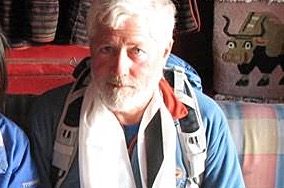
    Here’s my 2008 photo of Gordon & a merchant of Lo Manthang in remote Mustang, Nepal.
    Here’s my 2008 photo of Gordon and a merchant of Lo Manthang in remote Mustang, Nepal.

    Gordon also became involved in white-water rafting in the 1980s and survived many challenging river trips, including two Grand Canyon adventures. In 2016, we finally enjoyed a multi-day river trip with him, thanks to our mutual friend Chris Puchner. We loaned Gordon our “sportscar” raft and he navigated it down the large and sometimes scary rapids of Idaho’s Main Salmon River without mishap.

    Part of the fun of being around Gordon was his rich imagination. His little plastic friend Piglet traveled many places with him and proved fascinating to Gordon’s many female friends.

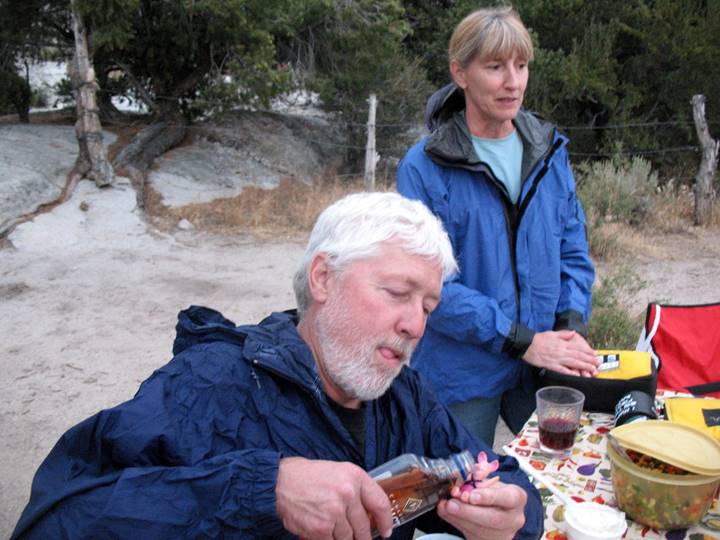
    Here’s Gordon at the City of Rocks sharing a drink with Piglet while my wife Dorita politely averts her gaze.
    Here’s Gordon at the City of Rocks sharing a drink with Piglet while my wife Dorita politely averts her gaze.

    Although Gordon continued to work part-time, he was usually willing to go explore old mines or Native American rock art with us.

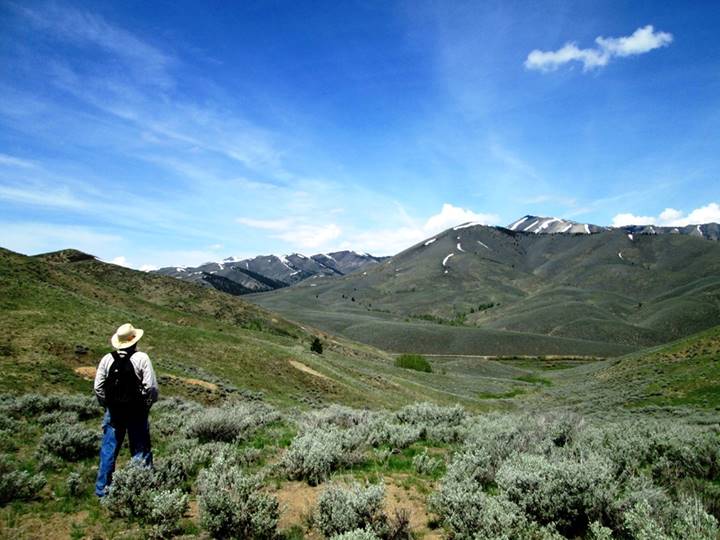
    This photo of Gordon was taken this spring as we were hiking back from a 1880’s mine we explored west of Hailey.
    This photo of Gordon was taken this Spring as we were hiking back from a 1880s mine we explored west of Hailey.

    Final Thoughts 

    I deeply appreciate that except for a miraculous catch of Gordon’s falling rappel rope by a rock flake, during a thunderstorm on the Finger of Fate back in 1978, we almost certainly would have lost Gordon 41 years ago. So we have been in the bonus Gordon round for many, many years, which I know we are all grateful for.  

    So we have been blessed that Gordon survived not only that 1978 storm and rappel failure, but he also graced us with his lively presence until now.

    I miss him.