Category: White Cloud Mountains

  • T.M. Bannon by Rick Baugher

    T.M. Bannon by Rick Baugher

    Thomas M. Bannon was also a self-taught mountaineer. Although his name is not widely known in mountaineering circles, during his surveying career from 1889 to 1917 he climbed nearly one thousand summits in the American West. More than two hundred of these summits were in Idaho. Bannon’s cryptic reports, supplemented by the rock Cairns, Wooden triangulation signals, chiseled cross-reference marks; and brass benchmarks that he left behind tell his fascinating story. More than one hundred of his Idaho ascents were probably first ascents. These climbs included many of Idaho’s highest and most famous peaks, including Mount Borah (which he called Beauty), Leatherman Peak, and Invisible Mountain in the Lost River Range; Diamond Peak (which he called Thumb), Bell Mountain (Bannon’s Finger), Lem Peak, and May Mountain (Bannon’s Hi Peak) in the Lemhi Range; Standhope Peak and Smiley Mountain in the Pioneers; Castle Peak in the White Clouds); and Mount McGuire in the Salmon River Mountains. Bannon’s death at 48 cut short an extremely active life.

    I spent a good part of the 1990’s investigating pioneer government surveyors in the Idaho and western US mountains. This involved recovering some 100 mountain top triangulation stations placed by Bannon & party in Idaho from 1911-1915. In his career as USGS Topographical Engineer 1894-1917 T.M. Bannon had a hand in making ~50 topographic maps.

    Having grown up myself in Maryland, a highpoint was a July 1995 pilgrimage to the Bannon burial plot at St Lawrence Martyr R.C. Church in Jessup. Bannon family monument (like T.M.’s triangulation monuments) occupies a prominent position in the church graveyard.

    Photo on right is T.M.B. gravestone. Rick Baugher Photo

    Obituary notice from Washington Evening Star, Feb 6, 1917:

    THOMAS M. BANNON DIES AFTER A BRIEF ILLNESS

     Was Engineer of Topographic Branch Geological Survey- Funeral Thursday at Jessups, Md.

    Thomas M. Bannon, engineer of the Topographic Branch of the geological survey and a prominent resident of Anne Arundel county, Md, died Sunday evening at Maryland University Hospital in Baltimore. Mr Bannon had been ill only a short time. [Author’s Note: USGS said field worker deaths at that time often attributed to typhoid fever].

    Mr. Bannon had been connected with the geological survey since 1888, the greater portion of his service having been given to topographic and geodetic surveys in different western states.

    Prior to the organization of the United States reclamation service, Mr Bannon was detailed to collect the data which that organization used in connection with the development of its projects in Idaho and Utah [Author’s Note: chiefly Bear River drainage].

    In 1908 he was detailed to the Porto Rican government and placed in charge of surveys in developing irrigation of the semi-arid portion of the island.

    During the last few years Mr Bannon’s efforts had been directed to the extension of geodetic work in western Montana and eastern Idaho and in mapping portions of the national forests in Idaho.

    In addition to his official duties with the government Mr Bannon served seven years as a member of the board of governors of the Maryland board of correction and was active in many local and charitable organizations of Anne Arundel county.

    Mr Bannon was unmarried, is survived by two sisters, Mary and Francis Key Bannon, and three brothers, James T., Phillip M., and Joseph Bannon.

    Final notes: It is believed Bannon thru his mother Evaline was related to Francis Scott Key. Bannon’s federal appointment as an 18 year old was thru Rep. Barnes Compton, also an F.S. Key relative. Survey director John Wesley Powell was chided for hiring “Congressmen’s nephews”. Bannon estate in Jessup was demolished in 1950 to make way for Baltimore Washington Expressway.

    See also: Appendicitis Hill and T.M. Bannon and 1929 Borah Declared Idaho’s Highest Peak

  • The Missing Link: Norman Clyde in Idaho

    The Missing Link: Norman Clyde in Idaho

    Idaho is a virtual sea of mountains. While there is no doubt that Native Americans rambled across the state’s mountain summits and that explorers, trappers, miners, ranchers, surveyors and locals were climbing Idaho’s mountains from the time Lewis and Clark first passed through the state, there are few recorded accounts of these early ascents.

    When I wrote Idaho: A Climbing Guide, I noted at the time the second edition was published that “The following [Climbing History] is a thumbnail sketch of Idaho’s mountaineering history, filled with unfortunate, but unavoidable gaps.” In the intervening years, I have searched for additional accounts of Idaho climbers to fill in the gaps. I recently came across a couple of 92-year-old Idaho Statesman articles that answered one of my unanswered questions about the Sawtooth Range.

    The birth of modern Idaho Sawtooth mountaineering has historically been credited to Robert and Miriam Underhill. Robert, a Harvard philosophy professor and an Appalachian Mountain Club member, was a cutting edge American mountaineer in the 1920s and 1930s. Miriam was the top American female climber of her time. They climbed in the Sawtooths in 1934 and 1935 and then published articles in the Appalachian Mountain Club’s journal, Appalachia, in 1934 and 1935. No doubt, these articles awakened the wider climbing community to the Sawtooth’s impressive granite peaks but who told the Underhills about the Sawtooths?

    The Idaho Department of Commerce publicized the scenic beauty of the Sawtooths as early as 1910. However, it is unlikely that the Underhills read about Sawtooth climbing opportunities in an Idaho Department of Commerce brochure or in Idaho Statesman articles, like the the 1927 article “Crown of the Sawtooths” by Bob “Two Gun” Limbert.

    It turns out that the link between the Underhills and Idaho was Norman Clyde. Norman Clyde (1885-1972) was unquestionably one of the most prolific Sierra Nevada explorers and climbers. He is credited with more than 130 first ascents in the Sierra, has a peak, a minaret and many routes named after him. Less well known are Clyde’s climbing adventures in Montana, Wyoming and Idaho. Yes, Idaho. Although a very obscure fact, in 1927, Clyde climbed in both the Sawtooth Range and the White Clouds.

    Clyde was also a prolific writer. The Bancroft Library at the University of California maintains Clyde’s papers which includes an archive of 1,467 articles. Three of these articles cover Clyde’s visit to Idaho in 1927: An Ascent of Castle Peak; Up and Down Castle Peak; and A Glimpse of the Sawtooth Mountains of Central Idaho. Two of these articles, An Ascent of Castle Peak and A Glimpse of the Sawtooth Mountains of Central Idaho (albeit with a slightly altered form) were published in the Idaho Statesman in 1929.

    Clyde’s visit to Idaho was first noted in a September 10, 1927 news clip in the Idaho Statesman:

    CLIMBS SAWTOOTH PEAKS

    HAILEY — Norman Clyde, who makes a specialty of guiding parties on mountain climbs, is in the Sawtooth country looking for new territory and has finished climbing a number of the major Sawtooth peaks, including some of the White Cloud peaks and Castle Peak. He reports that Castle Peak is not so hard to climb as the Grand Teton, where he conducted a party last year, but is a mountain that will appeal to mountain climbers. Mr. Clyde’s home is at Independence, California.”

    The first Clyde article published by the Statesman was a shortened version of his  longer, unpublished  article, A Glimpse of the Sawtooth Mountains of Central Idaho. The Statesman article was entitled A Southerner’s Glimpse of the Sawtooth Mountains. It appeared on June 2, 1929. This article recounted his ascent of Decker Peak and described the rugged crest.

    Arriving at the crest of the ridge, I came upon a trail leading toward the summit of the range. This I followed until it terminated near timber line. To the southwest, beyond rocky cirques, the summit of Mount Decker came into view. Here it was necessary to drop down several hundred feet in order to avoid an impassable crag.”

    Despite suffering from a violent toothache, Clyde pressed on. He recounted:

    As I advanced, more and more of the rugged crest of the range came into view. After surmounting several craggy and glaciated pitches, I reached a talus slope just below the summit. Seized with the elan that fills me when nearing the summit of a mountain, I soon traversed this and scrambled up to the crest of a narrow arete which I followed to the highest point of the peak.”

    Clyde then described the view in terms that make climbers grab their packs and head for the mountains:

    The panorama that lay outspread around me was thrilling. For a score of miles in either direction extended the crest of the Sawtooths—a maze of craggy peaks, deep cirques, narrow ridges and pinnacled knife-edges. Azure lakes lay ensconced in verdant timbered bowls of the lower basins while others lurked in rocky cirques, tinged with a shade of turquoise; one with an indescribable amethystine hue. Masses of snow clung here and there to precipitous slopes, while several remnants of almost vanished glaciers appeared in sheltered depressions. Fleecy clouds floated slowly past, crossed the Sawtooth Valley and gathered about Castle peak and the White Cloud peaks. In every direction, range after range extended to the horizon. To the north, the broken crest of the Sawtooths continued for a considerable distance. To the southeast, undulating lines varied by several precipitous mountains faded away in the distance. To the east, beyond the Sawtooths were the high masses of the Boulder and Hyndman groups .”

    The second of Clyde’s three Idaho articles, An Ascent of Castle Peak, was published in the Idaho Statesman on June 9, 1929. His article doesn’t mention if he found evidence of a previous ascent but does constitute the earliest description of a climb of the White Cloud Peaks giant.

    Clyde made his base camp for his Idaho explorations at the F.W Shaw Ranch near Obsidian. He undoubtedly learned about the lay of the land from his hosts. Following, this advice, he approached Castle Peak via Fourth of July Creek. He climbed an unnamed peak along the way, probably the still unnamed Peak 10405, and then made his way of into Chamberlain Basin and the lake below Castle Peak’s South Face. The next day he climbed up the face, writing:

    Leaving camp early on the following morning, I was soon trudging up the steep slope that rises to the east of the lake to an elevation of about 1,500 feet above it. As I surmounted it, I came into full view of Castle Peak, towering above a lake-studded basin a few hundred feet below me. A number of steep chutes seemed to rise almost vertically toward its summit, which appeared to consist of a series of pinnacles of almost equal height. One chimney, just to the left of the summit almost reached it but, as the apparently perpendicular wall above it appeared to possess few holds, I decided to go to the east and ascend its Southwest Shoulder or attempt to find a way up–another.”

    His account into the unknown continued:

    “. . . Crossing above one of them, I made my way up a a broad stretch of talus and then up a chute, broad and gently sloping at first, but soon narrow and steep. After reaching its head by a somewhat difficult scramble, I crossed one narrow arete to another and went toward what appeared to be the summit, but upon reaching it I found it to be only a point on a jagged knife-edge, with another higher one to the east, beyond a deep gash in the arete. Dropping down several hundred feet, I quickly climbed to the top of it. Probably the highest point on the mountain, but several pinnacles of almost equal or possibly greater height were seen to the east. . . .”

    Thus, Clyde was confronted with the same question that still confounds climbers 92 years later: which point on Castle Peak’s ragged summit ridge is the true summit? He continued:

    To make certain of not missing the highest point of the mountain, I proceeded to climb the other pinnacles. As I worked my way along the cliff, surmounting one after another of them, I found interesting but not very hazardous climbing, except possibly in one instance where I carelessly stepped on a loose mass of rock that suddenly gave way. Fortunately I had a good handhold, and after hanging in partial suspension for a few moments I was able to proceed along a narrow shelf. Eventually I came to the last of the higher pinnacles.”

    No doubt the Idaho Statesman’s publishing of Clyde’s articles and similar articles gave local climbers further reason to explore the Idaho mountains.  How did Clyde inspire the Underhills to travel form their home at Harvard to Idaho?

    Clyde was a member of the Sierra Club. In 1931, Sierra Club officer Francis Farquhar invited Robert Underhill to the Sierra Nevada to teach the latest techniques of roped climbing to Sierra Club members. Clyde was part of this group. Given Underhill’s drive to explore mountains world wide, there can be no doubt that he and Clyde exchanged climbing stories over a campfire.

    The link between Clyde and the Underhills led to the opening of the Sawtooth Range to a cosmopolitan, out of state, array of climbers including Fred Beckey, Luis Stur, Gordon Webster, Steve Roper, Bill March, Jeff Lowe and the Iowa Mountaineers. Idaho climbers followed these climbers and established themselves in the Pantheon of Sawtooth Climbers. Lyman Dye started the first Sawtooth climbing guide service and he was later followed by Kirk Bachman who established Sawtooth Mountain Guides. Reid Dawdle, Ray Brooks, Dave Bingham, Kevin Swigert, Jeff and Kelly Rhoads and many others redefined and refined the Sawtooth climbing ethic which started with Norman Clyde’s 1927 visit.


    Read more about Norman Clyde in Wikipedia and in the Adventure Journal.

  • Castle Peak and Molybdenum

    Castle Peak and Molybdenum

    In the 1960s, the American Smelting and Refining Company was preparing to develop an open pit molybdenum mine on the North Side of Castle Peak. The remnants of the company’s extensive mining camp are still standing below the peak. There is a good summary of the dispute on the Boulder White Clouds Council’s website: The Battle for Castle Peak. This battle is briefly mentioned on Page 22 of the book.

    Cecil Andrus

    The battle to save the White Clouds was heated and decisive. Cecil Andrus opposed the mine and, in part, won the race for Governor as a result of his stance. Once the mine was stopped, the next battle (creation of the Sawtooth National Recreation Area) took place in Washington, D.C. Idaho Senator Frank Church led the battle in Congress.

    This history is extensively covered in many places. I will add a few historical tidbits as I come across them.

    This photo was part of an Idaho State Journal article published on July 7, 1969.
    This photo was part of an Idaho State Journal article published on July 7, 1969.
  • Which Idaho Peak is the Highest?

    Which Idaho Peak is the Highest?

    In the early 1920s, Hyndman Peak was considered Idaho’s highest summit. After an article (not yet located) in the Idaho Statesman declared Hyndman the highest, a protest was sent to the Statesman and subsequently published by the paper. The protest, set out below, declared Patterson Peak in the White Clouds as the highest Idaho summit and claimed it was 13,000 feet high. Patterson is far from a dominating summit and the article, possibly written in jest, either ignores nearby Castle Peak, which lords over every other White Cloud summit or, as the hand-drawn map implies, is actually mistaking Patterson Peak for Castle Peak.


    Click on Photo to enlarge.

    SOMEWHERE in Central Idaho (in the southwest part of Custer County to be exact), there is a modest, unassuming mountain. Patterson is the name and Patterson never has been one to go out of his way in search of notoriety. He knew his merits, did Patterson, and was satisfied even if the world in general ignored him. 

    And to the southeast another mountain rears his head. There is nothing unassuming about the latter, Mount Hyndman. He claims to be the tallest fellow in Idaho, and broadcasts his claim to the world. There is something about his arrogant bearing, the sheer sweep of his cliffs, which proclaims his worth to a wondering world. And the world watching him, decided he knew where of he spoke. On his massive shoulders was pinned the toga and thousands visited him. 

    But there were those in the world who were determined that justice should be done. Perhaps there is a wee bit, too, of disgust at Hyndman’s overweening pride. At any rate, one day they started to broadcast. 

    The Statesman: On the unimpeachable authority of United States Geological Survey figures, proclaimed one day that Hyndman was the highest mountain in Idaho and one of the three or four highest in the northwest. 

    “And that’s just where you’re wrong,” quoth some unidentified correspondent. “There’s a taller baby yet, Patterson Peak. That’s no apple sauce and we can prove it.” 

    Forthwith the scoffers at Hyndman’s greatness produced a sheet of paper—nothing less than a list of the highest peaks is Idaho. There was Hyndman, all right—12,078 feet high, just as The Statesman had said he was, but there also was Patterson, an opposite the name of this shy, retiring violet was written “altitude 13,000 feet.” 

    And there the matter rests. Who invaded the solitude of Patterson Peak’s ages-long retreat, applied the unromantic baronet and the matter-of-fact triangulation formulas, stripped him of his mystery and his romance, and put him down in cold, hard type.

    Who had the temerity to challenge the hitherto undisputed reign of Mount Hyndman, arrogant and bold, in behalf of this diffident pretender, whose only claim lies in the support of his friends? Truly it will be a battle of the giants this struggle for the throne of Idaho. Rumor hath it that Patterson himself, though unassuming in demeanor, is not lightly to be scaled, not to be crossed with impunity. And to the qualities of Hyndman all will bear witness.

    The thing might be easily decided were there photographic studies of the new claimant extant. One could gaze on his profile, compare it with the lordly majesty of Hyndman, and award the palm to the most King-like. It mightn’t be scientific but it would be monstrously satisfying.  

    Unfortunately, Patterson in his retirement has attracted few visitors. Nobody has recognized his regal descent or is it ascent and his lineaments, if reproduced on paper, are unrecognizable from those of a score of peaks about him. Just one remedy seems possible. Engineering parties might be sent out to make accurate check of all the data on both, then  decide which is the true monarch. Till that day comes, each will have his champions and wordy will be the battle.


  • Death on Castle Peak

    Death on Castle Peak

    Fatal mountaineering accidents are rare in Idaho, but they do occur. Rarer still are fatalities from Summertime avalanches. Most people associate avalanches with Wintertime, and Winter is when most avalanches do occur. However, for climbers, it’s the Summertime avalanche that can be an overlooked risk.

    Stanley, Idaho resident Jared Spear died on Castle Peak in a rare Summertime avalanche. His friends discovered that he was missing and initiated a search. An air search located his truck at the Castle Peak trailhead on July 6 and spotted a fresh avalanche on Castle Peak. Jarad was an experienced snowboarder.

    Sawtooth National Forest Avalanche Center Report

    Saturday, July 2, 2005, a snowboarder (male, 31 years old) was killed while doing a solo, one-day ascent and snowboard descent of 11,815-foot Castle Peak. He was descending late in the afternoon and tracks show that he completed 3 or 4 turns below the summit and triggered a point release, wet slide that grew in size. The slide was triggered and ran in steep, rocky terrain and dropped over 1,000 feet. The debris consisted of snow, dirt, and many loose rocks that had been entrained in the slide, indicating a full-depth wet release. Deep posthole tracks were observed climbing up sections of the face so he was aware of the wet, loose nature of the snowpack.

    The victim was not buried and appeared to have died of trauma and exposure. He was reported missing on Wednesday, when he did not show up for work after the holiday weekend. His body was located Thursday morning (July 7) by a group of local friends and searchers and evacuated by Sawtooth Forest helicopter Thursday afternoon. The slide was on the North Face of the 11,815-foot peak and the victim was found at 10,600 feet.

    Although point release, wet slides are always a Summertime concern, the high mountain snowpack has been unusually loose and wet at high elevations this Summer. We have not seen the development of a typically denser Spring and Summer snowpack this year. This is due to a combination of a weak shallow snowpack throughout the entire Winter, large amounts of snow at high elevations during May and very poor overnight freezes since early June.  Reported by Janet Kellam, Director, Sawtooth National Forest Avalanche Center.

    Idaho Mountain Express and Guide Article

    Seve Benson of the Idaho Mountain Express and Guide  [Sun Valley’s retired newspaper (2014)] wrote the following article about the incident and the effort to create a Search and Rescue team as a result of Spear’s death. The full 2005 article is located below and also in the paper’s online archive, currently located here.

    Wednesday, July 27, 2005

    Stanley seeks to start search-and-rescue team

    Friends of deceased snowboarder criticize rescue effort


    By STEVE BENSON
    Express Staff Writer

    Friends of Jared Spear, a Stanley man who died after triggering a wet-snow avalanche on Castle Peak on July 2, are leading efforts to form an official search-and-rescue team in Custer County.

    During a meeting with local law enforcement agencies in Stanley on Monday morning, several of Spear’s friends criticized the Custer County Sheriff’s Department for its limited role in the search and recovery of Spear’s body from the peak in White Cloud Mountains.

    Spear’s friends were responsible for organizing the search and locating his body. They felt the Sheriff’s office could have done more in the early stages of the search and displayed poor communication throughout the ordeal. They also blasted Custer County Sheriff Tim Eikens for providing information to the media before members of the search party had conducted their own reports of the incident.

    Eikens commended the search party, but also reminded all in attendance that his office was not notified that Spear was missing until the afternoon of July 6. He added that his office did all it could under the circumstances. “Before we put anybody at risk (in a search process), we have to know all of the information and there wasn’t a lot of information,” he said, adding that he did not even know the identities of the people in the search party.

    Addressing the communication issue, Custer County Sheriff’s deputy Mike Talbot said it was not intentional as technical difficulties hampered radio communications. But Eikens did not want to argue about what happened and focused instead on how to improve search-and-rescue efforts in the future. “We’re here out of respect for Jared,” Eikens said. “We’re trying to make something positive out of something negative. “This is not fun, it’s a traumatic event … but we need to support each other, and get your people to become part of the team.”

    Custer County, unlike Blaine County, does not have an official search-and-rescue team that acts in conjunction with the Sheriff’s office. The search party—comprised of 10 of Spears friends—found his body in the early morning hours of July 7. Upon discovering he had been missing for several days, they organized an impromptu search party on the afternoon of July 6. A reconnaissance flight over the area on the afternoon of July 6 located Spear’s truck at a Castle Peak trailhead—deep in the White Cloud Mountains—and spotted avalanche debris from a large wet slide on the peak’s North Face. Not knowing whether Spear was alive or dead, the party coordinated an all-night effort that included travel on foot and motorbikes. Spear was found in a boulder field about a thousand feet below the summit. He was 31 years old.

    According to a report written by Sean Tajkowski, who was a member of the search party, the avalanche ran about a thousand feet through steep, rocky terrain. Tajkowski said Spear was never buried by the debris and was not immediately caught by the slide. He added that Spear filmed part of his descent with a hand-held video camera and that the recovered footage supports his conclusions.

    Pete Isner, Custer County Deputy Coroner and a member of the Stanley Police Department, said Spear died from trauma suffered in the slide. Isner said his investigation remains open since he has not received all of the information from the field, but he believes Spear died soon after the slide, squashing any rumors that he may have survived as long as 24-48 hours after the accident.

    Kirk Bachman, founder of Sawtooth Mountain Guides, acted as the coordinator of the search for Spear. He did not criticize the Sheriff’s office and expressed his support of the creation of a Custer County search-and-rescue team. He also commended Eikens for being supportive of such an endeavor. “The Sheriff’s office is the legal authority on any search and we want to work with you guys,” he said.

    Eikens said when he first came into office two years ago he tried to create a Custer County search-and-rescue team but found little interest from local residents. After three hours of discussion, which included the full reading of a separate report prepared by Bachman and Tajkowski, Talbot passed around search-and-rescue applications. Almost all of the dozen or so citizens in attendance filled out an application.

    Talbot encouraged those who wished only to lend resources, such as all-terrain vehicles, horses, boats or aircraft to search-and-rescue missions, to sign up and specify their potential contributions. “We’re moving in the right direction,” Bachman said during a break in the meeting. “We’ll hold more meetings and focus on training and better communication.”

  • Robinson Bar Ranch by Joe Leonard

    Robinson Bar Ranch by Joe Leonard

    [Editor’s note: Robinson Bar Ranch holds a unique spot in Idaho’s climbing history as it became the home of the first guide service in the United States dedicated to backcountry skiing. Joe Leonard tells its fascinating story below. Joe is an amazing human being. Be sure to read a bit about his life at this link: Joe Leonard and about some of his Sawtooth and White Cloud climbs at this link: THE LOST AND WANDERING.]

    Paradise has many faces waiting to be discovered.


    While Norm, Ron, Bill and I camped at the base of Mount Regan, awaiting first light to begin our ascent of the mountain, we talked about how beautiful the mountains were in the Winter and I mentioned the fact that I just couldn’t understand why more people weren’t out climbing and skiing. I knew in the mountains of Europe, it was quite common. Being somewhat of a entrepreneur, I shared with my climbing partners a dream I had carried in mind for quite sometime. I wanted to start a new business: backcountry ski trips that would start from the doors of a beautiful lodge, such as those I had read about in Europe.

    I wanted to share the beauty of the Winter mountains with friends, family and anyone else who had a longing for adventure – wanting to provide them with the opportunity of experiencing what I had, in hopes their lives would be as enriched as mine had been. I must have done a pretty good job of explaining my vision, for when we finished our conversation, all three offered to join me in the dream. We decided right then that our first step would be to find the perfect location in the Sawtooth Valley for our base of operations and in April of 1969 we started looking.

    There were two ranches between Sun Valley and Challis that would be perfect for our base: the Idaho Rocky Mountain Ranch and Robinson Bar Ranch. On a beautiful Spring morning in April, Norm and I left Boise early and headed towards the mountains filled with great expectations. We stopped at the Idaho Rocky Mountain Ranch first. It was perfectly situated in the Sawtooth Valley near Stanley and only fifty miles away from Sun Valley, where we hoped we would attract many of our clients. The visit with Mr. Bogart, the eccentric owner of this beautiful property, was disappointing to say the least. His life on the ranch was one of quiet repose and he had turned it into a private museum of sorts. He was not willing to open it to the public and nothing we could say would change his mind.

    Discouraged but undaunted, we continued on to Robinson Bar Ranch. We drove through Stanley and followed the Salmon River, crossed the bridge that spans the Yankee Fork of the Salmon River and finally arrived at the turnoff that would lead us into Robinson Bar Ranch. The road into the ranch was still snow-covered but we had our skis and looked forward to some exercise after driving for so many miles. The quaint bridge that crossed the Salmon River into the ranch was built in the 1800s and, at one time, the road was the only access from Challis to Stanley and Sun Valley. It was the original stage coach route between these small western towns and Robinson Bar Ranch was the overnight stopping place. The Ranch was full of history and was undoubtedly one of the most beautiful ranches in the American West.

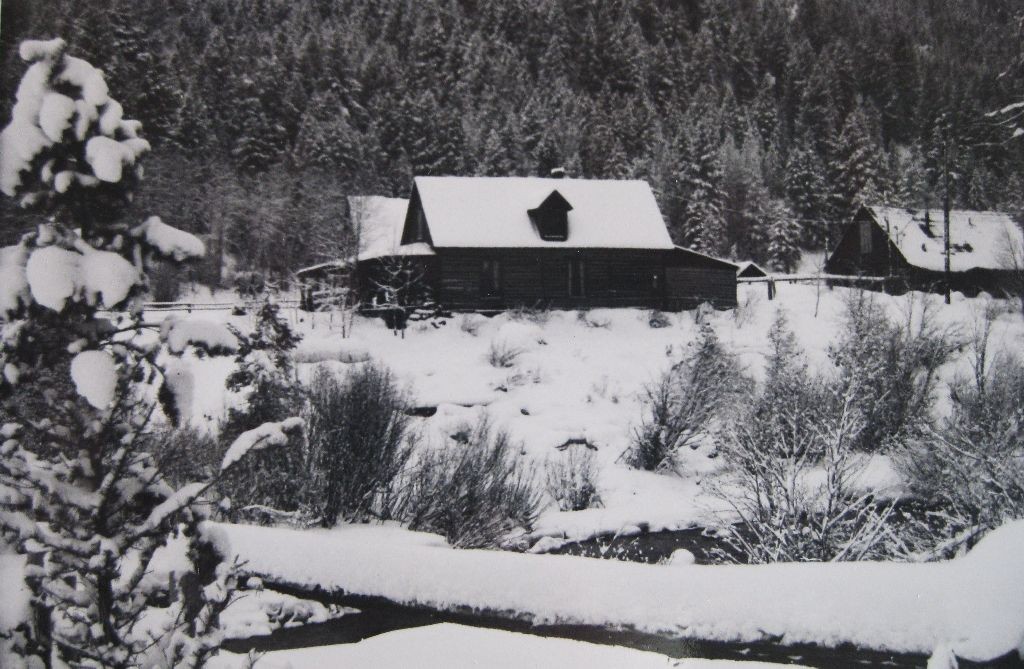
    Robinson Bar Ranch in 1974. Joe Leonard Photo
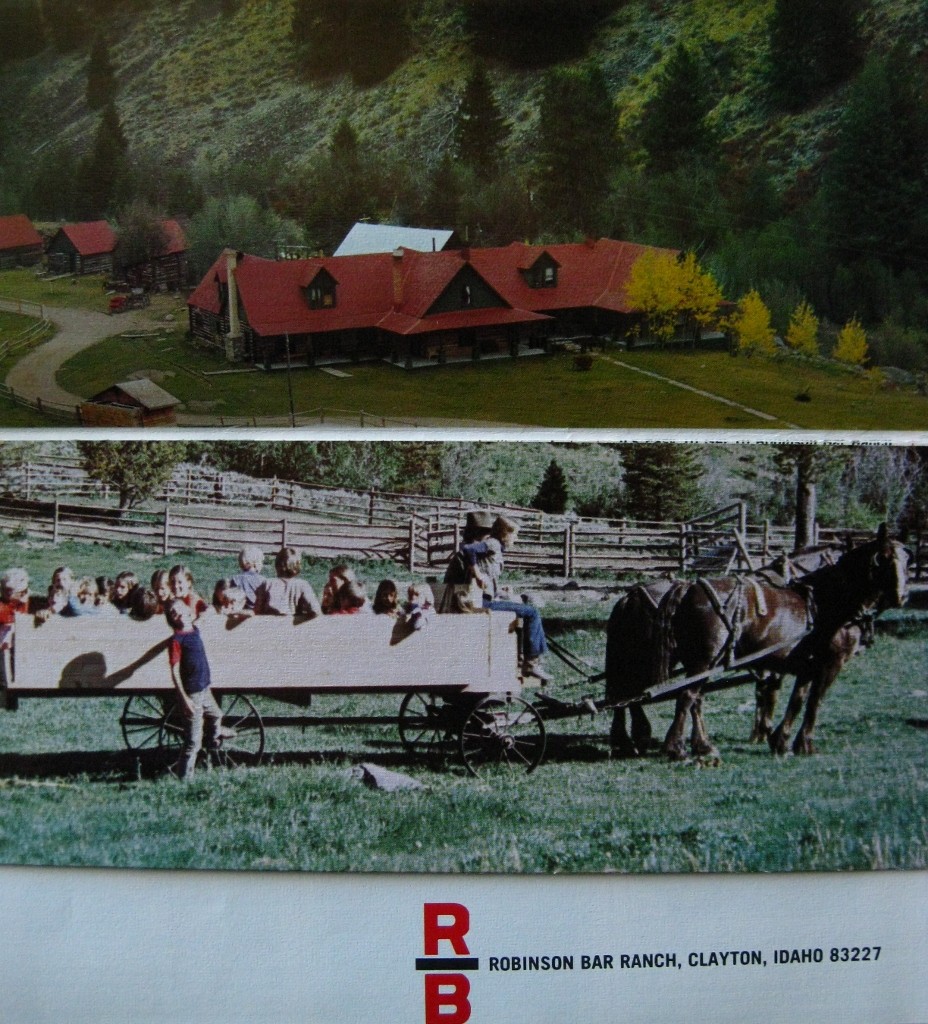
    Robinson Bar Ranch in 1974. Joe Leonard Photo

    We skied across the bridge and followed the road, which meandered along the river for 3 miles where it began its slow climb up and out of the river canyon into a small valley where the ranch was located. The scene was beautiful beyond description: a majestic 2-story log lodge solidly stood next to Warm Springs Creek with the White Cloud Mountains rising beyond as a backdrop. When once we stopped gazing at the beautiful log building and the cabins lining the creek behind, we noticed the steam rising out of the natural hot water pools. It was breathtaking, and it seemed almost impossible to imagine that this amazing ranch could become the home of my dream.

    We met the caretaker who was a nice young man. He was delighted to see us. He hadn’t had many visitors that Winter and was happy to give us as much information about the ranch as we wanted. Everything about the ranch was perfect: good snow in the Winter, plenty of firewood in surrounding forests, every kind of skiing you could want and hot springs to rest a weary body. He told us that the owners and their families would all be arriving the second weekend in May and we could meet them then. He explained that most of the owners were well-connected executives from Idaho corporations and wealthy families from Boise.

    May finally arrived and all 4 of us left Boise with high hopes, arriving at the ranch in the afternoon. There were lots of people working outside on one of the cabins, clearing rubble that had accumulated over the years. They were so preoccupied with their project that they didn’t pay much attention to us. After watching them for a while, we realized these folks just might be the owners and, if we pitched in clearing the rubble, we might win some favor when we told them we wanted their ranch. We pitched in and, in short order, all of the rocks and rubble had been separated into 3 or 4 piles.

    While we were working, I noticed people quizzing each other trying to figure out who we were and why we were working so darn hard. When the work was finished, Patsy Young (a niece of Idaho Senator Frank Church), who was the manager of the ranch at that time, invited us to dinner. We protested knowing that we had arrived unexpectedly and didn’t want to put them out, but she said there was nothing to worry about. The food was served family style and there was more than enough. We cleaned up at a long metal wash basin, with several faucets from which flowed natural hot water at a pleasant 105 degrees. The smells from the pine forest and meadows, everything in sight, brought back memories of my childhood spent on the ranch at Deer Creek (the other side of the Sawtooth Mountains) and I knew in my heart I had found my new home.

    After cleaning up as best we could, we were shown into the dining room and offered cocktails and hors d’oeuvres. We felt welcome and tried to stay calm and relaxed, realizing our moment was soon coming. Dinner, which was fabulous and served with excellent wine, was filled with stories. I shared some of my wild survival tales with them and we finished with the story of our successful first Winter ascent of Mount Regan. Even though it was obvious they all led lives quite different from ours, they seemed to enjoy our company and then the question was finally asked: “What brings you to Robinson Bar?”

    I looked across the table, making eye contact with each of them, including their beautiful wives for a brief moment, trying to calm my beating heart I said: “We want to start the first back-country skiing enterprise in the United States this coming Winter and we would like to use your ranch for lodging our skiing and climbing clients. We are not well-financed so, instead of paying you for leasing the ranch, we will winterize all of the cabins and the lodge.”

    Nothing but what seemed unending silence and then at last a question: “What is back-country skiing, Joe?” Before we said our final farewells and left the ranch that evening, they said that they would make a decision and get back to us. After what seemed years of waiting, one evening the phone rang and the secretary of one of the owners was on the line: “Is this Joe Leonard?” My stomach was flip-flopping like crazy as I said: “Yes it is.”

    “I was told to call you to see if you could meet with a few of the Ranch owners in regards to your proposal. Would six o’clock tonight at John Fery’s office work for you?” At the time John was the vice-president of Boise Cascade. The meeting was going well. All of the owners were very open and friendly, asking many reasonable questions. I was hoping all the while that I was answering them to their satisfaction. The last question they asked was if I realized that we wouldn’t make much money, adding, most probably none.

    “That is a possibility,” I said. “But nonetheless, making money isn’t why we are passionate about the venture. Back-country skiing is popular in Europe and will be popular here one day. We will at the least be the forerunners. That is a fact and all of us will share in that reality.”

    The owners all agreed to our proposal. We shook hands and in June 1970, I moved back to my mountains, my family in tow. Some things are just to good to be true. The years I spent at Robinson Bar were full of constant wonder and the most exciting of my life. Over the years since, I have had the great pleasure to spend time with the people who we guided, worked with, and visited the Ranch and they, inevitably, felt the same as I. It was magical in so many ways.

    The cover of a Robinson Bar Ranch brochure. Joe Leonard Photo
    The cover of a Robinson Bar Ranch brochure. Joe Leonard Photo

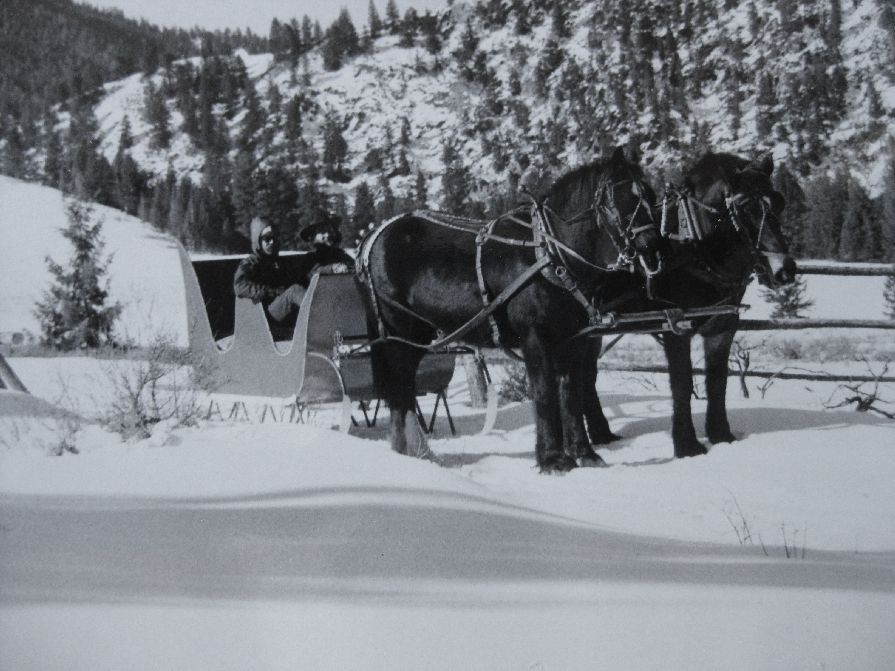
    During the Winter months, the only way into the ranch was by skiing or sleigh, pulled by our extraordinary team of Clydesdale horses. As one traveled down the winding road that followed the Salmon River and led to the Ranch, you felt as though you were entering another world, in another time. The lodge had 13 guest rooms and an enormous kitchen and dining area. The living room carried a sense of the Old West, setting ones imagination afire. Our guests came from around the world and many a night, they sat in the warmth of the big stone fireplace listening to tales, old and new. The Ranch became so popular that it was soon opened year-round and we began guiding backpack trips and horsepack trips. In the Summer of 1972, we opened a kayaking school and provided the first guided kayaking trips on the Main Salmon River and Middle Fork of the Salmon River.

    The only way into the ranch during the winter powered by our Clydesdale horses. Joe Leonard Photo
    The only way into the ranch during the Winter powered by our Clydesdale horses. Joe Leonard Photo
    Chuck and Shorty at work pulling a sled. Joe Leonard Photo
    Chuck and Shorty at work pulling a sled. Joe Leonard Photo
    Joe Leonard skiing below Castle Peak in 1972. A photo taken by a National Geographic photographer. Joe Leonard Collection
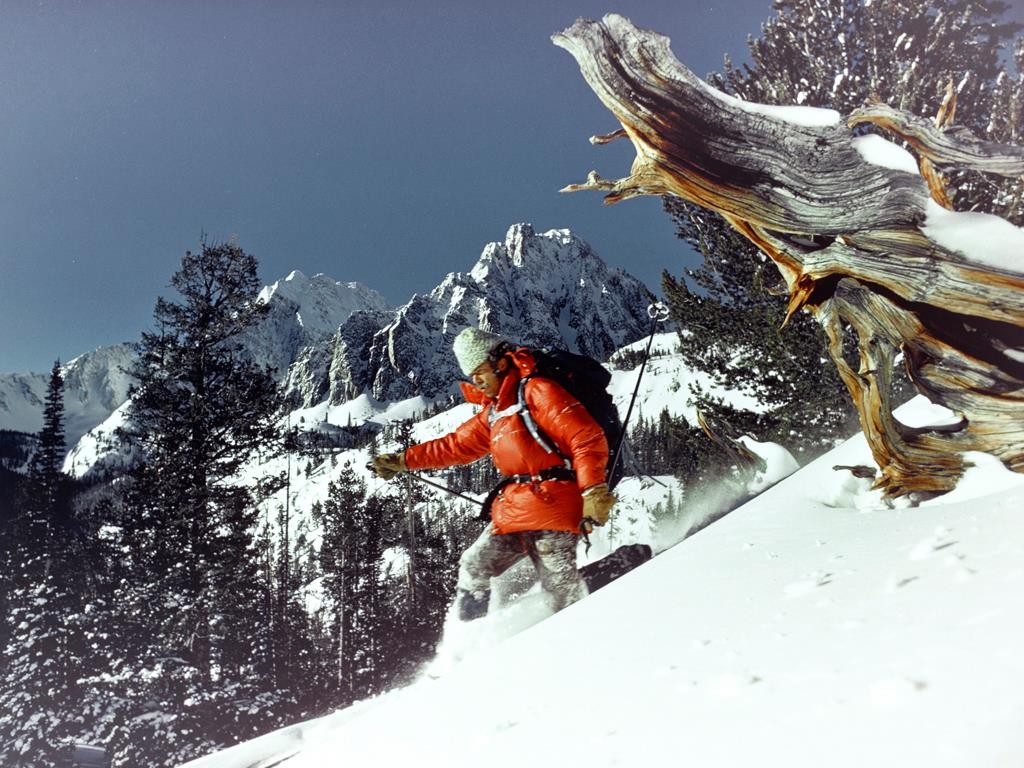
    Joe Leonard skiing below Castle Peak in 1972. A photo taken by a National Geographic photographer. Joe Leonard Collection

    ​Soon after, we held the first White Water Rodeo in the United States on the Salmon River, just below the ranch. When I look back on those years, I am always filled with deep emotion. That I could have been so blessed to have lived some of my fleeting life in such a remote and beautiful paradise seems a rare gift. I was truly living my dream.

    “Whatever you can do or dream, you can begin it. Boldness has genius, power and magic in it. Begin it now.”  Goethe